


 09/05/2026
  929 views
When facing unfortunate illness, accidents, or needing to take time off to care for a sick child, employees often worry about their income and complex administrative procedures. The sickness allowance application form and the process for receiving social insurance (SI) benefits are a crucial financial “lifeline” that every working person should understand. This article from 1Office will serve as a comprehensive guide, updated with the latest regulations from the 2024 Law on Social Insurance for our readers.
Mục lục
- 1. What is the Social Insurance Sickness Benefit?
- Sickness Allowance Application Form for the Trade Union (Used to request additional support)
- 3. Conditions and Benefit Levels for Sickness Allowance (Updated with the latest Social Insurance Law)
- 4. Detailed Guide on Procedures and Required Documents
- 6. Conclusion
The social insurance (SI) sickness benefit is not just a financial support payment; it is one of the fundamental pillars of social security, designed to protect the income of employees when they face health issues that force them to temporarily stop working.
More specifically:
- Beneficiaries: This benefit applies broadly to employees working under contracts (including eligible short-term contracts), cadres, civil servants, public employees, and other individuals participating in compulsory social insurance.
- Humanitarian purpose: This benefit was created to compensate for a portion of lost income, helping employees cover living and medical expenses during treatment for illness, non-work-related accidents, or when they need to take leave to care for a sick child under 7 years of age.
- Solid legal basis: All regulations regarding conditions, benefit levels, and procedures are strictly defined in the Law on Social Insurance (latest update 2024) and its implementing documents, ensuring transparency and fairness.
Sickness Allowance Application Form for the Trade Union (Used to request additional support)
In addition to the “hard” payment from the SI fund, if your company has a strong grassroots Trade Union, you can absolutely receive an additional financial support amount. This is a meaningful supplementary benefit that demonstrates the care of the organization representing employees.
SOCIALIST REPUBLIC OF VIETNAM
Independence – Freedom – Happiness
——————-
…………., date……month……year 20…..
APPLICATION FOR SOCIAL ALLOWANCE
To: – Chairman of the People’s Committee of the commune (ward, township)……………………….
– Chairman of the People’s Committee of the district (urban district, town, city)………..
Province, city……………………………………………………………….
My name is: ……………………………………………………………Male, female…………………………….
Date of birth……..month……year………..
Place of origin:…………………………………………………………………………………………………….
Current permanent residence at………………………………………………………………………….
Commune (ward, township)………………………………… district (urban district, town, city)…………………..
Province……………………………………………………………………………………………………………
State personal and family circumstances, type of beneficiary…………………………………………………
………………………………………………………………………………………………………………..
……………………………………………………………………………………………………………….
Therefore, I am writing this application to request………………………………………………………………………….
……………………………………………………………………………………………………………..
…………………………………………………………………………………………………………….
| Confirmation by the Village Head confirming the case of Mr./Ms. ………………………………………………… stated above is correct. We request the People’s Committee of the Commune, District to consider…………………………………………..(Sign, print full name) |
Applicant
(Sign, print full name)
|
| Confirmation and recommendation of the Commune-level People’s Committee People’s Committee of ………………………….. Commune |
Based on the documents and the results of public posting at the Commune People’s Committee headquarters and announcements on the commune’s media channels from [date]… [month]… 20.. to [date]… [month]… 20……, it is requested that the Chairman of the District People’s Committee review and make a decision.
Sickness benefit application form submitted to the Trade Union to receive additional support
To receive this support, you need to draft a separate application to the Executive Committee of the Trade Union. The core content required in this form includes:
- To section: Clearly state that it is addressed to the company’s Board of Directors and the grassroots Trade Union’s Executive Committee.
- Personal information: Full name, union member ID (if remembered), current department/unit.
- Reason for applying for benefits: This is the most important section. You need to present your (or your child’s) sickness situation truthfully, concisely, yet completely. Clearly state the treatment period, the severity of the illness, and the financial difficulties you are facing due to the long-term leave.
- Confirmation section: The application must be signed by the applicant. More importantly, it needs confirmation from your direct manager or the HR department to prove that you were actually on sick leave. Finally, there is the approval section for the Trade Union representative.
Note: This form usually does not have a rigid, standard format for all workplaces, but it often follows Form C12-TLĐ or a specific template issued by your local trade union. Please contact a trade union officer directly to get the most accurate form.
The 2024 Social Insurance Law has very specific regulations to ensure the best benefits for participants. Below is the updated information you need to remember.
3.1. Conditions for Receiving Benefits
You don’t automatically receive social insurance money just by being sick. Your benefits will only be processed if you fall into one of the following cases:
- You are sick or have had an accident (note: not a work-related accident) that requires you to take time off for treatment. The prerequisite is a confirmation from an authorized medical facility.
- You have to take time off to care for a sick child under 07 years of age, which also requires a corresponding medical confirmation.
Cases of denial: You will not be eligible for benefits if the sickness or accident is due to self-harm, drunkenness, or the use of narcotics or narcotic precursors.
3.2. How to Calculate the Sickness Benefit Amount
The benefit amount is not a fixed number; it depends on the salary level on which your social insurance contributions are based and the duration of your participation. According to Article 28 of the 2024 Social Insurance Law, the formula is as follows:
- Basic benefit level: Calculated as 75% of the salary on which social insurance contributions were based in the month immediately preceding the leave. For example: If your salary for social insurance contribution is 10 million VND/month, the benefit for 1 day of sick leave = (10,000,000 / 24 working days) x 75%.
- Long-term sick leave (over 180 days): For illnesses requiring long-term treatment (as listed by the Ministry of Health), after the first 180 days (still at 75% benefit), if treatment must continue, the benefit rate for the subsequent period will be lower and depend on the length of social insurance contribution:
- 65% benefit: If you have contributed to social insurance for 30 years or more.
- 55% benefit: If you have contributed to social insurance for 15 to less than 30 years.
- 50% benefit: If you have contributed to social insurance for less than 15 years.
- Convalescence and health recovery benefit after sickness: If your health has not fully recovered after the period of sick leave, you are entitled to an additional 5 to 10 days of leave for convalescence. The allowance for each day of this leave is 30% of the statutory base salary.

3.3. Maximum Leave Duration
The duration of your paid sick leave under social insurance depends on your working conditions and who you are caring for:
- Working in normal conditions: A maximum of 30 to 60 days per year, depending on the length of social insurance contribution (less than 15 years, 15-30 years, or over 30 years).
- Working in arduous, toxic, or hazardous environments: Entitled to an additional 10 days compared to the normal rates above (i.e., a maximum of 40 to 70 days/year).
- When caring for a sick child:
- Maximum of 20 days/year for each child if the child is under 3 years old.
- Maximum of 15 days/year for each child if the child is from 3 to under 7 years old.
- Illnesses requiring long-term treatment: The leave period can be up to 180 days (including public holidays, Tet holidays, and weekly days off). If treatment is still required after 180 days, you can continue the leave but at the lower benefit rates mentioned above.
4. Detailed Guide on Procedures and Required Documents
The process for claiming sickness benefits has been greatly simplified, but accuracy in paperwork remains the deciding factor.
4.1. Step 1: Prepare Medical Documents
As soon as your treatment period ends, you need to request the medical facility to provide the following complete documents:
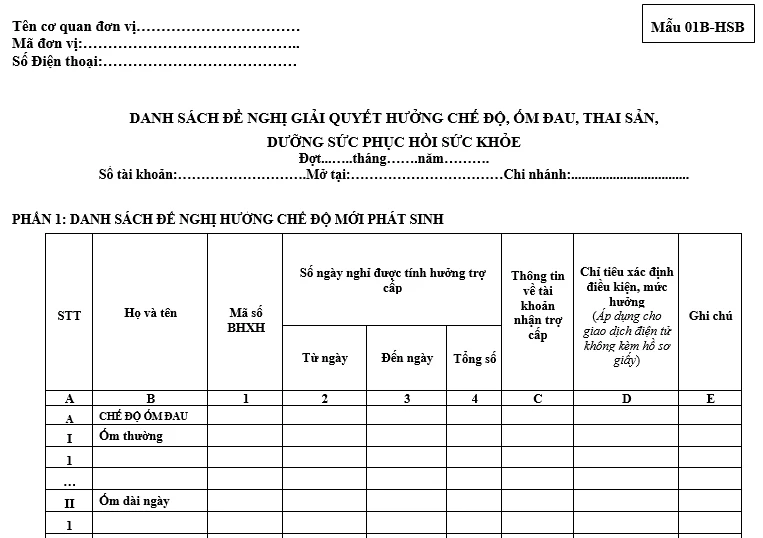
- For inpatient treatment (hospitalization): A copy of the
6. Conclusion
Understanding the sickness allowance application form and the Social Insurance (BHXH) claim process not only helps you secure your financial benefits but also gives you peace of mind during your medical treatment. Always be proactive in collecting all necessary medical documents immediately upon hospital discharge and coordinate closely with your company’s HR department to ensure your claim is processed as quickly as possible.
















