


 10/05/2026
  159 views
Selling over the phone is one of the most effective ways to reach customers, helping businesses expand their market without incurring significant travel costs. Understanding the process and necessary skills will help sales staff be proactive, increase their closing rate, and optimize business efficiency. In this article, let’s join 1Office to explore the detailed 5-step process and 5+ crucial skills for successful phone sales.
Mục lục
1. What is selling over the phone?

- Selling over the phone is a method of introducing and selling products or services through direct calls to customers

Selling over the phone, also known as telemarketing, is a method of introducing and selling products or services through direct calls to customers. Businesses use this channel to approach, consult, and encourage customers to make a purchase. The person performing this job is often called a telesales agent. This is an indirect form of selling that helps increase customer reach and boost revenue.
Businesses should adopt telemarketing for the following outstanding benefits:
- Reach the right target customers: Telemarketing helps businesses filter and accurately reach potential customer groups, deliver appropriate messages, and limit waste from targeting the wrong audience.
- Save costs and time: Compared to many other marketing channels, implementation costs are low, yet it can reach a large number of customers in a short time without needing to invest in physical premises or printed materials.
- Create personal connections and increase trust: Through direct calls and the consulting skills of telesales agents, businesses can easily build trust, understand needs, and receive immediate feedback to improve products and services.
- Easy to manage and measure effectiveness: Telemarketing allows for clear tracking of response rates, interest levels, and conversion rates, helping businesses optimize their sales strategy.
- Flexible in terms of personnel: The telesales team can be expanded or downsized as needed, helping businesses optimize recruitment and operational costs.
2. Pros and cons of selling over the phone
Below are the common benefits and challenges encountered when selling over the phone, helping you consider a suitable strategy:
| Advantages | Disadvantages |
|
|
3. The 5-Step Phone Sales Process
Below is a basic 5-step process, from customer outreach to closing the deal, to help sales staff effectively implement phone sales:
3.1. Step 1: Prepare for the Call
Before starting any sales call, telesales staff need to thoroughly prepare their information base. It is crucial to have a clear understanding of the product or service the business offers, including its features, benefits, and unique selling points, to consult with confidence.
Additionally, researching the target customer profile helps staff call the right person with the right needs. The customer list should be standardized with complete contact information and previous interaction history, if any, to avoid repeating content or creating a poor experience. Finally, telesales staff should choose a quiet space, maintain a clear voice, and have a relaxed mindset to ensure the call flows smoothly and creates a professional impression.
3.2. Step 2: Set Goals
Every telesales call needs a clear objective. Staff should determine in advance what they want to achieve: introduce a new product, invite a customer to an event, advise on a service upgrade, or collect feedback. Setting goals helps guide the entire conversation, prevents it from going off-topic, and makes it easier to evaluate effectiveness after the call.
Goals should be specific and measurable, such as: “successfully introduce the product,” “gather information on needs,” “close a deal worth X,” or “schedule a consultation appointment.” When goals are clear, telesales staff will be more confident and more likely to achieve the desired results.
3.3. Step 3: Prepare a Phone Sales Script Template

A professional telesales script is a tool that helps staff communicate coherently and handle any situation flexibly. The script should begin with a friendly greeting and a clear introduction of the company’s name to build trust from the very first seconds.
Next, prepare survey questions to uncover the customer’s needs and problems. Additionally, telesales staff should draft answers to common questions and subtle ways to handle rejections. Once the customer’s needs are understood, it becomes easier to present relevant benefits and solutions.
Finally, the script should have a polite closing, thanking the customer and outlining the next steps, such as placing an order, sending information, or scheduling a follow-up call.
3.4. Step 4: Monitor and Evaluate Call Quality
After each call, thoroughly documenting the conversation is an essential step. Staff should record customer feedback, important questions, any issues that arose, and areas for improvement for the next call. The effectiveness of each call should be compared against the initial goals to assess the level of achievement.
In addition, businesses should use CRM software or specialized tracking tools to manage customer data, measure the number of calls, conversion rates, and consultation quality. This data forms the basis for periodic reports, which can be used to optimize processes and improve the performance of the telesales team.
To effectively manage customer data and measure call quality, businesses can use 1Office CRM software. 1Office CRM helps track the number of calls, conversion rates, and consultation performance, while also providing periodic reports to optimize processes and enhance the efficiency of the telesales team.
3.5. Step 5: Enhance Call Performance

To maintain long-term effectiveness, businesses need to continuously upgrade the skills of their telesales team. Training courses on communication, persuasion, handling objections, or in-depth product knowledge will help staff become more confident and professional.
Simultaneously, call scripts should be updated regularly based on actual customer feedback and new business goals. Applying technology such as auto-dialers and call recording/monitoring software will help improve both productivity and quality.
Finally, optimizing the target customer list is a crucial factor in increasing the success rate and avoiding wasting resources on unsuitable prospects.
4. Successful Phone Sales Methods for Any Project
Here are effective phone sales methods applicable to various types of projects, helping to increase closing rates and improve customer relationships:
4.1. Effective Time Management
To achieve high results, telesales staff should create a daily calling plan based on a prioritized customer list, categorized by potential. Each initial call should be limited to 5-10 minutes, just enough to probe for needs while avoiding lengthy, inefficient conversations. Using a customer management tool like a CRM helps track interaction history, record feedback, and eliminate non-potential customers, thereby preventing wasted time.
Applying this method brings many practical benefits: work productivity increases by 30-50%, employees focus on high-quality customers, sales become more stable, and daily work pressure and stress are reduced.
4.2. Probing – Avoiding “No-Po” Customers & Connecting with Decision-Makers
The first step in the call is to open with a brief, compelling offer. Next, the employee needs to identify the real needs and the decision-maker with gentle probing questions. If the person on the line is not the decision-maker, quickly redirect the conversation to the right person to avoid wasting time.
Applying this approach brings clear benefits to the customer: they only receive relevant information, save valuable time, and can make a purchasing decision more quickly and with greater satisfaction.
4.3. Asking Questions to Build Trust

Instead of asking directly, telesales staff should lead with a subtle offer, for example: “I’d like to hear about the current challenges in managing your team so I can suggest a suitable solution.” This approach helps customers feel respected and builds trust from the very beginning.
Focus on open-ended questions related to the problems, goals, and benefits the customer desires, while also asking for permission before delving into details to maintain a comfortable and friendly atmosphere. When a customer declines or is unavailable, you can ask: “What would be a convenient time for me to call you back?” This both shows respect for their time and preserves the opportunity to nurture a potential customer.
Asking intelligent and strategic questions not only enhances interaction but also helps to clearly understand real needs, increase conversion rates, and strengthen the company’s position in the eyes of the customer.
4.4. Active Listening
Listening is not just about hearing the customer’s words but also observing their emotions, tone of voice, and intonation. Employees need to respond promptly, note important points, and ask relevant follow-up questions. Active listening helps customers feel respected, increases rapport, and opens up opportunities for more effective consultation.
4.5. Effective Presentation & Demo
Once the customer’s needs are understood, telesales staff should present the product or service concisely, get straight to the point, and focus on the benefits it provides. If possible, a visual demo or sharing a real-world example will help the customer better visualize the product’s value. An effective presentation is not only persuasive but also saves time for both parties.
4.6. Successfully Closing the Deal
In the 4.0 environment, winning a contract requires precision, responsibility, and efficiency. Maintain a sales funnel full of potential customers and closely track the contract through each stage, ensuring it aligns with the customer’s buying journey.
Today, it’s not just about creating an order but persuading the customer to actually sign a contract. Sincere listening and assessing the value of creative solutions are key. Sales 4.0 helps telesales combine technology, processes, and expertise to make customers feel in control, prompting them to proactively seek you out.
4.7. Purposeful Collaboration
Now, you need to collaborate proactively—maintain regular contact, build a list of quality customers, and continuously push for contract signings. Effective collaboration is more than just being friendly with colleagues, following up on their referrals, or simply recording information in the system.
Your role is to work proactively with external partners, build good relationships within the client’s company to make selling easier, and always stay updated and maintain connections.
4.8. Other Methods

Below are some other methods to optimize phone sales effectiveness, complementing the basic steps and skills already mentioned:
- Get straight to the point: When starting the call, state your purpose clearly from the beginning. Customers will feel that their time is respected, and you can easily get to the core of the conversation, avoiding lengthy detours.
- Replace questions with offers: Instead of asking, “Are you interested?”, you can say, “I’d like to share a solution that could help you…”. This approach is both proactive and polite, making it easier for customers to receive information without feeling pressured.
- Present benefits to the customer: Every statement should emphasize the value the customer will receive, such as cost savings, improved work efficiency, or simply reduced implementation time. When customers see clear benefits, they are more likely to agree.
- The customer is king: Always prioritize the customer’s needs, feelings, and perspectives. Listen to them, respect their opinions, and adjust your presentation accordingly. This is a crucial factor in building trust and a long-term relationship.
- Always maintain a positive attitude: Whether the customer declines or you encounter difficulties, maintain a friendly, optimistic, and professional tone. A positive attitude not only helps you control the call better but also leaves a good impression on the customer.
- Always learn from every call: After each call, take notes on what went well and what needs improvement. Learning from practical experience helps enhance skills, optimize strategies, and increase the closing rate in future calls.
5. Essential Skills to Become a Successful Telesales Professional

Here are the telesales skills that every employee should equip themselves with to achieve high efficiency and confidence in their work:
5.1. Professional Tone of Voice
The voice is the primary “tool” of a telesales agent. A clear, confident, and friendly voice helps create a good impression from the start. When talking, you should adjust your speaking speed to a moderate pace, emphasize key points correctly, and use a positive tone. A professional voice not only makes it easier for customers to receive information but also reflects the confidence and credibility of the business.
5.2. Listening to Customers
Listening skills are crucial for correctly understanding customers’ needs and desires. Instead of just focusing on introducing the product, telesales agents should let customers share their problems and concerns. Active listening helps you offer suitable solutions while building trust and a lasting relationship with customers.
5.3. Understanding the Product & Competitors
A successful telesales professional needs to have a solid knowledge of the product or service, as well as a clear understanding of competitors’ strengths and weaknesses. With complete information, you can provide accurate advice, compare value, and emphasize the superior benefits of your product to customers. This increases persuasiveness and reduces the likelihood of customer doubt or rejection.
5.4. Handling Rejection
Rejection is common in telesales. Instead of giving up or getting angry, a telesales agent should remain calm, polite, and try to understand the reason for the rejection. An effective approach is to ask gently: “Could you share the reason so I can improve and offer a more suitable solution for you?” This professional conduct not only maintains goodwill but also opens up opportunities for future calls.
5.5. Patience & Not Hanging Up
Patience is a decisive factor for success in telesales. Not every customer is ready to buy immediately, and many initial calls may not yield results. Always maintain a positive attitude, patiently explain the benefits, remind them of appointments, or send additional information. Not hanging up prematurely helps you increase conversion rates and build a professional image in the eyes of customers.
6. Optimize Your Sales Process with 1Office CRM
Register for a free feature Demo!
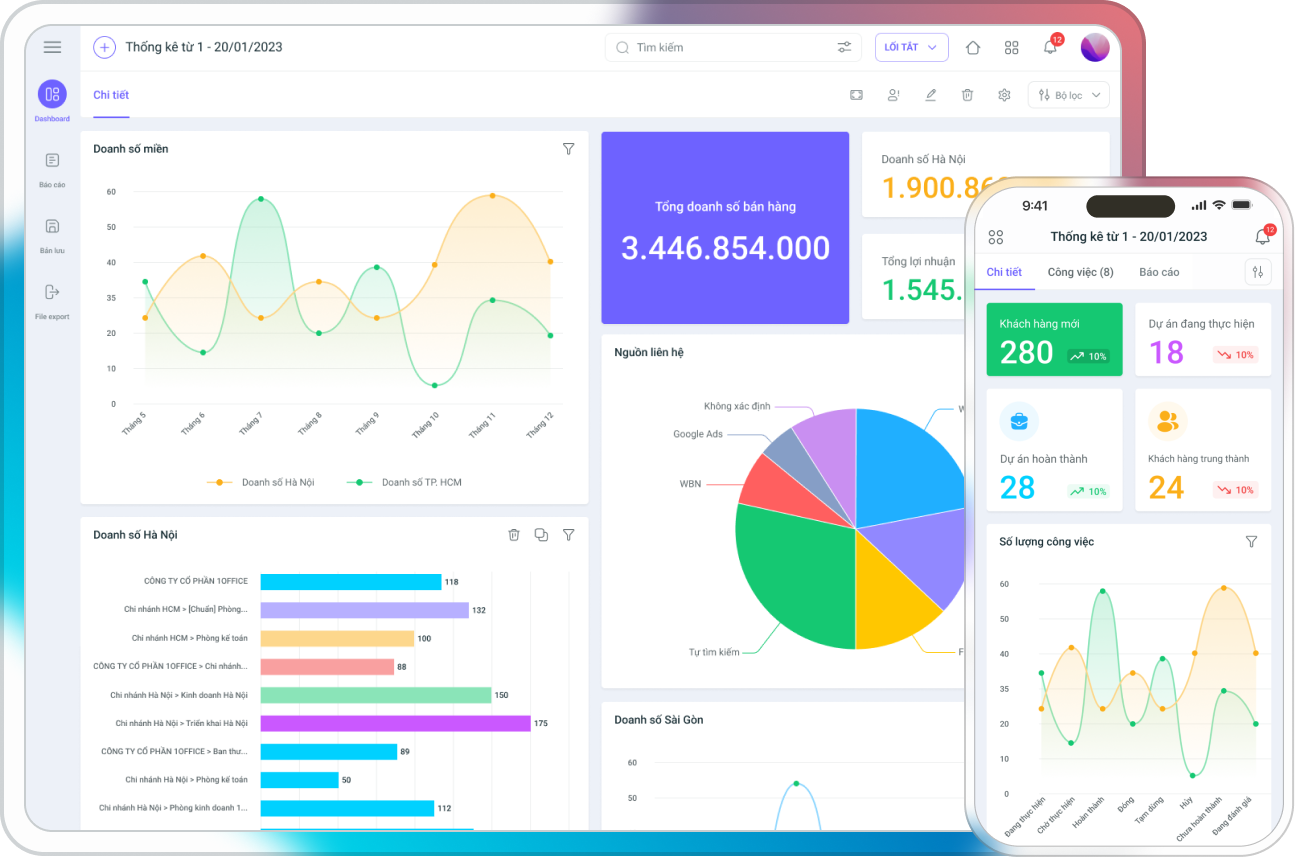
1Office CRM is a professional customer relationship management tool that helps sales teams optimize the entire sales process. Key benefits include:
- Centralized Customer Information Management: store and classify data from multiple sources (call center, email, website), helping sales staff grasp the complete contact history, needs, and feedback of customers.
- Detailed Sales Process Tracking: monitor every step from calling and consulting to closing the deal, helping sales staff know exactly what action to take next.
- Automated Calling and Customer Care Processes: automatically remind call schedules, send quotes, create online orders and contracts, reducing manual procedures, saving time, and increasing deal-closing rates.
- Real-time Performance Reporting: track sales, commissions, number of calls, and results for each employee, thereby improving work efficiency and motivating the team.
- Multi-channel Connectivity: make calls directly from the CRM, send emails, and chat, helping to enhance interaction and provide prompt customer care.
- Revenue Forecasting and Sales Planning: based on actual data, helping managers and staff adjust strategies appropriately to optimize business results.
7. Conclusion
Understanding and correctly applying the process along with important skills will help each employee become more confident in telesales, increase deal-closing rates, and build lasting customer relationships. If your business is looking for a CRM software solution to optimize telesales, please leave your information HERE for the 1Office team of experts to provide a detailed consultation tailored to your business needs.
















