11/05/2026
  139 views
The PAS formula is one of the most popular content writing models for addressing customer pain points and leading them to a solution. If you want to understand what the PAS formula is and how to apply it to sales copy, this is a must-read.
Mục lục
1. What is the PAS formula?

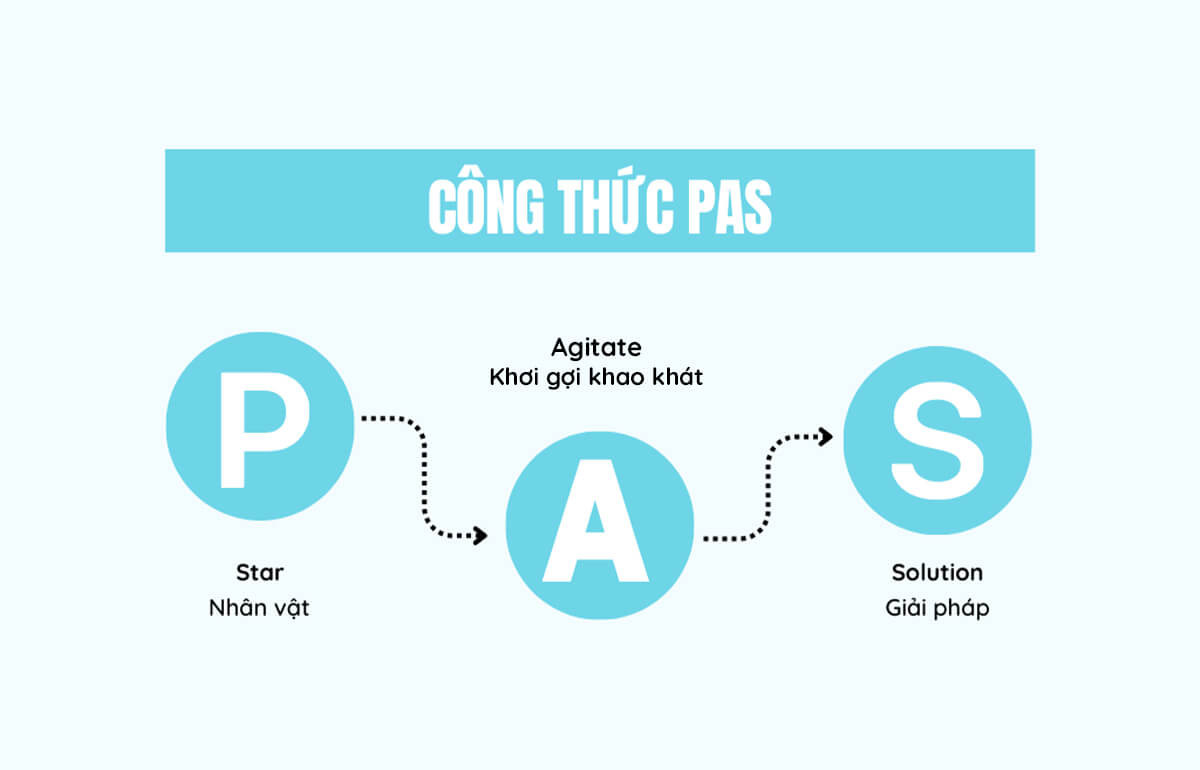
The PAS formula is an acronym for three words: Problem – Agitate – Solve. To build PR or sales content based on this formula, you need to follow this outline:
- Problem: Present the problem the customer is facing.
- Agitate: Show how the problem affects the target audience, describing how the situation could worsen if the problem is not solved.
- Solution: Propose a solution (your product/service’s features) to quickly fix the problem and cleverly showcase the <span style="font-weight:
3. Why is the PAS formula effective?

You might be wondering why the PAS formula is so effective for PR and sales content. The answer lies in human psychology and behavior. We tend to avoid pain, whether it’s physical or emotional, financial or safety-related.
Based on Sigmund Freud’s “Pleasure Principle” theory in psychology, human behavior often stems from one of two goals: seeking pleasure or avoiding pain. The PAS formula is built on the second element – avoiding pain.
Typically, we spend more on medicine to treat illnesses than on vitamins or supplements. Although in the long run, taking vitamins and nutritional supplements is more beneficial for health. However, are you sure you will maintain the habit of using them daily to strengthen your health and resistance? Or instead, do you only reach for medicine when you feel pain or unwell whenever symptoms appear?
In most cases, our motivation often comes from the desire to avoid pain rather than to seek pleasure. Therefore, content that focuses on a customer’s problem and offers a suitable solution will be more engaging than content that creates satisfaction. That’s why the PAS formula is the perfect choice for your marketing content.
4. Comparing the PAS formula with the AIDA formula
Both the PAS formula and the AIDA formula are used to attract attention and stimulate customer interest, however, there are clear differences between them in terms of purpose and effectiveness:
Criteria PAS Formula AIDA Formula Full Name Problem – Agitate – Solve. Attention – Interest – Desire – Action. Effectiveness Effective because it directly addresses the customer’s pain points and problems, tapping into their emotions. Examples of pain points and consequences that can be mentioned include physical, mental, work-related, financial, performance, etc.
Its effectiveness comes from creating content that generates demand at each touchpoint in the customer journey. It helps readers approach the product naturally, bringing satisfaction and enjoyment to the user.
Advantages Customers are psychologically driven to escape pain, fix problems, and reduce risks; they are always looking for solutions to improve their situation. This remains true until the problem is solved, allowing you to quickly provide persuasive and engaging content to your target audience. Always make consumers aware that your product or service is what they truly need to solve their problem.
Furthermore, the PAS formula also helps you deploy content to effectively drive user action.
Attracts a large number of potential customers to interact with the content by creating curiosity about the product. Disadvantages You need to know how to deploy content appropriately and reasonably; overuse can cause boredom and annoyance for customers. Your products or services can be easily replaced by other products on the market. Most customer trust is not long-lasting and changes over time.
In reality, no single formula can guarantee that your content will perform as expected. Each formula has a different purpose and context for use, depending on customer insights, the product, the message you want to convey, etc.
5. Comparing the PAS and 4C Formulas
In marketing, PAS and 4C are both popular formulas that help marketers create persuasive content. However, each formula has its own approach and strengths. The following table will help you see the differences clearly:
Criteria PAS (Problem – Agitate – Solution) 4C (Clear – Concise – Compelling – Credible) Objective Targets pain points, evokes emotions, and guides customers to a solution Conveys a concise, clear, compelling, and credible message Approach Leads through an emotional journey: Problem → Agitate → Solution Sets standards for the message: Clear → Concise → Compelling → Credible Advantages Creates empathy, drives action, suitable for advertising and sales Coherent, easy-to-read, trustworthy content, suitable for emails, reports, and SEO articles Limitations Can be off-putting if overdone, perceived as “fear-mongering” to customers Can be dry, lack emotion, and difficult to create a personal connection with Suitable Applications Facebook/Google ads, landing pages, telesales, viral videos Email marketing, B2B content, press releases, consulting documents 6. Comparing the PAS formula with the 4C formula
In marketing, PAS (Problem – Agitate – Solution) and 4C (Clear – Concise – Compelling – Credible) are two widely used formulas for creating persuasive content. Although they share the common goal of attracting and retaining customers, their approaches and strengths are very different.
Criteria PAS (Problem – Agitate – Solution) 4C (Clear – Concise – Compelling – Credible) Objective Focuses on evoking the customer’s pain points, making them aware of the problem, and driving action Focuses on delivering a concise, clear, compelling, and highly persuasive message Approach Emotional guidance: Problem → Agitate → Solution Sets a standard for content: Clear → Concise → Compelling → Credible Advantages Easily connects with emotions, creates empathy, and prompts customers to act quickly Coherent and concise content, enhancing credibility and professionalism Limitations Overusing the “agitate” step can make customers feel threatened or offended Risks being dry and emotionless, making it difficult to connect deeply with the reader Suitable Applications Social media ads, sales landing pages, telesales scripts, video marketing Email marketing, B2B content, reports, SEO articles, press releases 7. Advantages and Disadvantages of the PAS Formula in Modern Marketing
The PAS (Problem – Agitate – Solution) formula is considered one of the most effective content frameworks in marketing due to its conciseness, directness, and ability to resonate with customer psychology.
Advantages:
-
Addresses the pain point directly: Starting with the “Problem” allows the content to get straight to the issue customers are facing, thereby creating empathy and capturing attention immediately.
-
Stimulates strong emotions: The “Agitate” stage skillfully deepens the discomfort or consequences if the problem is not solved, creating a motivation to act.
-
Clear solution: The “Solution” provides a specific answer, helping customers feel secure and trust the brand.
-
Easy to apply across multiple channels: PAS can be used in advertising, email marketing, SEO content, sales scripts, and even presentations.
Disadvantages:
-
Risk of over-exaggeration: If the customer’s pain point is exploited excessively, the content can be offensive or make the reader feel manipulated.
-
Lack of depth in the solution stage: Some marketers focus heavily on the “Problem” and “Agitate” stages, but the solution they offer is too generic, leaving customers without enough confidence to make a decision.
-
Not suitable for all industries: Some fields, such as education, healthcare, or industries that require a gentle, positive approach, may not be suitable for a direct application of PAS.

Advantages and Disadvantages of the PAS Formula in Modern Marketing ———————————-
Above is some useful knowledge about the PAS formula and how to apply it in sales or PR content creation. We hope this article helps you create content that attracts customers, increases conversion rates, and boosts revenue. We wish you success!
-