


 13/05/2026
  258 views
Career advancement is an initial goal every employee aims for when working at a company. Therefore, to retain talent and create a competitive environment that helps improve work productivity, businesses need a specific career path for every position in the company, especially for capable individuals. In this article, let’s join 1Office to explore the 5 most effective steps to build a career path for employees.
Mục lục
- I. What is a career path for employees?
- II. The role of a promotion path for the business
- III. 5 steps to build an effective career path for your business
- 1. Create and update an organizational chart for each department
- 2. Update the job description for each position in the path
- 3. Define performance standards for each position
- 4. Organize combined training and employee development
- 5. Apply a software solution to standardize the career path
- 6. Example of a development path within a business
- IV. How to Connect Career Paths with Employees
- V. Considerations When Building an Advancement Path for Employees
I. What is a career path for employees?
A career path, also known as a promotion path, is a directional map of developmental job titles that an employee can achieve at each level, built scientifically based on evaluation criteria set by the company.
For example:
- For an Administrative position, the titles from low to high would be: Administrative Assistant — Executive Assistant — Office Manager
- For Branding: Advertising Account Coordinator — Assistant Account Executive — Account Executive — Senior Account Executive
A career path helps employees visualize all the routes leading to the highest possible job title they can achieve in their career. A career path not only helps employees see their professional development potential but also sets clear milestones to create work motivation.
The criteria considered when compiling promotion titles include:
- Career aspirations
- Skills
- Expertise
- Experience
- Personal talents
- Achievements
Based on these factors, managers will evaluate and consider promoting employees after a certain period.
Read more: The Art of Retaining Talented Employees to Reduce Staff Turnover by 80%
II. The role of a promotion path for the business
Building a specific, detailed, and reasonable career path plays an important role for the business itself and the workforce in particular:
1. Create a healthy competitive environment, enhancing work performance
By looking at the career path, each employee will know what they need to do to achieve their set goals. Based on the requirements for each position, employees will strive to meet them, thereby creating a healthy competitive environment where all employees are motivated.
Through this, employees will work more productively and bring many positive results to the business.
2. Reduce turnover rates
Imagine a company with no promotion path or clear bonus criteria—where would employees find the motivation to strive? Such a company can easily lead to stagnation and a loss of work energy among employees.
More seriously, not building a clear career path also increases turnover and causes significant losses to the sustainable development of the business. Therefore, a company with a long-term, clear development vision will help retain employees for the long haul.
3. Enhance engagement
The bond between employees and leaders, and between staff and the company, will be strengthened with a promotion path that satisfies employees and is reasonable for the market situation.
4. Retain and attract talent for the business
Reality shows that many growing businesses are struggling to attract top talent. A reasonable and widely promoted career path can play a major role in attracting the interest of talented individuals.
Being able to build an effective career path for employee development will help the business enhance its image and position. As a result, a skilled workforce with high technical and professional qualifications will seek out the company to collaborate and work. At the same time, talented employees will also voluntarily stay and contribute for the long term.
5. Improve the quality of the management team
By investing in recruitment and building a detailed, transparent, and clear career path, you will build a more diverse and dynamic leadership team.
Businesses should focus on training veteran employees who have been with the company for a long time to create a diverse and dynamic leadership team. Not to mention, this also helps the business reduce the cost of recruiting new employees from outside for leadership positions.
III. 5 steps to build an effective career path for your business
1. Create and update an organizational chart for each department
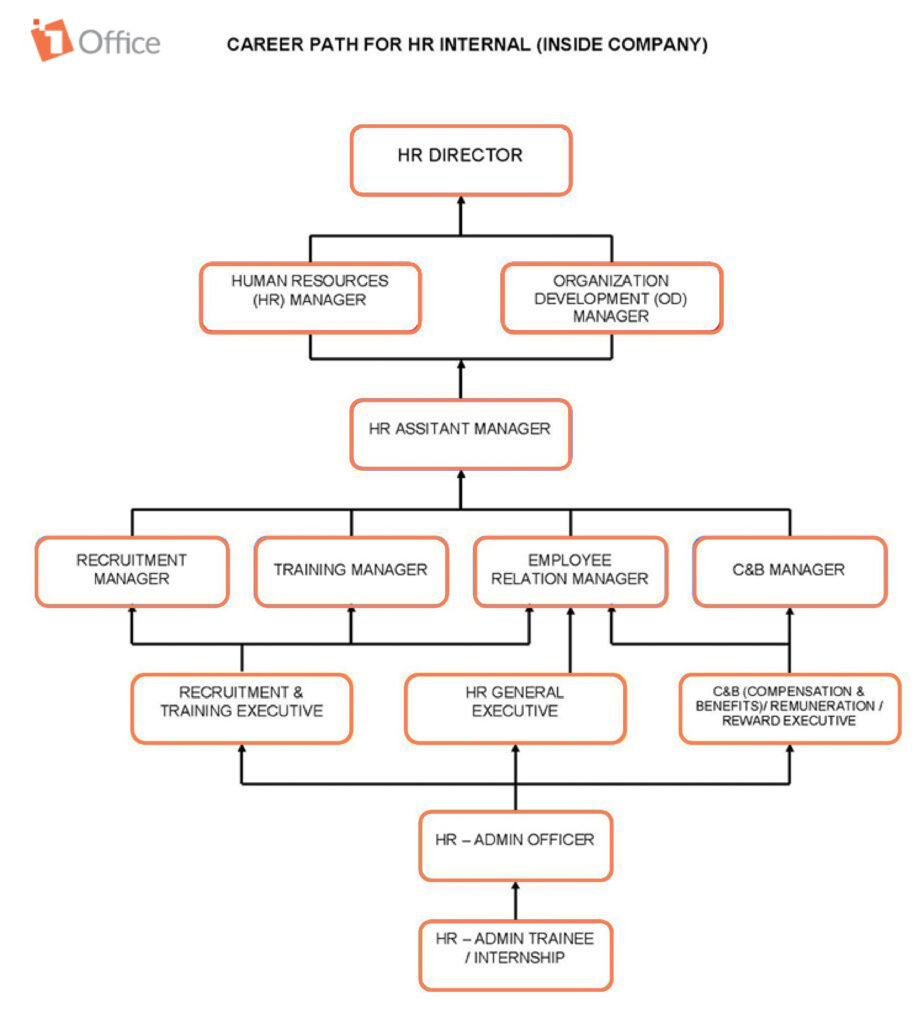
No employee can accurately envision their promotion opportunities if the company/recruiter does not mention it from the beginning. This is the simplest way to help employees see the promotion path in their functional area.
A basic chart or graphic is all that’s needed to illustrate potential position changes within any specific business function (e.g., marketing, sales, HR, customer care,…).
This company organizational chart is the foundation for the employee’s career orientation program, as it highlights career development opportunities in a way that is easy to understand, easy to follow, and can be changed if necessary.
2. Update the job description for each position in the path
Next, you should create descriptions for each position in the career path, also known as position profiles – a detailed description for the job positions highlighted in the promotion path.
For each position, the business needs to outline and document a description of core duties, skills, and general requirements. To add more clarity to the career orientation program, some KPI requirements should be added.
This description will be key to positioning the capabilities of junior employees, considering whether they are competent enough to take on a higher position at a specific time in the future.
| Read more: 5 Steps to Create a Job Description with a Standard Template for All Positions and Roles |
3. Define performance standards for each position
In this step, you need to define the performance standards the business requires for each job position. This means that any employee in any position who wants to advance needs to clearly understand what they will have to accomplish in that higher role.
The business should document the behaviors and productivity results of top-performing employees at your company; then, use this as a benchmark for all other job positions to build an effective career advancement path for employees.
4. Organize combined training and employee development
To motivate employees on their career path, the business should provide internal training courses to disseminate information and hone necessary skills. Examples include leadership training, cross-functional training, international exposure, etc.
Regarding training, if you are a manager, don’t hesitate to ask employees what kind of training they desire, as they are the core human resource that the career path in general and the training program in particular are aimed at.
See more: Standardized human resource training and development process for businesses
5. Apply a software solution to standardize the career path
To standardize the process of building a career path for employees—including the steps, standards for each stage, responsible personnel, completion deadlines, etc.—and ensure its long-term application in the business, you can use the leading personnel career path management software, 1Office.
This superior 4.0 software will help you:
- Manage all business processes within the company.
- Coordinate smoothly between related departments.
- Standardize and optimize data exchange flows.
- Easily set up all types of processes, clearly note job descriptions and titles, and make changes easily when needed.
6. Example of a development path within a business
Use the 5 steps above to build a career advancement path for the Human Resources & Administration (HR&A) department:
| Position | Requirements | Benefits | Main Responsibilities |
| HR Intern | Not much experience required
Communication skills Teamwork skills Enthusiastic and proactive at work |
Fixed salary (depending on company policy)
Opportunity to learn many new skills Build relationships Enhance your CV |
Support recruitment consultation for candidates
Work with HR to build a reputable recruitment team Organize and screen candidate profiles and personnel records |
| HR Specialist | Completed internship and probation period (3 months internship and 2 months probation)
Successfully meet the recruitment targets set by the company |
Fixed salary
Commission for each successful hire Opportunity for promotion to higher positions |
Manage and supervise all personnel information data;
Organize recruitment; Plan job postings; Screen candidate CVs Coordinate intern recruitment |
| Head of HR | Age
Proven track record as an HR specialist Management experience Experience in recruiting and training candidates |
Fixed salary
Health insurance coverage Good salary and bonus schemes |
Recruit personnel
Ensure adequate staffing levels across all locations Conduct onboarding training Monitor and ensure personnel adhere to procedures |
| HR Director | Graduated in Human Resources, Management, or other related fields.
Evaluated based on the total number of CVs per recruitment drive; Percentage of qualified candidates |
Highest salary in the HR department
Comprehensive welfare benefits Attractive perks Work directly with other departments Participate in developing company strategies. |
Direct and manage teams and sub-departments within the HR department.
Analyze and organize specific HR-related data Identify personnel gaps within the company Collaborate with HR specialists in the department |
IV. How to Connect Career Paths with Employees
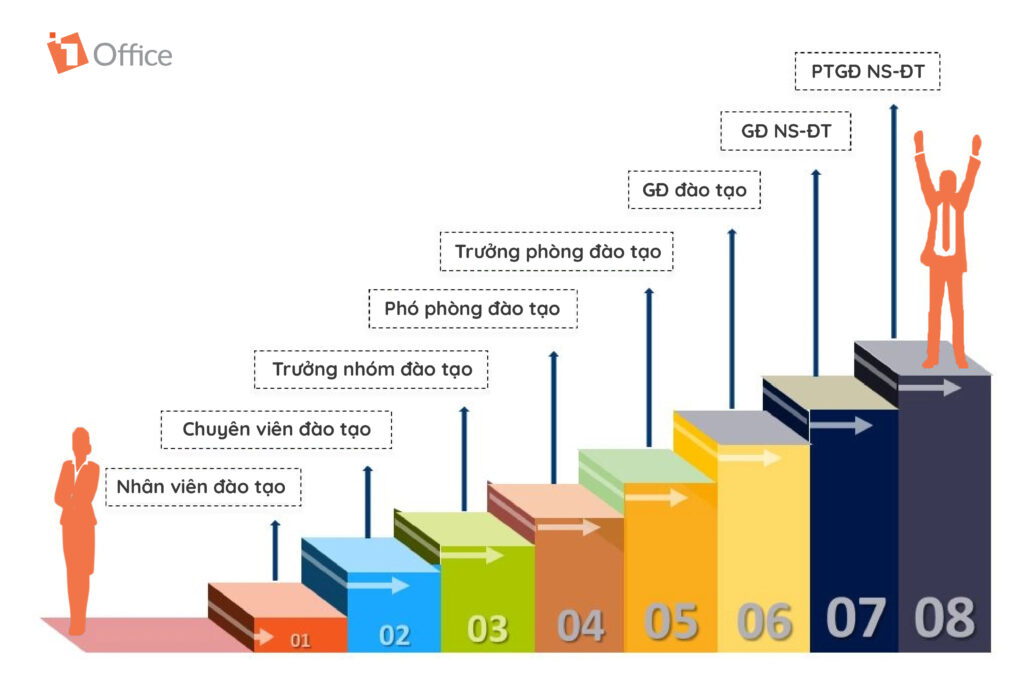
Building a quality, clear, and transparent career path for employees is an urgent requirement. But how to make that advancement path more accessible to employees is also a challenge that concerns many businesses.
To help all personnel easily accept and strive to follow the career path, businesses can do the following:
1. Survey Employee Insights Before Establishing a Career Path
To connect the career path with employees, businesses should start by surveying and accurately understanding insights into their aspirations, difficulties, motivations, and current capabilities. Conducting this survey will provide management with the initial information needed to analyze, evaluate the career path, and identify the skills that need to be developed for each employee.
Businesses can choose to conduct a company-wide career development survey even before building the framework for the career path, and then conduct another survey a few months after launching the program.
2. Hold Internal Meetings as a Basis for Building Employee Advancement Paths
To clearly understand the future career orientation of each employee, managers can conduct small internal meetings to listen in detail to the desires of each individual after the survey is completed.
The information provided by employees and managers in the meeting will be a crucial key for the business to build the most effective career path. Because work is not just about transparency and clarity; managers also need to consider the desires and thoughts of employees to make the most reasonable decisions or policies.
3. Find Common Ground Between Employee Desires and Business Direction
You need to understand that each company’s resources are limited and it’s impossible to meet all the needs of every employee. Therefore, don’t make too many promises to employees; instead, take the time to find a consensus between individuals and the business regarding the career path.
When employees’ development aspirations have common ground with the business’s direction, it will be easier for management to build an advancement path for them.
As predecessors with experience, managers should share with employees the reasons why the business is implementing a career advancement path and emphasize that the company is committed to investing in the development of each employee. This will make employees feel that the business is concerned about their benefits and long-term growth.
Additionally, if the business has the resources to organize a company-wide career orientation program, provide additional materials including content about the career path you have built. You can design them in two formats: an overview and a detailed version for each professional field, then let employees choose based on their ambition.
V. Considerations When Building an Advancement Path for Employees
A career path will be truly effective if it has investment from both the business and the employees. In addition, you also need to note the following points to build an effective career path:
For the business:
- Managers and leaders should not make too many promises or guarantee anything in absolute terms. Instead, they should support employees as much as possible
- Employees are responsible for their own efforts and advancement, while managers are observers, supporters, and evaluators. This needs to be agreed upon from the beginning.
- Managers should also not invest too much time in supporting employees, as this can sometimes delay their own work.
For employees:
- Always maintain a mindset of continuous learning
The job market is always changing rapidly. Therefore, to keep up with the trends of the times, each of us needs to add many necessary skills as a profitable investment in ourselves.
To find out which skills are most in demand in your industry, carefully review the profiles and resumes of other colleagues to grasp the necessary skills to learn and improve.
- Connect with colleagues
Connecting, sharing, and exchanging information with colleagues about necessary skills and new jobs will help clarify future directions.
Connecting helps you understand the company’s approach to building employee advancement paths so you can strive accordingly.
- Be flexible in seizing opportunities
Don’t confine yourself to an overly safe career plan. Always be open to all opportunities and remember the ultimate goals you need to achieve. This way, the career path you build can be more perfect and bring more interesting experiences.
Above is all the information about advancement paths that we wanted to share with our readers. And as mentioned above, a software solution is an excellent choice for businesses to build and manage advancement paths for positions in your department. If your business needs a tool to support building career paths for employees, 1Office is a perfect solution. For all detailed information, please contact:
- Hotline: 083 483 8888
- 1Office Fanpage: https://www.facebook.com/1officevn
- YouTube Channel: https://www.youtube.com/c/1OfficeNềntảngquảnlýtổngthểDoanhNghiệp
















