


How to Create a Detailed Annual Plan for Your Sales Department


Every department in a business needs specific plans, whether short-term or long-term. Among them, the annual plan is considered the strategic document that defines the goals and direction for that department. For a company’s sales department, the annual work plans are about defining KPIs to reach new goals. So, how do you create a complete annual work plan for the sales department? Let’s find out in the article below!
Mục lục
I. What is annual planning? Why do businesses need it?
1. What is annual planning?
As mentioned above, annual planning is the process of creating a strategy, making fundamental decisions, and taking formative actions. When creating an annual work plan template, leaders and department managers will answer questions such as: “what is the organization?”, “what does the organization do?”, and “why does the company need to do this?”…
Most long-term departmental plans involve senior management. For the sales department—the spearhead of every business—the strategy must be carefully considered and developed, especially regarding: “What are the company’s forward-looking goals?” and “What does the sales department need to do to maintain its competitive position?”.

2. The importance of annual planning for businesses
Creating an annual work plan is essential for the business as a whole and for each department to achieve its goals. Moreover, it determines your success, so it’s crucial to invest in making it detailed. Specifically, a business needs to build a comprehensive and feasible annual plan because:
- It helps departments and the business define a clear direction to achieve their goals.
- It outlines the best methods for executing planned tasks, helping the business and departments assess feasibility.
- It provides contingency plans for potential risks.
- It helps the business and departments (specifically the sales department) have a plan to continue operations in case of unforeseen circumstances.
- It gives the business and departments a general overview of the future, the changes they will face, and the potential impacts.
- It makes it easier to monitor all stages, allowing for the creation of a seamless coordination plan.
- The ultimate goal is to help the business achieve its sales targets as quickly as possible.
It is important to note that your annual work plan must be closely linked to your strategic plan. A strategic plan is a document that outlines the strategy your business is pursuing to achieve its overall growth objectives. The strategic plan takes into account stakeholder needs, market constraints, resources, etc., and has a 5 to 10-year outlook.
| See more: Latest Standard Excel Work Plan Template 2022 |
II. How to build the most effective annual plan for the sales department
1. Analyze the overall market
To understand the market situation, competitors, whether the company’s product is strong enough, or if it needs any improvements, the sales department always needs to conduct an overall market analysis to get the most comprehensive view of the market and to reflect on the business itself.

To carry out this task, the SWOT analysis model is both an effective and extremely simple tool for establishing a company’s strategy.
SWOT is an acronym for the first letters of English words and is based on the following aspects of a business:
- Strengths: The company’s strengths. The unique advantages of the company, project, product, etc. These must be the outstanding, unique characteristics that the company holds compared to its competitors.
- Weaknesses: The company’s weaknesses and limitations. You need to overcome these weaknesses if you want to compete with rivals in the market.
- Opportunities: Opportunities. What external environmental factors will help your business run more smoothly.
- Threats: Challenges for the company. Any external factor that is causing difficulties for the company on its path to success is a threat.
Through SWOT analysis, the company will clearly see its goals as well as the internal and external factors that can positively or negatively affect the goals it has set.
2. Identify the target audience for the business plan
This is the part where you need to clearly understand your company’s product and the company goals it aims for. Once these are clearly understood and defined, the target customer audience will also be clearly identified, narrowed, or expanded to create a suitable business strategy.
For example: your company follows a B2B model, meaning the primary target audience is businesses that need digital transformation or require software to solve employee or work stagnation issues. Once the target audience is identified, everything you outline in the plan will be more organized and aligned with the goals.
3. Set goals
When deciding on your goals, write them down on paper before starting the planning steps. Dr. Gail Matthews of Dominican University says that doing this increases the likelihood of success by 42%. For the easiest approach, you should apply the following SMART formula:
- S – Specific: Ask the questions Who? What? Where? Why? The more precise the description, the higher the chance of success.
- M – Measurable: Measure progress. Only with specific metrics can the company know where its performance stands.
- A – Achievable: What skills does the company, specifically the sales department, already have? If not enough, how can they be improved?
- R – Relevant: The sales department needs to recognize whether this is a truly desired goal. The planning steps are only meaningful when this question is answered.
- T – Timebound: Each task must have a predetermined completion deadline. This acts as a deadline schedule to ensure all employees work seriously and complete tasks on time.
A specific example of using the SMART model with the goal of “increasing the order closing rate”:
- S – Specific: I want to increase the order closing rate
- M – Measurable: The order closing rate reaches at least 70% of calls requesting product consultation
- A – Attainable: With the capabilities of the Customer Care team and the product’s outstanding features, I want the order closing rate to reach at least 70% of calls requesting product consultation
- R – Relevant: To achieve outstanding revenue
- T – Timely: The goal needs to be completed before 31/12/2022
Thus, it can be seen that the specific goal of the sales team has been outlined by the company based on the SMART model to serve as a foundation for subsequent tasks.
See more: 8 principles for effective planning, enhancing feasibility with the golden formula 5W1H2C5M
4. Identify necessary resources
This is a mandatory activity in the planning steps. Any goal that does not take resources into account is just like a “dream” list.
- Human resources or knowledge resources are the most core and mandatory factors. A marketing director wants to drive more traffic. They will need content creators to spark curiosity and clicks.
- Technology and supporting software help increase efficiency in the digital age. A marketer aiming to attract potential customers needs tools to run ads. Therefore, this factor also needs to be calculated and included in the planning steps.
- Financial and time resources are the most practical means that must be considered. Otherwise, the project will only exist on the pages of the plan.
5. Evaluate and refine
A roadmap created in an annual work plan template is not immutable; it will certainly fluctuate constantly. This is quite understandable in the context of continuous technological and social change. They directly or indirectly affect your goals.
Therefore, you need to monitor and evaluate progress for both large and small tasks. From there, necessary alternative plans can be made to meet emerging needs.
III. Annual KPI plan template for business operations
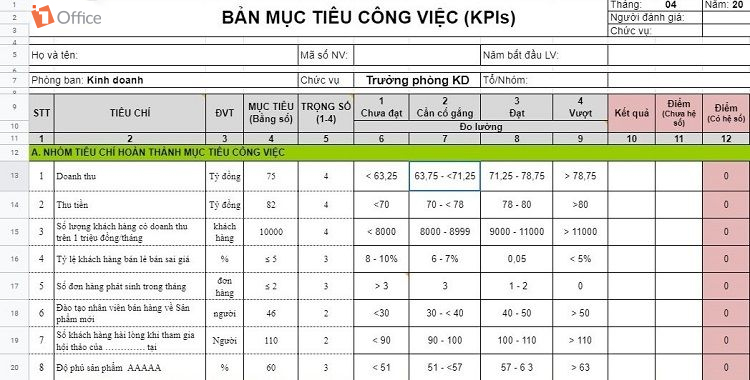
With a KPI target plan for the sales department, a business can create a simple version using Excel or a complete version with content from the cover and table of contents to the main content with the 4 sections mentioned above.
IV. Implement and create effective business plans with 1Office software
1Office task management software – An effective solution for creating an annual plan. The software helps optimize employee productivity. Many businesses turn to task management software to allocate resources more effectively, from planning and assigning tasks to tracking, monitoring, and evaluating project results.
- Assign permissions to project participants, easily add people, and define the roles of each individual in the task
- Allows for assigning and receiving tasks anytime, anywhere on mobile devices, laptops, and tablets via in-app notifications or email
- Automatically notifies relevant people of progress, changes, or new updates via email
- Create flexible departments/functional groups and projects
- With assigned permissions, each level is allowed to access and see how far their employees have progressed and the completion percentage compared to the plan. Additionally, those involved in the task can also receive notifications and easily track related work.
With the information above, we hope your business will find useful insights for creating an effective annual plan for your sales department. For more detailed information about the 1Office task management software, please contact us via:
- Hotline: 083 483 8888
- 1Office Fanpage: https://www.facebook.com/1officevn
- Youtube Channel: https://www.youtube.com/c/1OfficeNềntảngquảnlýtổngthểDoanhNghiệp




