13/05/2026
  339 views
Any business that wants to achieve long-term and sustainable success needs to focus on setting goals and planning. If work is done and assigned instinctively, without a specific plan, work efficiency will be non-existent, and employees will become discouraged because they don’t know what to do. Therefore, businesses need to have specific planning methods that can be applied in all situations and projects.
Mục lục
I. What is planning?
Planning is the skill of organizing work by priority within a specific period. The purpose of planning is to help businesses easily control time, workflows, and work efficiency.
Planning is considered one of the important soft skills, necessary not only in life but also in large enterprises.
II. Common mistakes businesses make when planning
Planning methods are very important for every business. However, not every business knows how to apply common planning methods to create reasonable and clear plans. Most businesses today make the following mistakes when creating a business plan:
- Incomplete plans
A proper business plan needs to ensure it includes all the necessary elements: customers, products/services, marketing and sales activities, management, and activities related to competitors. Lacking any of these elements will make the implementation and post-execution evaluation incomplete and inaccurate.
- Overly vague planning
Vague information is what causes many business plans to fail. When applying planning methods, many businesses do not provide all the necessary information or only list very general items. This leads to difficulties for employees in receiving and carrying out their tasks.
- Creating unfounded and unrealistic tasks
The process of creating a good business plan needs to be based on accurate practical grounds and viewed objectively.
These mistakes lead to consequences where employees do not fully understand their duties, work without knowing their purpose due to a lack of specific goals, work progress becomes chaotic, and managers do not have a basis for assigning tasks and holding people accountable.

III. Important considerations when creating a business plan
- Thoroughly check time indicators to grasp the situation
Set clear timelines before planning: Start time, end time, and contingency time for resolving risks
- Planning should be based on the current situation
A business cannot use data from the previous year or projected future data to plan for the present. What is the current situation, what is the plan, for what purpose, and how does it serve the current work, etc.
Create a plan that is suitable for factors such as human resources, location, budget, etc.
- Create clear and transparent tasks
List reasonable and clear tasks, and clearly assign who does what so that employees know their main duties and which goals they are working towards, avoiding situations where they are unsure of what they are doing.
- Use comprehensive data for planning
The data used for planning must be accurate, clear, and within feasible limits to ensure the objectives.
| Read more: 8 effective planning principles to enhance feasibility with the golden 5W1H2C5M formula |
IV. 4 Effective Business Planning Methods for Enterprises
1. Effective Context Analysis with SWOT
Use the SWOT model to analyze factors related to the context and situation before planning. A SWOT analysis is one of the 5 steps in forming the business production strategy of an organization, enterprise, or project, based on evaluating 4 factors:
- Strengths: The company’s strengths to leverage and develop
- Weaknesses: Limitations to overcome so they don’t affect the plan’s implementation
- Opportunities: Opportunities that can be seized from the plan
- Threats: Risks that may be encountered during the plan’s implementation
Applying the SWOT model to analyze the business context before planning offers many benefits, such as gaining a general overview of the specific situation, improving weaknesses, mitigating risks, and seizing opportunities in a timely manner. This is one of the effective planning methods used by many businesses.
See more: What is the Business Model Canvas? How to Build a BMC Model from A-Z
2. Clearly Define Goals with the SMART Model
SMART is an effective goal-setting model designed to help businesses establish and evaluate the feasibility, relevance, and reasonableness of goals in a business plan based on 5 criteria:
- Specific
- Measurable
- Actionable
- Relevant
- Time-bound
Defining business goals according to the SMART model helps the process of achieving a company’s long-term or short-term goals become highly effective. However, managers still often face difficulties in setting goals using the SMART model.
- Specific Goals:
When setting SMART goals, managers need to ensure the goal is specific. There should be clear numbers for definition. For example, “Increase brand awareness” => “In Q2, increase brand awareness by 20% compared to Q1.” You need to use KPIs to measure work performance and business activities to know which numbers need improvement.
- Measurable:
When creating a business plan, managers must be sure they can measure the goal using numbers. It needs to be clearly defined with specific figures to increase or decrease quantities and achieve the company’s desired objective.
1Office work management software can help you in this process by providing specific data for evaluation and goal setting, thereby enabling effective planning methods.
- Achievable
Achievable means it can be done. The number a SMART goal aims for should be within a range that the team can accomplish. For example, if the number of visitors to the company’s website increased by 10% last month, a goal to increase that number by 8-10% would be more achievable than a 25% increase.
In this case, 1Office can help businesses with: Visually compiled, multi-dimensional reports. It also provides complete statistics of business indicators in real-time, with a feature to filter by a desired time frame.
- Relevant
The relevance between the main goal and smaller objectives will greatly affect goal setting. If you focus on this criterion of the SMART model, your marketing goals will surely align with and support the company’s overall objectives.
- Time-bound
Setting goals with a specific timeframe will help managers and staff stay on the right track and follow a specific schedule. A time limit for completing the goal also helps motivate the company’s employees.
Avoid setting goals without a specific time limit, such as: “This year, we will launch a major marketing campaign.”
| Read more: 5 causes of wasted time for businesses and how to fix them |
3. 5W1H – The “Key” to Defining Work Content Effectively
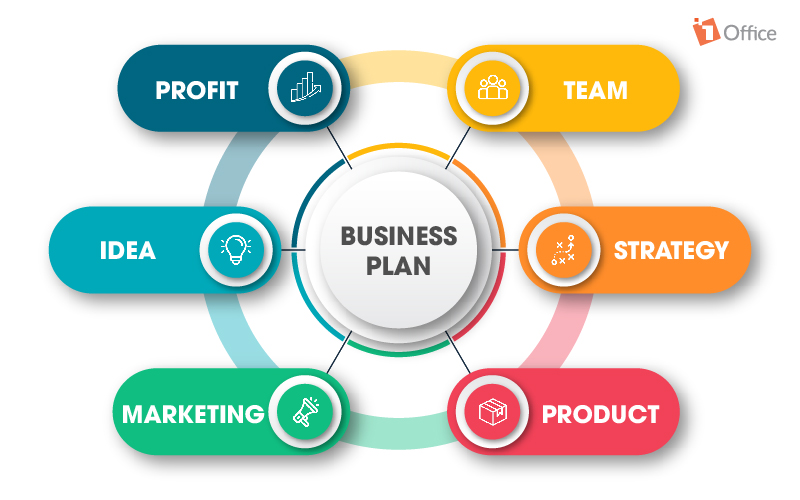
5W1H is a formula for building content that is widely applied in the fields of business, marketing, and management.
- What? – Define the business’s products and services
In this element, the business needs to answer the questions: What is the product? What are its advantages and attributes? What industry is the product in, and who are the competitors?
- Who? – Identify the customer
Who will need the business’s products/services? Consumers or large enterprises? Correctly identifying the target audience is essential to finding an appropriate and accurate approach. You need to put yourself in the customer’s shoes to envision their purchasing behavior.
- Why? – Why do customers come to your business?
In this section, you need a plan to highlight the superior features of your business’s products/services and the differences compared to the market and competitors. This is also a factor that helps enhance creativity and perfect the product/service quality.
- When? – The time to launch the strategy to the market
When is the right time to implement the plan? How will smaller tasks be completed to stay on schedule? You need to clarify these things when creating a business plan. This way, the planning methods will be fully applied and deliver high efficiency.
- Where? – Business location
Pay close attention to the location where your business will carry out the planned work, as it determines 30% of your success or failure.
- How? – How to plan effectively?
Once you have an overall picture of your plan, it’s time to create a specific, detailed plan and be continuously creative in its implementation.
4. Managing emerging risks with the 2C model
2C: Control – Check
- Control: Ensuring the project stays on track is a crucial task for which the manager is the head and responsible person. Any task undertaken requires this step for incremental improvement and completion to achieve the best results. What tools to use for measurement and how to use them will be outlined in the plan. These tools will vary depending on the nature of the work and the desired results.
- Check: Determine the method the manager will use for inspection in this case. How often must it be checked, and who will perform this task? Will the manager do it personally, or will an assistant?
1Office is a business management software that provides powerful support for creating and applying business planning methods, used by countless businesses. In each step of the plan-building methods, 1Office helps businesses solve specific problems related to processes, evaluation capabilities, and effective task assignment.