


Post-Pandemic Workforce: Job Loss or Resignation


The human resources problem is a hot topic as life returns to the “new normal”. What do employees want after the pandemic? What should businesses focus on to attract and retain personnel, with the deeper goal of recovering production and business activities? What is the solution to the trend of employees proactively quitting their jobs? How is the workforce changing post-pandemic? All will be answered in this article by 1Office.

Mục lục
1. The picture of Vietnam’s economy after 2 years of the Covid-19 pandemic
In the last days of 2019, China announced the first patient with Covid-19. About 20 days later, on January 23, 2020, Vietnam had its first case, a patient who had entered from Wuhan. From then until the most recent time (November 2021), in just under 2 years, the number of infected patients has reached over 977,000, with over 22,000 deaths – a very sad figure. Not only did it cause loss of life, but Covid also directly affected the economy, especially in terms of human resources. After 2 years, more than 100,000 businesses have withdrawn from the market due to the impact of the pandemic (over 35,000 in 2020 and over 70,000 in 2021). Although there are many reasons for businesses to withdraw, such as being unable to operate due to Covid’s impact, lack of output, high operating costs, and changing industries to adapt to the pandemic, its heavy impact on the human resources sector cannot be denied. Covid was like a “great flood” that swept away years of hard work by many businesses, leaving employees adrift in a vortex of job loss and unemployment, not knowing where to turn.
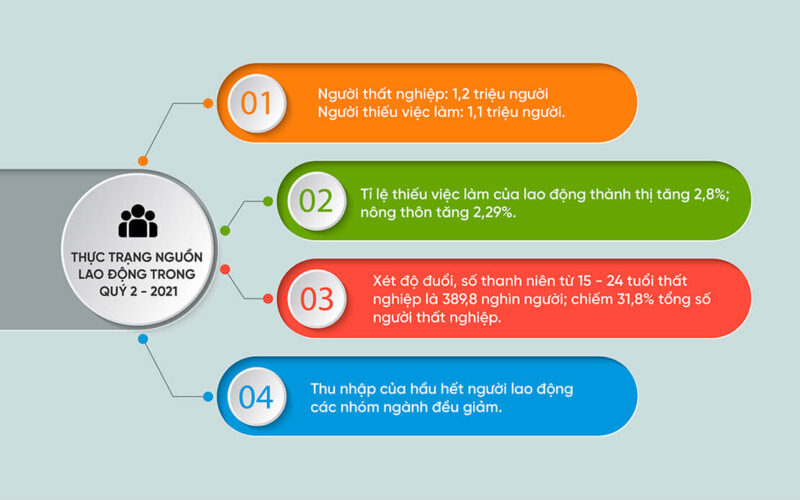
From the situation above, the picture of Vietnam’s economy after 2 years of the Covid pandemic has become bleaker than ever. Prolonged social distancing has burdened workers with worries about their livelihood. In addition, due to sudden job loss, most workers only have enough savings to cover living expenses for 3-6 months, with a few cases only able to sustain themselves for about 1 month. Faced with the reality of unemployed workers and reduced incomes due to businesses scaling down production, for the first time, a support package of 38,000 billion VND was approved by the National Assembly and the Government through Resolution 116 to help employees and employers overcome difficulties caused by the Covid-19 pandemic. But ultimately, this is only temporary support, and workers still need to proactively find solutions for their employment situation after the pandemic. Should they continue with their old jobs or switch careers? What do employees need from a job post-pandemic? Which industries are safe choices? What are the upcoming trends for the HR sector, and what do businesses need to do to retain employees? The answers will be in the following sections of the article.
2. The impacts of the pandemic on the human resources sector
The 2 years of the pandemic have had a significant impact on the human resources sector. Not only did it cause the unemployment rate to soar, but it also changed perspectives on various industries. The post-pandemic personnel groups most heavily affected are tourism, aviation, real estate, and construction. These industries are highly dependent on environmental conditions and the quality of life of the people. When life is stable, the demand for housing, leisure, land accumulation, and shopping is high, and vice versa. Since the beginning of 2020, due to Covid, many provinces and cities across the country have had to continuously implement social distancing, especially in major cities like Ho Chi Minh City, Hanoi, Da Nang, Can Tho, etc. In the construction industry, many projects had to be halted or had their schedules extended, which directly affected the construction workforce and indirectly affected the real estate market. Social distancing also caused the aviation and tourism sectors to be almost “frozen” for nearly a year, to the point that mainstream news had to use the term “devastated.” Resorts and hotels closed en masse or cut staff, leaving the workforce in this sector struggling to maintain their livelihoods. However, these are also the sectors with the most positive recovery potential, with the highest demand for personnel recruitment after the pandemic, as public demand will increase again as soon as the pandemic is controlled.

The post-pandemic personnel groups with little or no negative impact belong to the telecommunications, electricity, healthcare, petroleum, journalism, banking, and information technology sectors. Banking and telecommunications were less affected because they are sectors that serve the essential needs of the people – they cannot stop operating or are very minimally affected. The Information Technology industry was almost unaffected by Covid, as the nature of this sector’s work is primarily conducted online. In the long term, the labor market demand will also adjust and increase in the information technology and automation sectors.
From the information above, it can be seen that the human resources sector will experience a significant shift in industry groups after the Covid “storm”. Post-pandemic personnel in the heavily affected sectors are facing important decisions about whether to stick with their old professions and wait for businesses to recover, or to switch to industries in the “safe” category, as both Vietnam and the world have concluded that we may have to find ways to “live with the pandemic” rather than hoping it will disappear completely. The stable and less-affected sectors will attract a significant number of workers looking to change careers, thereby increasing job competition and creating new opportunities. .
3. Post-pandemic HR trends: Job loss or resignation?
In reality, the relationship between the economy, businesses, and employees is like a domino effect; when one falters, the others stumble. It started with businesses, under the impact of Covid, unilaterally terminating employment contracts ahead of schedule instead of putting employees on temporary leave. From the employee’s perspective, passively losing a job is equivalent to a “crisis.” Without a job, they generate no economic value while still facing the daily challenge of making ends meet with numerous expenses. Job loss means a psychological burden from financial stress, on top of the pressure to stay safe during the pandemic. Many employees shared that they fell into a state of prolonged stress due to job loss and the fear of the pandemic affecting their and their families’ health. Even after entering the “new normal” phase, many workers remained unemployed because they realized it wasn’t easy to find a new job immediately after the pandemic. The reason is that when many people lose their jobs and then look for new ones simultaneously, the competition becomes much higher. Businesses also have more choices among candidates. At this point, those with average or poor expertise, or those who cannot demonstrate outstanding advantages, will be rejected. Therefore, even after the pandemic, they remain stuck in place, unable to find employment.
The majority of laid-off workers are manual laborers or those with low professional qualifications – a major disadvantage for them during the pandemic. Businesses will immediately lay off employees they deem non-essential or unimportant to cut operating costs. Losing a job is something no one wants, whether in normal times or especially during and after a pandemic. However, it also serves as a “warning” to employees about the need to assess their work capabilities. If you don’t cultivate experience and learn new skills to increase your value in the eyes of business owners and recruiters, you will be the first “scapegoat” when the company decides to downsize. The most stable job isn’t one where you stay in one place for a long time without change, but one where your work is unaffected by any environment or external impact, where you are still valued and have your own worth. This mindset is something many workers today lack.

In contrast to being passively laid off, many people intended to or decided to quit their jobs right after the pandemic. This is also becoming a “trend” that is quite popular among young people. There are many answers to explain why this trend has emerged. For example, after the pandemic, they noticed potential needs in other industries (starting a business when the market is beginning to recover is both an opportunity and a challenge). It’s an opportunity because the recent pandemic forced many weak companies to close, reducing competition. It’s also a challenge because starting a business when the market is struggling to recover means customer demand is much lower. Additionally, customers will seek out long-standing, established names that survived the pandemic to buy products and services. Without the right direction, you can easily fall into a “pit” of your own digging. Meanwhile, some people decided to leave their companies after seeing the company’s poor management capabilities exposed when facing social crises: poor benefits, failure to meet employee needs such as salary cuts and bonus reductions, causing employees to gradually lose faith in long-term dedication to the company. After social distancing ended, many people decided to become freelancers, allowing them to work safely from home while also focusing on family care. The most common fields are online business, content creation, design, etc. These jobs don’t require them to go to an office; all they need is a computer with an internet connection to complete their work. Many even take on 2-3 jobs at the same time to increase their income.
On another note, after witnessing Covid cause millions of deaths, the YOLO lifestyle (proactively quitting a job to live a truly fulfilling life – You Only Live Once) has emerged like a fresh breeze among the youth. It awakens the “dormancy” in many people who were engrossed in work all day, doing things they disliked, and not enjoying life. They feel that life needs to be more meaningful and complete with the things they want, going where they like, no longer bound by the 8 am – 5 pm daily schedule. They proactively quit to re-evaluate what job they want to do, what their abilities are, or even simply take a gap year for 1-2 years or start a business. Along with that, many people have now quit their jobs to move back to their hometowns to reduce the cost of living in the city. They might choose to start a business in their hometown (where there is less competition) or to be closer to family, in a fresh and pleasant atmosphere – a place where personal life may be less vibrant than the city but is very suitable for those looking to find their own path. Leaving the city for the countryside is not a short-term choice, something you do on a whim and quit if you don’t like it. It’s a story of entrepreneurial will, of building a long-term life.
4. Solutions for the post-pandemic human resources challenge
From a business perspective, companies need the cooperation of their employees to survive and then grow. The current reality shows that labor shortages, whether due to proactive layoffs or employee resignations, are a significant loss for businesses.
According to Mr. Bui Sy Loi, a senior expert from the Ministry of Labor, Invalids and Social Affairs and former Vice Chairman of the National Assembly’s Committee for Social Affairs: “The urgent requirement now is to have both short-term and long-term solutions to prevent a breakdown in the labor market; if a breakdown occurs, it will be very dangerous. The crucial issue is to have solutions to attract labor back to work so that businesses can restore production. The decisive factor, and the root cause for restoring production and recovering the economy after the Covid-19 pandemic, is having sufficient labor.”.
When solving the post-pandemic human resources problem, managers have two issues to address: retaining existing employees and recruiting new ones. To retain existing employees—the core force that has been with the company—it is essential to take actions that directly care for their working lives (stabilizing salaries, bonuses, and work benefits; creating a bond between employees and the company). In the new normal, they have additional personal needs such as healthcare, in addition to salary and bonus issues, like social insurance, vaccination support, and regular health check-ups. The art of retaining talented employees is a special secret of visionary leaders in the new era, where core, high-quality employees are considered the right hand of the business. Placing them in a fair competitive environment, with compensation commensurate with their abilities, and not making “empty promises” are prerequisites that businesses must consider when wanting to retain employees and manage human resources post-pandemic.
In terms of recruiting new people to replace those who have resigned or former employees, leaders need to develop a specific recruitment plan. If the wave of job losses and resignations is like a red ocean, then recruiters are the fishermen. The right mindset to solve the human resources problem is like a ship heading in the right direction. In this case, the “fishing rod” is the information and recruitment communication channels used to find talent, along with the company’s existing reputation. The “good bait” is the benefits offered to personnel. By skillfully using these elements to attract new people, businesses will certainly achieve positive results. Today’s recruitment channels are quite diverse, from social media to recruitment websites, company websites, referrals from relatives and acquaintances, to headhunting firms, all of which can meet a company’s recruitment needs. Additionally, recruiting freelancers and remote workers is another solution to consider post-pandemic—employees do not need to come to the office but can still ensure quality work is completed. Furthermore, when recruiting freelancers, a company’s job postings will undoubtedly receive a significant number of applications, as many people currently want to increase their income by taking on additional freelance work.
Finally, through this article, from a business perspective, managers will identify areas for improvement within their companies to meet the needs of society and employees post-pandemic. From the employee’s perspective, post-pandemic personnel facing job loss or resignation—whichever path is taken—see it as a choice, a necessary turning point to re-evaluate their work and recognize their capabilities to keep up with the market. No path is easy if you don’t try to change—recruiters, businesses, and employees all need to see the positive aspects after the pandemic to shift their mindset about work. 1Office believes that by doing so, we will all be fine!




