13/05/2026
  292 views
Job transfers, while infrequent, are an unavoidable part of a company’s operations.
Each job transfer significantly impacts the employee, their departing and receiving departments, and relevant clients. Therefore, businesses must pay close attention to fully and carefully notifying the employee, related departments, and clients. However, how to do this correctly and sufficiently is a question not every business can answer.
Let’s explore the standard employee transfer process for businesses with 1Office in the article below!
Mục lục
What is an employee transfer?
(based on Article 31 of the Labor Code)
There are two types of employee transfers: temporary transfers and permanent transfers.
Temporary Transfer
A temporary transfer is a type of transfer that does not require the employee’s consent but cannot exceed a cumulative total of 60 days in a calendar year. The employee must be notified at least 3 working days in advance and receive a salary of at least 85% of their previous job’s salary, but not lower than the regional minimum wage stipulated by the Government.
Permanent Transfer
A permanent transfer is the transfer of an employee to a different, permanent position, which requires the employee’s consent. The employee must be notified 7 working days in advance, sign a new labor contract, and receive a salary of at least 85% of their previous job’s salary, but not lower than the regional minimum wage stipulated by the Government.

Causes and Effects of Employee Transfers
Employee transfers occur when a business needs to reduce or supplement staff between different departments to serve its development goals. A transfer can also happen when a company wants to create special development opportunities for an employee or simply believes the employee is a better fit for another position.
The effects of a transfer impact not only the employee and the employer but also the related departments within the organization.
For the Business
Transfers help improve work efficiency in both the employee’s departing and receiving departments. The receiving department gains an employee, boosting its productivity. The departing department can reduce operating costs and enhance the work efficiency of its remaining individuals.
For the Employee
The employee may face challenges adapting to a new job and environment, leading to a temporary decrease in productivity. This is a very sensitive time for the employee, reflecting the company’s care for them and showing them their value within the organization. For this reason, employee transfers are one of the significant causes of employee turnover.
The Employee Transfer Process
The standard process for this transfer includes the following steps:
Step 1: The company’s leadership (or the responsible manager) meets with the heads of the employee’s departing and receiving departments (and other relevant departments, if any).
Step 2: The company notifies the employee and awaits their consent (for a permanent transfer). The employee has 7 days to make a decision.
Step 3: The HR department is responsible for announcing the transfer decision. The departing department proceeds with the handover and resolves any outstanding issues.
Step 4: The receiving department welcomes the employee, and the company signs a new contract with them (for a permanent transfer).
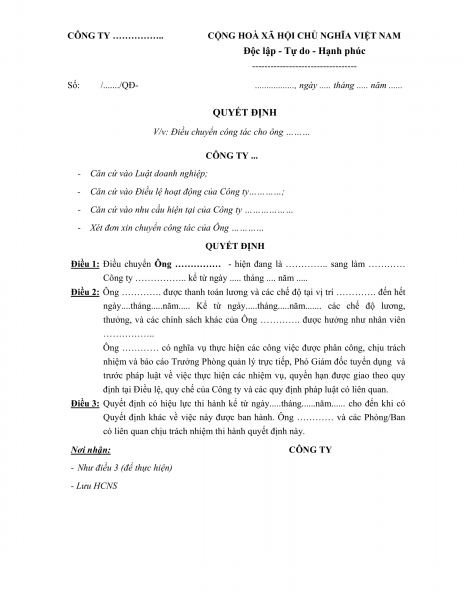
These are the four basic steps of an employee transfer, but different companies will have different ways of implementing them depending on their internal culture and the specific department. For example, in Step 3, the way the transfer decision and job handover are handled can demonstrate care for the employee and the professionalism of the staff.
In younger companies, they might add a small farewell party in Step 3. This is a good opportunity to show appreciation for the transferring employee and enhance the internal culture.

For businesses with an internal communication channel or a dedicated tool, the employee often gets a dedicated social post as a tribute and a good luck message.
Or, more meaningfully, creating a special video, like the humorous transfer clip from 1Office below.
https://www.youtube.com/watch?v=EG3n7wdpUfU
Conclusion
Internal personnel transfers are an unavoidable part of any business. The professionalism and the extent to which a company values its employees are clearly demonstrated through this process. Therefore, we hope that businesses will pay closer attention to meticulously managing these personnel transfers.
Sign up for 1Office to reduce administrative procedures at the button below