11/05/2026
  374 views
Terminating an employee is a sensitive decision that can affect a company’s reputation if not handled in accordance with the law. A well-structured employee termination process helps minimize legal risks, but not every business knows how to do it correctly. This article from 1Office will guide you through a legally compliant 4-step termination process, the necessary paperwork, and common risks for businesses to avoid.
Mục lục
1. A 4-Step Employee Termination Process to Avoid Legal Risks
To ensure the employee termination process complies with Vietnamese law, businesses must follow Clause 1, Article 70 of Decree 145/2020/ND-CP, with the handling procedure as follows:
Step 1: Record the Violation, Prepare and Send a Report

Recording the employee’s violation
Before proceeding with disciplinary action, the employer must gather sufficient evidence and notify the violating party of the disciplinary action. There are typically two scenarios:
- At the time of the violation: When an employee is found to have committed a disciplinary violation, the employer will prepare a violation report and notify the organization where the employee is a member (if the employee is under 15 years old, their legal representative must be notified).
- After the violation occurs: The employer gathers evidence to prove the employee’s fault.
Step 2: Notify and Organize a Disciplinary Hearing
Regarding the organization of the meeting: The employer organizes a disciplinary hearing. The employee subject to discipline must be notified of the meeting time at least 5 working days before the meeting date.
On the day of the meeting:
- Before the meeting begins, if any participant gives prior notice that they cannot attend, the employee and employer must agree to change the meeting time and location.
- At the scheduled meeting time, if any participant is absent, the employer will still proceed with the disciplinary hearing as normal.
Regarding the content of the meeting:
- The meeting organizer must clearly state the content, time, and location of the meeting, the full name of the person being disciplined, and the specific violation to all attendees.
- The content of the disciplinary hearing must be recorded in minutes and approved before the meeting concludes, with signatures from the attendees. If someone refuses to sign the minutes, the minute-taker must clearly state their full name and the reason for not signing (if any) in the minutes.
Step 3: Issue the Disciplinary Decision of Termination
Within the prescribed statute of limitations, the authorized person issues the disciplinary decision and sends it to the participants of the disciplinary hearing. The statute of limitations for disciplinary action is stipulated in Article 123 of the 2019 Labor Code as follows:
- The statute of limitations is 06 months from the date the violation occurred.
- For violations directly related to finance, disclosure of technological secrets, or business secrets of the employer, the statute of limitations for disciplinary action is 12 months.
- If, after the employee’s sick leave, maternity leave, or temporary detention ends, the remaining statute of limitations is less than 60 days, the employer is allowed to extend the statute of limitations by an additional 60 days.
Step 4: Finalize Salary Payment for the Terminated Employee
Pursuant to Article 48 of the 2019 Labor Code, all payments related to the interests of each party (including employee allowances and compensation to the company) must be fully paid within 14 working days.

Finalizing salary for a terminated employee
For the special cases below, the payment period may be extended but not exceeding 30 days:
- The employer is not an individual who has ceased operations;
- The employer changes its structure, technology, or for economic reasons;
- Division, separation, consolidation, merger; sale, lease, conversion of the enterprise’s form; transfer of ownership or right to use assets of the enterprise or cooperative;
- Natural disasters, fires, hostilities, or dangerous epidemics occur during the salary finalization process.
2. Documents Businesses Need to Prepare for Lawful Employee Termination
To ensure the labor contract termination process is smooth and transparent, businesses must store all related documents completely and carefully. Preparing all necessary paperwork not only protects the rights of both the employer and the employee but also significantly reduces the risk of disputes arising during the disciplinary process.
The important types of documents typically required in this case include:
- Violation report detailing the evidence leading to the employee’s dismissal.
- Notice of a disciplinary hearing for the employee.
- Minutes of the disciplinary hearing for dismissal.
- Employee termination decision.
- Labor contract of the terminated employee.
- Internal labor regulations.
- Social insurance book.
- Compensation claim file, including the compensation request form, the basis for the compensation claim, personal identification of the affected party, and any related documents and evidence for the claim (if any).
3. Potential Legal Risks and How Businesses Can Avoid Them
3.1. Common Mistakes That Lead to Unlawful Terminations Without Businesses Realizing It
During the termination process, businesses often make some basic errors that can lead to serious real-world consequences:
-
- Insufficient evidence collection: This can provide grounds for the violator to deny the violation or countersue the disciplinary decision. Therefore, the business must be extremely diligent in collecting sufficient evidence of the violation, especially when the misconduct occurred before it was discovered.
-
- Not carefully considering the subject of termination: Sometimes, employers make a hasty decision to terminate without carefully considering whether the severity of the violation warrants dismissal. This not only damages the organization’s reputation but, more seriously, the employee can sue the employer (based on the 2015 Civil Procedure Code).
- Improper notification timing and format: The law clearly specifies the time and format for notifications related to labor discipline, including organizing a disciplinary hearing. Ignoring or incorrectly implementing these requirements will invalidate the process.
3.2. Legal Consequences of Unlawful Termination
When a termination decision is deemed unlawful, the business faces consequences such as:
- Having to reinstate the employee according to the signed labor contract. This not only causes serious disruption to the personnel structure but can also set a bad precedent, weaken internal discipline, and create management difficulties.
- Compensating for damages, paying wages, social insurance, health insurance, and unemployment insurance for the days the employee was not allowed to work.
- Paying the employee an additional amount equal to 02 months’ salary under the labor contract.
- The organization’s reputation will certainly be negatively affected. Violating labor laws will become a stain on the company’s record, affecting its ability to attract talent and causing a loss of trust from partners, customers, and the public.
3.3. Preventing Legal Risks in Labor Disciplinary Actions
To minimize risks when carrying out the termination process, businesses should focus on:
- Carefully consider all factors before proceeding with employee termination: The business needs to objectively reassess whether the violation is truly serious enough to warrant dismissal. Is there sufficient evidence of the violation? Has the employee been given an opportunity to improve?
- Prepare sufficient evidence of the violation
- Strictly follow each step of the employee termination process.
- Standardize Internal Labor Regulations: Ensure the Internal Labor Regulations are clear, detailed, lawful, and easy to understand.
- Train those with termination authority: Ensure that responsible individuals (HR, department heads, etc.) have a firm grasp of labor law regulations on disciplinary actions and the correct procedures to follow.

Carefully consider all factors before proceeding with employee termination
Even with thorough preparation, the employee termination process still holds potential risks if the business lacks tools for HR management and data storage. In a context where employees are increasingly sensitive about their rights, standardizing and digitizing the process is not just a defensive tool, but also a reflection of the company’s professionalism and responsibility.
That’s why 1Office is here, accompanying businesses in building effective HR processes and management. With our Lowcode and AIplatform, we help businesses build, standardize, and apply disciplinary action processes systematically right on the system.
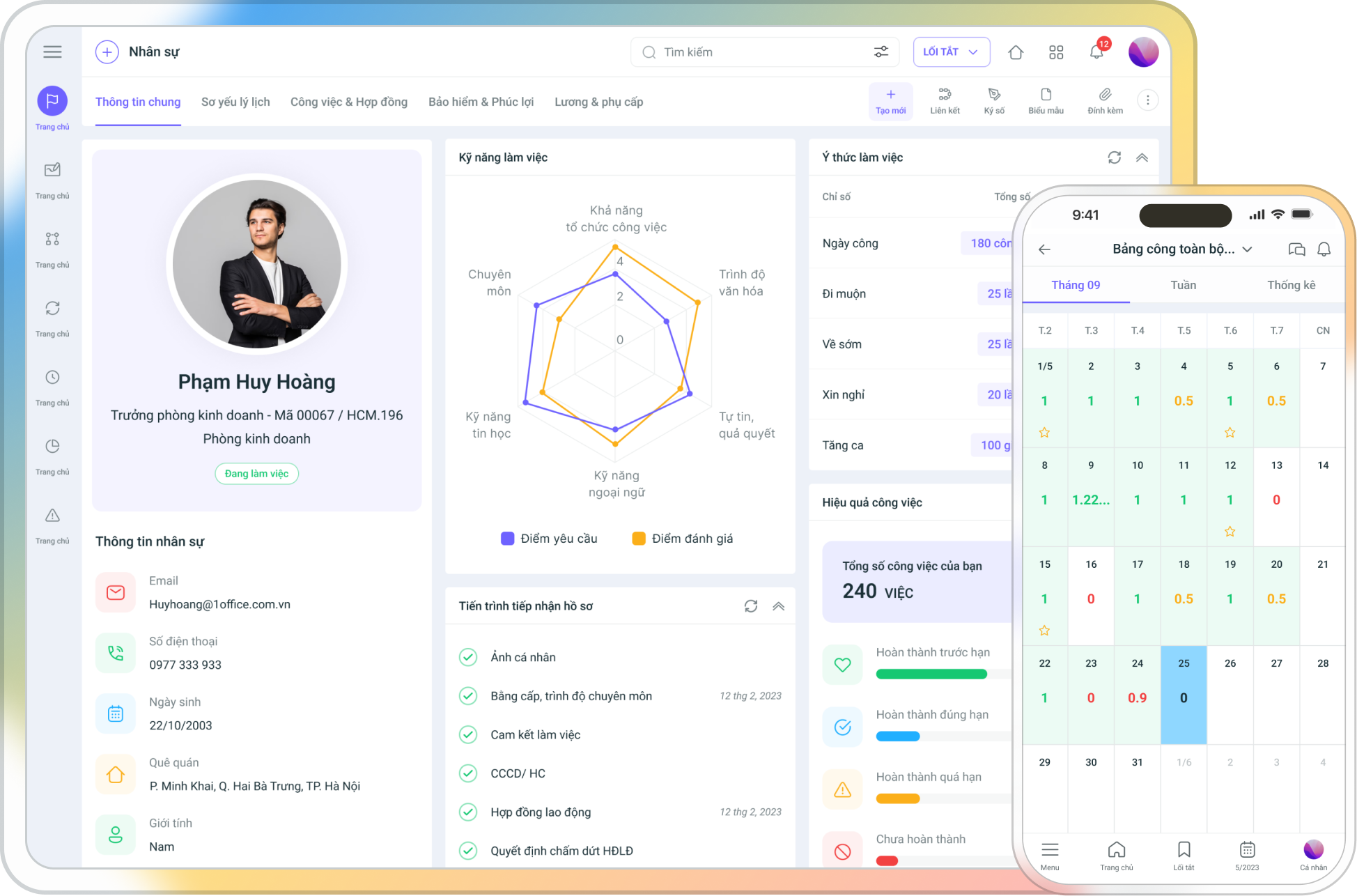
1Office helps businesses manage personnel easily
Register for a free 1Office Demo account!
1Office partners with businesses to “create” a modern HR management system – where all activities from recruitment, timekeeping, and payroll to performance evaluation are connected, automated, and optimized:
- Store all processing documents: Violation reports, meeting invitations, termination decisions, and handover records are all stored on the system, easily accessible in case of disputes.
- Centralized employee profile management: All personnel information is stored completely, including work history, evaluations, and especially the history of reminders/disciplinary actions.
- Customizable digitized processing workflows: Businesses can design, operate, and flexibly adjust the entire HR process (from onboarding and KPI evaluation to salary and bonus adjustments) with just a few drag-and-drop actions, thanks to the Lowcode platform combined with AI that provides optimal suggestions.
- Automated employee behavior & performance tracking: 1Office automates the data collection process from timekeeping, KPI, and task systems… to update work progress, measure performance, and create a foundation for transparent evaluation – instead of relying on managerial intuition.
- Clear access permissions: The role-based permission system ensures that only authorized personnel can view, edit, or approve HR-related decisions, enhancing security and minimizing the risk of internal information leaks.
- Link with employee KPI/OKR for periodic evaluation.
We hope the information in this 1Office article has helped you clearly understand the legally compliant employee termination process, enabling you to proactively build a transparent and rigorous disciplinary system. And to ensure every step is consistent and secure, platforms like 1Office will be a companion tool to help businesses enhance their HR management capabilities professionally and effectively.