


 09/05/2026
  153 views
A Memorandum of Agreement (also known as an agreement record) is a document that formally records the consensus between two or more parties on specific contents and terms regarding a particular issue. This is an important document that helps to clearly define the rights, obligations, and responsibilities of the participating parties, while also serving as legal evidence in the event of future disputes.
Unlike a standard contract (which is typically more tightly binding, detailed, and comprehensive), a memorandum of agreement is often used in more flexible, less complex situations, or simply to record the results of negotiations, temporary agreements, or to supplement or adjust specific contents. However, when properly drafted and signed by all parties, a memorandum of agreement still holds legal validity equivalent to a civil transaction as stipulated by the Civil Code of Vietnam.
Simply put: If a contract is the “private law” between parties, then a memorandum of agreement is the official “record of understanding” after a discussion, ensuring that no one can “forget” or “misunderstand” what was committed.
Mục lục
- 1. What is a Memorandum of Agreement?
- 1.6. Cases Where a Memorandum of Agreement May Be Invalidated
- 1.7. When to Use a Memorandum of Agreement Instead of a Contract?
- 2. Differentiating Between a Memorandum of Agreement and a Contract: When to Use Which?
- 2.1. Detailed Comparison of a Memorandum of Agreement and a Contract
- 2.2. Difference in Nature: Intent and Purpose of Establishment
- 2.3. Difference in Document Formality
- 2.4. Difference in Binding Content and Scope of Regulation
- 2.5. Difference in Legal Validity and Sueability
- 2.6. Specific Cases: When to Use a Memorandum of Agreement vs. When a Contract is Mandatory
- 3. General Structure of a Standard Memorandum of Agreement
1. What is a Memorandum of Agreement?
In legal practice in Vietnam, a memorandum of agreement is a very common type of document used in many fields such as civil, labor, business-commercial, and internal corporate governance. However, because it is not specifically defined in a separate legal document, many individuals and businesses still do not fully understand its nature, legal validity, and scope of application.
Understanding and using a memorandum of agreement correctly not only helps to record the consensus between parties but also plays a crucial role in preventing disputes and protecting legal rights and interests in the future.
1.1. The Concept of a Memorandum of Agreement in Vietnamese Legal Practice
Currently, Vietnamese law does not have a specific clause that provides an official definition of a “memorandum of agreement.” However, based on its legal nature and practical application, a memorandum of agreement is understood as:
A document that records the consensus between two or more parties on one or more specific issues arising during a transaction, work process, or the resolution of related rights and obligations.
A memorandum of agreement is formed based on the principles of:
- Freedom of commitment and agreement
- Voluntariness
- Equality between parties
- Not contrary to law and social ethics
Under this interpretation, a memorandum of agreement can be considered a form of written civil transaction if its content clearly expresses the rights and obligations of the parties.
Confusion between a memorandum of agreement and other legal documents is quite common. Below are the key distinctions.
1.2.1. Memorandum of Agreement vs. Contract
- Contract: A legal document aimed at establishing, changing, or terminating civil rights and obligations between parties, with high binding force.
- Memorandum of Agreement: Usually records consensus on a specific issue, which can be a precursor, supplement, or adjustment to a contract.
In many cases, a memorandum of agreement can have a value equivalent to a contract if it meets all the conditions regarding subjects, content, and form.
1.2.2. Memorandum of Agreement vs. Meeting Minutes
- Meeting Minutes: Primarily record the proceedings and opinions exchanged during a working session, meeting, or dialogue.
- Memorandum of Agreement: Emphasizes the final result, which is the consensus and commitment to implement.
Meeting minutes are generally not legally binding, whereas a memorandum of agreement can give rise to an obligation to perform.
1.2.3. Memorandum of Agreement vs. Memorandum of Understanding (MOU)
- Memorandum of Understanding (MOU): Serves as a guideline for cooperation, expressing the goodwill between parties.
- Memorandum of Agreement: Is usually more specific, with clearer commitments and a higher potential for being binding.
1.3. The Purpose of Creating a Memorandum of Agreement
A memorandum of agreement is created to serve various purposes in practice:
- To accurately record the content agreed upon by the parties
- To avoid disputes, misunderstandings, or denial of responsibility
- To serve as a basis for implementing work or fulfilling obligations
- To act as evidence in case of a dispute
In many cases, a memorandum of agreement is used as a more flexible and quicker solution compared to signing a formal contract.
1.4. The Role of a Memorandum of Agreement in Practice
1.4.1. In Civil Relations
A memorandum of agreement is often used to:
- Agree on the division of assets
- Agree on a resolution plan for civil disputes
- Record agreements on loans, compensation, or payments
1.4.2. In Labor Relations
A memorandum of agreement plays an important role in:
- Agreeing to terminate a labor contract
- Adjusting salary, bonuses, and benefits
- Resolving disputes between employees and employers
1.4.3. In Business and Commercial Activities
In business, a memorandum of agreement is often used to:
- Agree on a cooperation plan
- Adjust the progress or scope of work
- Record agreements on liquidation or debt reconciliation
1.4.4. In Internal Corporate Governance
A memorandum of agreement is also used for:
- Assigning responsibilities among departments
- Agreeing on capital contributions or internal transfers
- Resolving conflicts between shareholders or members
1.5. Legal Validity of a Memorandum of Agreement
1.5.1. Does a Memorandum of Agreement Have Legal Validity?
A memorandum of agreement has legal validity if:
- The parties have full legal capacity and capacity for civil acts
- The content of the agreement does not violate legal prohibitions
- It is not contrary to social ethics
- The signing is completely voluntary
In this case, the memorandum of agreement is considered a lawful civil transaction and can be used as a basis for resolving disputes.
1.5.2. Comparing the Legal Validity of a Memorandum of Agreement and a Contract
| Criteria | Memorandum of Agreement | Contract |
| Purpose | To record mutual agreement | To establish a legal relationship |
| Scope | Usually narrow, specific | Comprehensive |
| Binding Level | Depends on the content | High |
| Enforceability | Conditional | Very high |
1.5.3. Conditions for a Memorandum of Agreement to be Legally Valid
A valid memorandum of agreement must ensure:
- Parties: The right people with the right authority
- Content: Clear, specific, and not contrary to law
- Form: In writing, with signatures
- Intent: Voluntary, not under duress
1.6. Cases Where a Memorandum of Agreement May Be Invalidated
Although widely used in practice, not all memoranda of agreement are legally valid. If the drafting and signing do not comply with the principles of civil law, the memorandum of agreement may be declared wholly or partially invalid, meaning the parties’ interests will not be protected by law as intended.
In reality, many disputes arise not because the parties lack an agreement, but because the memorandum of agreement was drafted incorrectly from the start, making the document legally insufficient. Below are common cases where a memorandum of agreement risks being invalidated.
Common Cases
- Content violates the law or prohibited regulations
A memorandum of agreement will be invalid if its content:- Contradicts current laws and regulations
- Infringes upon the legal rights and interests of a third party
- Is contrary to social ethics
- Example: agreements to evade taxes, unlawfully terminate employees, or transfer assets that do not meet legal requirements.
- The signatory lacks legal authority
This is a very common error in businesses. A memorandum of agreement can be invalidated if:- The signatory is not the legal representative
- There is no valid power of attorney
- The signature exceeds the scope of authorization
- In this case, even if the content of the agreement is reasonable, the document may still not be legally recognized.
- The memorandum of agreement was signed under duress or deception
If one party can prove that the signing:- Was not based on voluntary intent
- Was due to threats, coercion, or deception regarding the content
- then the memorandum of agreement may be declared invalid under civil law.
- Lacks basic information of the participating parties
Some memoranda of agreement are written in general terms, lacking important information such as:- Full name, ID card number, or business registration number
- Address, contact information
- The signing capacity of the parties
- This lack of information makes it difficult for dispute resolution bodies to accurately identify the parties, thereby reducing or completely nullifying the legal validity of the document.
Important note: A memorandum of agreement not only needs a “signature” but must also involve the right people, the right content, the right authority, and the right legal context.
1.7. When to Use a Memorandum of Agreement Instead of a Contract?
In many real-world situations, signing a full contract can be time-consuming and procedural, while the parties only need to quickly record a consensus or handle a specific issue. In such cases, a memorandum of agreement becomes a more flexible and effective solution, if used for the right purpose.
However, a memorandum of agreement cannot always replace a contract. The choice of document depends on the nature, scope, and binding level of the agreement.
Cases where a memorandum of agreement is preferred
- Need to quickly record a consensus between parties
When the parties have reached an agreement but:- Have not yet drafted a formal contract
- Need immediate confirmation as a basis for implementing work
- then a memorandum of agreement helps to “frame” the agreed-upon content, reducing the risk of future changes of mind.
- The agreement’s content is temporary or short-term
A memorandum of agreement is suitable for agreements that:- Apply for a short period
- May change as practical conditions change
- Do not require long-term legal binding
- To amend or supplement a previously signed contract
During the execution of a contract, the parties may encounter:- Changes in schedule
- Adjustments to the scope of work
- Agreement on how to handle a new issue
- In this case, the memorandum of agreement acts as a supplementary document, recording the consensus without needing to re-sign the entire contract.
- To resolve specific issues or minor disputes
For situations that require quick resolution, such as:- Debt reconciliation
- Compensation agreements
- Agreeing on a plan to terminate cooperation
A memorandum of agreement is a streamlined legal tool that saves time and costs for the parties involved.
2. Differentiating Between a Memorandum of Agreement and a Contract: When to Use Which?
In practice, many individuals and businesses use a memorandum of agreement instead of a contract, believing the two documents are “equivalent.” This is an incomplete understanding that carries many legal risks if applied in the wrong context.
Although both are based on the principle of freedom of contract, a memorandum of agreement and a contract differ significantly in their nature, purpose, level of binding, and ability to protect rights in a dispute. Choosing the wrong type of document can lead to the agreement not being recognized or lacking sufficient grounds for a lawsuit.
2.1. Detailed Comparison of a Memorandum of Agreement and a Contract
The table below helps you clearly see the differences systematically and makes it easy to apply in practice.
| Criteria | Memorandum of Agreement | Contract |
| Nature | Records the consensus on one or more specific issues | Establishes, modifies, or terminates a legal relationship |
| Purpose | Records intentions, resolves arising issues | Binds comprehensive rights and obligations |
| Form | Usually a simple document | A tightly structured document with a complete format |
| Content | Narrow scope, focuses on a single issue | Covers the entire relationship between the parties |
| Binding Level | Depends on the content of the agreement | High legal binding |
| Ability to Sue | Conditional | Clear, favorable |
| Sanctions | Usually not detailed | Specifies penalties and compensation |
2.2. Difference in Nature: Intent and Purpose of Establishment
A contract is created to establish a full and long-term legal relationship, in which the parties have anticipated the rights, obligations, risks, and penalties for violations. The intent of the parties when signing a contract is to commit to performance and bear legal responsibility.
Meanwhile, a memorandum of agreement typically serves to:
- Record the results of a discussion
- Agree on a resolution plan
- Adjust or supplement a specific content
In other words, a contract is about “establishing a relationship,” while a memorandum of agreement is about “resolving an issue.”
2.3. Difference in Document Formality
In principle, both can be created in writing; however, the level of requirement is very different.
- A contract typically:
- Has a strict structure
- Includes full clauses on rights, obligations, penalties for violations, and dispute resolution
- Some types of contracts require notarization or authentication (e.g., real estate sales)
- A memorandum of agreement:
- Can be simpler
- Does not require notarization, unless stipulated by law
- Focuses on the content agreed upon at the time of creation
Using a memorandum of agreement for transactions that legally require a contract may result in the document not being recognized in a dispute.
2.4. Difference in Binding Content and Scope of Regulation
A contract typically stipulates:
- The scope of work or transaction
- Detailed rights and obligations of each party
- Term, value, and payment method
- Penalties for violations and compensation for damages
Meanwhile, a memorandum of agreement typically:
- Only addresses one or a few specific points
- Rarely has clear penalty clauses
- Relies heavily on the good faith of the parties for implementation
This is why a memorandum of agreement should not be used for high-value or high-risk transactions.
2.5. Difference in Legal Validity and Sueability
Legally:
- A contract is a solid basis for a lawsuit when one party violates it
- A memorandum of agreement is only grounds for a lawsuit if:
- The content clearly states rights and obligations
- It contains complete information about the parties
- It does not violate the law
In legal practice, courts often prioritize the validity of a contract. A memorandum of agreement is only considered supplementary evidence or an independent civil transaction if it meets the necessary conditions.
2.6. Specific Cases: When to Use a Memorandum of Agreement vs. When a Contract is Mandatory
Choosing the right type of document helps minimize risks and save on future legal costs.
A memorandum of agreement should be used when:
- Needing to quickly record a temporary agreement
- Adjusting or supplementing a clause in a signed contract
- Agreeing on a resolution for a minor dispute
- Recording work results, reconciliations, or partial liquidations
A contract is mandatory or should be used when:
- The transaction has a high value
- The legal relationship is long-term
- There are high-risk factors
- The law requires a contract
- Needing to clearly define penalties, fines for violations, and compensation
3. General Structure of a Standard Memorandum of Agreement
A memorandum of agreement is only truly valid when drafted with the correct structure, includes all necessary components, and clearly expresses the committed intent of the parties. In reality, many memoranda of agreement are deemed invalid or difficult to use in disputes, not because the content is wrong, but because they lack a standard structure or are not presented according to legal conventions.
Essentially, a standard memorandum of agreement should be structured into 5 main parts: introduction – information of the parties – content of the agreement – general provisions – signing and confirmation. Each part has its own legal role and should not be omitted arbitrarily.
3.1. Introduction of the Memorandum of Agreement
The introduction is the basis for establishing the legitimacy and context of the memorandum. This part is often overlooked but is very important when considering legal validity.
This section typically includes:
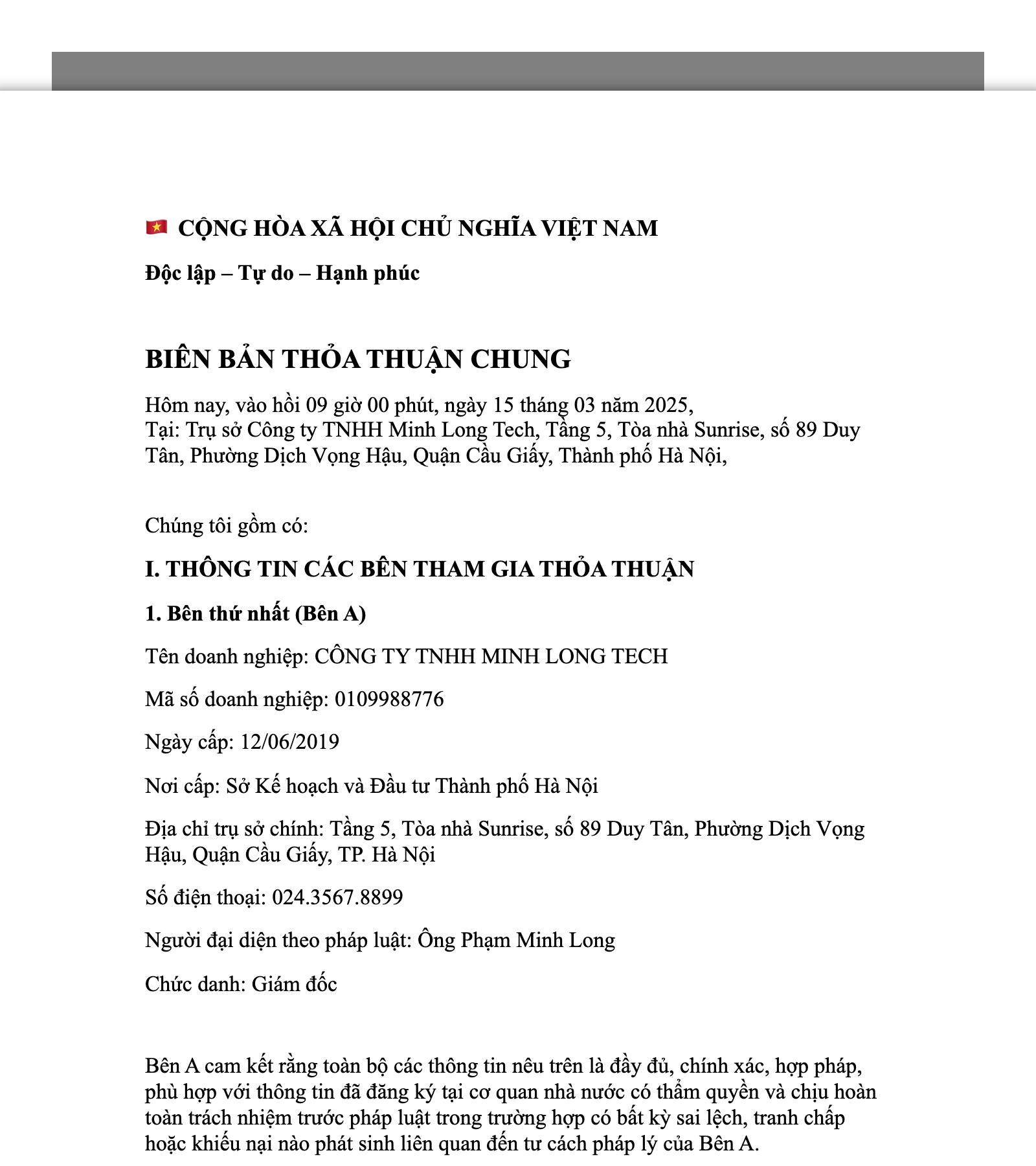
- National Emblem – Motto – Document Title
Clearly stating “SOCIALIST REPUBLIC OF VIETNAM – Independence – Freedom – Happiness” helps the document conform to standard administrative and legal formats.
The document title should be clearly stated as: MEMORANDUM OF AGREEMENT or MEMORANDUM OF AGREEMENT ON… to correctly identify the nature of the document. - Place and time of creation
Clearly stating the date, month, year, and place of creation helps to:- Determine the effective date
- The full legal information of the participating parties
- The subject of the agreement (work, assets, rights, obligations, etc.)
- The basis for the agreement (previous contract, actual needs, existing disputes, etc.)
- What is this memorandum for?
- What issue needs to be agreed upon and recorded?
- After signing, what specific actions do the parties need to take?
- Keep the content of the memorandum focused
- Avoid redundant or unnecessary clauses
- Easily prove the parties’ intentions in case of a dispute
- Direct and easy to understand
- Avoid vague or emotional expressions
- Do not use ambiguous
<liUsing the correct memorandum of agreement template is just the first step. For the document to be truly valid and to mitigate legal risks, the drafter must understand how to write it with the correct procedure, focus, and legal language. In reality, many memoranda of agreement are invalidated or difficult to enforce not because of a lack of a template, but because they are written incorrectly or too emotionally.
Below is a standard 5-step process applicable to most types of memoranda of agreement in civil, labor, and business matters.
5.1. Step 1: Prepare Information Before Drafting
Before starting to draft, preparing complete information is a decisive factor for the accuracy and legal validity of the memorandum of agreement. Missing or inaccurate information can render the entire document unusable when a dispute arises.
The drafter needs to review and clearly confirm:
Thorough preparation from the beginning helps avoid repeated revisions and limits serious errors later on.
5.2. Step 2: Clearly Define the Purpose of the Memorandum of Agreement
Each memorandum of agreement should serve only one main purpose, avoiding the inclusion of too much content, which can make the document confusing and difficult to implement.
Before drafting, clearly answer the following questions:
Clearly defining the purpose helps to:
5.3. Step 3: Draft the Content of the Memorandum of Agreement
This is the most crucial step, directly determining the clarity and enforceability of the memorandum of agreement.
5.3.1. Use Clear and Coherent Language
The language in the memorandum of agreement should be:
















