


 12/05/2026
  62 views
Customer information management is an essential activity for every business, not only helping to maintain good customer relationships but also enhancing the effectiveness of nurturing sales opportunities and boosting revenue growth. However, many businesses struggle with building or standardizing their customer information management systems, leading to negative impacts on sales and missed business opportunities. Let’s explore common mistakes and the Top 7+ methods for standardizing your customer information management system with 1Office in the article below.
Mục lục
- The importance of a customer information management system
- Classifying customer information to collect and manage
- Common mistakes in customer information management
- Standard process for storing and managing customer information
- 7+ Ways to Optimize Your Customer Information Management System
- Standardize the data entry process
- Link and manage data centrally on one platform
- Apply advanced data analysis technology
- Periodically check and clean data
- Enhance information security
- Train and raise employee awareness
- Personalize the information management system
- Use 1CRM customer information management software
The importance of a customer information management system
Managing customer information is not just about storing data; it also involves various aspects such as analyzing, predicting needs, and delivering the best service to customers.

Enhance customer care and connection
With the ability to store and retrieve all customer data, including transaction history, feedback, and personal information, the system allows the customer care team to better understand the needs and issues of each individual. This not only helps businesses personalize the consultation experience for customers but also allows customers to feel valued and professionally served.
Additionally, customer requests or complaints are closely monitored, ensuring no case is overlooked or delayed. This is the foundation for businesses to build credibility and enhance the overall customer experience, while also helping to retain them amidst increasingly fierce market competition.
Build potential customer profiles
All customer information is consolidated on a single system. Therefore, this information not only helps businesses gain a deeper understanding of market needs but also supports the accurate and effective classification and segmentation of customer files.
Based on the customer profiles built, businesses can adjust their marketing strategies and product development to suit each segment. For example, advertising campaigns can be personalized or more clearly targeted, thereby increasing conversion rates. Furthermore, this information is also a valuable resource for businesses to predict consumer trends and improve future business decisions.
Optimize future sales opportunities
A customer information management system provides businesses with a comprehensive picture of the sales cycle, from recording potential opportunities to tracking the progress and results of each one. Through detailed analysis and reporting, businesses can easily identify the factors influencing customers’ purchasing decisions, thereby adjusting their sales strategies for greater effectiveness. This not only helps improve the closing rate but also minimizes the risk of losing sales opportunities due to a lack of information or poor management.
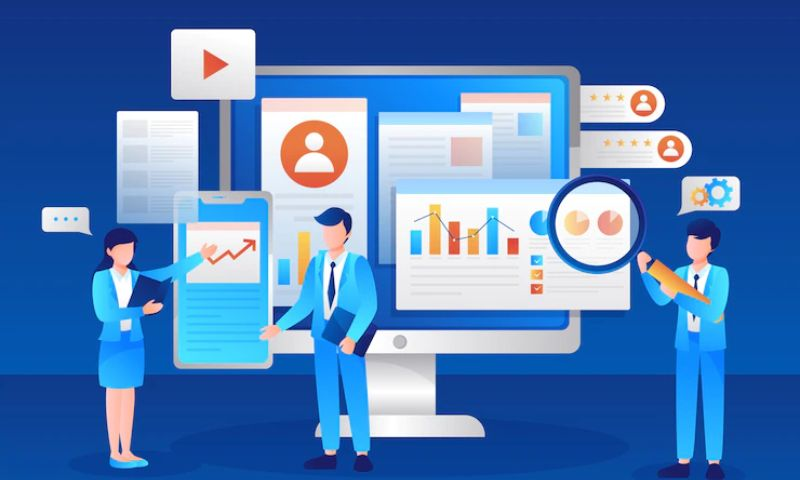
Additionally, the system also assists businesses in forecasting future demand trends, helping them better prepare resources and strategies. Businesses can identify peak periods or products with strong growth potential. Consequently, marketing and sales plans can be developed proactively and accurately, creating a sustainable competitive advantage in the market.
Classifying customer information to collect and manage
Customer information management goes beyond just storing names, addresses, or phone numbers. There are many different types of information that businesses need to pay attention to.
Demographic information
For individual customers, the information includes:
- Contact name: Helps identify the customer and personalize communication.
- Age: To analyze consumer trends by age group.
- Location: Residential address to manage marketing areas.
- Interests: To understand preferences for personalizing marketing campaigns.
- Education: To assess the customer’s educational level.
- Income level: Used to classify customers by spending capacity.
- Field/Job industry: To better understand the customer’s industry and market.
For business customers, in addition to the personal information mentioned above, businesses need to store the following information:
- Company name: Helps identify the business and personalize communication.
- Field/Industry: To better understand the business’s field of operation.
- Company size: To assess the size of the business.
Basic contact information
- Phone number: A direct and quick method of communication.
- Email: For sending notifications and promotions.
- Address: For delivering goods and sending mail, contracts.
- Communication method: Preferred way to contact the customer (phone, email, mail, etc.).
Customer care history
- Assigned employee: To identify the personnel responsible for consulting and managing customer care
- Care process notes: Helps managers control and track specific actions in a customer consulting/care cycle
- Products/services of interest or purchased: To know which products are popular.
- Special promotions/discounts: To track discount programs the business applies for the customer.
- Previous purchase history (if any): Includes time & frequency of purchases, helping the business analyze items and purchasing intervals.
Feedback information
- Survey results before, during, and after purchase: To assess satisfaction and better understand the strengths and areas for improvement in the product/service.
- Complaints: Record and handle complaints to improve service.
- Feedback questions: To answer inquiries and enhance the customer experience.
Common mistakes in customer information management

Fragmented data, scattered in many places
In many businesses, customer data is often stored in various sources such as emails, Excel files, or separate systems. This situation mainly stems from the lack of a centralized management solution or a lack of synchronization between departments in data entry and management.
When information is fragmented, businesses cannot get a complete picture of the customer, leading to incorrect decision-making or missed business opportunities. In the long run, this reduces operational efficiency, making it difficult for businesses to maintain a competitive edge against competitors who have undergone digital transformation and use centralized management systems.
Updating information with incorrect format/classification
Data entry with incorrect formats, misclassification, or inconsistencies is a common problem in many businesses. The main cause is often the lack of clear data entry standards or inadequate employee training on how to update customer information.
As a result, businesses easily face errors when analyzing data, making reports inaccurate and reducing the quality of business strategies. If not corrected, these errors will accumulate over time, eroding departments’ trust in the data and wasting resources on constant review and correction.
Not updating data continuously (real-time)
One of the biggest mistakes is not ensuring customer data is updated in real-time. This situation often occurs when businesses still use manual management methods or do not invest in automation systems. Failure to update data promptly causes businesses to react slowly to changes or requests from customers.
For example, promotional or customer care programs may be targeted at the wrong audience, damaging the brand’s reputation. In a fiercely competitive business environment, the ability to access information quickly is the key to maintaining customer satisfaction and loyalty.
Neglecting to build and optimize the security system
Many businesses, especially small and medium-sized ones, often overlook investing in a customer data security system. This is partly due to the high cost of security investments or a lack of full awareness of the potential risks from attacks or data loss. However, a single security incident can have serious consequences, from losing customer trust to legal and financial damages. In the context of increasingly strict data protection regulations, neglecting security will put the business at long-term risk, affecting its sustainable development.
Standard process for storing and managing customer information
Step 1: Collect and perform raw processing of customer information
Businesses need to implement effective information collection channels such as website registration forms, surveys, or point-of-sale (POS) systems. The initially collected data is often raw, unverified, or unstandardized. Therefore, raw processing is necessary to eliminate invalid, duplicate, or unnecessary information.
During this stage, applying automation tools will help speed up processing and minimize errors. At the same time, businesses must ensure that all collection activities are transparent and comply with personal data protection regulations.
Step 2: Classify and store data
After being cleaned, customer information needs to be organized and stored scientifically. Businesses should classify data according to criteria such as age, needs, shopping behavior, or geographical area, making it easy to search and manage information. CRM systems or cloud platforms are the top choices for storing data centrally and securely.
This is not just a step for storing information but also the foundation for ensuring data is ready to serve business activities. To achieve high efficiency, businesses need to continuously review and standardize storage protocols, while also integrating data from various departments to ensure consistency.
Step 3: Analyze and process customer information
In this step, businesses will use analytical tools and techniques to transform raw data into useful information, such as identifying potential customer personas or predicting market trends.
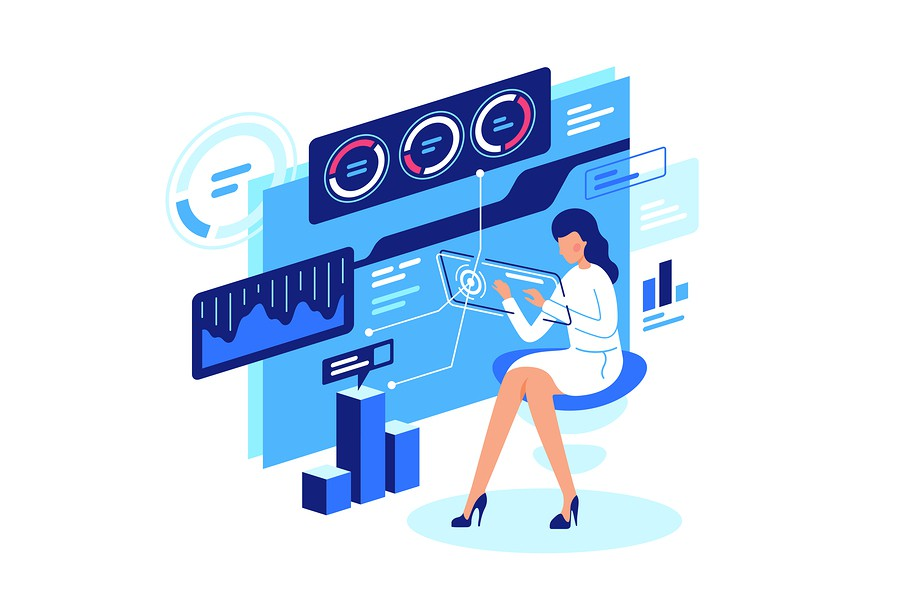
The ability to analyze accurately helps businesses not only understand customers better but also optimize their business strategies. An important note is that the analyzed information must have depth, accurately reflecting the real needs and behaviors of customers, rather than just stopping at surface-level metrics.
Step 4: Apply information to business operations
Once useful information is available, businesses need to quickly incorporate it into practical strategies. For example, businesses can personalize marketing campaigns, optimize customer care processes, or improve products based on feedback. This is how to turn information into a real competitive advantage in the market.
An element that cannot be overlooked in this stage is measuring the effectiveness of the applied strategies. This not only helps businesses optimize future strategies but also creates a continuous improvement loop to serve customers better and better.
Step 5: Update and secure information
Customer data needs to be updated regularly to ensure accuracy and promptly reflect market changes. In addition, information security is a mandatory requirement in the context of increasing cybersecurity threats.
Businesses should establish periodic processes to review and refresh data. At the same time, investing in robust security solutions such as data encryption or security monitoring systems is extremely necessary. A good security system not only protects information but also strengthens customer trust in the business.
7+ Ways to Optimize Your Customer Information Management System
Standardize the data entry process
One of the fundamental ways to optimize a customer information management system is to establish unified data entry standards. This includes clearly defining necessary data fields, formats (phone number, email, address), and mandatory rules for data entry. This process helps minimize errors and duplication, ensuring data is always clean and easy to analyze and retrieve. Additionally, businesses should train employees on the importance of accurate data entry and use automation support tools to reduce manual work.
Link and manage data centrally on one platform

An effective customer information management system needs to be centrally integrated, connecting data from departments such as marketing, sales, and customer service. This integration not only helps synchronize information but also makes it easier for departments to coordinate in analyzing and using data.
Using modern CRM software capable of integrating with other platforms (email, social media, ERP) is an optimal approach. This helps eliminate data fragmentation and enhances the ability to manage and exploit information.
Apply advanced data analysis technology
To maximize the value of customer data, businesses need to use modern data analysis tools like AI, machine learning, or big data. These technologies help businesses detect trends, build detailed customer personas, and predict future consumer behavior. By applying advanced data analysis, businesses not only improve their decision-making capabilities but also enhance their ability to personalize services, thereby improving the customer experience.
Periodically check and clean data
Customer data can become outdated or inaccurate if not checked and cleaned periodically. Businesses need to establish a data review process, including removing duplicate information, filling in missing data, and updating changes from customers. The habit of regularly checking data not only ensures accuracy but also helps the system run smoothly, providing better support for business strategies.
Enhance information security

In the context of increasing cybersecurity risks, data security is a critical factor that cannot be overlooked. Businesses need to implement security solutions such as data encryption, firewalls, access control management systems, and periodic data backups.
Additionally, it is necessary to comply with international data protection standards like GDPR to ensure legality and build trust with customers. A strong security system not only protects the business but also enhances brand reputation.
Train and raise employee awareness
An effective customer information management system needs to be operated by a team of employees with good skills and data awareness. Businesses should organize regular training programs, guide employees on using the management software, and emphasize the importance of data in serving customers. Well-trained employees will help minimize errors in the data entry and processing workflow, ensuring the system operates efficiently and optimally.
Personalize the information management system
Each business has its own unique characteristics and business goals, so the customer information management system needs to be customized to fit specific needs. This may include adding specific data fields, designing specialized reports, or integrating features suitable for the industry. Personalization not only helps the system operate more flexibly but also optimizes the use of information in making strategic decisions.
Use 1CRM customer information management software
CRM (Customer Relationship Management) software is a tool that helps businesses automate the process of collecting, storing, and analyzing customer data in a centralized and efficient manner. Features such as managing transaction history, tracking interactions, and personalizing customer care help enhance connection effectiveness and increase customer satisfaction. When selecting and implementing CRM software, businesses need to consider its ability to integrate with other systems like ERP or sales platforms. Additionally, customizing the CRM to fit industry specifics and business strategies will help maximize the tool’s potential, bringing practical value to the business.
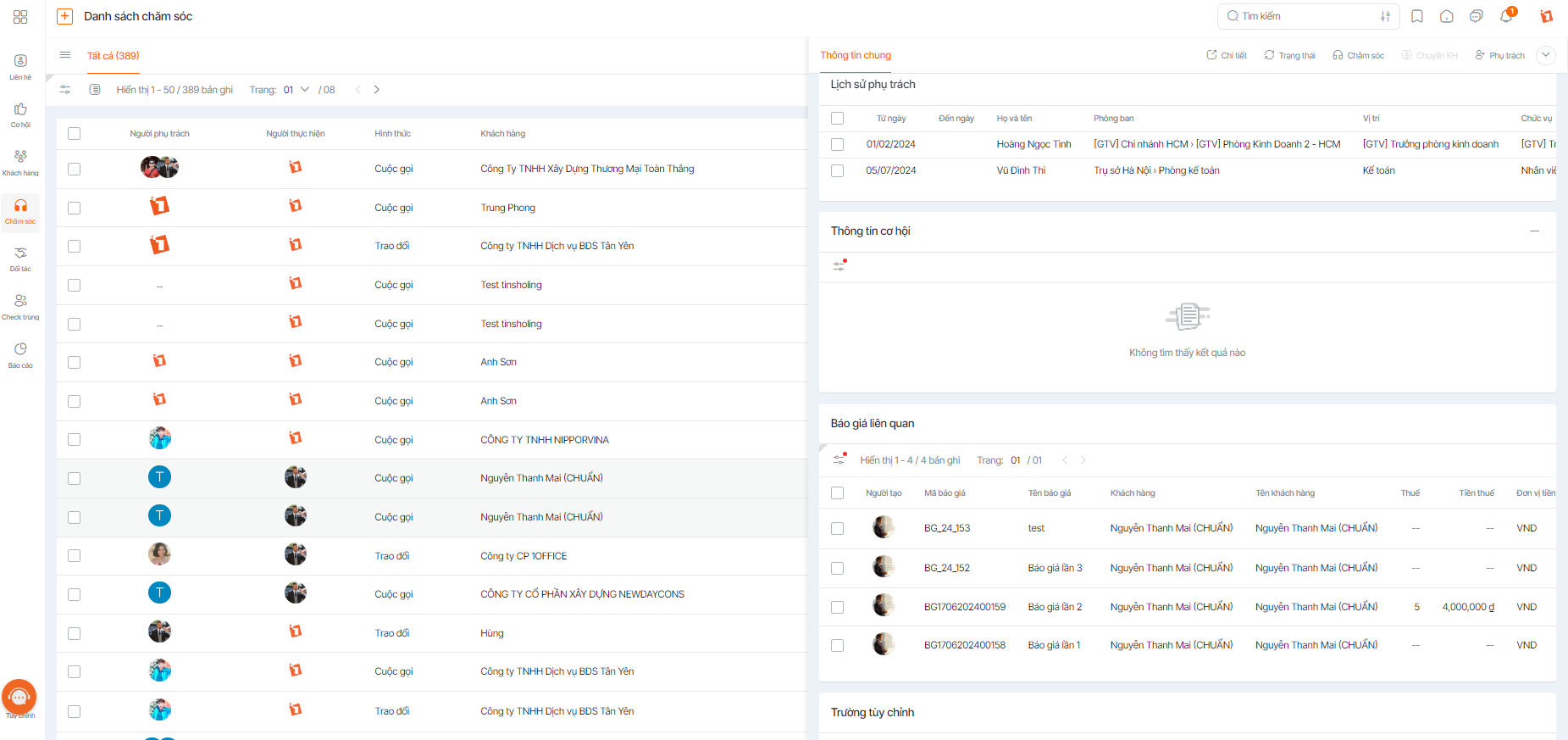
When it comes to the best customer information management software available today, it’s impossible not to mention 1CRM – The comprehensive toolkit for managing business operations and customer care from 1Office. 1CRM meets all the management and customer care needs and challenges of businesses of all sizes, in every business sector, including:
- Customer data management: Manage potential customer lists, track sources and statuses to help evaluate conversion rates
- Customer care: Assign responsible personnel, track care history, and evaluate customer care KPIs for employees
- Business opportunity management: Build sales pipelines, manage opportunities, and track revenue forecasts
In addition, 1CRM also possesses all the necessary features, helping businesses immediately have a comprehensive information management and customer care system with unlimited integration, upgrade, and expansion capabilities:
- Supports performing direct care activities on the software, such as sending Email Marketing, making calls, or sending SMS messages to customers.
- Allows scheduling care and sending notifications to customers, while also supporting customization of various automatic alerts like care alerts, birthday reminders, etc.
- Tracks care history, purchases, transactions, feedback, and previous customer interactions with the business.
- Integrates a call synchronization feature, helping to save call history and interactions with customers.
- Supports setting up automated care, helping to optimize the customer care process and enhance interaction.
Sign up for a free 1CRM trial!
———————————
Optimizing the information management system not only helps businesses improve work efficiency but also enhances customer relationships. We hope the information in this article will be helpful for your business in optimizing your customer information management system and, from there, developing plans and strategies to improve your customer care process in the future. We wish you success!
















