13/05/2026
  426 views
B2B Sales has been changing dramatically in recent years. Previously, B2B selling was much easier because sellers could predict customer behavior. But in today’s era, B2B customers have changed a lot with different buying habits and characteristics.
Instead of relying too heavily on suppliers as before, today’s B2B customers tend to do their own research, look for the most suitable options… before making a final decision. Therefore, they tend to have higher expectations for your solution. If you can’t solve their problems and provide the value they desire, they will surely turn their backs on you.

In this article, we provide the B2B Sales Handbook to help you better understand today’s B2B landscape as well as a comprehensive sales method to help you get closer to customers, increase potential customers, and boost sales and revenue.
Mục lục
I. What is B2B Sales?
B2B Sales (business-to-business) refers to transactions between two businesses. In its most basic form, one company or business sells a product/service to another business. A common example of B2B sales is a technology company selling management software to other companies. You can learn more about the What is B2B Sales profession here.
II. The difference between B2B and B2C Sales
In B2C sales, a business sells a product/service directly to consumers, who will then use that good or service. For example, a clothing store sells products directly to consumers for them to wear.
Here are some notable differences between B2B and B2C Sales:
– More decision-makers are involved: Unlike B2C sales, where the seller only has to convince one person to buy their product, B2B sellers must deal with multiple stakeholders from various departments before they can close a sale. The number of parties involved in a B2B purchase is increasing. According to a Harvard Business Review report, the average number of people involved in a typical B2B sale increased from 5.4 in 2015 to 6.8 in 2017.
– Larger transaction values: While a B2C seller might sell one product to a single end-user, businesses often buy in bulk, purchasing multiple units at a much higher price.
– Longer sales cycles: There is no impulse buying in B2B sales. With more parties involved, higher price points, and more touchpoints, it takes longer to close a deal. According to a report by CSO Insights, nearly half (46.4%) of B2B sales to new customers take more than 7 months to complete.
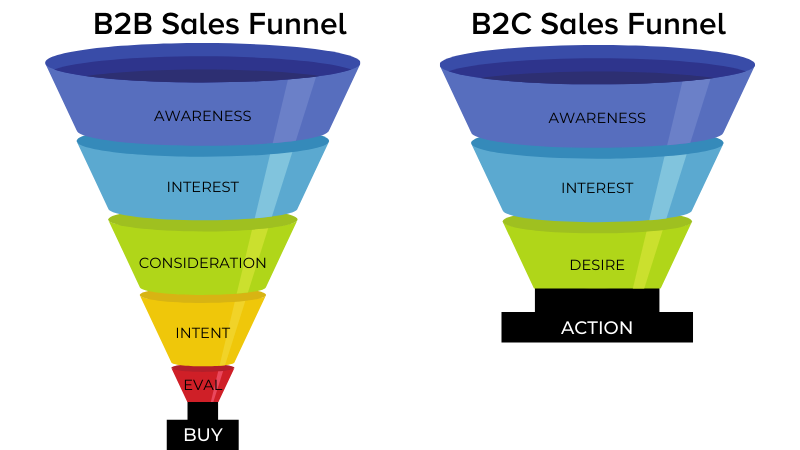
– More flexible pricing: Generally, B2C consumers accept the fixed price that is offered. But in B2B sales with larger transaction values, the pricing strategy is different. Customers always want to negotiate the price before deciding to purchase.
– More complex payment process: For B2C sales, consumers usually pay immediately upon purchasing goods/services. B2B customers will pay after receiving the product and an invoice is issued.
Although the B2B sales steps are much more complex than B2C sales, there are still certain similarities between them. To become a good salesperson, you still need to find potential customers, make contact, directly present the product/service to the customer, and successfully close the deal.
III. How has B2B Sales changed?
In the past, B2B selling was much easier. Customers were willing to buy if the supplier could offer a suitable option for their needs at an affordable price.
But today, the B2B Sales model is changing more and more dramatically. So what has caused such a transformation? Below are 4 main reasons for the change in the B2B sales cycle.
The younger generation is changing consumer behavior
They are the generation that grew up with technology and has access to a vast amount of knowledge, so their demands for products/services are also stricter. Most of them do not want to rely on salespeople and prefer to do everything themselves, from identifying problems to finding solutions…
The number of parties involved in the B2B buying process
Typically, about ten people are involved in a buying group, but nowadays, businesses no longer rigidly limit the number of participants. Among them, 64% of C-level executives have the final say, while about 80% of non-C-level individuals also influence the purchasing decision. The length of the B2B sales cycle has also increased by 22% over the past 5 years.
B2B customers can research the technical aspects of a product
Statistics show that even in industrial and manufacturing sectors, 67% of transactions are influenced by digital. B2B buyers conduct an average of 12 online searches before contacting a supplier’s website.

Repetitive buying cycles
Meanwhile, 90% of today’s B2B buyers repeat at least one or more tasks in their buying journey. In summary, customer buying behavior has changed significantly and is difficult to predict.
IV. 5 Mistakes to Avoid in B2B Sales
Here are 5 common mistakes in B2B sales that businesses should avoid to acquire more customers.
1. Focusing only on selling instead of building relationships
Customer relationships are built before any product/service is sold to the customer. The most effective way to sell B2B is… not to sell. Let customers feel they have the power to choose rather than being forced to buy a certain product/service. The best way to persuade a customer to buy is to point out the problems they are facing and offer a solution that can solve those problems.
2. Focusing only on product features and benefits
Customers today are no longer overly concerned with the features and benefits of the products/services a company offers. They only care about the final results they will get. Overemphasizing and “hyping up” the product will inadvertently push customers further away.
3. Offering only one proposal to the customer
Moving to the proposal stage means you are close to closing the deal with the customer. And you need to remember that customers always prefer to have choices, rather than being “forced” to choose. Therefore, rigidly offering a single proposal can hinder your deal-closing process if that proposal does not satisfy the customer.
4. Rushing the customer
After every B2B sales meeting, what you should do is confirm: What are the next steps for both parties after today’s meeting? However, you should also give them time to consider your subsequent offers; don’t rush the customer for an immediate answer.
Always try to understand what makes the customer hesitate and be ready to respond to the obstacles that are giving them pause.
5. Promotions and discounts
Offering promotions and discounts is good, but it’s not the best solution, especially in B2B sales. The “perfect” customer is one who will care about and value what you provide, more than the price. Discounting can sometimes attract the wrong target audience and significantly diminish your value in the customer’s eyes. Therefore, focus more on the solution you provide and the value you bring.
V. Tips for Successful B2B Sales
Here are 4 sales tips to improve your B2B customer approach while ensuring a mutually satisfactory transaction.
Tip 1: Use Customer Relationship Management (CRM) software
You can use Customer Relationship Management (CRM) software to manage and track potential customers and build better relationships throughout the sales process.
1Office is one of the effective CRM solutions for businesses that helps store and leverage data, offers high security, and is suitable for businesses of all sizes. The software records the history of customer interactions, helping to report on customer status and effectively evaluate the performance of each employee.
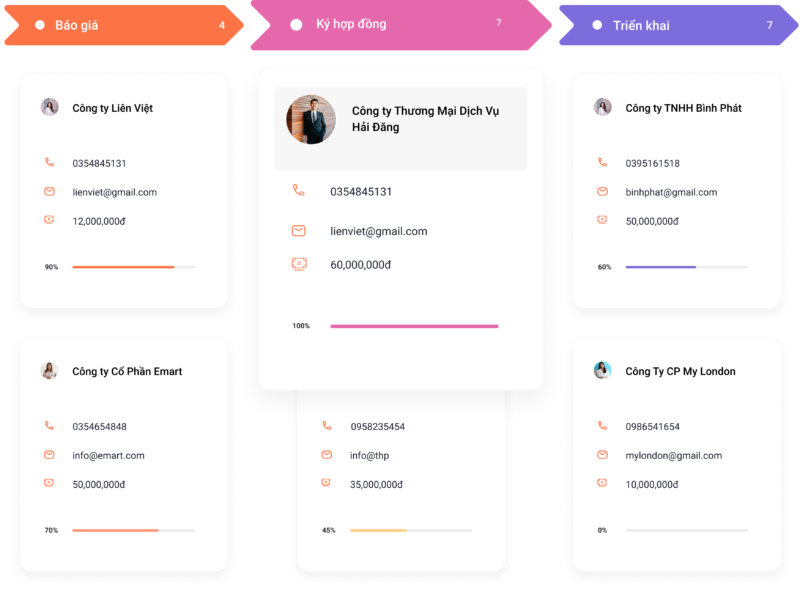
CRM customer management software meets comprehensive customer care needs—Before, During, and After the sale—thanks to these useful features:
- Build automated multi-channel customer care scripts,
- Set up a Pipeline-style sales process,
- Support for checking duplicate customer information
- Distribute customers to each salesperson according to various scenarios.
Read more: CRM for small and medium enterprises
Tip 2: Focus on solution-based selling
Ask customers in-depth questions to clarify the problems and difficulties their business is facing.
What are the company’s goals?
What would they do if they had more resources or time?
What difficulties is the company facing?
Tip 3: Apply methods to stimulate purchasing
The salesperson needs to use their expertise and understanding to introduce the best solution to the customer, incorporating up-selling in sales tactics.
Present at least 3 proposals to the customer, including a low-priced option, a slightly more expensive option, and a premium option. Using this strategy sets the stage for each choice and often encourages the buyer to move to the higher-end option. As a result, the customer will spend more, and the seller’s revenue will also be higher.
Read more: Up sale Cross sale
Tip 4: Understand that B2B sales is a long journey
Efforts to build and maintain good customer relationships do more than just help businesses build trust. A repeat customer who already knows and trusts your brand is likely to contribute more to your business’s long-term success than a new customer.
To do this, pay more attention to their business operations and needs by thoroughly researching the customer and organizing specific meetings for discussion and exchange between parties.
Conclusion
Regardless of the sales method or skill used, the ultimate goal of B2B Sales is always to increase quality potential customers and long-term value. That is why you need to provide long-term solutions that fit the customer’s needs and leverage the right technology to support the B2B sales process most effectively.
To experience the leading modern and professional CRM software, click the “Register for a trial” button below or call 0834 838888 to have 1Office experts discuss and provide the fastest support.
For more detailed information, please visit:
Fanpage: https://www.facebook.com/1officevn/
Youtube: https://www.youtube.com/channel/UCeTIRNqxaTwk0_kcTw6SxmA