


BPM (Business Process Management) – The “Secret Weapon” for Businesses in the Digital Age


Business Process Management (BPM) is one of the most challenging questions in business. Each company has a different organization and different personnel, leading to different work operation cycles and project management methods. BPM emerged as a “magic wand” to help manage processes and solve the daily problems of time, cost, etc., that arise in a business.
Mục lục
1. What is BPM (Business Process Management)?
What is BPM? According to the standard definition on bpm.com, BPM (Business Process Management) is a concept that refers to the combination of modeling – automating – executing – controlling – measuring – optimizing business workflows, supporting the key goals and outcomes of a company.
To understand it better, let’s look at the structure of a business. Whether large, small, or medium-sized, state-owned or private, a business will have a pyramid structure: at the top are the leadership, CEO, and directors. Below them are departments and department staff. For small businesses, it goes directly to units with interrelated tasks. All are tightly linked in relationships that support and drive the company’s growth. This is where BPM comes in, with the role of helping leaders manage the company’s overall processes.
BPM starts with the leader’s mindset in business management. The mindset is that instead of manual, paper-based management or traditional management through word-of-mouth and direct communication, BPM converts processes into a digitized format with digital data for easy management and tracking of work progress. It helps improve work performance and manage the progress, time, and quality of each individual and department within a process. Moreover, a key highlight of BPM that business leaders can see is its ability to track individuals in detail throughout their work process. From the combination of departments in a business, such as the front-end including sales and customer care, to the backend (administration – human resources, marketing, IT, etc.). Every task appears in BPM, allowing leaders to thoroughly understand the workflow of each department, which projects are ongoing or upcoming, what tasks are backlogged, and which issues need to be addressed.
For these reasons, BPM is like a “treasure” for businesses—everything is consolidated in a standardized, scientifically digitized, specific, and automated format. Every aspect of work, such as who does what, time, progress, and cost, is considered to simplify cumbersome processes. If a business process consists of a series of small tasks, then with BPM, by modeling these operations, we can easily identify certain tasks that can be eliminated or automated. This will help the business save time and costs while still achieving high efficiency.
2. BPM – A Story from the Past to the Present
To be successful, a business must keep up with the trends of the times, but to be a leader, that business must be the one creating trends or pioneering in its field. Digital transformation is not a story confined to a few hours of seminars or a few books, and neither is BPM. What is the connection between digital transformation and BPM? When you approach digital transformation, you develop the mindset to approach BPM.
The history of Business Process Management is parallel and closely linked to the history of digital transformation. Economists and foreign businesses were the first to approach BPM. A new management mindset was mentioned in Frederick Taylor’s “The Principles of Scientific Management” in the late 18th and early 19th centuries: “the process is hidden within the work process when manual details are concealed.” Later, economists developed this into the idea that “a process can be manually reconstructed within the same scope of operation as before.”
Although this could only be described on paper and there was no basis for practice yet, it shows that people of the last century recognized the importance of managing work scientifically quite early on (remember that at that time, computer networks and computers did not yet exist to optimize work).
Until the mid-20th century, the emergence of computers and the Internet brought a breath of fresh air to business. It directly related to how business organizations were managed and operated—contributing to either accelerating the development or eliminating businesses from the market in the following years. The Internet and computers allowed companies and managers to create and optimize business processes quickly.
The role of the Internet and computers in business management in general, and business process management in particular, is undeniable. Outstanding advantages include: synchronized data connection helping to manage the entire business anytime, anywhere; on a digital platform, large volumes of documents are stored and are easy to search and use by anyone, anywhere; and the digitization and operation of all business processes on a single platform.
3. What are the steps in the Business Process Management (BPM) cycle?
Learning about Business Process Management in an enterprise is already a progressive mindset in the market; however, to actually get started, business leaders and CEOs need to understand the BPM cycle.
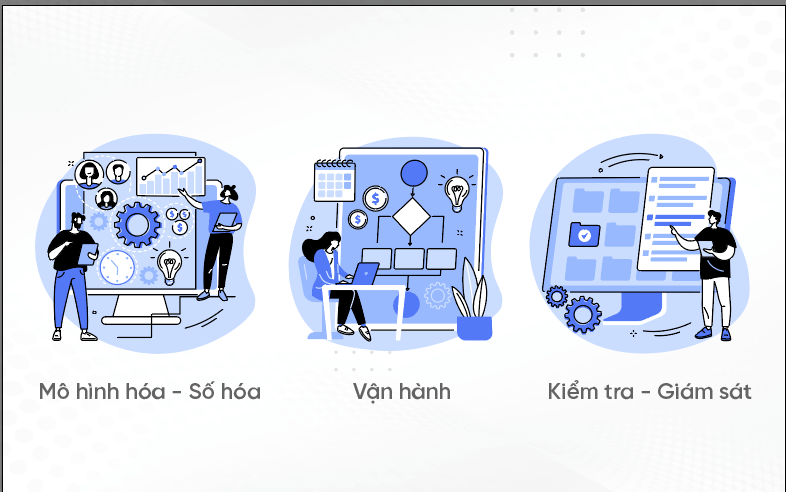
- Modeling: Understanding the problems that need to be addressed in your business, the challenges you are facing, and the work of various departments is the initial premise for the next step of automation. Analyze which tasks have repetitive, time-consuming steps and which tasks require a leaner workforce. From there, design paper-based, manual business processes into electronic ones.
- Digitization: At this stage, electronic processes corresponding to different business operations will be assigned to the production and business management model. The optimization of BPM allows for the reuse of old processes and the combination of many small processes into one large process. The automation model minimizes redundant tasks, information search time, and manual steps, thereby limiting errors. Even documents are stored scientifically and are easily searchable as needed.
- Execution: The execution phase is the time for action—operating the business towards optimizing productivity and efficiency. With BPM, managers can control the progress of work: how far along it is, the volume of work being done, which parts are delayed, and who is responsible.
- Monitoring: After the execution period, monitoring is necessary to manage the scope of the process, who is responsible, and whether issues have been resolved.
- Measurement and Optimization: Measure to determine the pace of progress (fast or slow), assess whether the process efficiency is suitable for the business, and answer the question of whether the business has optimized productivity and processes. Is this model suitable, or does it need improvement?
For example, when a business wants to manage its operations on a unified platform, the leader will first gather all information about their company. From there, they model the business—determining what steps are needed to complete a task with the desired outcome, who participates in each step, their purpose for participating, how much time is needed for each step, and what forms, documents, and conditions are required.
That is modeling. Then, when recreating it on software for automatic assignment and tracking across multiple processes, they will identify emerging issues to make adjustments, review arising situations, and find solutions. The final step is to measure and optimize the process.
4. Benefits of using BPM in a business

The first benefit that everyone can see is increased productivity. In a project that requires many different operations, BPM limits redundant or inefficient tasks, reducing wasted work time. Instead of spending time manually counting papers or searching for paper documents, users can easily search with simple operations. They can also see who is executing a process, who is managing it, how far along it has progressed, and how long the project has been running.
Repetitive, time-consuming tasks are also automated—this is a significant improvement in reducing redundant manpower. Those involved in the project can focus their time and intellect on more important work. As a result, the business will reduce project management and operational costs.
Finally, with the accuracy of an automated system and the flexibility of interconnected links in the workflow (this process leads to that process, this task leads to that task), BPM’s ability to closely oversee work in terms of completion status, incompletion, and error location helps to minimize risks and mistakes in the process.
The technological revolution is entering a phase of strong development, and businesses must constantly change to survive, and only then can they grow. If they are slow to adapt, businesses will certainly be eliminated from the market. Therefore, automating and optimizing business processes through Business Process Management is a competitive advantage in business. Investing in a comprehensive BPM enterprise management software is something that should be done immediately in this era to keep up with the digital age and operate the business scientifically and flexibly.




