10/05/2026
  164 views
Choosing a specialized HRM software for the tourism industry is a key technology solution to automate and optimize the entire operational process. The tourism industry is a unique service sector that is heavily dependent on the quality of its personnel, has high volatility, and a frequently mobile workforce. Let’s join 1Office for a detailed review of the top 7 HRM solutions for travel companies.
Mục lục
1. Review of 7 highly-rated HRM software for the tourism industry
Human Resource Management (HRM) software is a technology solution that helps automate and optimize the entire HR management process. It is especially important for the tourism industry due to its labor-intensive nature and the complexity of its services. Below are 7 outstanding solutions designed to address these challenges.
Comparison Overview
| Software | Suitable Scale | Key Features | Advantages for the Tourism Industry |
| 1HRM | All scales |
|
|
| VnResource HRM Pro | Medium and large, corporations |
|
|
| BambooHR | Small and medium (25–300 employees) 13 |
|
|
| 1Base HRM+ | All scales |
|
|
| Zoho People | Small and medium, startups, multinational companies |
|
|
| Fast HRM | Small and medium (SMEs) |
|
|
| Sage HR (CakeHR) | Small and medium (SMBs) |
|
|
1.1. 1HRM
1Office is not just a standalone HRM software but a comprehensive business management platform that allows travel companies to solve all operational challenges on a single system. With the unique characteristics of the tourism industry, 1Office provides specialized solutions, especially the application of AI and in-depth project (tour) management capabilities.
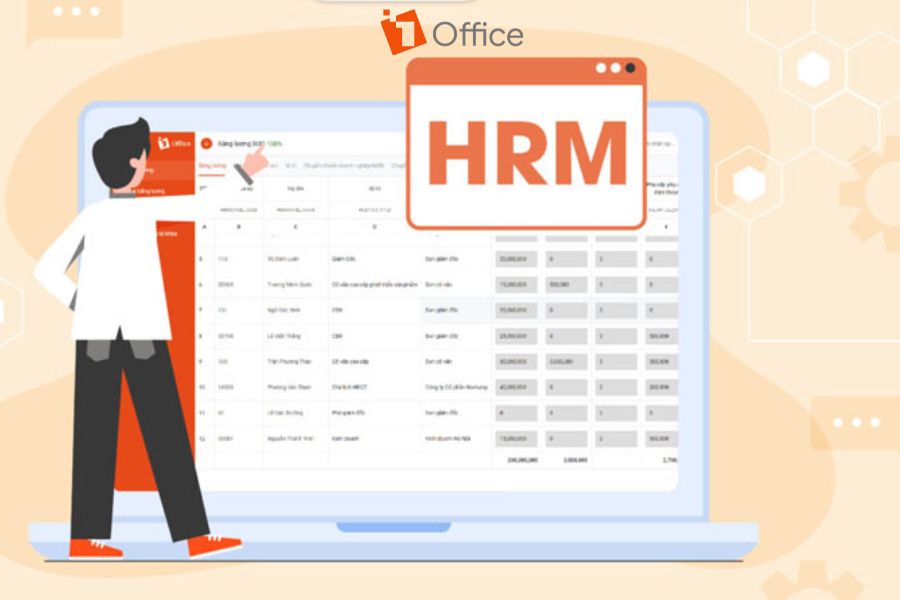
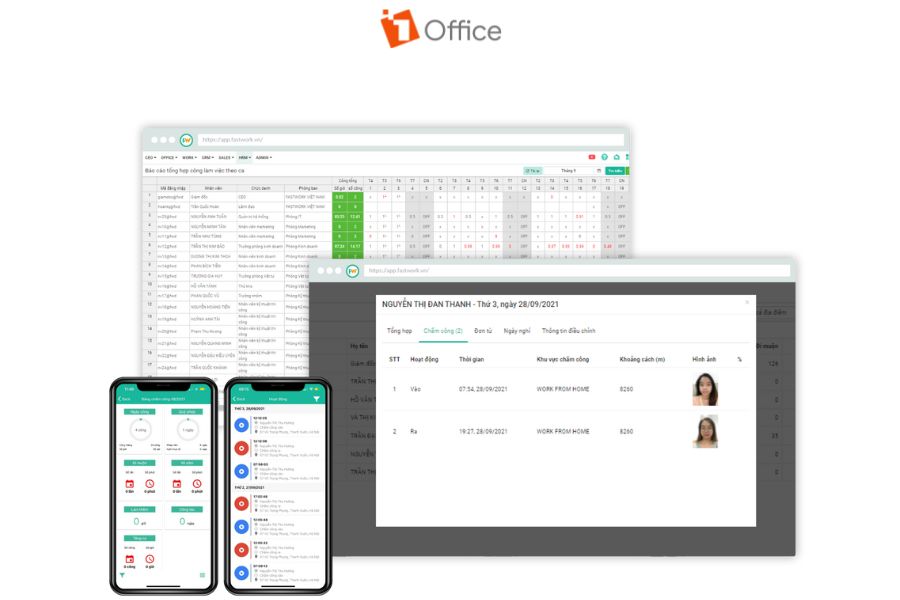
- Solves the mobile timekeeping challenge: The tourism industry has a team of tour guides and tour operators who are constantly on the move. 1HRM completely solves this problem by supporting all timekeeping methods, especially timekeeping via phone (GPS, WiFi). Timekeeping data is aggregated in real-time, helping HR and managers monitor closely without waiting until the end of the month.
- Solves the payroll calculation challenge: 1HRM supports various payroll calculation methods, including: Daily wage, project-based pay (paid per project/tour), and sales-based pay (commission, revenue, KPI). The system allows setting up flexible payroll formulas like Excel and automatically inherits data from timekeeping and KPIs to calculate salaries, completely minimizing manual errors.
- Solves the recruitment challenge: The tourism industry has a high employee turnover rate, requiring continuous recruitment. The Recruitment module of the 1HRM tool integrates AI to automatically screen CVs. The AI will analyze candidate profiles (for tour guide, tour operator positions…), assess skills, and recommend the most suitable profiles, helping HR save time and find the right people.
- Solves the training & onboarding challenge: 1HRM integrates a Learning Management System (LMS), allowing businesses to build online training courses. The system also automatically suggests courses based on competency assessment results.
1.2. BambooHR
BambooHR is a well-known international solution, suitable for small and medium-sized tourism enterprises (SMEs), with an ideal scale of 25 to 300 employees.
Key features:
- Highly rated for its intuitive, easy-to-use interface, which facilitates quick implementation and training.
- Provides optimal solutions for key operations such as recruitment, timekeeping, employee record tracking, and performance analysis.
- Easy to set up and integrate with other tools.
However, BambooHR does not have a built-in payroll feature. This is a major limitation for the tourism industry, which needs to handle complex salaries/commissions.
1.3. VnResource HRM Pro
VnResource HRM Pro is a professional and comprehensive human resource management solution, designed for medium-sized businesses and large corporations in Vietnam, with deep industry-specific customization capabilities.
Key features:
- The system allows for building flexible salary formulas for each department (part-time, full-time, collaborator) and handles complex salary types such as per-tour pay, KPI-based salary, and 3P salary.
- Effectively solves the timekeeping challenge for tour guides and mobile employees via GPS and Wi-Fi.
- Ensures that HR, insurance, and tax processes strictly comply with Vietnamese legal regulations, which is crucial when managing various types of contracts (seasonal, collaborator).
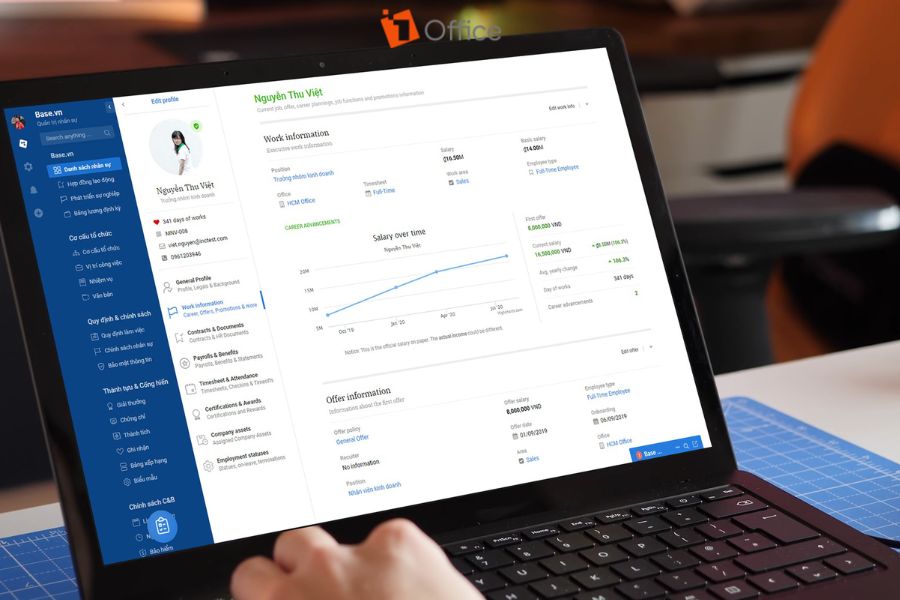
1.4. 1Base HRM+
Base HRM+ is a comprehensive human resource management software that provides an ecosystem of solutions to manage the entire employee lifecycle.
Key features:
- Offers multiple individual HR applications (Recruitment, Timekeeping, Payroll…). Tourism businesses can start with the most essential modules (like Timekeeping, Payroll) and expand later.
- Designed with a focus on user experience, making it easy for employees to perform tasks on the mobile app.
- Supports KPI/OKR management tools, suitable for tracking the performance of the tour sales team.
1.5. Zoho People
Zoho People is a cloud-based HRMS (Human Resource Management System) that is lightweight, user-friendly, and optimized for small and medium-sized enterprises (SMEs).
Key features:
- Suitable for startups or small-scale travel companies that want to implement quickly with low initial costs.
- Provides a mobile app for basic tasks like timekeeping and viewing information, helping to manage mobile teams.
- Offers good support for time management, timekeeping, and leave tracking.
Limitations: Requires users to be proficient in English, and deep customization for Vietnam’s complex payroll operations may be limited.
1.6. Fast HRM
Fast HRM is a popular human resource management software in Vietnam, focusing on optimizing basic HR processes, making it well-suited for small and medium-sized enterprises (SMEs).
Key features:
- A good choice for small travel companies and ticket agencies with limited budgets.
- Effectively meets the needs for managing employee records, timekeeping (integrates with time clocks), and basic payroll.
Limitations: It may be challenging if the business requires advanced features such as GPS time tracking, flexible KPI/commission management, or training management (LMS).
1.7. Sage HR (CakeHR)
Sage HR (formerly CakeHR) is a cloud-based HRM solution aimed at small and medium-sized businesses (SMBs).
Key features:
- Very strong in managing work schedules and leave approval processes, suitable for the tourism industry with its non-fixed work schedules.
- Supports modern management methods like OKRs and KPIs, suitable for evaluating sales and operations teams.
- Provides an employee self-service portal (for leave requests, viewing schedules, etc.), helping to reduce the administrative workload for the HR department.
2. Specific Human Resource Management Challenges in the Tourism Industry
The tourism industry is a service sector characterized by high labor intensity and very high employee turnover. Consequently, managing human resources in this industry is particularly complex, with three major challenges:
2.1. Difficulties in Recruiting and Retaining Employees
This is a primary challenge. The service industry requires employees to have excellent customer interaction skills, quick problem-solving abilities, and the capacity to work in a high-pressure environment. Finding and attracting employees with the right professional skills is a major challenge.
Alongside this is the difficulty in retaining employees. The high turnover rate in the industry makes it easy for employees to switch to other jobs if they are dissatisfied with their salary, benefits, or work environment.
2.2. Complexity in Timekeeping Management
Regarding timekeeping, tourism businesses have two distinct types of personnel with completely different work characteristics: Tour guides, who frequently lead tours, travel for work, and work at non-fixed locations. Then there are the back-office staff who work in the office on a fixed schedule. This creates significant difficulties in standardizing timekeeping data and monitoring remote work hours.
2.3. Challenges in Payroll Calculation
Regarding payroll, this complexity can easily lead to errors and internal conflicts. For example:
- Sales department: Salary includes commissions per tour, bonuses for exceeding KPIs, and spot bonuses.
- Tour guides: Salary is calculated hourly, with KPI-based pay per tour, tour-related allowances, and spot bonuses.
- Part-time/seasonal tour guides: Have their own salary regulations and are only paid when they lead a tour.
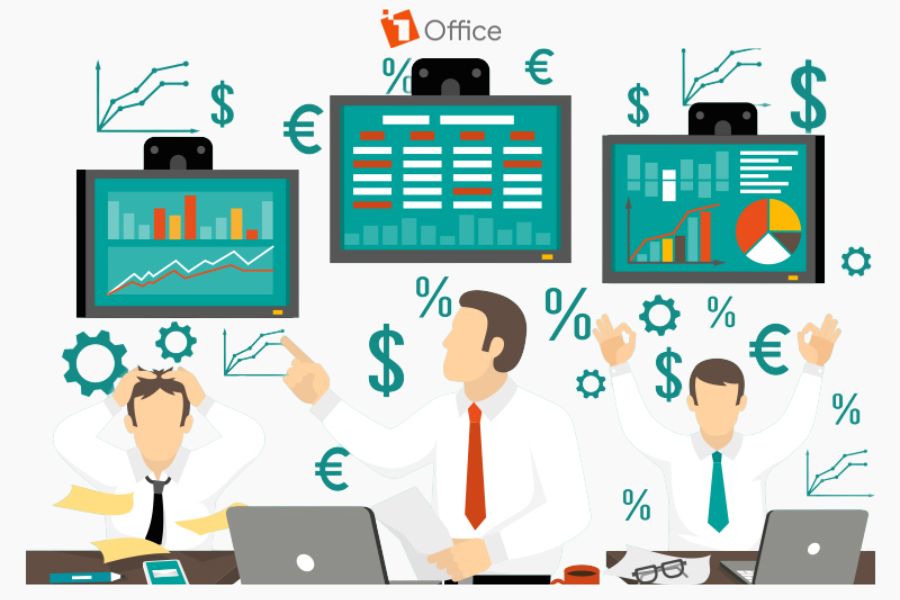
2.4. Passive and Unsynchronized Data Management
The service industry requires a dynamic work environment, but passive management makes it difficult for employees to feel motivated and supported. Especially for medium to large enterprises with thousands of records, managing information manually with paper documents or separate Excel files is inefficient. It leads to a series of problems such as taking up office space, incurring storage costs, making it extremely difficult to retrieve and search for information when needed, and a high risk of losing important records.

3. Core Features Needed in HRM Software for the Tourism Industry
To address the three challenges above, HRM software for the tourism industry must be equipped with specialized features that help organizations manage human resources effectively and automate processes from recruitment, timekeeping, and payroll to training.
3.1. Diverse Timekeeping Methods and Mobile Management
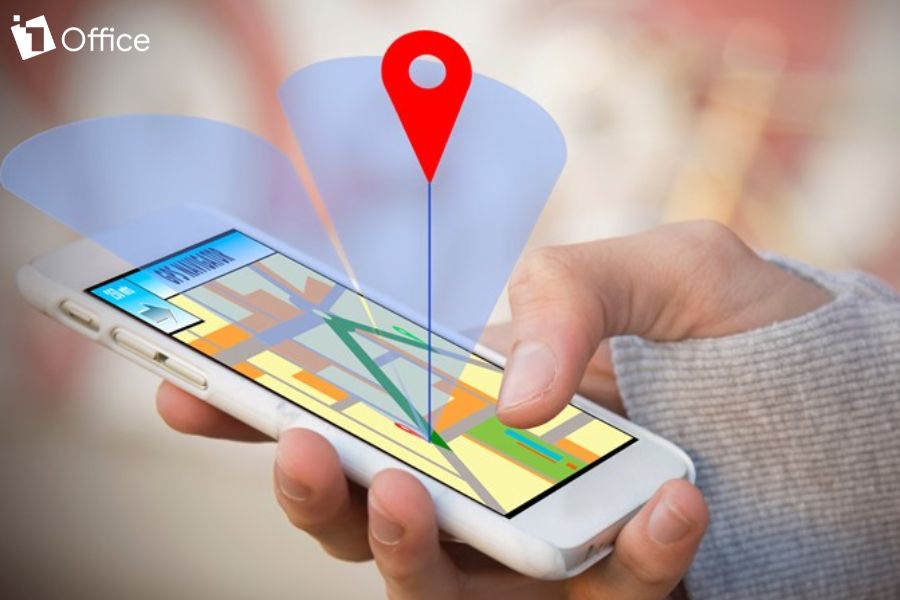
This is a mandatory requirement. The software must support automatic tracking of employee time and attendance. It needs to integrate with traditional time clocks at the office (fingerprint, Face ID, card swipe).
Most importantly, the GPS timekeeping feature is essential for employees who frequently travel for business or lead tours. All timekeeping data from multiple sources (time clocks, GPS app) must be automatically transferred to a single, unified platform. This helps the HR department reduce time spent on organizing and auditing, and minimizes data discrepancies.
The system also needs a mobile application or a portal for employees to easily request leave, register for overtime, and monitor their working hours.
3.2. Flexible Payroll Module Tailored to Industry Specifics
To address complex salary and bonus calculations, the software must help the HR department flexibly create different salary formulas for each department or employee level (part-time, full-time, collaborator).
It must be able to automatically calculate complex salary components such as tour-based pay, KPI-based salary, 3P salary, spot bonuses, and various tour-related allowances. At the same time, the system must automatically calculate and deduct taxes and social insurance in compliance with Vietnamese labor laws.
3.3. Automated Recruitment and Training
To cope with high employee turnover rates, the recruitment and training processes must be automated. For recruitment, the software should streamline the process by automating tasks such as posting jobs, receiving and reviewing applications, scheduling interviews, and screening candidate information.
For training, the system should improve the onboarding process by automating paperwork, setting up new accounts, and assigning online training courses (E-learning), while also tracking the learning progress of new employees.
3.4. Centralized Database
Instead of Excel files and paper filing cabinets, HRM software for the tourism industry must provide a centralized database to store and manage all HR-related information. This allows the HR department to easily access employee data (including performance reviews, attendance records, and personal information) anytime, anywhere, leading to more effective data management and analysis.

3.5. Self-Service
An important feature to reduce administrative workload and enhance the employee experience is self-service. The software should provide a portal or a mobile app.
Through these, employees can proactively track their attendance, salary, and personal profile information. They can also easily perform procedures such as requesting leave, registering for overtime, or submitting business trip requests directly on the system.
4. How to Choose the Right HR Management Software for a Tourism Company
When selecting HRM software, tourism businesses need to focus on the following criteria to ensure the system provides maximum support for their service operations.
4.1. Suitability for Industry Specifics and Business Scale
The first criterion is that the software must be flexible and customizable to fit the specific characteristics of the tourism service industry. These characteristics include flexible timekeeping (GPS) and the ability to set up complex salary formulas (tour-based/KPI-based pay).
Additionally, it’s necessary to consider the software’s scalability to ensure the system can still meet demands as the workforce grows in the future without needing a complete replacement.
4.2. Flexible HR Operations Management
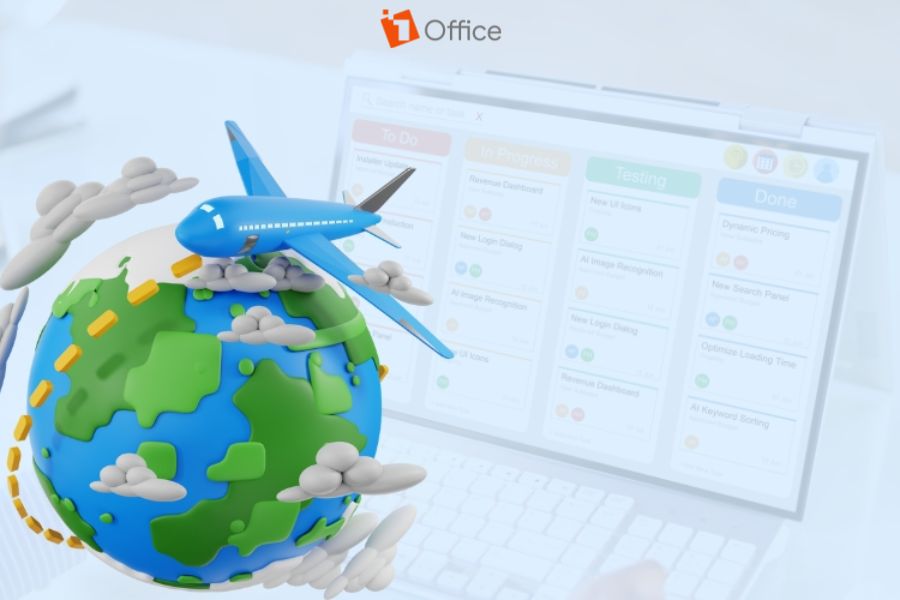
The system must be flexible, allowing the business to easily adjust features according to its specific needs, such as changing the organizational structure, updating salary and bonus policies, or modifying the timekeeping process. It must also support performance management (KPIs) and track work progress to improve employees’ individual skills.
4.3. Easy Integration with Existing Systems
The ability to integrate with other software the business is currently using (such as ERP systems, accounting software, or tour management tools) is crucial. An HRM system with an open, easily connectable API will help optimize information flow, avoid data duplication, and ensure consistency in enterprise-wide management.
4.4. Compliance with Vietnamese Regulations and Labor Laws
The software must ensure high security for sensitive data such as employee salaries, bonuses, and personal records. The HRM system must help businesses easily track and update the latest legal policies. It needs to be able to automate compliance-related tasks in accordance with Vietnamese labor laws, helping to minimize legal risks.
Conclusion
HRM software for the tourism industry provides valuable data for leadership to make strategic decisions about developing and retaining talent. Is your business ready to automate the tour-based payroll process and effectively manage your team of tour guides? Contact 1Office today for an in-depth consultation and learn how our platform can solve the unique HR challenges of the tourism industry.