


 11/05/2026
  322 views
The Waterfall model is a project management model widely used around the world. In the context of today’s strong economic development, businesses in Vietnam are increasingly focusing on optimizing project management processes to improve work efficiency. However, when applied in the Vietnamese business context, what are the pros and cons of this model? Let’s explore in the article below.
Mục lục
- What is the Waterfall Model? The Core Stages of the Waterfall Model
- Why is Project Management More Effective with the Waterfall Model?
- Challenges and Risks to Consider When Using the Waterfall Model
- Pros and cons of the Waterfall model
- Comparing the Waterfall model with other project management methods
- Future Development Trends: Can the Waterfall Model Still Dominate?
What is the Waterfall Model? The Core Stages of the Waterfall Model
The Waterfall model, also known as the cascade model, is a sequential project management method that moves from one phase to the next without going back to a previous step.
This method was developed in the software industry in the 1970s and is particularly suitable for projects with clear, stable requirements that are unlikely to change during implementation.
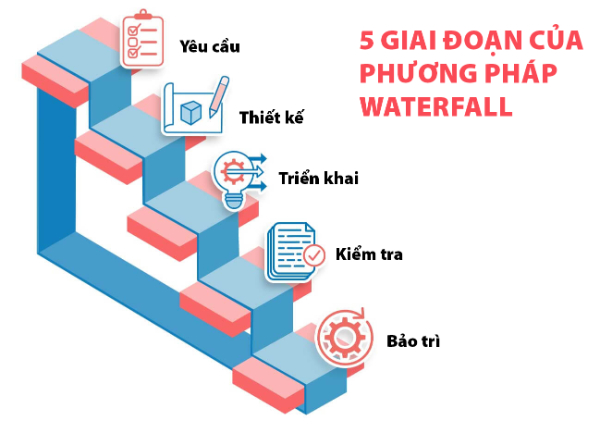
The Waterfall model consists of sequential stages, including:
- Requirements Analysis Stage: Listen to and gather all requirements from clients or users, ensuring all requirements are clarified from the very beginning.
- Design Stage: Analyze and design a solution that meets the requirements, shaping the structure of the system or product.
- Implementation Stage: Carry out the development and construction of the product according to the approved design.
- Testing Stage: Test the accuracy and effectiveness of the product before deployment.
- Maintenance Stage: Provide support after the product has been deployed, including bug fixes and upgrades if necessary.
Waterfall requires the project to be clearly divided into stages and executed sequentially, one step at a time.
Each stage must be completed before moving on to the next, creating an easy-to-follow roadmap that can sometimes lack flexibility.
Why is Project Management More Effective with the Waterfall Model?
Transparent and Easy-to-Track Workflow
Waterfall provides transparency with clear, easy-to-track stages. In textile manufacturing, teams can detect design flaws early, minimizing material waste.
This transparency also builds trust with partners and clients. This is particularly important in the Vietnamese business culture, where reputation is a key factor.
Compatibility with Traditional Management Styles
Waterfall aligns well with the traditional management styles common in Vietnam. In road and bridge construction, the sequential process helps maintain the schedule without major changes.
Small and medium-sized enterprises can avoid the pressure of transitioning to modern models. This ensures stability, especially in industries like agricultural processing.
Tight Control Over Budget and Schedule

The Waterfall model helps Vietnamese businesses control their budgets thanks to detailed upfront planning. In construction, material costs and timelines for each item are clearly defined, preventing budget overruns.
Tracking progress is also easier with sequential steps. Managers can make timely adjustments, ensuring the project is completed on schedule without disrupting the overall plan.
Simplifies Training for New Personnel
Waterfall’s systematic process helps train new employees quickly. In a software company, they only need to learn one stage, such as testing, which shortens their onboarding time.
This reduces training costs, making it suitable for businesses with high employee turnover. The customer service or seasonal manufacturing industries benefit greatly from this advantage.
Easy to Plan and Allocate Resources
Waterfall allows for detailed planning and precise resource allocation. In export furniture manufacturing, a business can calculate the wood and labor needed for each step, optimizing costs.
It also helps predict risks such as material shortages or price fluctuations. This allows Vietnamese businesses to maintain efficiency and meet international market demands.
Challenges and Risks to Consider When Using the Waterfall Model
Limited Ability to Respond to Change
Waterfall is like a one-way street – you can only move forward and cannot easily turn back. If the market suddenly changes, for example, if a client wants to add a new feature to the product, making adjustments is very difficult.
When you are halfway through, for instance, manufacturing a machine according to the old plan, going back to update it with new trends would disrupt everything.
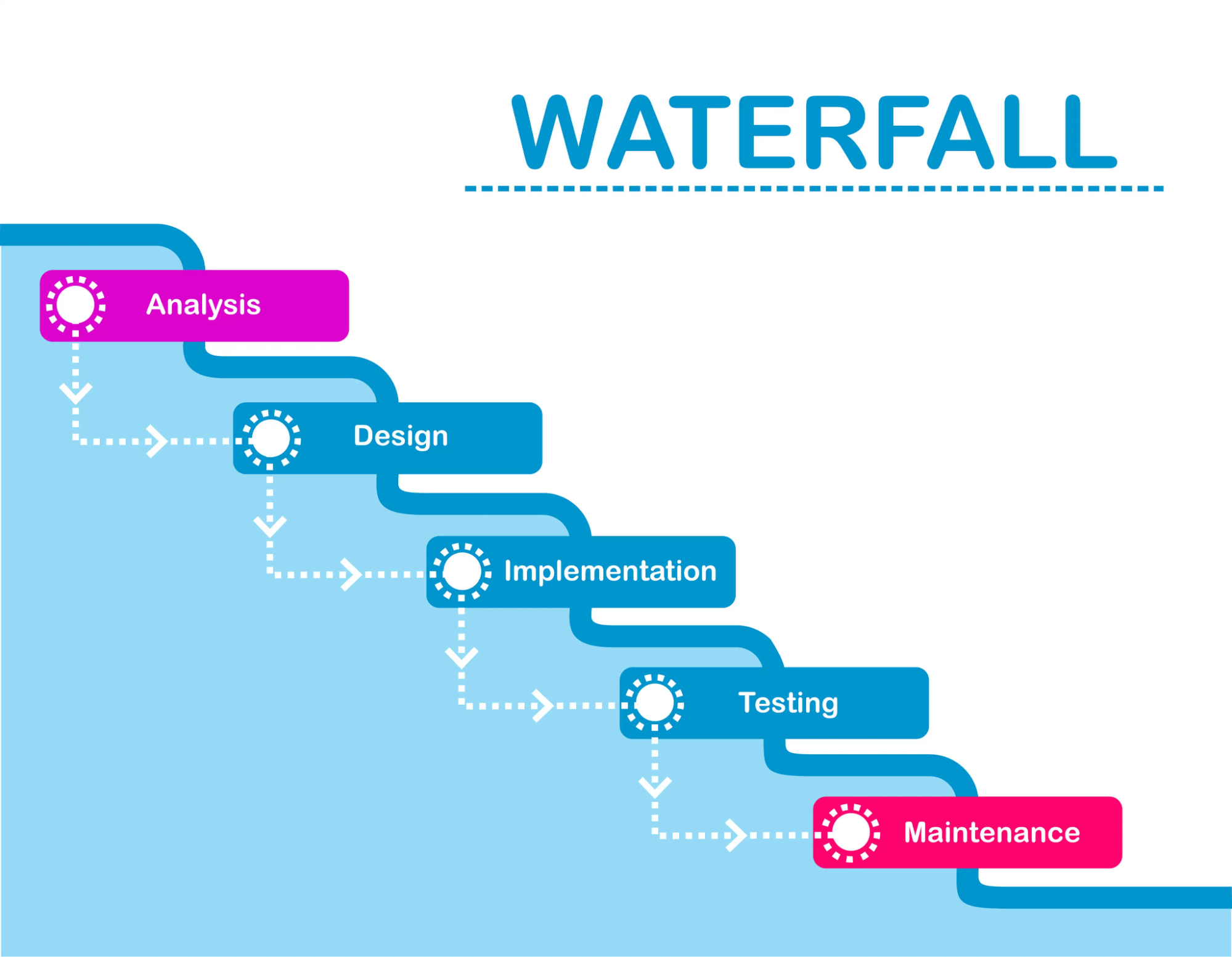
The problem lies in how Waterfall divides work into fixed steps. Once a step is completed, you cannot go back to a previous step without delaying the entire project. This is particularly disadvantageous in industries like technology or retail, where customer demands change constantly.
For example, a Vietnamese company developing a mobile app using the Waterfall model might struggle when a competitor launches a new feature that customers demand immediately.
Risk of Incorrectly Defining Initial Requirements
If you misunderstand the customer’s wishes or misjudge market needs from the very beginning, the entire project can go in the wrong direction.
For example, you might think the customer needs a simple e-commerce website, but later they want to add an appointment scheduling feature – at that point, making changes is not only time-consuming but also costly.
Waterfall requires everything to be clear from the start, but in reality, you can’t always guess correctly.
A construction company using Waterfall to build a house might plan the room sizes incorrectly, and when this is discovered during the finishing stage, they have to demolish and rebuild – wasting both time and money. This risk is significant because the model doesn’t allow for early testing and adjustments.
High adjustment costs in later stages
When a project is nearing completion and you have to make changes, the costs will skyrocket.
For example, if you produce a batch of clothing based on an old design, and then the customer says they want to change the color – redoing the work is almost like starting from scratch, from buying new fabric to sewing again, all while the deadline is tight.
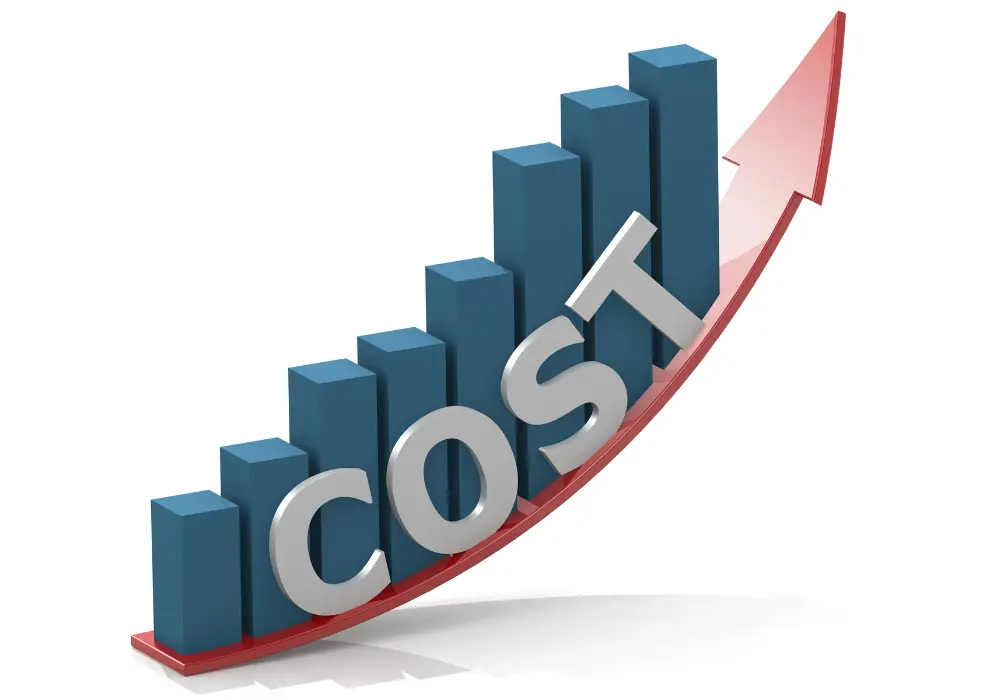
Waterfall discourages mid-project changes because everything is predetermined. If you discover a major bug during the testing phase, such as the software not running on a new phone, the cost to fix it will be much higher than if it were detected earlier.
This makes Waterfall less effective for projects that require flexibility, such as technology application development.
Project completion time is often extended
Because every step must be fully completed before moving to the next, if there are any mistakes, you have to repeat the entire process.
For instance, an interior design company using Waterfall might spend months redoing blueprints if the client is unsatisfied after the installation is complete.
The sequential nature of Waterfall extends the timeline, especially when requirements change. While other methods like Agile allow you to build and fix simultaneously, Waterfall forces you to wait until the end of each phase to see the results.
This is particularly disadvantageous for small businesses in Vietnam, where speed to market is often a crucial factor for survival and competition.
Pros and cons of the Waterfall model
Advantages of the Waterfall Model
Well-suited for projects with a pre-defined strategy
The Waterfall model is very useful when you know exactly what you need to do from the very beginning. For example, if your company needs to build a product where everything must be perfect on the first delivery – like a piece of machinery or critical software – then this model is a good choice. It helps you follow the pre-set plan without getting disorganized.
Simple and easy-to-understand process
Waterfall is like a to-do list: you complete each step one by one before moving to the next. This makes everything clear, easy to track, and allows you to predict when the project will be finished. For tasks like building a house or manufacturing goods, this method is very convenient because everyone knows where they are in the process.
Familiar and reliable
Waterfall is a traditional method that has been around for a long time and is used by many industries, such as construction and large-scale manufacturing. It’s like an old but still effective formula, especially for companies that prefer to work in familiar ways and are resistant to too much change.
Limitations of applying the Waterfall model
Difficult to change once the project has started
Waterfall is like a straight-flowing river: once you’ve passed a certain point, it’s hard to go back and make corrections. If the customer wants to change their mind or something new happens in the market mid-project, making adjustments will be very time-consuming and labor-intensive. This makes it less flexible than more modern methods, like Agile.
Limited customer involvement, leading to mismatched expectations
When using Waterfall, you only consult the customer at the beginning and at the end. Throughout the process, they have almost no opportunity to provide feedback. Therefore, if you misunderstand their needs initially or the customer changes their mind, the final product may not be what they wanted.
A small mistake can cause major problems
Because each step in Waterfall depends on the previous one, if you make a mistake right from the start – for example, misunderstanding a requirement – that error will cascade through the entire project. By the time it’s discovered, fixing it is often costly and takes much more time than planned.
Comparing the Waterfall model with other project management methods
| Criteria | Waterfall | Hybrid | Agile | Kanban | Scrum |
| Implementation Method | Clear, sequential steps (requirements gathering, analysis, design, implementation, testing, maintenance) | Combination: high-level plan + incremental adjustments | Work in small increments, continuous adjustments | Manage tasks on a board, focus on workflow | Work in short cycles (sprints), frequent delivery |
| Flexibility | Very low – difficult to change once started | Medium – more flexible than Waterfall | High – easy to change based on needs | High – continuous adjustments based on workflow | High – flexible within each sprint |
| Completion Time | Often longer, especially when rework is needed | Depends on the project, can be fast with good integration | Faster, delivers small increments continuously | Depends on workflow, delivers gradually as work progresses | Fast, delivers after each sprint (2-4 weeks) |
| Cost of Change | High – changes late in the project are expensive | Medium – depends on the phase | Low – changes are made early and often | Low – adjustments are made as needed | Low – changes are made during or after each sprint |
| Progress Tracking | Easy to track due to transparent steps | Easier than Agile, more complex than Waterfall | More difficult, requires specialized tools and team | Easy – visual Kanban board tracks the flow | Medium – requires strict sprint management |
| Risk from Incorrect Requirements | High – incorrect initial input affects the entire project | Medium – risk is reduced by testing in increments | Low – errors are detected and fixed early | Low – focuses on continuous improvement | Low – review and adjust after each sprint |
| Suitable for Projects | Fixed requirements, few changes (construction, manufacturing, banking software) | Projects that need both planning and flexibility | Rapid changes, frequent experimentation (software, startups) | Continuous task management, no clear endpoint needed | Complex projects requiring fast delivery (software) |
| Ease of Adoption for Small Businesses | Easy – does not require a complex team | Medium – requires understanding of both methods | Difficult – requires a flexible team and modern tools | Easy – only needs a simple board, few process changes | Medium – requires a well-coordinated team |
Comparison with Kanban
Kanban stands out with its visual board-based task management, helping you track a continuous workflow without the rigid phases of Waterfall. If the Waterfall model is like finishing task A before moving to task B, Kanban allows for multitasking and immediate adjustments, making it ideal for projects without a clear endpoint, such as customer support management. However, Waterfall is still better when you need a concrete plan from start to finish, like developing banking software.
Comparison with the Hybrid Model
Hybrid is a combination of Waterfall and Agile, offering the benefits of both: a solid plan like Waterfall and the flexibility to adjust parts like Agile. With Hybrid, you can create a high-level plan for a project, such as custom software development, but still make modifications as needed without disrupting the entire process. Waterfall is more rigid and doesn’t allow for easy changes, whereas Hybrid balances stability and adaptability.
Differences Between Waterfall and Agile
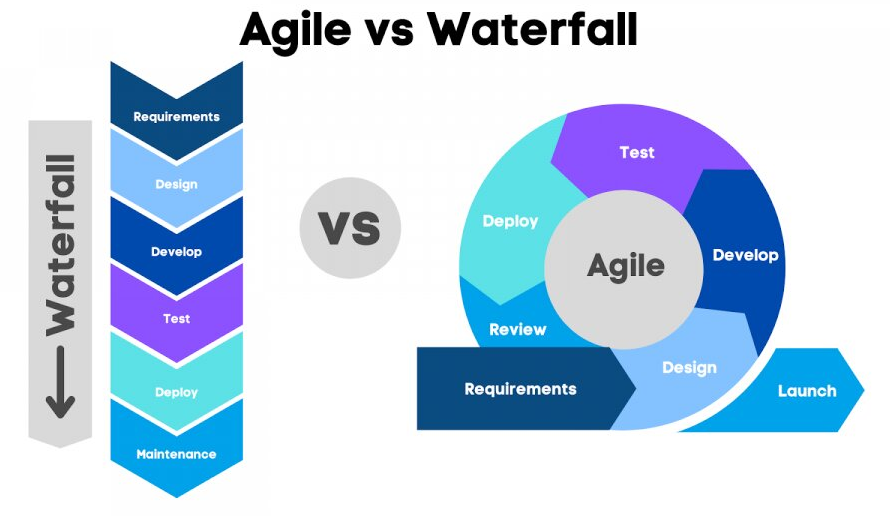
The Agile model surpasses Waterfall in flexibility, allowing for requirement changes at any time during development. For example, if you’re building an app and the client wants to add a new feature, Agile can easily accommodate it, whereas Waterfall would require waiting until the end of the project, which is costly and time-consuming. Agile is suitable for fast-changing environments like tech or startups, while Waterfall shines in stable projects like construction or manufacturing, where everything is clearly planned from the beginning.
Comparison with Scrum
Scrum, a framework within Agile, focuses on working in short cycles (sprints) and delivering quickly every 2-4 weeks, making it well-suited for complex projects like software development that require continuous testing. Compared to Waterfall, Scrum is much more flexible and reduces risk through frequent reviews, whereas with Waterfall, it can take months to see results. However, Waterfall is easier to implement for small businesses that don’t require a complex team, while Scrum demands close coordination among team members.
Future Development Trends: Can the Waterfall Model Still Dominate?
Is the Waterfall model being forgotten in the age of Agile’s rise? Not quite! Although not as flexible as modern methods, Waterfall is quietly evolving to maintain its position in specific fields. Let’s explore the new trends and how it can help Vietnamese businesses continue to leverage its advantages.
How is AI Changing the Waterfall Model?
Artificial intelligence (AI) technology is being integrated to address Waterfall’s biggest weakness: defining initial requirements. AI tools, such as customer data analysis or market trend prediction, help businesses create more accurate plans from the outset, reducing the risk of errors. For instance, a manufacturing company in Vietnam could use AI to analyze market demand before starting the Waterfall process, ensuring the final product is not outdated.
The Waterfall Model in High-Tech Projects
Although Agile dominates the software industry, Waterfall is still favored in complex projects like healthcare or aviation—where precision is a critical factor. According to a report from the PMI (Project Management Institute), about 30% of high-tech projects still used Waterfall or its variants in 2024. In Vietnam, businesses manufacturing hardware or developing banking systems can leverage this trend to ensure superior quality.
Recommendation for Vietnamese Businesses: Smart Combination
The future of the Waterfall model isn’t about complete replacement, but about combining it with modern tools. Try using Waterfall for the high-level planning phase, then apply Kanban to track the workflow more flexibly. A garment company in Ho Chi Minh City successfully used Waterfall for pattern design and then switched to management software to adjust production in real-time—saving both time and costs.
Waterfall isn’t dead—it’s just changing to better fit the times. Are you ready to try new ways to turn the old “waterfall” into a competitive advantage?
——————————-
The Waterfall model remains an effective project management method for Vietnamese businesses, especially in industries with stable requirements. However, to succeed with this model, businesses need to carefully assess its suitability and be prepared to face challenges. Combining the Waterfall model with other methods can be the key for Vietnamese businesses to optimize their project management processes and achieve long-term success.
















