


 11/05/2026
  301 views
What is a Founder? What is the role of a founder in a company? In the world of startups, a founder is not just the person who comes up with the initial idea, but also the one who guides the business through challenges and builds a solid foundation for sustainable growth. Whether you are nurturing a startup idea or learning how to become a successful founder, this article will answer all your questions. Let’s join 1Office to delve deeper into the qualities, skills, and secrets to becoming a respected founder and leading a company to achieve admirable accomplishments.
Mục lục
- 1. What is a Founder?
- 2. The Role and Responsibilities of a Founder in a Business
- 3. Differentiating a Founder from Related Positions
- 4. Essential Qualities and Skills of a Successful Founder
- 5. The Roadmap to Becoming a Founder
- 5.1. Discover and Define Your Passion
- 5.2. Research the Market and Identify Opportunities
- 5.3. Develop Your Idea and Build a Business Plan
- 5.4. Create a Business Model and Product
- 5.5. Fundraising and Team Building
- 5.6. Product Launch and Marketing
- 5.7. Company Management and Operations
- 5.8. Listening to Feedback and Continuous Improvement
- 5.9. Building Relationships and Seeking New Opportunities
- 6. What Makes a Suitable Co-Founder for a Startup?
- 7. 1Office – The “Indispensable Right-Hand” for Leaders in the Digital Age
- 8. Frequently Asked Questions about Founders
- 8.1. How to find a suitable Co-founder?
- 8.2. Can a Founder bootstrap a company without external investment?
- 8.3. When is the right time for a Founder to seek investors?
- 8.4. What should a Founder do when facing failure in a startup?
- 8.5. Where should a Founder start when launching a company?
- 8.6. Can you become a Founder without starting from scratch?
- 8.7. Does a Founder need to have experience in the industry they are starting up in?
- 8.8. What should a Founder prepare for to face market changes and fluctuations?
1. What is a Founder?
A Founder is the person who establishes a company, comes up with the initial idea, and starts building it from scratch. They not only create the business but also define its development direction and long-term strategy. With vision and determination, the founder plays a crucial role in building a solid foundation for the company.
More than just the creator, they are also responsible for shaping the company culture and selecting key elements such as core values and mission. They also ensure that the company’s activities always align with long-term goals, creating a competitive advantage in the industry.
Besides strategic planning, a founder must also possess leadership and management skills. They need to build an effective team, encourage creativity and innovation, and maintain good relationships with partners and investors. Strong leadership from the founder can be the deciding factor in the success or failure of the business.
2. The Role and Responsibilities of a Founder in a Business

A founder plays a crucial and decisive role in the development process of a business. They are not only the creator but also the one who sets the direction, leads, and ensures the sustainable growth of the company:
- Building Vision and Strategy: The founder is the one who creates the idea and long-term strategy for the company. They define the mission, goals, and direction of the business. The founder’s vision directly influences the company’s future development and orientation.
- Managing Finances and Resources: The founder is often the one who manages finances in the early stages, from raising capital to allocating resources effectively. Making wise financial decisions helps the business grow and expand.
- Building Corporate Culture: The founder has a profound influence on the company’s culture. They determine the core values and work environment, creating a solid foundation for the team to work effectively and cohesively.
- Leading and Developing the Team: A founder’s role extends beyond developing ideas to include building and leading the team. The founder is responsible for recruiting, training, and motivating team members to achieve common goals together.
- Representing the Company: The founder is often the main spokesperson for the company, attending events, and meeting with investors and strategic partners. They play a crucial role in building the company’s image and brand in the eyes of the public and partners.
- Monitoring Operations and Progress: The founder needs to closely monitor the company’s activities, ensuring all departments operate effectively and meet their set goals. They must always be ready to adjust strategies as needed to address emerging issues.
In summary, a founder’s role is not limited to establishing the company but also includes leadership, strategic direction, building corporate culture, and team development. The success of a business can heavily depend on the founder’s abilities and decisions.
| Position | Definition | Key Role | Key Responsibilities | Relationship with Other Positions | Authority and Responsibilities |
| Founder | The Founder is the person who establishes and initiates the company, shaping its long-term strategy and vision. | Builds the company’s vision and development strategy, leads the team from the very beginning. | Makes critical strategic decisions, raises funds, builds company culture, and ensures the company maintains its long-term vision. | The Founder is the primary initiator and leader, who can also be the CEO or delegate the role to another CEO. | The Founder has the authority to decide on long-term strategy and steer the company during its initial stages. |
| Co-Founder | A Co-Founder is a person who founds the company alongside the main founder, having a similar role but sharing the founding responsibilities. | Supports the founder in building and implementing the company’s strategy, sharing founding duties. | Shares founding responsibilities, develops products and services, and assists in strategic decisions and personnel management. | The Co-Founder shares founding responsibilities with the Founder and may take on an equivalent role or support the company in specific areas. | The Co-Founder has the authority to make decisions with the Founder, but responsibilities may differ depending on their area of charge. |
| CEO | The CEO (Chief Executive Officer) is responsible for managing the company’s daily operations and executing the strategy set by the Founder. | Manages daily operations, oversees departments, and ensures the company operates efficiently according to the strategy. | Is responsible for daily operations, managing finances and personnel, and ensuring the smooth running of the company. | The CEO is the one who executes the strategy but is not the founder. The CEO typically reports to the Founder or Owner. | The CEO has the authority to run the company but does not decide on the main strategy. The CEO is responsible for reporting to the Founder or Owner. |
| Owner | The Owner is the proprietor of the company, who can be an individual or an organization holding a majority of shares and having the final say on important matters. | Makes decisions on acquisitions, transfers, investments, and company development, and has the authority to manage or supervise the CEO. | Optimizes the company’s financial and strategic resources, controls the company’s growth, and monitors the CEO’s performance. | The Owner may or may not be the founder. The Owner has ultimate control but may not be directly involved in the company’s daily operations. | The Owner has the final decision-making authority on all financial and strategic matters and may participate in the company’s major decisions. |
4. Essential Qualities and Skills of a Successful Founder

To become a successful founder, in addition to professional knowledge and experience, the following qualities and skills are crucial:
Vision and Creativity
A founder needs a clear vision for the company’s future. They must not only recognize current opportunities but also anticipate future trends and changes. Creativity is the factor that helps a founder generate fresh ideas, improve products and services, and thereby create a competitive advantage in the market.
Leadership Ability
A successful founder must be able to lead their team effectively. They need to create a positive work environment, inspire, and guide the team through challenges. A founder’s leadership ability helps maintain team unity and drives the company’s growth.
Financial and Resource Management
Financial management is one of the critical skills that any founder must master. They need to know how to raise capital, allocate resources reasonably, and ensure financial stability during the startup phase. Financial management skills help a founder avoid financial risks and steer the company in the right direction.
Problem-Solving and Decision-Making Skills
Throughout the company’s development, a founder will face many problems and challenges. The ability to solve problems quickly and make accurate decisions is a determining factor in the company’s success or failure. A founder needs the ability to assess situations, devise creative solutions, and implement them effectively.
Perseverance and Passion
A founder needs great perseverance and passion for their startup venture. The entrepreneurial path is not easy, and there will always be failures and challenges. Perseverance helps a founder overcome difficult periods, while passion fuels their relentless effort.
Communication and Relationship-Building Skills
Communication skills are indispensable for any founder. A founder must be able to convey ideas, persuade partners and investors, and build good relationships with customers and stakeholders. Skillful communication helps a founder easily obtain necessary support and cooperation.
Adaptability and Flexibility
The market and business environment are constantly changing, so a founder must be able to adapt quickly to those changes. Maintaining flexibility in strategy and approach helps a founder adjust in a timely manner and avoid falling behind.
Confidence and Decisiveness
A successful founder needs confidence in their abilities and decisions. Confidence helps a founder face difficult situations, make strong decisions, and remain uninfluenced by external factors. Decisiveness also helps a founder demonstrate leadership and steer the company in the right direction.
5. The Roadmap to Becoming a Founder
Becoming a founder is not an easy path, but with thorough preparation and determination, anyone can start their entrepreneurial journey. Below are the basic steps on the roadmap to becoming a successful founder:
5.1. Discover and Define Your Passion
The first step on the entrepreneurial roadmap is to discover your passions and interests. A founder needs to identify a field they truly love and that has potential for future growth.
This helps you stay motivated when facing initial difficulties. You can start by exploring unresolved problems in your industry of interest or looking for opportunities to improve existing products and services.
5.2. Research the Market and Identify Opportunities
Before starting your venture, you need to thoroughly research the target market. Successful founders always understand consumer needs and find gaps that other companies have not yet filled.
Identify the problems customers are facing and how you can solve them effectively. Market research will help you make wise strategic decisions.
5.3. Develop Your Idea and Build a Business Plan
After researching the market, you need to develop your idea and transform it into a clear business plan. This plan should include long-term goals, a product development strategy, a marketing strategy, competitor analysis, and financial forecasts. The business plan is a roadmap that helps you stay focused and grow the company strategically.
5.4. Create a Business Model and Product
A founder needs to build a clear business model and start developing the product or service. You must ensure that your product solves a problem the market is facing. The business model needs to be flexible to change and evolve with market demands. You can also experiment with prototypes and gather customer feedback to improve the product.
5.5. Fundraising and Team Building
An important part of the startup journey is raising capital to bring ideas to life. You can seek investors, take out loans, or participate in business accelerator programs to raise money. At the same time, building a team of employees and associates is an indispensable factor. You need to find people with complementary skills who share the same vision for the company’s development.
5.6. Product Launch and Marketing
After careful preparation, it’s time to launch your product and bring it to market. Marketing is the deciding factor in attracting customer attention and introducing the product to the public. You need to implement an effective marketing strategy, including brand building, online marketing, using social media, and promoting through other media channels.
5.7. Company Management and Operations
Once the company is operational, the Founder will continue to operate and manage the company’s departments, from finance and human resources to product development. Managing a business requires you to work with partners, solve emerging problems, and always maintain the company’s growth. Management and team leadership skills are crucial for maintaining effective operations.
5.8. Listening to Feedback and Continuous Improvement
One of the key factors in maintaining business success is listening to customer feedback and improving products or services. You need to create a system to receive feedback, improve work processes, and always be creative to avoid falling behind. Sustainable development requires founders to constantly innovate and adapt to market changes.
5.9. Building Relationships and Seeking New Opportunities
Finally, building business relationships with partners, investors, and customers is a factor that helps the company grow in the long term. Founders also need to constantly seek opportunities for expansion and development, from expanding markets and launching new products to collaborating with other businesses.
6. What Makes a Suitable Co-Founder for a Startup?
When starting a business, choosing a suitable co-founder is a crucial factor that helps the business grow strong. An ideal co-founder not only complements your skills and experience but also shares your vision and values. Some important characteristics of a suitable co-founder include:
6.1. Complementary Skills
A suitable co-founder should have skills that complement yours, rather than being the same. If you are strong in marketing, your co-founder could be strong in technical skills or finance. This combination helps the company have a solid foundation in multiple areas.
Co-founders need to have a shared vision for the company’s long-term goals and development strategy. Sharing core values will help create a united and collaborative work environment for achieving common goals.
6.3. Good Communication Skills
Communication is key in any partnership, especially between co-founders. A suitable co-founder must be able to listen, exchange ideas, and resolve disagreements effectively to keep the company on the right track.
6.4. Passion and Commitment
A co-founder needs to be passionate about the project and have a long-term commitment to the company. Startups are full of challenges, so you need someone with the perseverance and determination to overcome all difficulties with you.
6.5. Risk Management Ability
A good co-founder knows how to manage risks and make smart decisions in difficult situations. They are not afraid of failure and can remain calm when facing challenges.
6.6. Teamwork Skills
A suitable co-founder needs to be an effective team player, knowing how to share responsibilities and tasks. Team spirit is a crucial factor that helps everyone work together smoothly and achieve common goals.
6.7. Aligned Views on Financial Management
Financial management is a critical factor for survival in the startup phase. Your co-founder needs to share your views on how to use financial resources, allocate budgets, and make sound investment decisions.
6.8. Experience and Flexibility
While startup experience isn’t a must, a co-founder with flexibility and the ability to learn quickly will more easily face the changes and challenges during the company’s development.
7. 1Office – The “Indispensable Right-Hand” for Leaders in the Digital Age
In the journey of building and running a business, founders and CEOs are not just strategists but also the ones making hundreds of important decisions every day. This pressure intensifies as the business expands and the market constantly fluctuates. This is precisely when an intelligent management platform like 1Office becomes an indispensable companion.
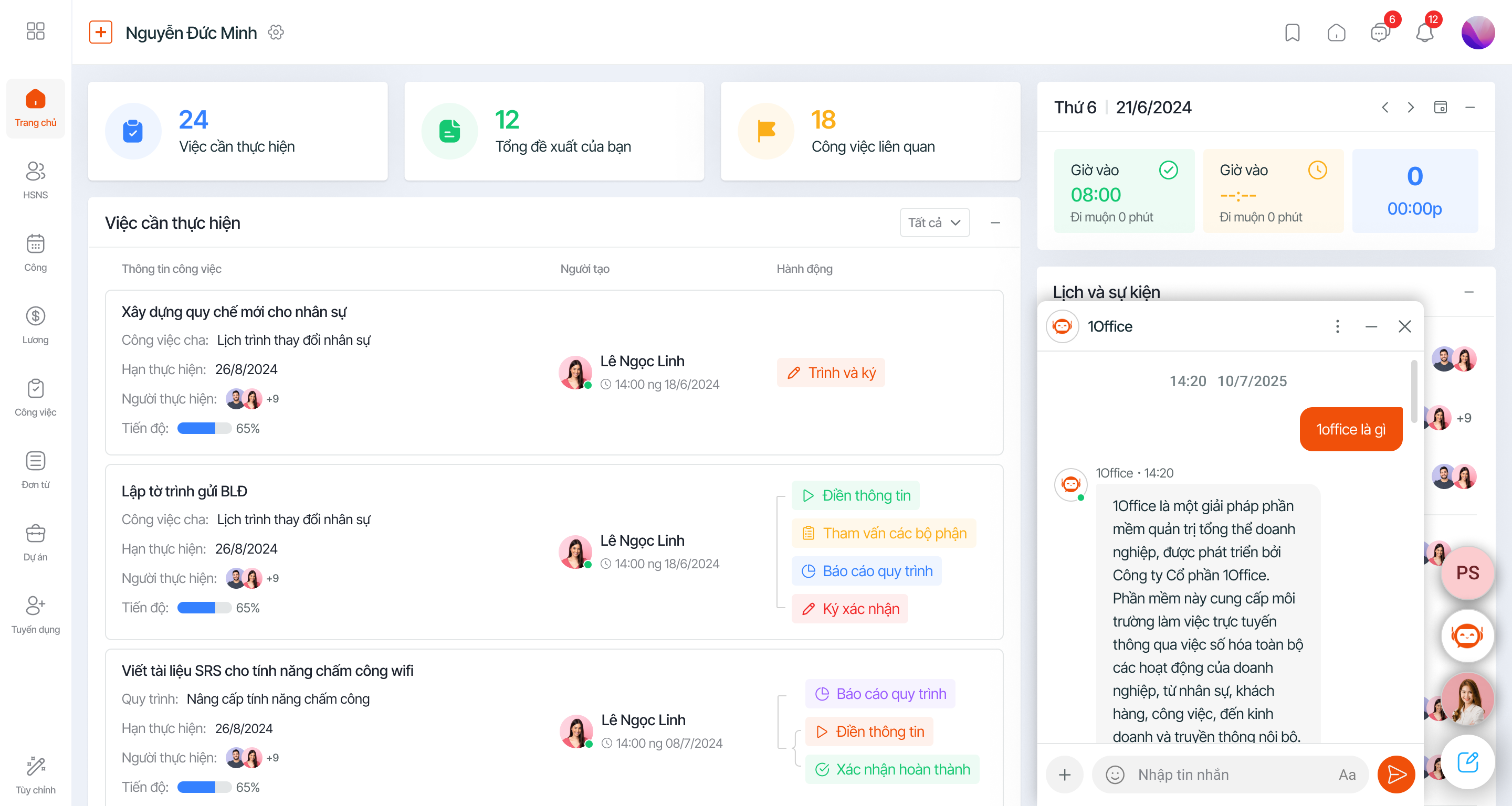
1Office is not just business management software; it is a comprehensive digital ecosystem integrated with AI technology and a Low-code platform, helping leaders master data, optimize processes, and react quickly to any changes. Specifically:
Support strategic decision-making with confidence and data
- The AI-powered virtual assistant in 1Office allows CEOs to ask direct questions about the business situation, such as sales figures, personnel, turnover rates, work performance, etc., and receive immediate responses.
- The system can also analyze past data and predict future trends, helping leaders make data-driven decisions rather than relying on intuition.
- Automated summary reports and visual charts are automatically generated from internal data, saving time and eliminating errors.
Optimize operations – reduce manual management workload
- 1Office allows you to manage tasks, projects, and personnel on a single platform, from assigning tasks and tracking progress to evaluating performance.
With Workrules Management, business processes like approving requests, routing documents, and reporting KPIs can all be automated according to predefined rules, minimizing human dependency and increasing transparency.
Flexible customization without programming skills
- Through the Low-code platform, CEOs or department managers can easily create or edit forms and workflows without writing code. This is especially useful when the business needs to adapt quickly to changes or develop its own internal features.
- The system interface can be flexibly designed by role, ensuring that each individual in the organization only sees and interacts with information relevant to their job.
Accelerate digital transformation with artificial intelligence
- 1Office not only helps process data but also supports the execution of actual tasks. For example, the system can automatically summarize meeting minutes, assign tasks based on meeting content, or professionally draft emails to candidates.
- The AI in 1Office can also personalize the user experience, remember behaviors, and suggest actions, helping employees work faster and more efficiently.
Secure, flexible, and ready to scale
- The system operates on a SaaS (Software as a Service) model, allowing CEOs to access and manage the business from anywhere with an internet connection.
- Data is securely stored on a cloud computing platform, with automatic backup and system maintenance capabilities, ensuring operational continuity and stability.
- 1Office is also ready to integrate with other systems via API, enabling businesses to develop flexibly without being tied to a single tool.
8. Frequently Asked Questions about Founders
8.1. How to find a suitable Co-founder?
To find a suitable co-founder, you need to identify the skills you lack and look for someone who can complement you. For example, if you are strong in marketing but weak in technical skills, find someone with experience in product or technology development. It is crucial that you and your co-founder share a common vision for the company, as well as shared values and goals. Make sure you can communicate effectively and share responsibilities at work.
8.2. Can a Founder bootstrap a company without external investment?
Yes, it’s possible. You can grow your company without capital from external investors, especially in the early days when the company is small and you can control costs. However, if the company grows rapidly and needs to scale, raising capital from investors may become necessary to expand production, develop the market, and attract customers. If you don’t want to depend on investors, you can use your own capital, borrow from friends or family, or participate in startup support programs.
8.3. When is the right time for a Founder to seek investors?
The right time to seek investors is usually when you have a viable product, have tested it in the market, and have a certain number of customers. Investors will be interested in the company’s growth potential, so having an initial customer base or stable profits will increase your chances of successfully raising capital. However, in the very early stages, you may need to raise funds for product development or marketing.
8.4. What should a Founder do when facing failure in a startup?
Failure is a part of the startup journey, and the important thing is not to give up. When you face failure, you need to analyze the causes to learn from your mistakes. Identify weaknesses in your strategy, product, or business model and adjust them. Persistence and adaptability are crucial. You can also seek support from other founders or join startup communities to learn how they overcame difficulties.
8.5. Where should a Founder start when launching a company?
The first step in starting a business is to define your idea and target market. After that, you need to build a clear business plan, including goals, growth strategies, competitor analysis, and financial forecasts. It is crucial to research the market and identify the actual needs of customers.
Next, develop a business model that can attract customers and generate profit. Don’t forget to build a strong marketing strategy to introduce your product to customers.
8.6. Can you become a Founder without starting from scratch?
Yes, you can. You don’t necessarily have to start from scratch if you have a good foundation, such as experience from previous companies or financial resources from family and friends. If you already have industry experience or a strong network, you can leverage these factors to build the company more quickly.
However, whether you start from an existing foundation or from scratch, building a solid business strategy and the ability to run the company are still crucial factors.
8.7. Does a Founder need to have experience in the industry they are starting up in?
Not necessarily. Although industry experience can help you better understand the market and competitors, the ability to learn quickly and have determination is more important.
Successful founders don’t always have experience in the field they start up in, but they have the ability to build strong teams, be creative, and solve problems effectively. The important thing is that you can learn from experienced people and continuously improve your products and services.
8.8. What should a Founder prepare for to face market changes and fluctuations?
A Founder needs to build a flexible business that can adapt quickly to changes in the market. To do this, you need to regularly monitor the market, identify new trends, and ensure that your product or service always meets the changing needs of customers. Continuous innovation strategies, creativity, and the ability to adjust strategies in a timely manner will help you overcome market fluctuations.
















