


 10/05/2026
  617 views
What is an HR Admin? This is the HR position responsible for managing administrative tasks in the human resources department, from recruitment, records management, and timekeeping to supporting compensation and benefits policies. In this article, let’s join 1Office to explore the detailed job responsibilities, role, and essential skills an HR Admin needs to work effectively and advance their career.
| HR (Human Resources) is the department responsible for managing all employee-related matters within a company, including recruitment, training, performance management, compensation, benefits, and corporate culture. The goal of HR is to ensure the company has the right workforce, an effective work environment, and legally compliant HR processes. HR plays a pivotal role in attracting, retaining, and developing talent, thereby enhancing operational efficiency and contributing to the company’s sustainable growth. |
Mục lục
1. What is an HR Admin? Differentiating Between HR Admin and HR Manager
Here is an overview of what an HR Admin is and the fundamental differences between an HR Admin and an HR Manager, helping you clearly understand the roles, responsibilities, and scope of work for each position within the human resources department:
1.1. What is an HR Admin?
An HR Admin (Human Resources Administrator) is a position responsible for managing all administrative activities related to human resource management within a company. Key responsibilities include planning and posting job advertisements, screening resumes, organizing interviews, onboarding new employees, managing employee records, labor contracts, social insurance, timekeeping, and preparing payroll, as well as answering inquiries about company policies and organizing internal events.
The HR Admin plays a crucial role in ensuring that HR processes are carried out legally, promptly, and effectively, contributing to a stable workforce and the smooth operation of the HR system. They typically report directly to the HR Manager and serve as an essential administrative link within the HR department.
1.2. Differentiating Between HR Admin and HR Manager
Below is a comparison between an HR Admin and an HR Manager to help you clearly understand the roles, responsibilities, and scope of work for each position in the human resources department.
| Criteria | HR Admin | HR Manager |
| Position | Human Resources Administrator | Department Head, Senior Manager |
| Role | Executes administrative tasks | Leads and plans HR strategy |
| Main Responsibilities | Manages records, contracts, payroll; supports recruitment and training; answers employee inquiries; handles administrative procedures | Develops HR plans; builds recruitment, training, and compensation policies; monitors performance; develops company culture; manages the entire department |
| Authority | Limited, executes tasks as instructed | Makes strategic decisions, oversees all HR functions |
| Management | Supervised by the HR Manager | Manages the HR Admin and other specialists |

2. HR Admin Job Description
After understanding what an HR Admin is, you can grasp the main tasks this position handles to operate the HR department effectively and support the company’s human resources strategy.
- Recruitment: Sourcing and selecting suitable candidates, from creating profiles, screening, and interviewing to communicating company procedures and policies to new employees.
- Records and Compensation Management: Tracking employee records, labor contracts, social insurance, and allowances, ensuring that compensation policies are implemented correctly according to regulations.
- Performance Monitoring and Evaluation: Tracking employee quality through KPIs and job performance, proposing appropriate salary adjustments, promotions, or personnel transfers.
- Payroll and Bonus Management: Preparing payroll and processing monthly salary and bonus payments for employees.
- HR Policy Support: Answering employee questions about policies and other HR-related issues within the company.
- Company Asset Management: Supervising the use of company assets and shared equipment, checking their condition, and retrieving them when necessary.
- Employee Engagement Activities: Implementing teambuilding programs and outings to improve morale and employee cohesion.
- Building Corporate Culture: Establishing internal regulations, enhancing organizational culture, and improving the company’s reputation and image.

3. Essential Skills & Expertise for an HR Admin
To excel in the role, an HR Admin needs to be equipped with the following skills and professional knowledge:
Skills:
- Management, Organizational, and Problem-Solving Skills: An HR Admin needs to organize tasks logically, monitor progress, and handle emerging situations to maintain a healthy work environment and ensure HR tasks are completed on time. When conflicts arise, they handle them skillfully to maintain work efficiency and internal cohesion.
- Communication and Counseling Skills: Effective communication helps an HR Admin convey policies, guide new employees, answer questions, and advise management, acting as a trusted bridge between employees and leadership while coordinating smoothly with other departments on HR projects.
- Multitasking and Pressure Tolerance: An HR Admin often has to handle multiple tasks simultaneously, from managing records, payroll, and HR reports to supporting internal events or special HR projects. The ability to multitask and work under pressure helps them meet deadlines while maintaining high performance and quality in a demanding environment.
- Attention to Detail and Diligence: Administrative personnel need to be meticulous, carefully checking records, contracts, and data to avoid errors and ensure legal compliance. This ability helps the HR Admin minimize legal risks for the company and ensures administrative processes are executed accurately and promptly.
- Teamwork and Collaboration Skills: An HR Admin must coordinate smoothly with other departments and management levels to ensure all HR activities run seamlessly. Strong collaboration skills help them effectively implement HR projects, programs, and internal events, while also supporting the HR Manager in executing the company’s human resource development strategy.
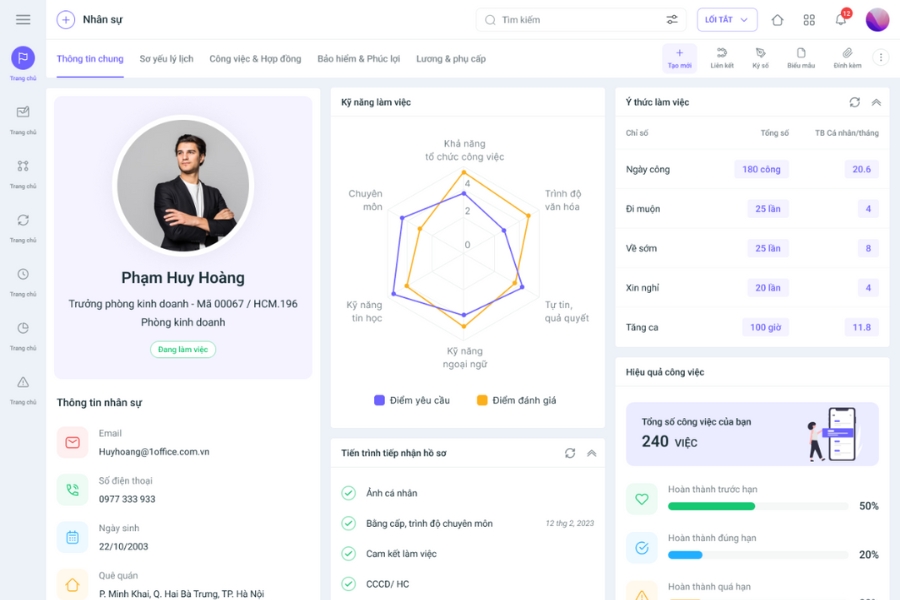
- Proficiency in HR Software and Office Applications: An HR Admin needs to be proficient in Microsoft Office and HR management software like BambooHR (an international HRM software) or 1Office HRM (a popular HRM software in the Vietnamese market) to manage records, track attendance, calculate payroll, and generate reports. This ability helps optimize administrative processes, reduce manual work, and provide accurate data to support the HR Manager’s decisions. As a result, an HR Admin can manage a large volume of records while ensuring high efficiency and accuracy.
| >>> Learn more: What is HRM software? Its role and benefits for businesses |
Regarding professional knowledge: HR Admins should have a degree in Human Resource Management, Business Administration, Labor Law, or related fields to have a solid understanding of personnel management, HR processes, and current labor laws. This knowledge helps HR Admins draft labor contracts, handle legal procedures, and resolve issues in compliance with regulations. Continuously updating their knowledge will help HR Admins work effectively in the ever-changing HR environment.
4. Salary and Career Opportunities for HR Admins
After understanding what an HR Admin is, you can refer to the average salary, promotion opportunities, and career development path for this position:
Regarding the salary of an HR Admin:
The salary for an HR Admin in Vietnam in 2025 is quite diverse, depending on experience, skills, and the size of the company.
- For beginners (0 – 2 years of experience), the starting salary typically ranges from 7.5 – 8.5 million VND/month.
- HR Admins with 2 – 5 years of experience can earn a salary of 15 – 30 million VND/month or higher at large corporations and foreign companies.
Nationwide, the common salary for this position is around 12-21 million VND/month. This income level reflects the important role of an HR Admin in the operation of the HR department and their potential for future career development.
Regarding career opportunities for HR Admins:
In terms of career opportunities, the HR Admin position is a crucial foundation in the HR department, opening up many clear paths for advancement. From this role, an individual can progress to HR Specialist, HR Manager, and senior management roles such as HR Director or CPO.
As the labor market becomes more competitive and businesses focus on human resource management, HR Admins with strong professional skills, practical experience, and good coordination abilities will have many opportunities for development. Additionally, HR Admins can also expand into related fields such as administration, training, or human resource development, thereby enhancing their professional value and strategic contribution to the company.

5. Career Path for an HR Administrator
The career path for an HR Administrator (HR Admin) in Vietnam typically follows this sequence:
- HR Intern / HR Assistant: This is the starting point, helping you get acquainted with processes, basic administrative tasks, and the culture of the HR department.
- HR Administrator / HR Staff: Performs administrative tasks, manages records, supports recruitment, and other HR activities, serving as a foundation for developing professional skills.
- HR Executive / HR Specialist: Takes on specialized responsibilities in areas such as recruitment, training, compensation and benefits management, and personnel development, while also advising departments and managers on HR issues.
- HR Supervisor / HR Team Leader: Manages a small team or sub-department, assigns tasks, trains and guides junior staff, and ensures the team’s work efficiency.
- HR Manager: Manages the entire HR department, develops HR strategies, plans resource development, and advises the board of directors on overall HR policies.
- HR Director / CHRO (Chief Human Resources Officer): The highest position, responsible for the organization-wide human resource development strategy, shaping culture and policies, and effectively managing senior human resources.
The time to advance from HR Admin to HR Manager typically takes 3–5 years, depending on ability, experience, and the conditions of each company. For smooth development, HR professionals need to continuously hone their leadership skills, strategic thinking, understanding of labor laws, and stay updated on modern HR management tools.

6. Frequently Asked Questions about HR Admins
Question 1: What is an HR Admin Executive
An HR Admin Executive is a senior position to an HR Admin, responsible for managing and executing key HR activities such as recruitment, training, contract management, compensation, and benefits. They coordinate with leadership to implement HR strategies, supervise junior staff, and ensure HR processes operate effectively, contributing to the development of the company’s human resources.
Question 2: What is an HR Coordinator
An HR Coordinator is an intermediary position in the HR department, responsible for supporting and coordinating daily HR tasks such as managing records, contracts, payroll, recruitment, training, and answering employee inquiries. They also act as a liaison between departments and management, ensuring HR processes run smoothly, especially in large-scale enterprises.
Question 3: How to become a great HR Admin
To become a great HR Admin, you need to:
- Master HR knowledge: Thoroughly understand labor laws, recruitment processes, records management, payroll, insurance, and benefits, while regularly updating on policy changes.
- Be proficient in work management: Plan, organize tasks logically, handle multiple tasks simultaneously, and ensure detail and accuracy.
- Communication & problem-solving skills: Communicate clearly, persuasively, and handle HR issues skillfully to maintain a harmonious work environment.
- Be proficient with tools: Master HR software and Microsoft Office to optimize administrative tasks.
- Professional attitude & willingness to learn: Always be dedicated, responsible, and proactively enhance skills and knowledge through professional training.
- Effective teamwork: Coordinate well with other departments to achieve common goals.
- Strategic & analytical thinking: Support the HR Manager in building effective HR policies.

In summary, what an HR Admin is and why this position is important in every business has been explained in detail. If your business is looking for an effective human resource management solution, 1Office HRM software will help automate processes, manage records, timekeeping, and compensation professionally. Please leave your information HERE, the 1Office team will contact you and advise on the most suitable solution.
















