10/05/2026
  590 views
Customer Lifetime Value, or what is CLV? This is a crucial metric that helps businesses measure the total value a customer brings throughout their relationship with the brand. In this article, let’s explore with 1Office how to calculate CLV, the significance of this metric, and how to apply it to optimize profits and enhance customer loyalty.
Mục lục
1. What is CLV? Why is it necessary to measure Customer Lifetime Value?
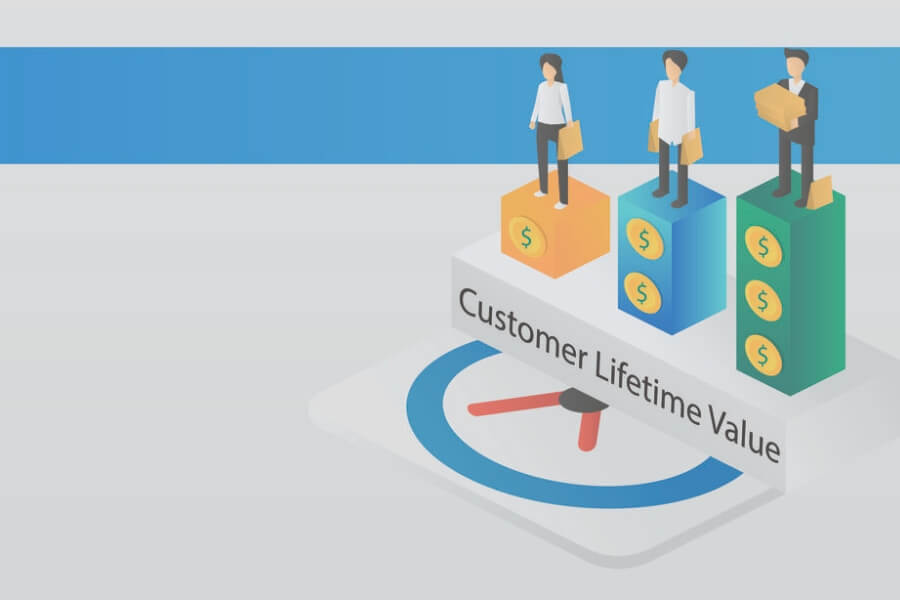
What is CLV? Customer Lifetime Value (CLV) is the total economic value a customer brings to a business throughout the time they use its products or engage with the brand. Instead of evaluating individual transactions, CLV considers the entire value a customer can generate throughout their relationship with the business.
CLV is not just a financial metric; it is also a crucial tool that helps support and customer care departments improve the user experience across the entire journey. A customer’s lifetime value increases as they continue to make repeat purchases, become more loyal, and contribute more to the company’s long-term profitability.
Measuring Customer Lifetime Value is necessary because this metric offers many significant benefits to a business, including:
- Long-term revenue growth: Helps identify the customer group that generates the highest revenue to prioritize retention, upselling, and cross-selling more effectively.
- Enhanced satisfaction and loyalty: CLV reflects customer behavior and needs, making it easier for businesses to adjust services, offers, and experiences to retain them longer.
- Targeting the ideal customer: Analyzing CLV helps identify high-value customer segments to optimize marketing strategies and budget allocation.
- Reduced customer acquisition costs: Focusing on nurturing existing customers—which is much cheaper than acquiring new ones—while also boosting referrals from satisfied customers.
- Simplified financial forecasting: CLV helps predict future cash flow more accurately, assisting businesses in planning for revenue, production, and staffing.
- Improved products and services: Based on the value customers contribute, businesses can easily identify areas for improvement, thereby enhancing the experience and strengthening loyalty.
2. How to calculate customer lifetime value
Below are the basic steps to calculate customer lifetime value accurately, helping you better understand what CLV is and how to apply it in practice:
2.1. Formula for calculating customer lifetime value
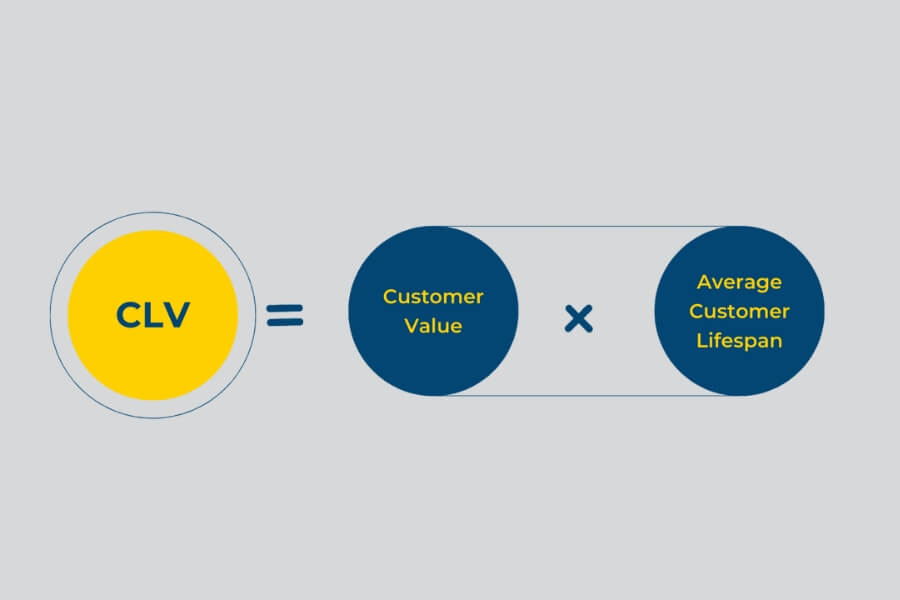
Customer Lifetime Value (CLV) is calculated as:
| General formula:
CLV = Customer Value × Average Customer Lifespan or CLV = CV × ACL Where: Customer Value = Average Purchase Value × Average Purchase Frequency |
Explanation:
- CV (Customer Value): Customer Value
- ACL (Average Customer Lifespan): The average lifespan of a customer, calculated in months or years.
After determining the average lifespan of a customer, you simply multiply it by the customer value to find out how much revenue they generate throughout their relationship with the business.
CLV shows the expected revenue from an average customer over their entire lifecycle. Not just an overall figure, CLV can also be calculated for individual customers or customer groups, allowing businesses to accurately assess the value of each segment.
2.2. Sample Example of How to Calculate Customer Lifetime Value
For a more detailed guide on calculating CLV, here is a classic example from Starbucks. A Kissmetrics report can be used to track the weekly purchasing habits of 5 customers and average them to find the customer lifetime value.
Step 1 – Calculate Average Purchase Value
The first step is to determine how much each customer spends per purchase. According to Kissmetrics, the average Starbucks customer spends $5.90 per visit.
Example: if you visit Starbucks 3 times a week and your total spending is $9 → Average Purchase Value = 9 / 3 = $3 per visit.
Repeat this calculation for 5 customers, then take the arithmetic mean to get the overall average purchase value.
Step 2 – Calculate Average Purchase Frequency
Next is to see how many times each customer visits the store per week. Kissmetrics shows that the average Starbucks customer visits 4.2 times per week.
So, the average purchase frequency is 4.2.
Step 3 – Calculate Average Customer Value
Customer Value = Average Purchase Value × Average Purchase Frequency.
After performing this for 5 customers and taking the average, the report shows:
Average Customer Value = $24.30/week.
Step 4 – Calculate Average Customer Lifespan
Kissmetrics provides the figure that the average lifespan of a Starbucks customer is 20 years.
If you need to estimate it yourself, you can use: Customer Lifespan ≈ 1 / Churn Rate.
Step 5 – Calculate CLTV
Since the data is measured weekly, we need to convert it to years:
- Average annual revenue: $24.30 × 52 weeks = $1,263.60
- CLTV: $1,263.60 × 20 years = $25,272
Thus, the average CLTV of a Starbucks customer is $25,272.
3. Approaches to Calculating Customer Lifetime Value
Below are common methods that help businesses estimate CLV effectively, while also providing a better understanding of what CLV is and its role in customer management:
3.1. Historical Approach
This is a method of calculating customer lifetime value (CLV) based entirely on past transactions. The core idea of this approach is: the total amount a customer has spent throughout their relationship with the business serves as the basis for estimating CLV.
To calculate Historical CLV, you need to determine:
- Total Customer Spending (Purchases): The total amount of money the customer has spent on all past purchases.
- Average Gross Margin (AGM): The profit earned from each transaction, usually expressed as a percentage.
Formula for calculating Historical CLV
| Historical CLV = (Purchase 1 + Purchase 2 + Purchase 3 + …) × AGM |
For example: Suppose a customer makes 4 purchases, each for 100 USD, and the average gross margin (AGM) is 25%: (100 + 100 + 100 + 100) × 0.25 = 100 USD. Thus, this customer’s Historical CLV is 100 USD.
3.2. Predictive Approach
This method is suitable for businesses with fluctuating purchase frequencies or when customer behavior changes continuously. Instead of relying solely on past transactions, the predictive method uses historical data combined with statistical models to estimate future customer lifetime value.
To calculate Predictive CLV, you need the following metrics:
- Average number of transactions (T): The average number of transactions per month.
- Average Order Value (AOV): The average revenue per order.
- Average Gross Margin (AGM): The profit margin earned from each transaction.
- Average Customer Lifespan (ALT): The number of months a customer continues to make purchases before churning.
- Total Clients: The number of customers analyzed within a specific period.
Predictive CLV Formula
| Predictive CLV = (T × AOV × AGM × ALT) / Total Clients |
Illustrative example: Suppose in January, a business has:
- 20 transactions
- AOV = 100 USD
- AGM = 25%
- ALT = 24 months
- Total number of customers = 5
Applying the formula: (20 × 100 × 0.25 × 24) / 5 = 2,400 USD
Thus, the Predictive CLV for that month is 2,400 USD.
3.3. Traditional Approach
This is one of the most common methods for calculating CLV. The traditional approach focuses on the profit margin a customer generates, combined with the customer retention rate and discount rate to reflect the time value of money.
To calculate Traditional CLV, you need to understand the following metrics:
- Gross Margin per Lifespan (GML): The total expected profit from a customer throughout their entire relationship with the business.
- Monthly Retention Rate (R): The percentage of customers who continue to make purchases compared to the previous month.
- Discount Rate (D): Usually around 10%, used to adjust for inflation and the time value of money.
Traditional CLV Formula
| Traditional CLV = GML × ( R / (1 + D – R) ) |
Illustrative example
Let’s assume:
- GML = 2,000 USD
- Customer Retention Rate (R) = 75%
- Discount Rate (D) = 10%
Applying the formula: 2,000 × (0.75 / (1 + 0.10 – 0.75)) = 800 USD
Thus, the customer’s Traditional CLV is 800 USD.
4. Applying Technology to CLV Calculation
Here’s how businesses can apply technology to calculate and track CLV more effectively, clarifying what CLV is and why this metric is crucial for long-term growth:
4.1. CRM (Customer Relationship Management) System
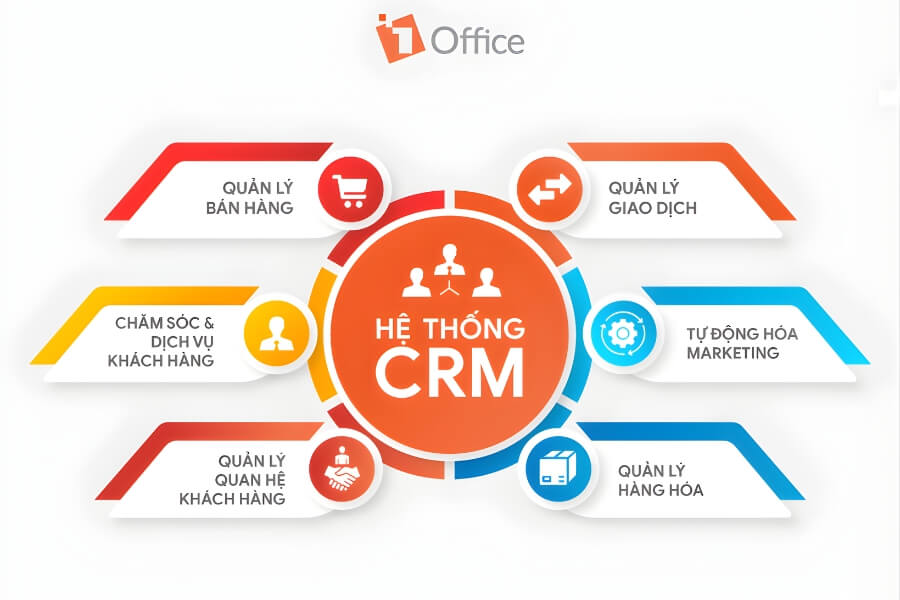
A CRM is the central hub for managing all customer information and interactions throughout their lifecycle. This system stores purchase history, feedback, transaction frequency, and value, thereby supporting accurate CLV calculations. Additionally, a CRM helps segment customers by value and loyalty, providing a foundation for businesses to implement effective care strategies and enhance CLV.
1Office CRM is a professional customer relationship management solution that has partnered with over 5,000 businesses. With more than 10 years of implementation experience, 1Office helps store and classify customer data, track interactions, and optimize care strategies, thereby effectively increasing customer lifetime value.
Read more: What is a CRM? Benefits, functions, and role of a CRM system
4.2. BI (Business Intelligence) Tools
BI provides in-depth analysis capabilities using customer data recorded by the CRM. These tools generate visual reports on customer count, average revenue, purchase frequency, customer lifespan, and other CLV metrics. Thanks to BI, businesses can predict trends and segment customers by behavior and value, enabling them to make strategic decisions to increase customer lifetime value.

4.3. Google Analytics
Google Analytics tracks customer behavior on digital platforms like websites and applications. This tool provides data on visits, engagement time, conversion rates, and average order value, supporting automated and continuous CLV measurement. When integrated with a CRM, Google Analytics gives businesses a comprehensive view of the customer journey, enabling them to build more effective customer retention and care strategies.
5. 5 Ways to Increase Customer Lifetime Value
Here are 5 practical strategies to enhance customer lifetime value:
5.1. Improve Product/Service Quality
CLV only increases when customers are genuinely satisfied with what they receive. Continuously improving product/service quality helps reduce churn, builds trust, and encourages customers to return more often. A good, stable, and reliable product is always the foundation for increasing customer lifetime value.
5.2. Create an Outstanding Customer Experience
From the research phase to post-purchase, every touchpoint affects the customer’s perception. Businesses can enhance the experience by optimizing the website/app interface, shortening response times, providing fast and relevant support, and maintaining a dedicated service attitude. When customers feel respected and understood, they will remain loyal for longer.
5.3. Implement Remarketing to Nurture Existing Customers
Remarketing helps businesses stay top-of-mind with customers. By using email, SMS, ads, or personalized notifications, you can remind customers about relevant products, exclusive offers, or suggest repurchases at the right time. Proper nurturing will boost purchase frequency and extend the customer lifecycle.
5.4. Apply Upselling and Cross-selling at the Right Time
Upselling (selling a higher-end version) and cross-selling (selling complementary products) are effective ways to increase the value of each purchase. However, the key is to suggest the right product to the right customer at the right time. When recommendations are based on actual needs and purchasing behavior, customers will see it as a helpful solution rather than just being “sold more”.
5.5. Building lasting relationships with customers
Long-term relationships are built on consistent care: post-purchase support, customer appreciation, community building, or providing useful content. When customers perceive value beyond the product itself, they become more loyal, refer new people, and generate stable, long-term profits.
Understanding what CLV is helps businesses optimize their customer care strategies, increase revenue, and retain customers for the long term. To manage customers effectively, track CLV accurately, and implement upsell, cross-sell, or remarketing strategies,
Your business can use 1Office’s CRM software – a comprehensive solution that helps optimize customer lifetime value intelligently and automatically. Contact 1Office today for a free consultation and to experience the optimal CRM solution for your business!