10/05/2026
  599 views
Inventory accounting plays a crucial role in the production and business operations of every enterprise. It is the process of recording, classifying, and tracking the status, quantity, value, and cost of items and products that a business holds in its inventory. If you are not yet familiar with this principle, let’s explore it with 1Office!
Mục lục
- 1. What is inventory?
- 2. Key inventory accounting principles to master
- 3. Inventory Accounting Methods (Perpetual and Periodic)
- 4. Guide to inventory accounting by transaction
- 5. Optimizing Inventory Accounting with Technology
- 5.2. 1Office’s Automation Solution for Effective Inventory Management
- Conclusion
1. What is inventory?
To manage effectively, readers first need to clearly understand what inventory is and the scope of this concept in corporate accounting.
1.1. Definition of inventory according to Vietnamese Accounting Standards
According to Vietnamese Accounting Standard 02 (VAS 02), issued and announced under Decision No. 149/2001/QD-BTC dated December 31, 2001, by the Minister of Finance, inventory (HTK) are assets defined as:
- Held for sale in the ordinary course of business.
- In the process of production for such sale.
- Materials, tools, and supplies to be consumed in the production process or the rendering of services.
Thus, this includes not only products in the warehouse waiting to be sold, but also raw materials waiting to be put into production or products currently on the processing line.

1.2. Common types of inventory
Inventory includes many different forms within a company’s value chain. Accurate classification helps accountants track and record to the correct accounts, ensuring the transparency of financial statements.
- Raw materials: Includes main materials, auxiliary materials, supplies, fuel… used to produce products or for management and sales purposes.
- Work In Progress (WIP): These are unfinished products and finished products that have not yet been formally transferred to the finished goods warehouse. This represents the value of raw materials, labor, and manufacturing overhead that have been incurred but have not yet resulted in a final product.
- Finished goods: These are products that have completed all processing stages, passed quality control tests, and have been transferred to the warehouse, ready to be sold or shipped.
- Merchandise: These are products purchased for resale without further processing or manufacturing. This type is mainly applicable to trading companies.
- Tools and supplies in inventory: Includes materials, scaffolding, formwork, specialized tools… with a short useful life or low value, which are gradually allocated to production and business costs.
- Other types: In addition, inventory (HTK) also includes Goods in transit (Account 151) – goods that have been purchased but have not yet arrived at the warehouse; Goods on consignment (Account 157) – goods that have been shipped to agents or customers but have not yet been accepted for payment; Goods sent for processing; and Unfinished services.
2. Key inventory accounting principles to master
Inventory accounting must strictly adhere to the principles stipulated in the Inventory Accounting Standard (VAS 02) and guiding circulars such as Circular 200/2014/TT-BTC to ensure the consistency and fairness of financial statements.

2.1. Valuation principle (Cost and net realizable value)
The correct valuation of inventory is the basis for calculating the cost of goods sold and determining profit.
- Cost principle: Inventory must be measured at cost. The cost of inventory includes: purchase costs, conversion costs, and other costs incurred in bringing the inventories to their present location and condition.
- Purchase costs include the purchase price, non-refundable taxes (such as import duties, special consumption tax), transportation, handling, and storage costs during the acquisition process. Trade discounts and rebates are deducted (-) from the purchase cost.
- Conversion costs include direct labor costs, fixed manufacturing overhead, and variable manufacturing overhead incurred in converting raw materials into finished goods.
- Lower of cost or net realizable value principle: At the end of the accounting period, if the net realizable value (NRV) is lower than the cost, the inventory must be valued at its net realizable value. Net realizable value is the estimated selling price of the inventory in the ordinary course of business, less the estimated costs of completion and the estimated costs necessary to make the sale.
2.2. Principles of Cost Recognition and Provisioning
Not all incurred costs are included in the value of inventory.
- Costs not included in the original cost: The following costs are not included in the original cost of inventory but are recognized as production and business expenses for the period:
- Costs of raw materials, labor, and other general production costs incurred above normal levels.
- Storage costs (except for storage costs necessary for the next production process).
- Selling expenses and general administrative expenses.
- Cost recognition: When inventory is sold, its original cost is recognized as a production/business expense for the period, matching the revenue recognized from it. This is an application of the Matching Principle in accounting.
- Provision for devaluation: At the end of the fiscal year, if the net realizable value of inventory is lower than its original cost, a provision for inventory devaluation must be made. The process of creating a provision for inventory devaluation is carried out on an item-by-item basis.
- Detailed accounting: Inventory accounting must be detailed in both value and physical units for each type, specification of materials, and goods, according to each management location (warehouse, counter, yard…).
3. Inventory Accounting Methods (Perpetual and Periodic)
According to current regulations, a business can only apply one of the following two methods to track and account for inventory and must apply it consistently throughout the accounting period.
3.1. Perpetual Inventory System
- Characteristics: This is a method of continuous and regular tracking, promptly reflecting the import, export, and on-hand status of inventory in the accounting records. At any given time, the accountant can determine the quantity and value of inventory.
- Cost of goods sold calculation: The value of goods sold can be calculated at any time a transaction occurs.
- The formula for calculating ending inventory is as follows:
Ending Inventory = Beginning Inventory + Purchases during the period – Cost of Goods Sold during the period.
- Applicable subjects: Suitable for manufacturing, construction, or businesses dealing in high-value items (such as machinery, equipment, cars, motorcycles…), high-tech products that require close control.
- Advantages: Easy to track and manage inventory regularly, contributing to the timely evaluation and adjustment of production and business activities, minimizing errors and losses.
3.2. Periodic Inventory System
- Characteristics: This method does not continuously track the import and export of goods during the period in the inventory accounts. Instead, inventory is only reflected at the beginning and end of the period.
- Cost of goods sold calculation: The value of goods sold can only be calculated at the end of the period after a physical count of the ending inventory is performed.
- The formula for calculating the cost of goods sold is:
Cost of Goods Sold during the period = Value of Beginning Inventory + Total Value of Purchases during the period – Value of Ending Inventory.
- Applicable subjects: Suitable for businesses dealing in low-value, high-volume items with many types and specifications (such as retail, apparel, pharmaceuticals, groceries…) where tracking each transaction is costly and inefficient.
- Disadvantages: Does not reflect individual import/export transactions during the period, calculation work is concentrated at the end of the period, making it difficult to promptly detect errors or losses of goods during the period27.
Summary of Accepted Costing Methods for Goods Sold
Regardless of whether the perpetual or periodic method is used, businesses need to choose a suitable costing method for goods sold (according to Circular 200/2014/TT-BTC and 133/2016/TT-BTC):
-
- First-In, First-Out (FIFO) Method: Assumes that the first items purchased are the first ones sold. The value of ending inventory is the cost of the most recently purchased or produced batch. This method reflects an inventory value that is close to the current market price.
- Weighted-Average Cost Method: The cost of goods sold is calculated based on the average cost of beginning inventory and purchases during the period. It can be calculated using the weighted-average for the entire period or a moving-average cost after each purchase.
- Specific Identification Method: The cost of goods sold is determined by the specific cost of the batch from which the items were sold. This method is applied to items that are stable, have high value, and are identifiable.
- Note: The Last-In, First-Out (LIFO) method is not accepted under current Vietnamese Accounting Standards.
4. Guide to inventory accounting by transaction
Inventory accounting will differ depending on the declaration method the business chooses. Below is a comparison table of basic entries:
| Transaction | Perpetual inventory system | Periodic inventory system |
| Receiving goods/raw materials into inventory | Debit Acct 152/153/156
Debit Acct 133 Credit Acct 111/112/331… |
No entry for inventory receipt (use Acct 611 – Purchases at the end of the period to aggregate) |
| Goods in transit | Debit Acct 151
Debit Acct 133 Credit Acct 111/112/331… |
Not recorded in the inventory account |
| Goods in transit received into inventory | Debit Acct 152/153/156
Credit Acct 151 |
Not recorded |
| Issuing goods for sale (Cost of goods sold) | Debit Acct 632
Credit Acct 156 |
Recorded at the end of the period:
Debit Acct 611 Credit Acct 156 (Transfer of beginning inventory) |
| Recording beginning inventory | Already reflected from the previous period’s end | Debit Acct 611
Credit Acct 156 |
| Recording ending inventory | Reflected throughout the period | Debit Acct 156 (Based on physical count results)
Credit Acct 611 |
| Closing entry for cost of goods sold | Not necessary (recorded for each issuance) | Debit Acct 632
Credit Acct 611 (Value of goods sold during the period) |
| Purchase discounts/allowances | Debit Acct 111/112/331…
Credit Acct 156 (if still in inventory) or Credit Acct 632 (if sold) |
No direct reduction recorded in the inventory account |
| Purchase on deferred payment (Interest portion) | Debit Acct 242 (Deferred interest)
Credit Acct 331 (Total amount payable) |
Not recorded in the value of purchased goods |
5. Optimizing Inventory Accounting with Technology
To overcome inventory challenges, businesses need to adopt professional management systems where technology is used to automate and standardize processes.
5.1. Challenges in Traditional Inventory Accounting
Despite clear principles and methods, inventory accounting still faces many challenges when performed manually or with non-specialized tools like Excel.
- Pressure for accuracy and timeliness: Inventory accounting requires meticulousness and high accuracy. The need to record transactions as they occur (perpetual inventory system) or to consolidate calculations at the end of the period (periodic inventory system) both place significant pressure on the accounting department.
- Complex calculations: Calculating the cost of goods sold using methods like the weighted-average cost after each purchase (moving average) is very complex and labor-intensive if done manually, easily leading to arithmetic errors.
- Risk of discrepancies: Delays in creating goods receipt/issue notes or slow document circulation between the warehouse and the accounting department can lead to discrepancies between physical stock and book records, making management difficult.
- Lack of risk control: Difficulties in conducting regular stocktakes and creating timely provisions for inventory devaluation when the net realizable value decreases can lead to an inaccurate reflection of the company’s asset value.
5.2. 1Office’s Automation Solution for Effective Inventory Management
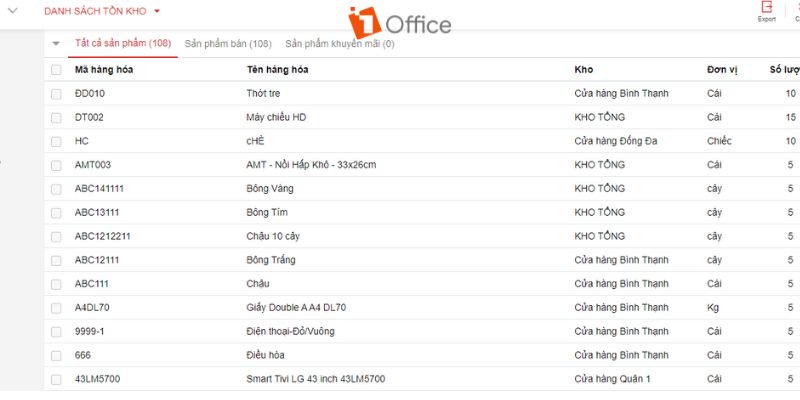
As businesses expand and the volume of stored products increases, manual inventory management can easily lead to data discrepancies, update delays, and a drain on resources. 1Office HRM software provides a comprehensive automation solution, helping businesses control inventory accurately in real-time and optimize operations.
1. Real-time warehouse data synchronization
The 1Office system automatically collects and updates goods issued, received, and on-hand quantities as soon as transactions occur.
- Completely eliminates manual data entry.
- Reduces errors and discrepancies between physical stock and system data.
- Helps managers track inventory at all times to make faster decisions.
2. Automatic low or excess inventory alerts
The software sets minimum/maximum inventory thresholds and automatically sends alerts when stock is running low or is overstocked.
- Avoid stockouts during peak periods.
- Reduce dead stock and optimize cash flow.
- Supports more accurate purchasing planning.
3. Automate stocktaking and reporting processes
1Office provides ready-made templates and reports:
- Daily/monthly/quarterly inventory reports (goods received, issued, and on-hand).
- Inventory turnover reports.
- Inventory valuation reports at specific times.
The system automatically aggregates data, saving businesses hours of manual reporting.
4. Connect inventory data seamlessly with other departments
A key advantage of 1Office HRM software is its ability to seamlessly connect data across multiple departments, specifically:
- The warehouse, operations, and sales departments can update data quickly without transferring Excel files.
- HRM can track warehouse employee productivity, the number of processed documents, working hours, and KPIs.
- Timekeeping, salary, bonus, and performance information for warehouse staff is automatically synchronized on HRM — reducing the workload for HR and increasing transparency.
5. Reduce operating costs through automation
Thanks to consistently accurate data and streamlined processes, businesses can:
- Save on warehouse & accounting personnel costs.
- Reduce costs from inventory loss and shrinkage.
- Optimize inventory turnover and cash flow.
- Shorten order response times, enhancing the customer experience.
Conclusion
Inventory accounting is a core asset management tool that directly affects a company’s cash flow and profitability. Mastering valuation principles and selecting the appropriate accounting method provides a solid foundation for ensuring transparency in financial statements.
Is your business ready to automate its inventory accounting process to optimize costs and resources? Contact the experts at 1Office today for a consultation on the most comprehensive management solution!