09/05/2026
  1205 views
An official request letter is one of the most common administrative documents used in state agencies, businesses, and organizations. However, not everyone knows how to draft an official request letter with the correct format, content, and in compliance with legal regulations. In this article, we have compiled the most standard official request letter templates for 2025, along with detailed instructions on how to write them, the process for sending and tracking their effectiveness, and free downloadable Word and PDF files to help you apply them quickly in practice.
Mục lục
- I. What Is an Official Request Letter? Definition & Key Role
- II. Standard Structure of an Official Request Letter According to Decree 30/2020/ND-CP
- III. A Collection of the Most Popular Official Request Letter Templates (Free Download)
- 1. General official request letter template
- 2. Official request for support letter templates
- 3. Official request for payment letter template
- 4. Official request for coordination letter template
- 5. Official request letter template to finalize social insurance records
- 6. Official request for commendation letter template
- 7. Official request letter template to register salary scale
- 8. Notes on using official request letter templates
- 1. Choose the appropriate channel for sending official letters
- 2. Store and manage official letters systematically
- 3. Track the processing status of official request letters
- 4. Response letters and closing the processing cycle
- Conclusion
I. What Is an Official Request Letter? Definition & Key Role
1. What is an official request letter? (According to law & practice)
An official request letter is a common type of administrative document, widely used in the management and operational activities of state agencies, organizations, and businesses to propose, request, or recommend a specific issue for the recipient to consider, coordinate on, or resolve within their authority.
According to Decree 30/2020/ND-CP on clerical work, although each type of official letter is not separately defined, the official request letter is classified as an administrative document and must fully comply with regulations on format, layout, language, and presentation. This helps ensure its legal validity, consistency, and formality in work-related correspondence.
In administrative and business practice, an official request letter is understood as a document that expresses the official will of an organization, used for legally significant communication instead of verbal exchanges, emails, or informal documents.
An official request letter is often used to:
-
Request the resolution of specific procedures or tasks
-
Request coordination and support between units
-
Recommend or propose solutions or courses of action
-
Serve as a basis for future record-keeping, reference, and task processing
2. Differentiating an official request letter from other administrative documents
In the course of work, many people easily confuse official request letters with other types of administrative documents due to their similar purposes. However, each type of document has different characteristics, users, and legal validity, and it is necessary to distinguish them clearly to use them in the correct context.
An official request letter is primarily issued by an agency, organization, or business. It serves as a formal means of work-related communication and usually requires the recipient to consider, respond to, or resolve the matter.
A quick comparison with some common documents:
-
Request form/application: usually prepared by an individual, expresses personal wishes, has narrower legal validity and scope of use
-
Submission paper/proposal: used to submit policies or plans to a higher authority for approval, typically internal
-
Official notice/announcement: solely for providing information, does not require a response
-
Official reply/response letter: used to answer or respond to a previously received official letter
Using the correct type of document not only demonstrates professionalism but also helps shorten processing times and avoid procedural errors.
3. The role and importance of an official request letter
The official request letter plays a crucial role in the administrative document system, especially as management activities increasingly demand transparency, clarity, and a legal basis.
For state agencies, an official request letter is the basis for receiving and processing:
-
Requests for guidance on administrative procedures
-
Requests for coordination between specialized units
-
Requests for information, records, and documents
For businesses and organizations, an official request letter helps to:
-
Communicate formally with state management agencies
-
Coordinate work with partners and clients
-
Standardize communication processes between departments
Overall, an official request letter is not just an administrative document but also a legal communication and management tool that contributes to:
-
Enhancing work coordination efficiency
-
Reducing the risk of disputes and misunderstandings
-
Creating a clear legal basis for processing and archiving records

II. Standard Structure of an Official Request Letter According to Decree 30/2020/ND-CP
1. Overview of the format of an administrative letter
According to Decree 30/2020/ND-CP on clerical work, all administrative documents—including official request letters—must adhere to a unified format and presentation technique. Complying with the correct format not only ensures the document’s legal validity but also reflects the professionalism, seriousness, and standards of the issuing agency or organization.
In practice, many official request letters are returned or delayed not because of incorrect content, but due to improper formatting, missing required components, or incorrect specifications. Therefore, understanding the standard structure is a mandatory requirement when drafting an official request letter in 2025.
2. Detailed guide to each component of an official request letter
National Emblem and Motto
The national emblem and motto are mandatory components placed at the top of the document, signifying the legal and state nature of the administrative document. The content must be presented with the exact wording, correct format, and proper placement, and should not be abbreviated or creatively altered.
-
National Emblem: “SOCIALIST REPUBLIC OF VIETNAM”
-
Motto: “Independence – Freedom – Happiness”
Name of the issuing agency or organization
The name of the issuing agency or organization is clearly stated in the upper left corner of the document, indicating the entity legally responsible for the letter’s content. The name must be written in full, as per the establishment decision or business registration, and abbreviations should not be used unless they are the official name.
Reference number and symbol of the document
The number and symbol help in systematically managing, retrieving, and archiving the document. Correctly writing the number and symbol helps identify:
-
Issuance order
-
Document type
-
Issuing unit
Typically, the number and symbol are presented in the following structure:
No.: …/…-…
Place and date of issuance
The place and date (day, month, year) of issuance are written on the right side, below the motto. This information determines the effective date and serves as an important basis for reference and task resolution.
Note:
<ul data-start="2
Specific request content:
Clearly state each request or proposal, present it coherently, with justification, and ensure it falls within the recipient’s authority.
Proposed solution or plan (if any):
Provide a course of action to make it easier for the recipient to review, coordinate, or make a decision.
4. Closing section of the official letter
The closing section demonstrates a standard, polite, and respectful administrative tone in official communication.
Includes:
-
Closing remarks and thanks, expressing the hope for consideration and resolution
-
Title, full name, and signature of the authorized person
-
Seal or digital signature of the agency or organization
5. Recipients and appendices (if any)
The “Recipients” section helps to clearly identify:
-
The main receiving unit
-
Other units receiving for coordination or record-keeping
If the official letter includes related documents, the attached appendices must be clearly stated to ensure the completeness and transparency of the file.
III. A Collection of the Most Popular Official Request Letter Templates (Free Download)
In administrative and business operations, official request letters are used for various purposes, depending on the work content, recipient, and resolving authority. Using the correct official request letter template not only saves drafting time but also ensures legality, standard formatting, and ease of reception and processing.
Below is a collection of the most common official request letter templates, widely used in government agencies, businesses, and organizations today. All templates can be edited, filled in directly, and applied flexibly to specific cases.
1. General official request letter template
The general official request letter template is a template with a broad scope of use, applicable to many different situations where highly specialized content is not yet required. This template is often used for general administrative requests, work-related exchanges, or proposals to resolve a specific issue.
The general official request letter template is suitable when:
-
The request content does not fall into a specialized category (finance, legal, social insurance, etc.)
-
Used for work-related communication between agencies and organizations
-
Applicable for small and medium-sized enterprises that need a flexible, easy-to-edit template
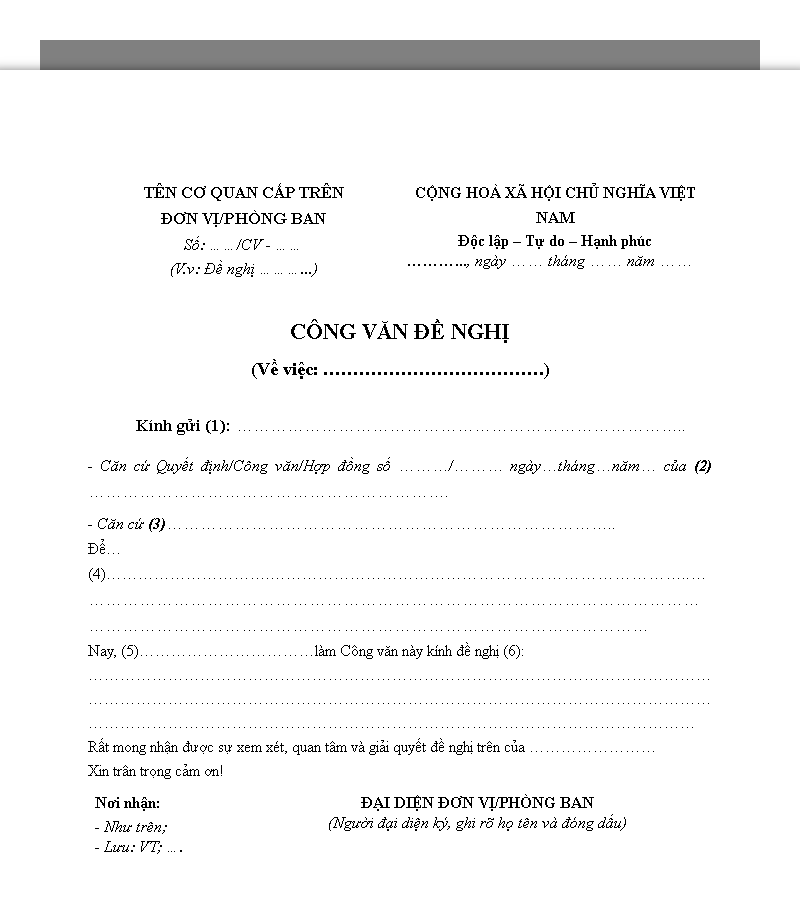
Download the general official request letter template (Free Word Download)
2. Official request for support letter templates
Depending on the nature of the work, the official request letter needs to have its language, content, and level of detail adjusted accordingly. Below are popular official request letter templates for specific purposes:
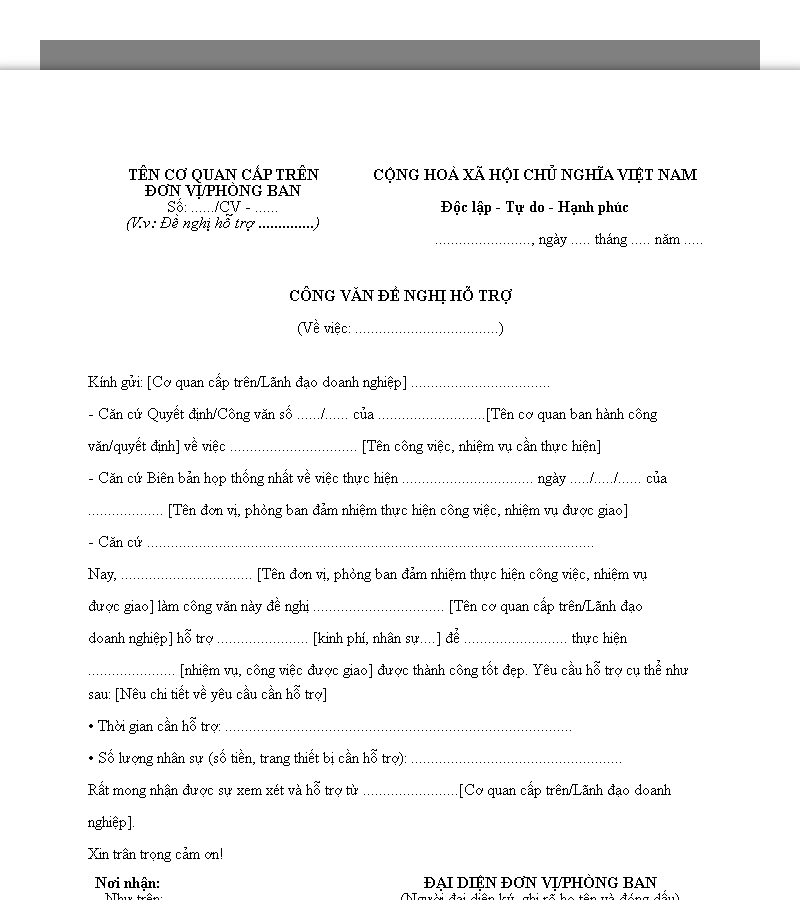
Download the Official Request for Support Letter Template Now
3. Official request for payment letter template
An official request for payment letter is an important administrative document commonly used in businesses to request a related party (partner, employer, or government agency) to make timely payments according to a contract, invoice, or agreed-upon commitment. This document not only facilitates cash flow but also serves as legal evidence in case of disputes, helping to protect the requester’s rights effectively and professionally.
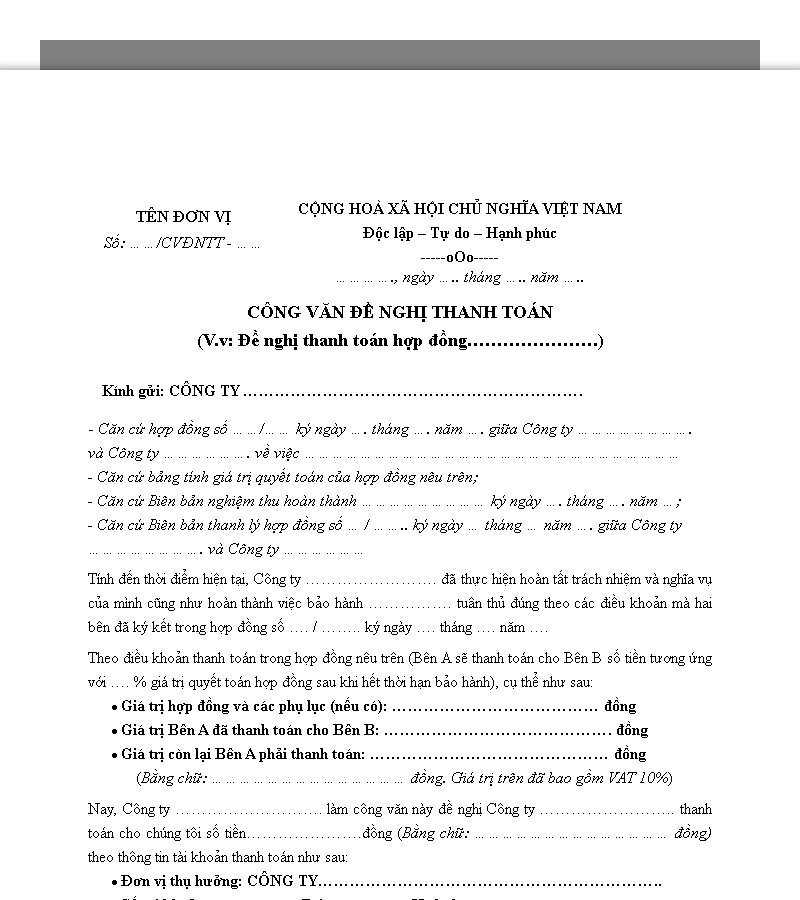
Download the Official Request for Payment Letter Template Now
4. Official request for coordination letter template
An official request for coordination letter is an administrative document created to call for support and cooperation from related units, departments, or organizations to jointly carry out a task, project, or common work. With formal and clear language, this letter helps ensure unified action among all parties, avoiding a lack of synchronization, while demonstrating a spirit of responsibility and professionalism in collective work.
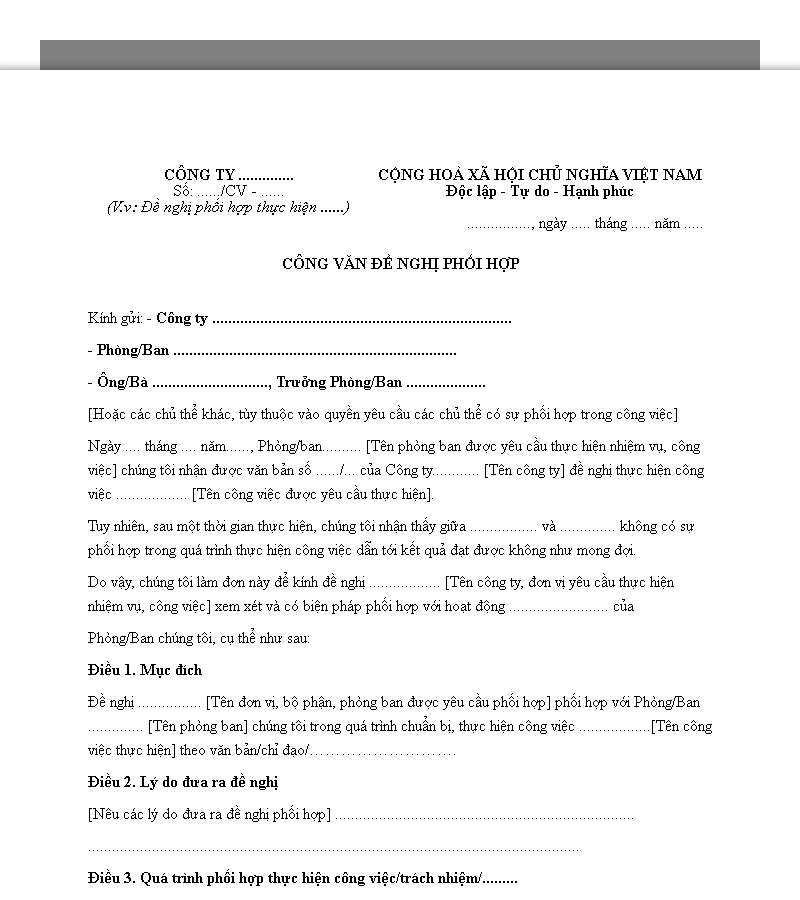
Download the Official Request for Coordination/Cooperation Letter Template Now
An official request letter to finalize social insurance (SI) records is a mandatory document that employers must send to the SI agency when an employee resigns, transfers, or terminates their contract. This document helps complete the procedure of recording the entire process of SI contributions and benefits, ensuring rights to pensions, unemployment, and health insurance for the employee, while also helping the business comply with legal regulations on social insurance.
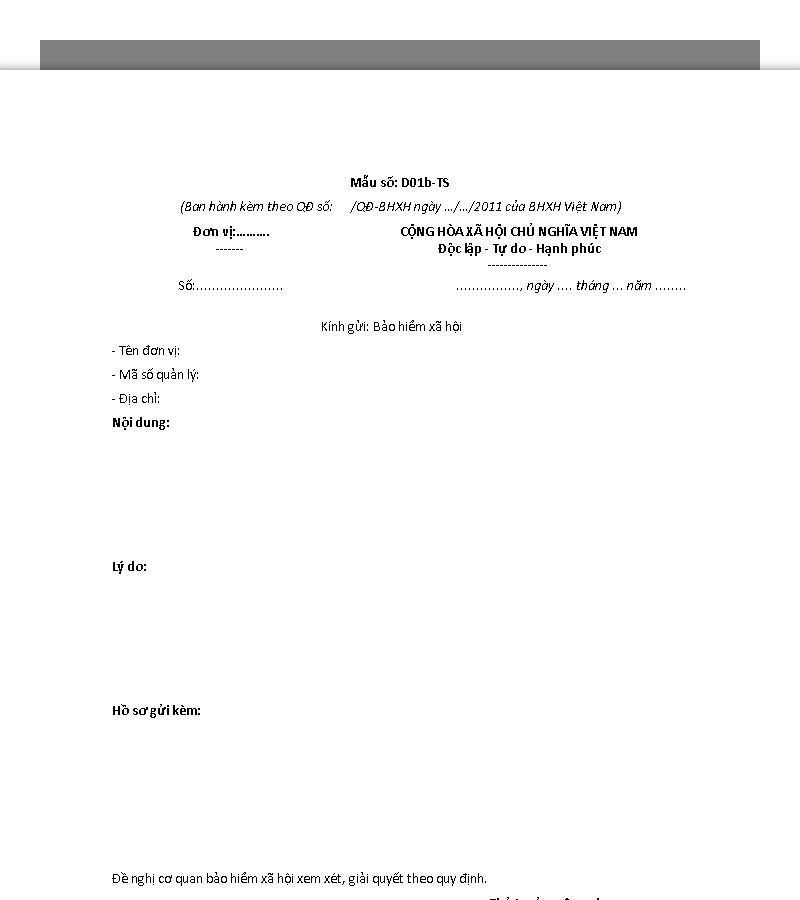
Download the Official Request to Finalize SI Records Letter Template Now
6. Official request for commendation letter template
An official request for commendation letter is a document created by an agency, unit, or organization to submit to a higher competent authority (People’s Committee, Ministry, sector, etc.) for consideration, recognition, and awarding of commendations (certificates of merit, awards, titles, etc.) to collectives or individuals with outstanding achievements in their work, labor, or studies. This document not only acknowledges contributions but also creates motivation for competition and encourages a spirit of responsibility and dedication.
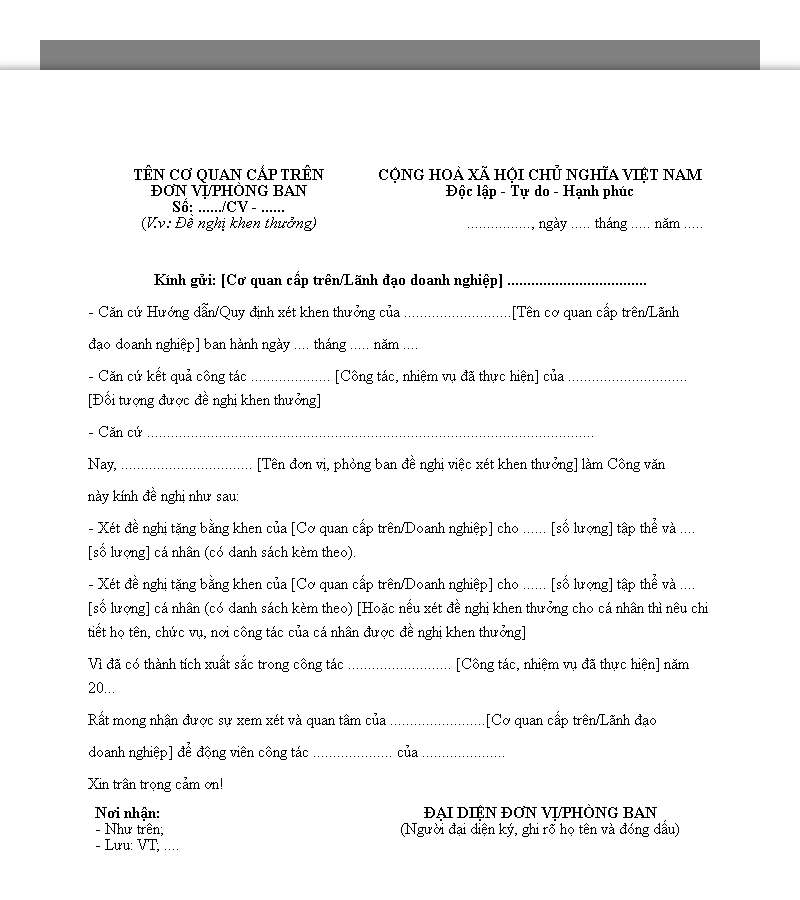
Download the Official Request for Commendation Letter Template Now
7. Official request letter template to register salary scale
An official request letter to register the salary scale is an important document that a business sends to the Department of Labor, Invalids and Social Affairs (or the competent authority) to officially register its internal salary system, including basic salary levels, allowances, and scales by job title. This helps ensure transparency, legality, and compliance with regional minimum wage regulations, while also creating a legal basis for implementing proper salary payments, protecting the rights of both the business and the employees.
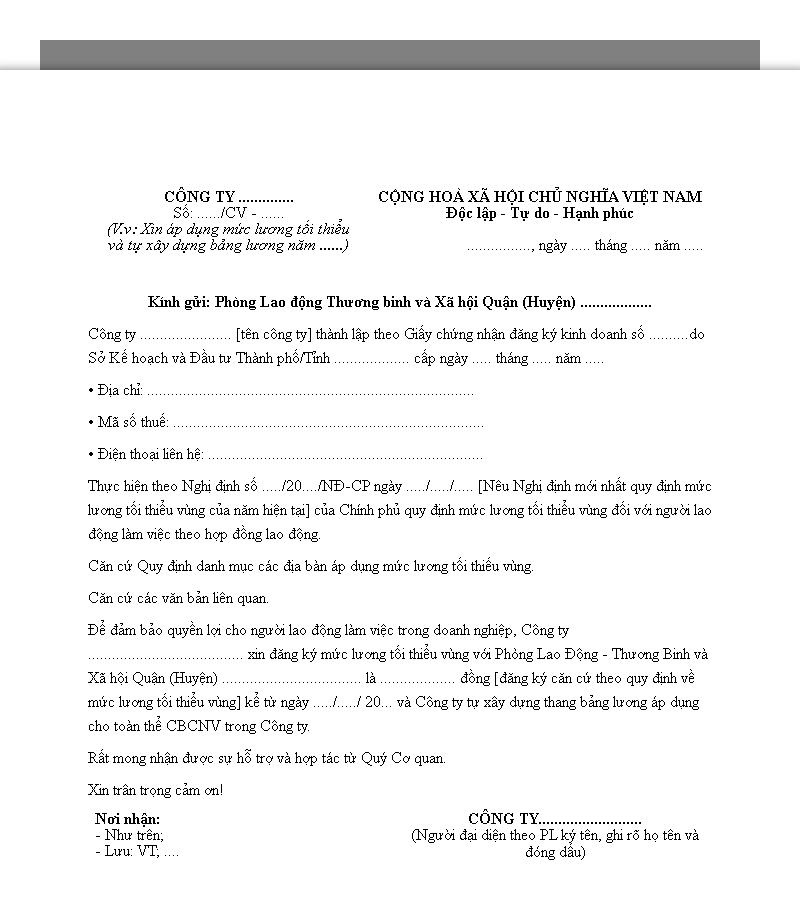
Download the Official Request to Register Salary Scale Letter Template Now
8. Notes on using official request letter templates
Although using pre-made templates saves time, when applying them, you need to:
-
Adjust the content to fit the actual situation
-
Ensure the signatory has the proper authority
-
Direct delivery: Submit the letter at the clerical or administrative department of the receiving unit. This method is suitable for important letters that require immediate confirmation of receipt.
-
Send by post: Used when sending official letters to government agencies or remote partners; it is advisable to use registered mail for verification purposes.
-
Send via email: Often used in parallel with a hard copy, in the form of a PDF file with a signature and seal (or digital signature). Suitable for quick exchanges or to shorten processing time.
-
Send via electronic portal: For agencies with online document submission systems, it is necessary to comply with the specific format and procedures of each portal.
-
Store the original copy (with signature, seal) at the clerical department
-
Store copies for relevant departments to track work
-
Store all attached documents (appendices, accompanying files)
-
Classify clearly by:
-
Year of issue
-
Type of letter
-
Receiving unit/individual
-
-
Fully record the sending date, channel, and receiving person/unit
-
Save the confirmation of receipt (receipt slip, email response)
-
Proactively follow up after 5–7 business days if there is no response
-
Note the results of the communication as a basis for next steps
-
The requested content has been resolved
-
Need to request additional information or clarification
-
Cannot be resolved yet and need to state the reason
-
Request an extension of the processing time
<li data-start="38
Below is a process applied by many businesses and organizations, ensuring professionalism, transparency, and easy control. It is suitable for standardizing internal processes and sharing on the website.
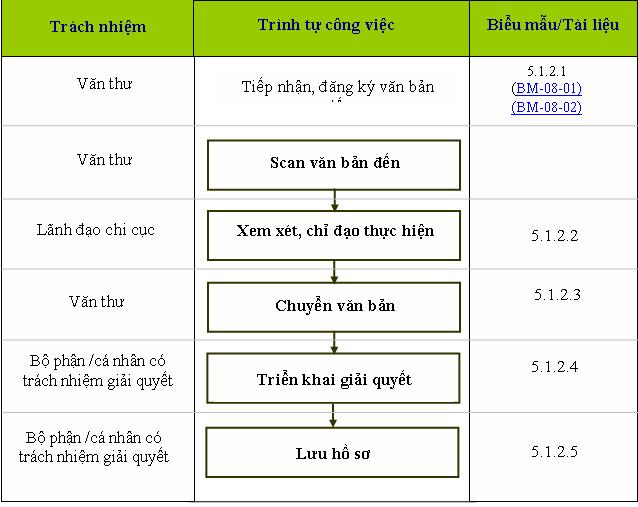
1. Choose the appropriate channel for sending official letters
The choice of sending channel should be based on the nature of the letter, the recipient, and the level of urgency. Sending through the correct channel helps ensure the letter is validly received and processed by the right authority from the start.
In practice, the channels for sending official request letters often include:
In many cases, to ensure effectiveness, businesses should combine multiple sending channels (e.g., email first, hard copy later) to avoid information disruption.
2. Store and manage official letters systematically
Storing official letters not only serves internal management but also acts as an important legal basis for future reference, explanation, or inspection. Therefore, request letters must be stored completely and systematically immediately after being issued.
An effective storage process needs to ensure:
For medium and large-sized businesses, using document management software will help minimize the risk of loss and increase search efficiency.
3. Track the processing status of official request letters
After sending, request letters need to be tracked proactively, rather than waiting passively for a response. Tracking helps the business understand the processing status and promptly take action to follow up or make adjustments.
The tracking process usually includes:
This approach helps businesses control the processing progress while also demonstrating professionalism in administrative communication.
4. Response letters and closing the processing cycle
A response letter is a crucial step to close the lifecycle of a request letter. Responding in writing helps to clearly confirm the processing results and avoid misunderstandings between parties.
A response letter is often used in the following cases:
For important matters, businesses should not just respond verbally or by phone, but should provide an official written response to ensure legality and transparency.
Conclusion
An effective process for sending and tracking request letters needs to ensure the right channel, right recipient, and right time, accompanied by systematic storage and proactive tracking. This is not just an administrative requirement, but also an element that demonstrates the professionalism and management capability of the business when working with partners and regulatory agencies.