09/05/2026
  174 views
Deposit Receipt Template is an important document that records the handover of a deposit and protects the rights of all parties in case of a dispute. In this article, 1Office will compile 4+ deposit receipt templates with downloadable files, clear content, and easy application for various transactions such as real estate, vehicle, or service purchases.
Mục lục
- 1. General Introduction to Deposit Receipts
- 2. Regulations on deposits and deposit receipts
- 2.1. Key provisions on deposits in the 2015 Civil Code
- 2.2. Related guiding documents and new legal regulations
- 2.3. Rights and obligations of the depositor and the deposit recipient
- 2.4. Legal consequences of breaching a deposit agreement
- Template 3: Record of receiving a deposit for car/motorcycle purchase
- Template 4: Record of receiving a deposit for other transactions (purchase of goods, services…)
- 5. Important notes to avoid risks when making a deposit
- 5.1. Thoroughly review the information and legal status of the parties
- 5.2. Create at least two copies of the receipt with equal legal validity
- 5.3. Do not use a deposit receipt to replace a deposit agreement when strict binding is needed
- 5.4. Note on witnesses
- 5.5. Avoid general and unclear clauses
- 5.6. Dispute resolution plan
- 5.7. Carefully preserve and store records
- 5.8. Clearly write the deposit amount in both numbers and words
- 6. Frequently Asked Questions (FAQs)
1. General Introduction to Deposit Receipts
A deposit receipt (also known as a deposit acknowledgment or deposit handover record) is a document created by the involved parties to confirm that one party has given the other a sum of money or a valuable asset, with the purpose of securing the signing or execution of a future contract.
According to Article 328 of the 2015 Civil Code, a deposit is a measure to secure the performance of a civil obligation, whereby the depositor gives the deposit recipient a sum of money, precious metals, gemstones, or other valuable assets for a specified period to ensure the conclusion or performance of a contract.
Role and Legal Significance:
- Securing Commitment: A deposit helps build trust and create a legal bond between parties before the official contract is signed, especially common in high-value transactions such as real estate, vehicles, or valuable goods.
- Penalty for Breach: If the contract is concluded and performed, the deposit will be returned or deducted from the payment obligation. If the depositor refuses to conclude or perform the contract, the deposit belongs to the recipient; conversely, if the recipient refuses, they must return the deposit and pay an equivalent amount in compensation, unless otherwise agreed.
- Evidentiary Value: The deposit receipt serves as crucial legal evidence proving that the asset handover has occurred, thereby protecting the legitimate rights and interests of all parties in the event of a dispute.
1.1. Differentiating Between a “Deposit Receipt” and a “Deposit Agreement”
Although both relate to the deposit measure under Article 328 of the 2015 Civil Code, they have distinct differences in content, purpose, and legal value:
| Criteria | Deposit Agreement | Deposit Receipt Record |
| Main Content | Fully stipulates all agreements regarding the deposit, such as: the deposit amount/asset, the purpose of the security (to enter into or perform the contract), the term, deposit penalties and compensation, information about the transacted asset, and the rights and obligations of the parties. | Primarily confirms the actual handover and receipt of the deposit, including the amount, time, method of handover, and confirmation of full receipt, often accompanied by a brief commitment. |
| Purpose of Use | Used when a detailed legal document is needed as the foundation for the entire transaction, usually signed before or concurrently with the deposit handover. | Used as evidence to prove the actual money handover, often created with or after the deposit agreement, especially when handing over cash or in multiple installments. |
| Legal Validity | Is an independent civil transaction with clear binding effects regarding deposit penalties and compensation for damages, and serves as the primary basis for legal action in case of a breach. | Serves as supplementary evidence. In the absence of a separate deposit agreement, the record can still be considered a deposit agreement if its content clearly expresses the will of the parties. |
| When to Use | Suitable for complex, high-value transactions (such as real estate purchases or transfers) that require clear stipulations of conditions and penalties. | Suitable for simple transactions or to supplement a deposit agreement, focusing on confirming the handover of money. |
Note: The 2015 Civil Code does not require deposits to be made in writing (unlike the 2005 Civil Code), but in practice, parties should create a written document to avoid disputes and facilitate proof before the law.
1.2. The importance of creating a deposit receipt in accordance with legal regulations
Creating a legally compliant deposit receipt (with clear content, complete information, signatures from all parties, and made in multiple copies) plays a particularly important role in civil transactions:
- Protecting the rights of all parties: The receipt serves as clear legal evidence in case of disputes, helping the court accurately determine obligations for refunds, deposit penalties, or compensation for damages.
- Mitigating legal risks: A written deposit agreement helps prevent denial of the money transfer or loss of the right to claim the deposit. In real estate transactions, the receipt also helps prove the transaction is genuine, avoiding the risk of it being declared void due to lack of evidence.
- Enhancing transparency and commitment compliance: Specifically recording the amount, deadline, and penalties helps all parties clearly understand their responsibilities, thereby minimizing conflicts and disputes.
- Consequences of improper creation: A missing or poorly drafted receipt can make it difficult to provide proof in court, lead to the loss of the right to impose a penalty, or result in the transaction not being legally recognized as a deposit.
A deposit receipt is not just a formality but an important legal tool that ensures the security of the transaction. Parties should use a suitable template, record all necessary information, and consider notarization to increase its evidentiary value when needed.

2. Regulations on deposits and deposit receipts
Below is a summary of current legal regulations governing deposits and the creation of deposit receipts, helping you apply them correctly and mitigate legal risks:
2.1. Key provisions on deposits in the 2015 Civil Code
The deposit measure is directly regulated in Article 328 of the 2015 Civil Code, with the following basic contents:
- Clause 1: A deposit is understood as one party giving another party a sum of money, precious metals, gemstones, or other valuable assets for a specified period to secure the conclusion or performance of a contract.
- Clause 2: When the contract is signed and performed as agreed, the deposit asset will be returned to the depositor or deducted from the payment obligation. If the depositor refuses to conclude or perform the contract, the deposit asset belongs to the deposit recipient. Conversely, if the deposit recipient refuses to conclude or perform the contract, they must return the deposit asset and pay an additional amount equivalent to its value, unless otherwise agreed by the parties.
Compared to the 2005 Civil Code, the 2015 Civil Code no longer requires deposits to be made in writing; they can be established through verbal agreement or actual conduct. However, to mitigate risks and facilitate proof in court, parties should still create a clear written document, such as a deposit agreement or a deposit receipt.
Decree 21/2021/ND-CP dated March 19, 2021, provides detailed regulations for the implementation of the Civil Code on securing the performance of obligations, clarifying the rights and obligations of parties in a deposit relationship (Article 38), the principles for handling deposit assets, and the application of the deposit measure to agreements not explicitly named “deposit” but having a corresponding content and nature.
The 2023 Law on Real Estate Business (Law No. 29/2023/QH15), effective from January 1, 2025, has added specific regulations to control deposit activities in transactions of off-plan real estate (houses, construction projects not yet completed), as follows:
- The developer can only receive a deposit of up to 5% of the selling price or lease-purchase price, and only when the real estate is eligible to be put into business (Clause 5, Article 23).
- The deposit agreement must clearly state the selling price or lease-purchase price.
- The first payment, including the deposit, must not exceed 30% of the contract value; the total amount paid by the buyer before handover must not exceed 95% if the Certificate of Ownership has not yet been issued.
These regulations were issued to enhance buyer protection and limit the abuse of large deposits when projects have not yet met legal requirements. As of 2026, there have been no significant changes in the law regarding deposits in general; guiding documents for the implementation of the Law on Real Estate Business, such as Decree 96/2024/ND-CP, continue to be applied.
2.3. Rights and obligations of the depositor and the deposit recipient
According to Article 328 of the 2015 Civil Code and Article 38 of Decree 21/2021/ND-CP, the rights and obligations of the parties are stipulated as follows:
| Related Party | Basic Rights | Primary Obligations |
| Depositor | – To have the deposit asset returned or deducted from the payment obligation when the contract is signed and executed.
– To have the right to receive back the deposit asset along with an equivalent amount of money if the deposit recipient refuses to enter into or execute the contract, unless otherwise agreed by the parties. |
– To deliver the deposit asset on time and with the agreed-upon value.
– To fully fulfill the commitment to enter into and execute the main contract. |
| Deposit Recipient | – To have the right to own the deposit asset if the depositor violates the obligation to enter into or execute the contract.
– To deduct the deposit asset from the payment obligation when the contract is executed as agreed. |
– To return the deposit asset and compensate with an equivalent amount of money when they are the breaching party (unless otherwise agreed).
– To preserve the deposit asset during the holding period. – To correctly fulfill the commitment to enter into and execute the main contract. |
The parties have the right to agree on other rights and obligations, provided they are not contrary to the law.
2.4. Legal consequences of breaching a deposit agreement
Pursuant to Clause 2, Article 328 of the 2015 Civil Code, the legal consequences of making a deposit are determined as follows:
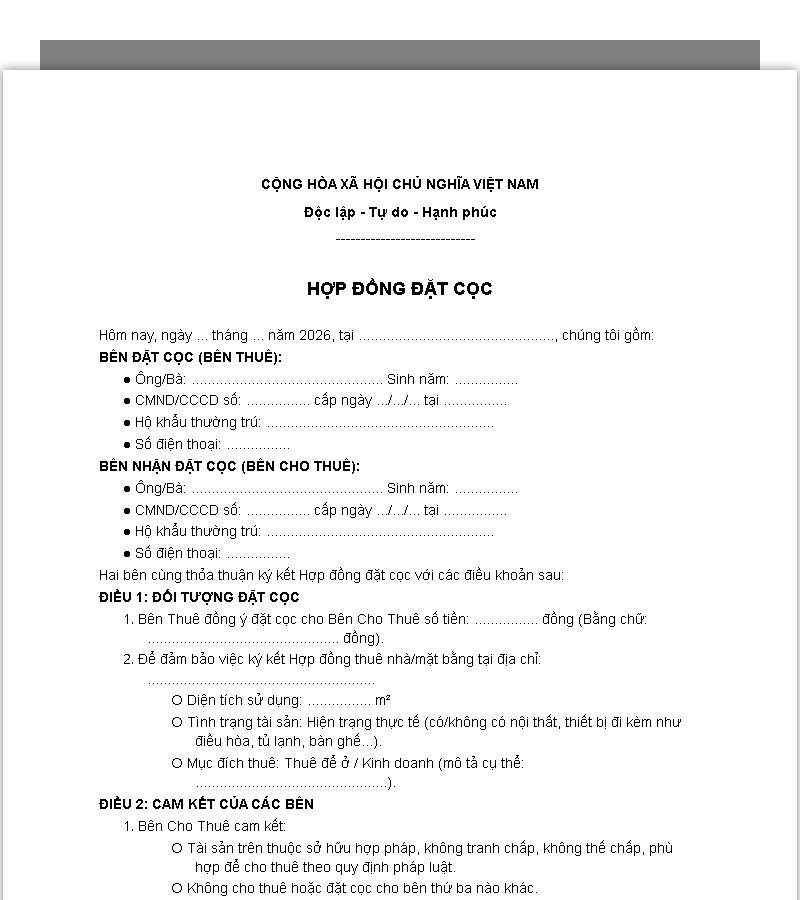
- The contract is signed and executed as committed: The depositThis record template is used in residential, apartment, or business premises rental transactions to document the receipt of a deposit and basic agreements before signing the official lease contract.
Notes on using the template:
- Lease term: Clearly define the lease period from the start date to the end date, including conditions for extension or early termination, if any.
- Rent and payment: Specify the monthly rent, payment due date, payment method, and principles for rent adjustment throughout the lease term.
- Security deposit: Usually equivalent to 1–3 months’ rent, used to secure the lessee’s obligations; clearly state the conditions for refund upon lease expiration and in the absence of any violations.
- Premises handover: Describe the condition of the house/premises, furniture, and accompanying equipment at the time of handover, along with responsibilities for maintenance and repair.
- Additional agreements: Clearly define penalties if a party breaches the commitment (forfeits the deposit, refuses to lease) and should be accompanied by an asset handover record to avoid disputes.

Template for record of receiving a deposit for house/premises rental >>> Download the Template for Record of Receiving a Deposit for House/Premises Rental now
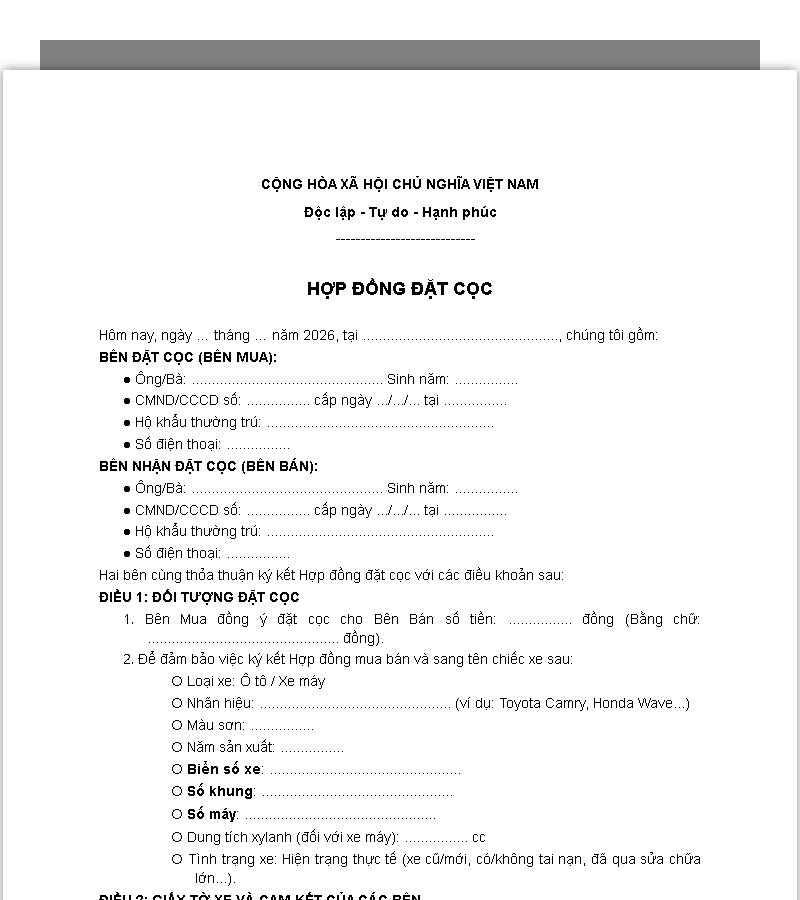
Template 3: Record of receiving a deposit for car/motorcycle purchase
Applicable for new or used vehicle purchase transactions, emphasizing the need to fully record vehicle identification information to mitigate the risk of disputes over origin.
Instructions for using the record template:
- Mandatory information: License plate number, frame number, engine number, paint color, year of manufacture, model/type of vehicle.
- Vehicle’s legal documents: Vehicle registration certificate, inspection certificate, insurance, original purchase invoice (if any); accompanied by a commitment that the vehicle is not subject to any disputes, pledges, or mortgages at a bank.
- Other agreed terms: Total transfer value, deadline for paying the remaining balance, responsibility for completing ownership transfer procedures, and deposit penalty amount if either party breaches the commitment.
Recommendation: It is advisable to have the vehicle’s condition checked at a reliable garage and to notarize the purchase contract to make the ownership transfer process smoother and more secure.
Template for record of receiving a deposit for car/motorcycle purchase >>> Download the Record of Receiving a Deposit for Car/Motorcycle Purchase now
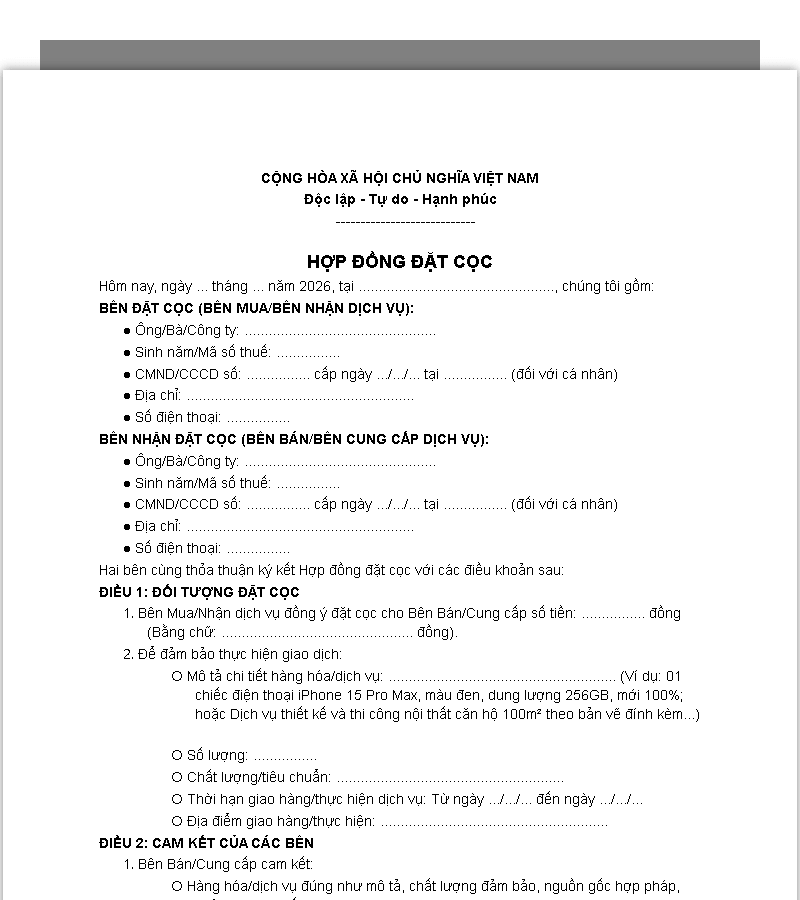
Template 4: Record of receiving a deposit for other transactions (purchase of goods, services…)
This is a general record template that can be used flexibly for various transactions such as the sale of goods (phones, equipment, machinery, agricultural products…), service provision, or other civil agreements.
Instructions for using the record template:
- Clearly define the transaction content: Specify the name of the goods or services, quantity, standards/quality, and total transaction value.
- Deposit terms: Clearly state the deposit amount, the deadline for signing the official contract, and the penalties for breach of commitment by either party.
- Flexibility: Terms related to warranty, delivery time and method, and installment payments can be added or adjusted.
Scope of application: Suitable for both small-value and large-scale transactions, easily customizable to meet the specific needs of each case.
Template for record of receiving a deposit for other transactions Checklist of items to review before signing a deposit agreement To minimize the risk of losing your deposit or encountering disputes, you should thoroughly check the following items before signing:
- Information of the parties: Full name, ID card/Citizen ID, address, and phone number must be recorded completely, accurately, and consistently.
- Subject of the transaction: Specifically describe the asset, goods, or service (address, license plate, related legal documents, etc.).
- Deposit amount: Clearly state in both numbers and words; specify the payment method (cash or bank transfer).
- Deadline and commitment: Clearly define the time for signing the official contract and how the deposit will be handled in case of a breach (forfeiture of deposit or double refund according to Article 328 of the 2015 Civil Code).
- Legal documents of the asset: Check the legality, such as the land use right certificate, vehicle registration; confirm there are no disputes, no mortgages, and no planning restrictions (can be verified with the competent authority if necessary).
- Breach clauses: Clearly state the responsibilities and penalties when one of the parties fails to comply with the agreement.
- Notarization or witnessing: Prioritize notarization for high-value transactions; for handwritten agreements, there should be a witness.
- Final review: Both parties should reread the entire content to ensure a clear understanding of their rights and obligations before signing and fingerprinting.
Note: The sample agreements are for reference only. For complex or high-value transactions, you should consult a lawyer to ensure safety and full legal compliance.
5. Important notes to avoid risks when making a deposit
For a deposit transaction to be conducted safely, clearly, and with minimal legal risks and disputes, the parties should pay special attention to the important points below, based on Article 328 of the 2015 Civil Code:
5.1. Thoroughly review the information and legal status of the parties
Before signing the deposit receipt or agreement, it is necessary to fully check the other party’s personal information:
- Full name
- ID card/Citizen ID card
- Permanent residence
- Marital status
- Relevant legal status.
For real estate transactions, the legal status of the property must be clearly verified: legal certificate, no disputes, not mortgaged, and not under any planning restrictions.
If the property is under joint ownership (spouses or co-owners), the consent of all owners is required. Consulting a lawyer or looking up information at the competent authority will help avoid the risk of a void contract or unnecessary financial loss.
5.2. Create at least two copies of the receipt with equal legal validity
The deposit receipt should be made in at least 02 original copies with identical content, signed by all parties (and fingerprinted if necessary). Each party keeps one copy as evidence in case of disputes. Having a witness sign will help increase the objectivity and transparency of the transaction.
5.3. Do not use a deposit receipt to replace a deposit agreement when strict binding is needed
A deposit receipt only serves to record the payment and receipt of money, while a deposit agreement is a document that specifies the rights, obligations, purpose of the deposit, deadline, and penalties for breach. For high-value transactions, especially real estate purchases, a separate deposit agreement should be created to ensure legal validity and a higher degree of binding. The receipt should only be considered supplementary evidence.
5.4. Note on witnesses
The witness should be an independent third party with no vested interest or blood relationship with the transacting parties. The witness’s information must be fully recorded (full name, ID card/Citizen ID card, address) and they must sign the receipt. This is a crucial factor that enhances the evidentiary value when resolving disputes in court.
5.5. Avoid general and unclear clauses
The content of the receipt or agreement should be specific and detailed: accurately describe the deposited asset, the deposit period, the signing date of the main contract, the remaining payment method, and the deposit penalty clauses according to legal regulations or specific agreements. Avoid using vague phrases like “after completing procedures” without defining a clear deadline.
5.6. Dispute resolution plan
In case of a dispute, direct negotiation in good faith should be prioritized. If an agreement cannot be reached, the parties can opt for mediation at the commune/ward People’s Committee or a mediation center. If the issue remains unresolved, they have the right to file a lawsuit at the competent People’s Court according to the Civil Procedure Code. Clearly stating the dispute resolution method in the receipt or agreement will facilitate the process.
5.7. Carefully preserve and store records
The original deposit receipt/agreement, along with related documents such as bank statements and copies of personal identification, should be kept in a safe place. It is advisable to back them up with photos or digital copies in case of loss. These are important pieces of evidence if a dispute arises or when dealing with competent authorities.
5.8. Clearly write the deposit amount in both numbers and words
The deposit amount should be accurately expressed in both numbers and words to avoid confusion (e.g., 100,000,000 VND – One hundred million dong). Bank transfers are preferred to have clear transaction records and limit disputes over whether the money has been exchanged.

Important notes to avoid risks when making a deposit 6. Frequently Asked Questions (FAQs)
Question 1: Is a handwritten deposit receipt legally valid?
Yes. A handwritten deposit receipt or agreement is still legally valid if it meets the conditions for a valid civil transaction: the parties have legal capacity, act voluntarily, and the content does not violate legal prohibitions or social ethics. The law does not require notarization/authentication. However, it is advisable to create a clear document, have a witness, and prioritize notarization to increase its evidentiary value in case of a dispute.
Question 2: Can the deposit be refunded? In which cases?
Yes, depending on the case:
- The main contract is signed and executed correctly: the deposit is refunded or deducted from the payment.
- The deposit recipient breaches the agreement: they must refund the deposit and pay an additional equivalent amount (unless otherwise agreed).
- In cases of force majeure, objective obstacles, or mutual fault: the deposit is refunded without penalty.
- The deposit agreement or the main contract is void: the parties return what they have received from each other.
Conversely, if the depositor unilaterally refuses to proceed without a legitimate reason, they will forfeit the deposit.
Question 3: When is it necessary to notarize a deposit receipt?
The law does not mandate notarization for deposits. However, notarization is recommended when:
- The real estate transaction is of high value.
- A notary is needed to verify the legal status of the property.
- You want to increase the evidentiary value and bind the parties’ responsibilities.
Question 4: What is the maximum deposit penalty according to the law?
The law does not specify a maximum amount. If there is no other agreement, the default penalty is equal to the deposit amount (the breaching party forfeits the deposit or pays double). The parties are free to agree on a higher or lower penalty, as long as it does not violate the law or social ethics. In practice, the court may adjust the penalty if it is deemed excessively unreasonable.
Using a standard Deposit Receipt Template not only helps make transactions transparent but also serves as crucial legal grounds in case of disputes. You can download and directly use the 4+ templates in this article, while also adjusting the content to fit each specific transaction to ensure legal safety.