


 09/05/2026
  156 views
Asset handover – from computers, company phones, vehicles, and production machinery to documents and project files – is one of the most crucial processes for ensuring transparency, accountability, and effective management in businesses, state agencies, and civil transactions. The asset handover record is a “living document” that accurately records the list, quantity, condition, and value of assets, as well as the time of transfer of ownership/management rights. It helps parties avoid losses, liability disputes, or errors during subsequent inventory checks and inspections. In this article, we will provide a detailed explanation of what an asset handover record is, its purpose, legal importance, applicable asset types, relevant legal basis, and the standard creation process – helping you understand and apply it effectively in asset management practice in 2026!
Mục lục
- What Is an Asset Handover Record?
- Legal Basis for Creating an Asset Handover Record
- Guide on How to Create an Asset Handover Record
- Collection of 10+ Common Asset Handover Record Templates
- Template 1: Handover of work tools and instruments
- Template 2: Handover of project documents and records
- Template 3: Handover of system accounts and passwords
- Template 4: Handover and receipt of public assets according to Circular
- Template 5: Handover of assets between administrative and public service units
- Template 6: Handover of official cars/motorcycles
- Template 7: Handover of production machinery
- Mẫu 8: Bàn giao thiết bị máy tính, điện thoại
- Mẫu 9: Bàn giao tài sản góp vốn
- Mẫu 10: Bàn giao tài sản giữa các công ty sáp nhập, chia tách
- Những Sai Lầm Khi Lập Biên Bản Bàn Giao Tài Sản
- Câu Hỏi Thường Gặp Về Biên Bản Bàn Giao Tài Sản
What Is an Asset Handover Record?
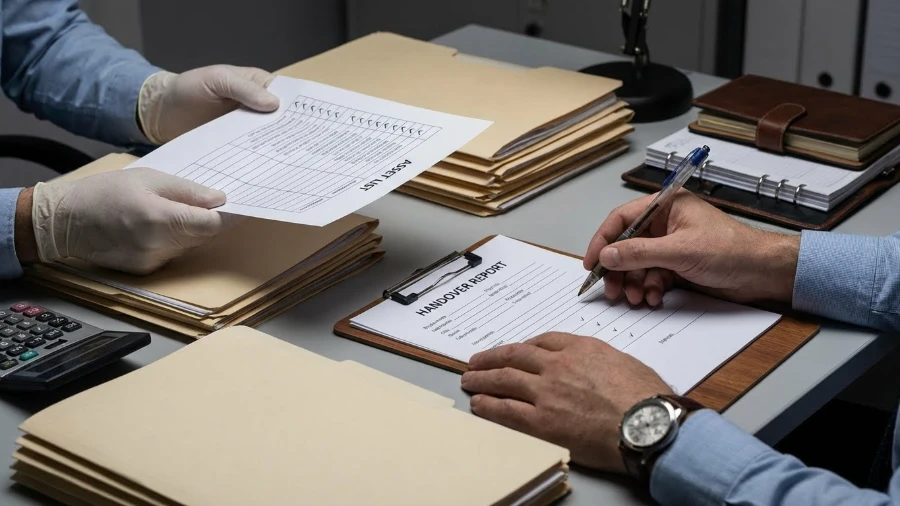
An asset handover record is an administrative document (or an agreement) created between relevant parties to officially document the transfer of ownership, management, or usage rights of one or more specific assets from the handing-over party (owner, managing unit) to the receiving party (individual, organization, new unit).
This document details the list of assets, quantity, current condition, remaining value (if any), and accompanying documents (invoices, ownership certificates, warranties, etc.). It also confirms the mutual agreement of all parties on the time of transfer and the responsibilities for maintenance and use after the handover.
Simply put: It is an official “transfer confirmation,” similar to a house handover record in a real estate transaction, a vehicle handover record upon transfer, or a machinery handover record when changing departments within a business.
Purpose of Use
An asset handover record is created for the following main purposes:
- Confirming ownership and management rights: Clearly proves the moment the receiving party officially becomes the owner or manager of the asset, and begins to bear responsibility for its maintenance, use, and depreciation (if applicable).
- Serving as a legal basis for dispute resolution: It is crucial evidence before a court, inspection agency, or auditor in case of conflicts regarding loss, damage, misplacement, or ownership disputes.
- Ensuring transparency in the transfer process: Guarantees that the transaction is conducted openly and objectively, avoiding “verbal agreements” that can lead to misunderstandings or fraud.
- Supporting asset management and accounting: It is a mandatory document for recording changes in fixed assets and tools in accounting books, financial statements, periodic inventories, and tax finalization (in accordance with the Law on Accounting 2015 and Circular 200/2014/TT-BTC).
Legal Importance
An asset handover record holds significant legal value for the following reasons:
- It is legal evidence recognized by courts and state agencies if prepared correctly (with signatures of all parties, no erasures, and accompanied by relevant documents).
- It serves as a basis for determining liability (the receiving party is responsible for maintenance and compensation for loss/damage due to subjective fault – according to Articles 280, 281 of the Civil Code 2015).
- Cases where it is mandatory under Vietnamese law:
- Handover of fixed assets when changing management units, upon termination of employment, or during liquidation (Law on Management and Use of Public Property 2017 – applicable to state assets).
- Handover of assets in sales or lease contracts (Commercial Law 2005, Civil Code 2015).
- Handover of assets during business division, separation, or merger (Law on Enterprises 2020).
- Handover of tools, instruments, and machinery at the end of a project (Decree 06/2021/ND-CP on management of construction investment projects).
Failure to create a record, or creating a cursory one, can lead to difficulties in proving ownership, determining compensation liability, or having it rejected by audit or tax authorities during finalization.
Applicable Asset Types
Asset handover records are typically used for almost all types of assets, including:
- Tangible Assets:
- Fixed assets: Machinery, equipment, vehicles, workshops, offices.
- Tools and instruments: Computers, phones, printers, office furniture.
- Raw materials, inventory (during warehouse transfers, shift handovers).
- Intangible Assets:
- Software, copyrights, software accounts, digital data (when transferring usage rights).
- Documents and papers: Contracts, invoices, original vouchers, accounting books, ownership certificates.
- Other Assets:
- Public assets (state assets, assets of state-owned enterprises).
- Leased assets (when returning to the owner).
- Liquidated assets (when a business is dissolved or goes bankrupt).
The asset handover record is an important and indispensable tool in asset management for businesses, state agencies, and civil transactions. Creating a detailed, objective record with complete signatures will help all parties protect their interests, ensure process transparency, and minimize legal risks.
Legal Basis for Creating an Asset Handover Record
Creating an asset handover record in Vietnam is not just an internal administrative procedure but is also governed by a strict legal framework to ensure transparency, accountability, and evidentiary value in case of disputes. Below are the main legal bases and an analysis of the record’s legal value.

- Civil Code 2015 (amended and supplemented with certain articles up to 2025) This is the foundational document regulating asset handovers:
- Article 117: Conditions for the validity of civil transactions (voluntary, not in violation of the law, participants have civil act capacity).
<li style="
Legal Validity of the Handover Record
An asset handover record has full and binding legal value when it meets the following conditions:
- Conditions for legal validity:
- Drafted in the correct administrative document format (national emblem, motto, signatures of all parties, no erasures – according to Decree 30/2020/ND-CP).
- The parties involved in the transaction have civil act capacity and act voluntarily (Article 117 of the 2015 Civil Code).
- Clear and detailed content: list of assets, quantity, condition, handover time, commitment of responsibility.
- Includes full handwritten signatures (transferor, transferee, witness if necessary) and a seal (if a legal entity).
- Accompanied by original documents (invoices, ownership certificates, inventory records) to increase credibility.
- Evidentiary value:
- Serves as legal evidence prioritized by the court in case of disputes (Article 92 of the 2015 Civil Procedure Code).
- Is the basis for determining the time of transfer of responsibility (the transferee is responsible for compensation if the asset is damaged or lost after the handover).
- Has a binding value equivalent to a supplementary contract, obliging the parties to fulfill the commitments in the record (e.g., commitment to preserve, not to transfer illegally).
The asset handover record is built on a solid legal foundation (Civil Code, Accounting Law, Land Law, Enterprise Law…), has high evidentiary value, and is mandatory in many cases. Drafting the record correctly not only ensures legal compliance but is also the most effective measure to protect the rights of all parties when managing and transferring assets.
Guide on How to Create an Asset Handover Record
An asset handover record is the most crucial document for recording the transfer of management, usage, or ownership rights of assets in a transparent, accurate, and legally valid manner. Creating a standard record not only helps businesses and state agencies comply with accounting and asset inventory regulations but also serves as a solid basis for resolving disputes, compensation claims, or future audits. Below is a detailed guide on how to create an asset handover record accurately according to Vietnamese law (updated 2026), including its structure, inventory list, and practical notes.

Mandatory Information
Record Title, National Emblem, and Motto
Presented at the top of the page, centered:
SOCIALIST REPUBLIC OF VIETNAM
Independence – Freedom – Happiness
ASSET HANDOVER RECORD
(Re: asset handover upon resignation / job transfer / liquidation / sale…)
Time and Place of Record Creation
Record the exact time to the minute:
At … hours … minutes, on … day of … month, year 2026
- At: …………………………………………………………… (e.g., Warehouse, 2nd floor, ABC Co., Ltd., 123 Le Loi Street, District 1, Ho Chi Minh City)
- Information of Participating Parties
- Transferor: Full name: …………………………………………………………… Title: …………………………………………………………… Department/Unit: …………………………………………………………… ID/Tax Code: …………………………………………………………… Contact information: ……………………………………………………………
- Transferee: Same as above.
- Witness (if any – recommended for high-value assets): Full name, title, department/unit, ID number.
Reason for Handover
- State clearly and specifically:
- Employee resignation.
- Job/department transfer.
- Sale or transfer of assets.
- Liquidation or disposal of assets.
- Lease or loan for use. Example: “Handover of fixed assets to a new employee according to Assignment Decision No. 01/QD-NS dated 01/01/2026”.
Detailed Handover Content (Asset Inventory List)
- Create a detailed table as follows (using a table is recommended for easy tracking):
| No. | Asset Name | Asset Code / Serial number | Unit | Quantity | Current Condition | Value (if any) | Special Notes |
| 1 | Laptop Dell Latitude 5430 | SN: 7X9Y0Z1A2B3C | unit | 1 | 100% new, sealed, not activated | 25,000,000 VND | Configuration: i7-1265U, 16GB RAM, 512GB SSD |
| 2 | HP LaserJet Pro M404n Printer | SN: CNBXC12345 | unit | 1 | Used for 12 months, in good working condition | 8,500,000 VND | 60% ink remaining, includes original box |
| 3 | MDF wood desk | Asset Code: TSCĐ-2025-001 | unit | 1 | Good, no scratches | 3,200,000 VND | Includes 01 swivel chair |
Guide to describing assets specifically:- Avoid generalities (“good”, “broken”): Describe in detail, such as “screen with no scratches, 98% battery, normal operation” or “has a 5cm scratch on the right corner of the desk.”
- How to determine asset value:
- Book value (according to accounting records).
- Remaining value (after depreciation).
- Agreed value between parties (if liquidated or transferred).
- It is not mandatory to record the value if the asset is a low-value tool or instrument.
Commitments of the parties
- The parties agree that:
- The assets are handed over according to the list and in the condition specified in the inventory.
- The receiving party is responsible for preserving and using the assets for their intended purpose, and for compensating for damages if lost/damaged due to subjective fault from the time of signing the record.
- The delivering party commits that the assets have a legal origin and are not in dispute.
- No further claims or disputes regarding the assets after signing.
Signature and full name
REPRESENTATIVE OF THE DELIVERING PARTY REPRESENTATIVE OF THE RECEIVING PARTY
(Sign, write full name, and stamp if any) (Sign, write full name)
WITNESS (if any)
(Sign, write full name)
Number of copies made
- The record is made in 03 copies of equal legal validity:
- Copy 1: Kept at the Accounting / Asset Management department.
- Copy 2: Kept by the delivering party.
- Copy 3: Kept by the receiving party.
Important notes when creating the record
- Presence of the parties: All parties (delivering party, receiving party, witness) must be physically present during the inventory check and signing of the record. Do not sign hastily before conducting a physical inspection.
- Carefully check information and actual assets: Conduct a direct inventory, test operations (machinery, equipment), measure (if necessary), take close-up photos (serial number, damage condition) to attach as an appendix.
- Handling assets with special conditions:
- Existing damage: Clearly state in the inventory list and include a commitment that the receiving party accepts it (no liability will be assigned later).
- Shortages: Create a separate record for shortages, requesting the delivering party to supplement or compensate.
- Principles of validity and responsibility after handover:
- The record is effective immediately upon signing.
- The receiving party is responsible for preserving, using for the intended purpose, and compensating for damages if violated (Article 280 of the 2015 Civil Code).
- Store the record for at least 10 years (according to the Accounting Law).
A standard asset handover record must contain complete information, a detailed inventory list, wet signatures, and be accompanied by visual evidence (photos/videos). Proper creation will help businesses manage assets effectively, comply with the law, and minimize the risk of disputes.
Collection of 10+ Common Asset Handover Record Templates
Handing over assets – from machinery, equipment, vehicles, tools, and instruments to documents and papers – is one of the most important processes in the management of businesses, state agencies, and civil transactions. A standard asset handover record not only helps to accurately record the list, condition, and value of assets but also serves as a solid legal shield, preventing loss, disputes over responsibility, or errors during audits and inspections. In this article, we have compiled a collection of over 10 of the most common asset handover record templates, from handovers upon resignation, departmental transfers, asset liquidation, sales, and leases to the handover of public assets – all structured in a standard format, easy to edit in a Word file, complete with detailed filling instructions and legal notes for you to apply immediately, manage assets effectively, and ensure maximum safety!
Template 1: Handover of work tools and instruments
When an employee resigns, transfers, or changes positions, the handover of work tools and instruments (pens, rulers, specialized tools, labor protection gear…) is a crucial final step to ensure assets are transferred completely and their condition is clear. This handover record helps businesses control small assets, prevent loss, and determine liability for compensation in case of damage or loss, while also creating transparency in internal management.
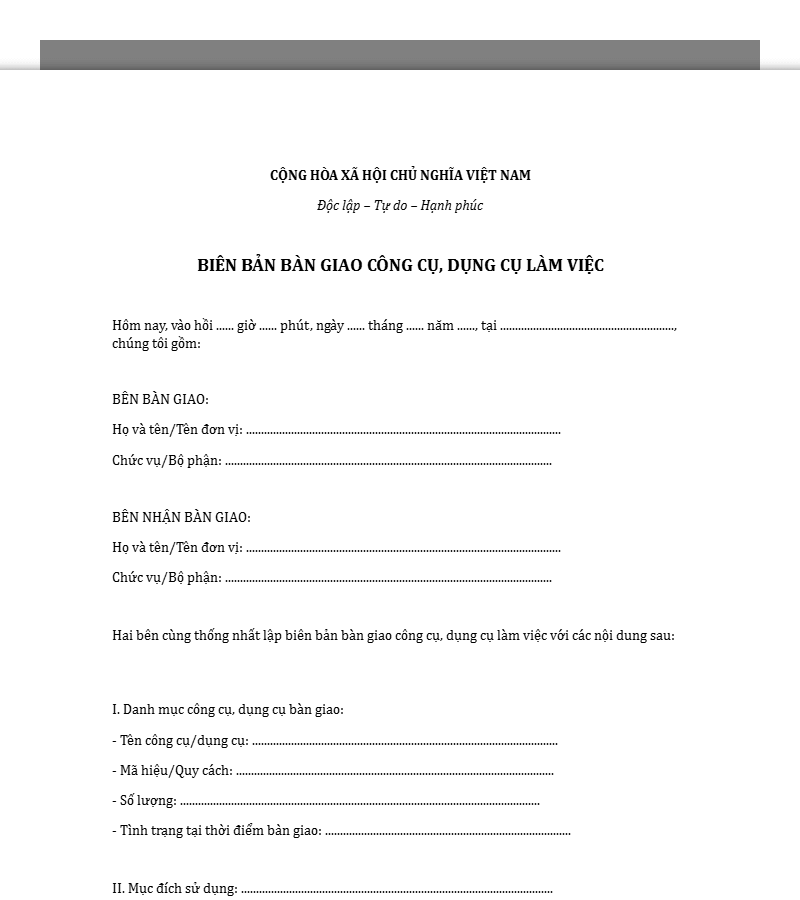
Download the Work Tool and Instrument Handover Record Template Now
Template 2: Handover of project documents and records
Handing over project documents and records (contracts, design drawings, progress reports, acceptance records, technical data…) is a mandatory process when a project concludes, is transferred between parties, or when the responsible personnel changes. This record template helps ensure the integrity and completeness of documents, prevents the loss of important information, and serves as a legal basis for resolving disputes related to intellectual property rights or project implementation responsibilities later on.

Download the Project Document and Record Handover Template Now
Template 3: Handover of system accounts and passwords
In the digital age, the handover of system accounts and passwords (company email, management software accounts, online banking accounts, ERP, CRM systems…) requires a detailed record to document the list of accounts, access rights, passwords (or how to reset them), and confidentiality commitments. This template helps businesses manage information security, avoid the risk of data leaks, and determine responsibility when security incidents occur after the handover.
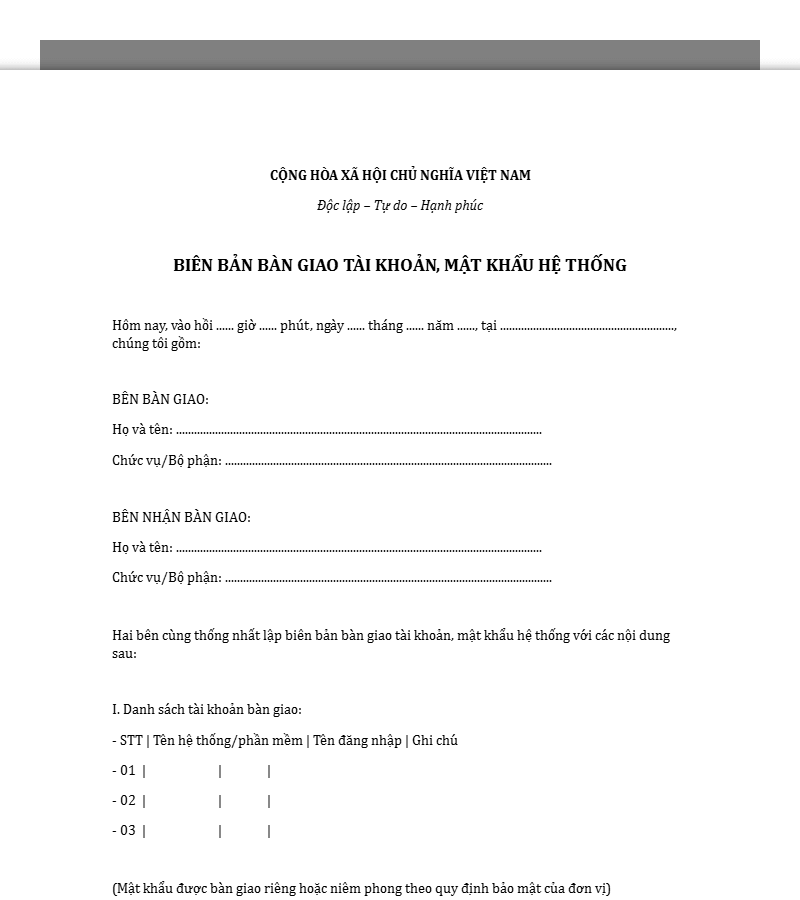
Download the System Account and Password Handover Record Template Now
Template 4: Handover and receipt of public assets according to Circular
For public assets (state assets, assets of administrative and public service units), the handover and receipt must strictly comply with the regulations in the 2017 Law on Management and Use of Public Property and its guiding circulars. This record template is designed according to legal requirements, fully documenting the list, condition, remaining value, and responsibility commitments, helping units manage public assets and avoid errors during inspections, audits, or transfers between agencies.
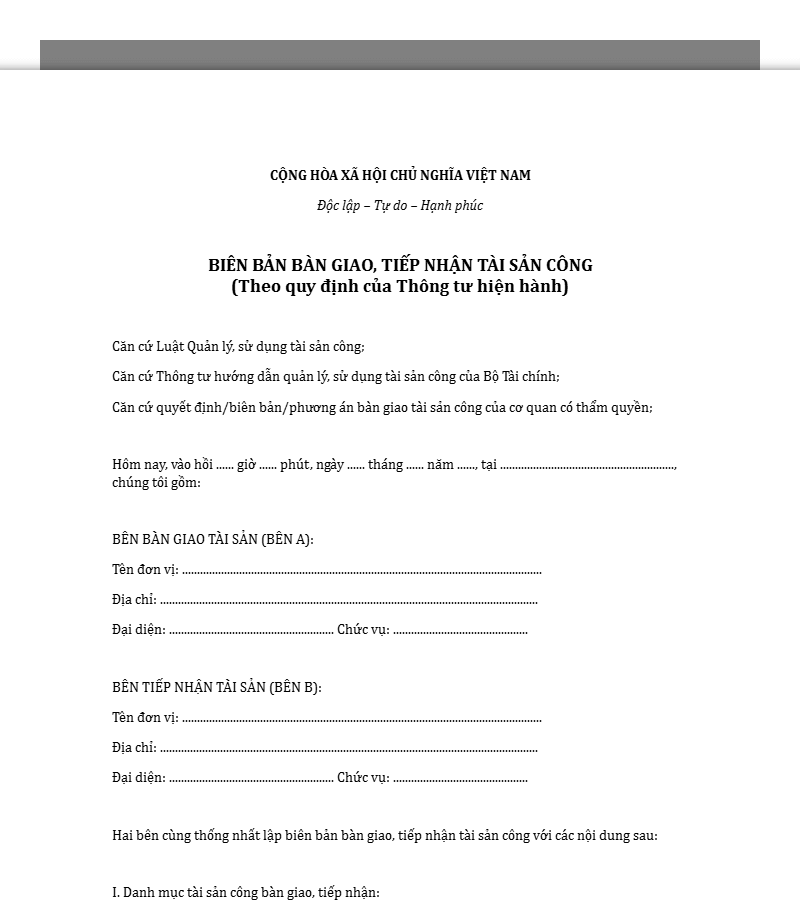
Download the Public Asset Handover and Receipt Record Template According to Circular Now
Template 5: Handover of assets between administrative and public service units
When administrative and public service units (schools, hospitals, state agencies) transfer assets (medical equipment, furniture, office machinery, official vehicles…), the handover record must comply with public asset management regulations. This template ensures transparency and clarity regarding the list, condition of assets, and preservation responsibilities, serving as an important legal basis for state budget settlement and preventing the loss of public assets.
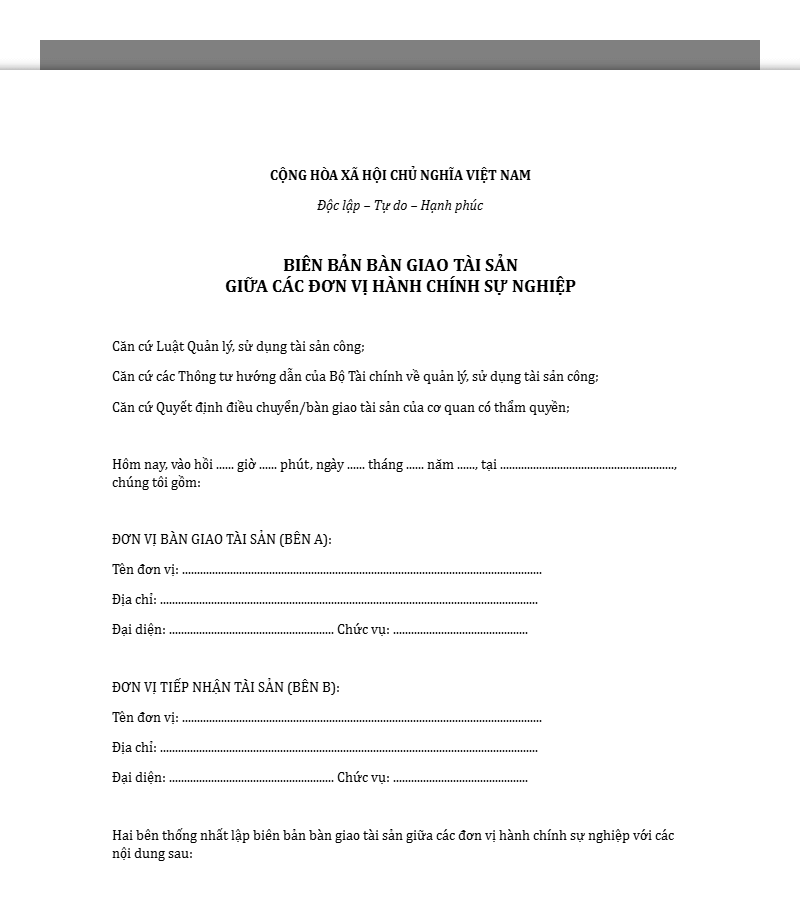
Download the Asset Handover Record Template for Administrative and Public Service Units Now
Template 6: Handover of official cars/motorcycles
Handing over official cars and motorcycles (vehicles for official business, specialized vehicles) is a complex process due to its connection with legal documents, technical condition, and maintenance responsibilities. This record template details the license plate, frame/engine number, vehicle condition, accompanying accessories, odometer reading, and preservation commitments, helping businesses and state agencies manage vehicles tightly and avoid disputes during liquidation or subsequent transfers.
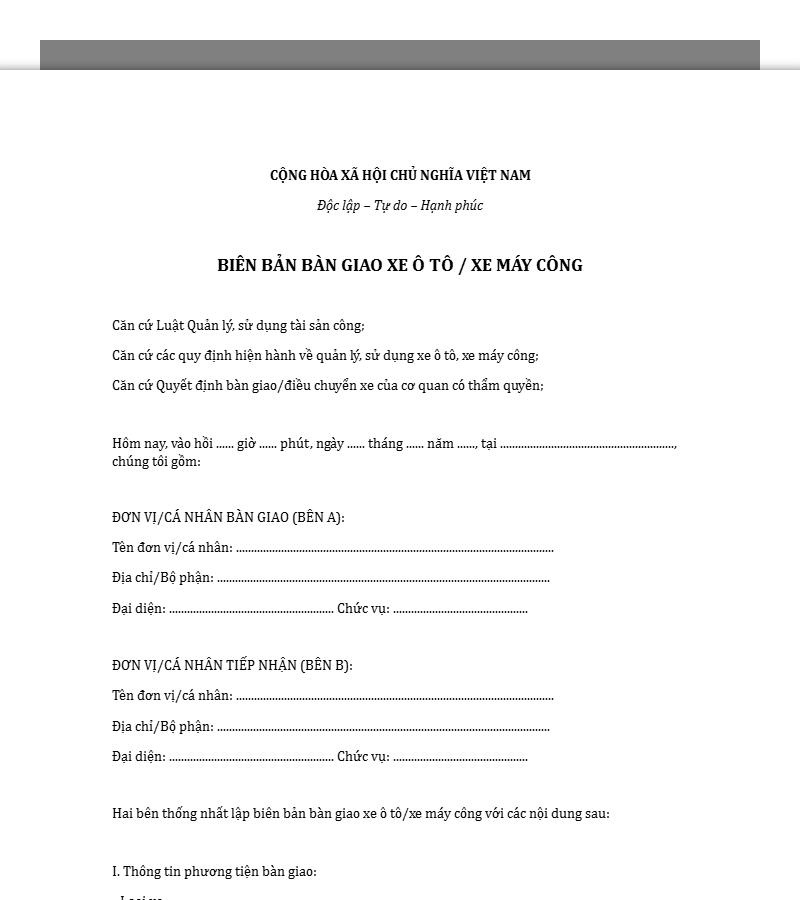
Download the Official Car and Motorcycle Handover Record Template Now
Template 7: Handover of production machinery
Trong sản xuất công nghiệp, việc bàn giao máy móc (máy CNC, dây chuyền, máy ép, máy dệt…) khi thay đổi ca làm, chuyển phòng ban hoặc kết thúc dự án đòi hỏi biên bản chi tiết về thông số kỹ thuật, serial number, tình trạng vận hành và phụ tùng kèm theo. Mẫu này giúp doanh nghiệp theo dõi hiệu suất máy móc, bảo trì định kỳ và xác định trách nhiệm nếu xảy ra hư hỏng, thất thoát trong quá trình sử dụng.
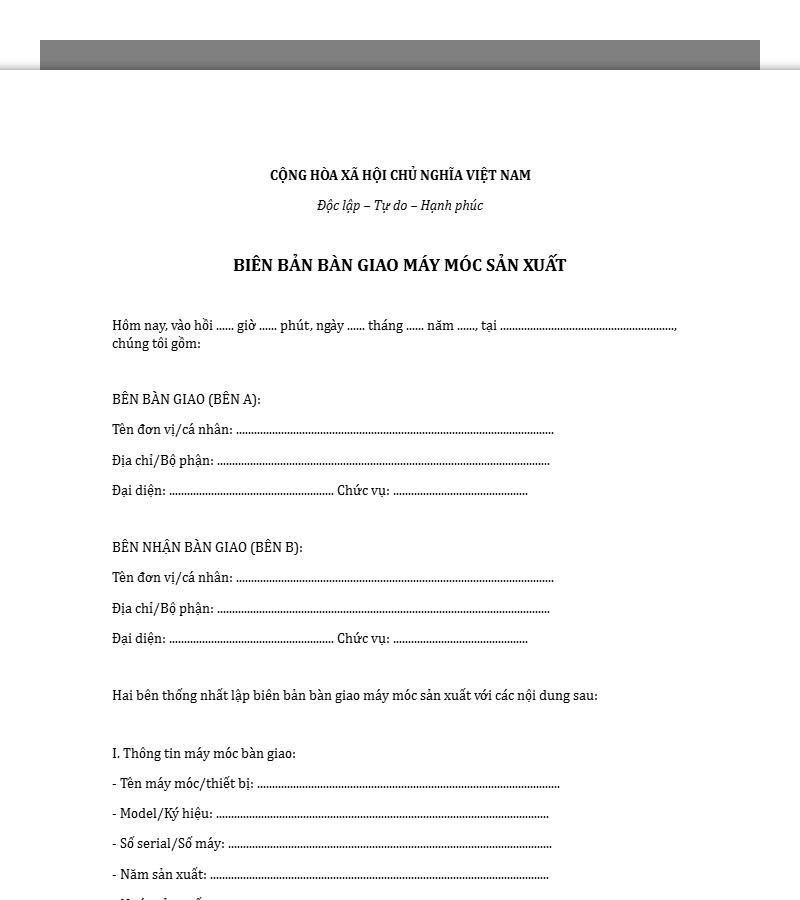
Tải Ngay Mẫu Biên Bản Bàn Giao Máy Móc Sản Xuất
Mẫu 8: Bàn giao thiết bị máy tính, điện thoại
Bàn giao thiết bị máy tính, laptop, điện thoại công ty cho nhân viên mới hoặc khi thay đổi nhân sự là quy trình phổ biến nhưng dễ gây tranh chấp nếu không rõ ràng. Mẫu biên bản này tập trung ghi nhận cấu hình phần cứng, serial number, phần mềm cài đặt, tình trạng pin/màn hình và cam kết bảo quản, giúp doanh nghiệp quản lý tài sản CNTT hiệu quả, tránh thất thoát và dễ dàng truy cứu trách nhiệm khi thiết bị hư hỏng.
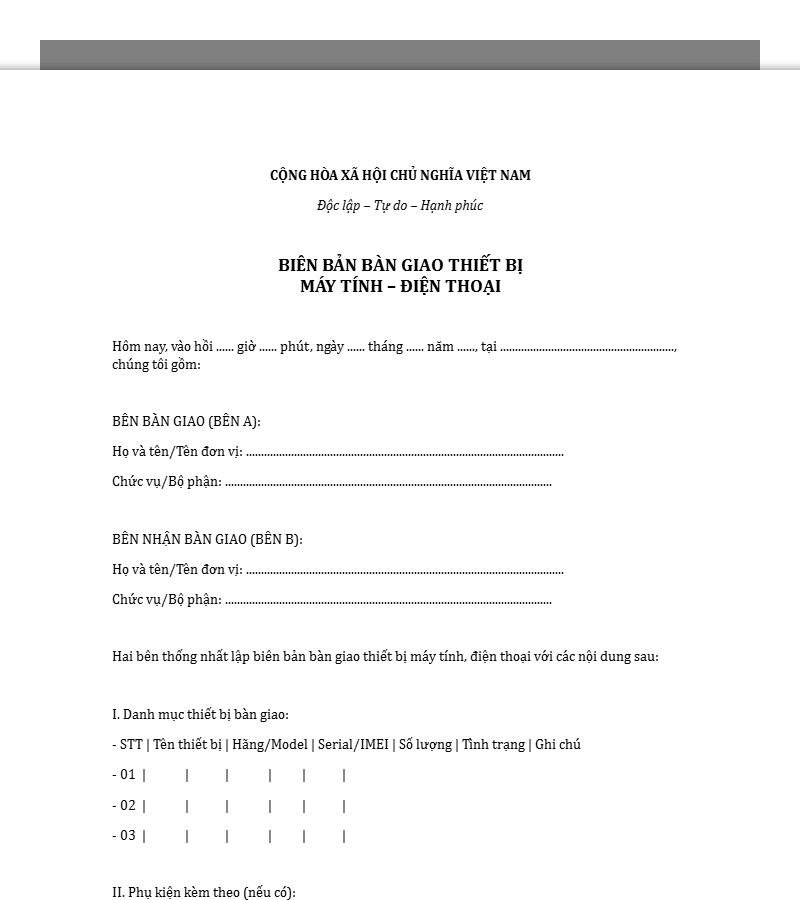
Tải Ngay Mẫu Biên Bản Bàn Giao Thiết Bị Máy Tính, Điện Thoại
Mẫu 9: Bàn giao tài sản góp vốn
Khi cá nhân hoặc tổ chức góp vốn bằng tài sản (máy móc, xe cộ, bất động sản, quyền sử dụng đất, phần mềm…) vào doanh nghiệp, biên bản bàn giao tài sản góp vốn là chứng từ bắt buộc để xác định giá trị tài sản, thời điểm chuyển giao quyền sở hữu và ghi nhận vào vốn điều lệ. Mẫu này đảm bảo tuân thủ Luật Doanh nghiệp 2020, giúp tránh tranh chấp về giá trị góp vốn và là căn cứ pháp lý khi đăng ký kinh doanh hoặc thay đổi vốn.

Tải Ngay Mẫu Biên Bản Bàn Giao Tài Sản Góp Vốn
Mẫu 10: Bàn giao tài sản giữa các công ty sáp nhập, chia tách
Trong quá trình sáp nhập, chia tách, giải thể hoặc tái cơ cấu doanh nghiệp, việc bàn giao tài sản (tài sản cố định, hàng tồn kho, tài liệu, quyền sở hữu trí tuệ…) đòi hỏi biên bản chi tiết để ghi nhận danh mục, tình trạng và giá trị tài sản chuyển giao giữa các pháp nhân. Mẫu này tuân thủ Luật Doanh nghiệp 2020, giúp các bên xác định rõ trách nhiệm, tránh tranh chấp tài sản và hỗ trợ quyết toán thuế, kiểm toán trong quá trình tái cấu trúc.
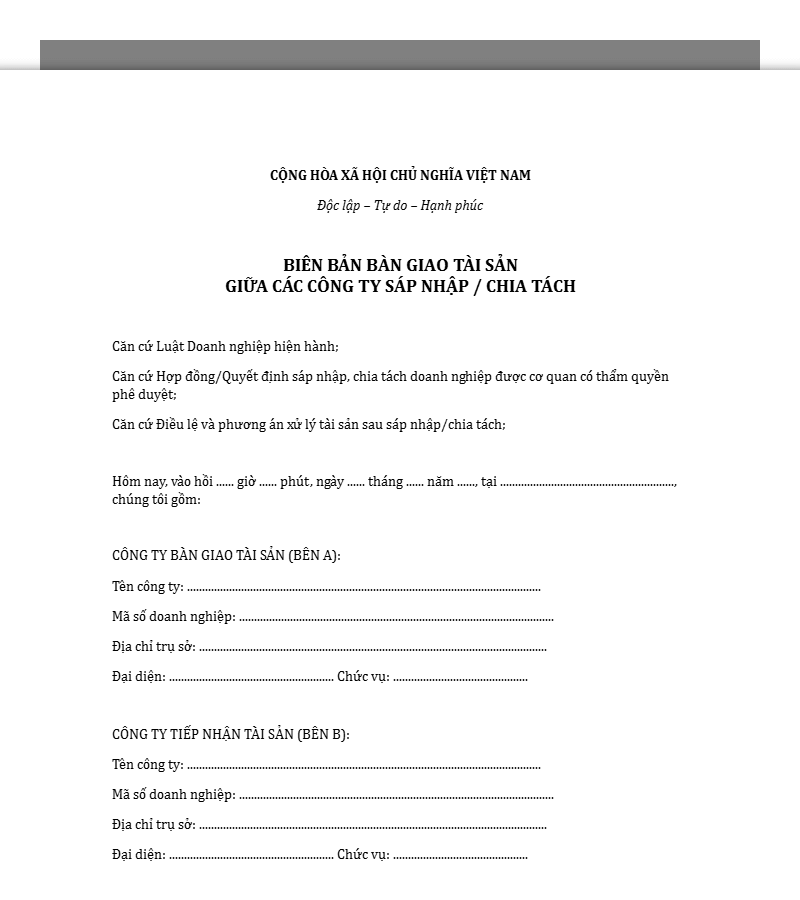
Tải Ngay Mẫu Biên Bản Bàn Giao Tài Sản Sáp Nhập, Chia Tách
Những Sai Lầm Khi Lập Biên Bản Bàn Giao Tài Sản
Việc lập biên bản bàn giao tài sản tưởng chừng đơn giản nhưng nếu mắc sai lầm nhỏ cũng có thể dẫn đến mất giá trị pháp lý, khó khăn trong quản lý tài sản hoặc thậm chí tranh chấp kéo dài, tốn kém. Dưới đây là các sai lầm phổ biến mà doanh nghiệp, cơ quan nhà nước và cá nhân thường gặp (dựa trên thực tiễn kiểm toán, thanh tra và tranh chấp tại Việt Nam năm 2026), kèm theo giải pháp khắc phục cụ thể, giúp bạn tránh rủi ro một cách hiệu quả.
1. Thiếu thông tin các bên
Sai lầm: Không ghi rõ chức danh, bộ phận, đơn vị công tác, số CCCD/MST, hoặc thông tin liên hệ của bên giao, bên nhận, dẫn đến khó xác định danh tính người chịu trách nhiệm khi xảy ra sự cố.
Hậu quả: Biên bản dễ bị bác bỏ giá trị chứng cứ, khó truy cứu trách nhiệm.
Cách khắc phục:
- Luôn ghi đầy đủ: Họ tên, chức danh (ví dụ: Trưởng phòng Hành chính, Thủ quỹ), đơn vị (Công ty TNHH XYZ – Phòng Kế toán), số CCCD/CMND/MST, số điện thoại/email.
- Nếu ủy quyền: Đính kèm giấy ủy quyền hợp lệ và ghi rõ thông tin người ủy quyền.
2. Mô tả tài sản chung chung
Sai lầm: Chỉ ghi “01 máy tính”, “01 bàn làm việc” mà không nêu mã tài sản, serial number, thông số kỹ thuật hoặc đặc điểm nhận dạng.
Hậu quả: Khó kiểm kê, xác định chính xác tài sản khi chuyển giao tiếp theo hoặc xảy ra mất mát.
Cách khắc phục:
- Sử dụng bảng kê chi tiết với cột: STT, Tên tài sản, Mã tài sản/Serial number, Đơn vị tính, Số lượng, Tình trạng, Ghi chú.
- Ví dụ: “Laptop Dell Latitude 5430, Serial: 7X9Y0Z1A2B3C, cấu hình i7-1265U, 16GB RAM, 512GB SSD”.
- Chụp ảnh cận cảnh (serial, tình trạng) đính kèm phụ lục và ghi rõ trong biên bản.
3. Không ghi rõ tình trạng tài sản
Sai lầm: Chỉ ghi “tốt” hoặc “bình thường” mà không mô tả cụ thể hư hỏng tồn tại (vết xước, màn hình nhấp nháy, pin yếu…).
Hậu quả: Tranh cãi về “ai làm hỏng gì” khi trả tài sản hoặc thanh lý, bên nhận dễ bị quy trách nhiệm oan.
Cách khắc phục:
- Mô tả chi tiết, khách quan: “Màn hình có vết xước nhỏ 3cm ở góc phải”, “Pin còn 85% dung lượng thiết kế”, “Hoạt động bình thường khi kiểm tra ngày lập biên bản”.
- Hai bên cùng kiểm tra thực tế trước khi ký, ghi chú “Bên nhận đã kiểm tra và chấp nhận hiện trạng”.
- Đính kèm ảnh/video hiện trạng để làm bằng chứng trực quan.
4. Thiếu chữ ký, con dấu
Sai lầm: Chỉ có chữ ký một bên, thiếu chữ ký bên nhận, người chứng kiến, hoặc không đóng dấu (nếu là pháp nhân).
Hậu quả: Biên bản bị coi là vô hiệu hoặc không đủ sức thuyết phục trước tòa, kiểm toán.
Cách khắc phục:
- Đảm bảo tất cả các bên (bên giao, bên nhận, chứng kiến) ký tay đầy đủ, ghi rõ họ tên, chức danh.
- Doanh nghiệp phải đóng dấu công ty hoặc dấu chức danh (thủ quỹ, trưởng phòng).
- Nếu ai từ chối ký: Ghi rõ lý do vào biên bản và mời thêm người chứng kiến hoặc đại diện UBND phường xác nhận.
5. Không có bên làm chứng
Sai lầm: Không mời người thứ ba chứng kiến, đặc biệt khi giá trị tài sản lớn (>50 triệu đồng), bàn giao khi nghỉ việc hoặc có yếu tố nhạy cảm.
Hậu quả: Một bên dễ phủ nhận nội dung biên bản sau này, khó chứng minh tính khách quan.
Cách khắc phục:
- Luôn mời ít nhất 1 người chứng kiến (kế toán trưởng, trưởng phòng khác, hoặc nhân viên trung lập).
- Ghi đầy đủ thông tin người chứng kiến (họ tên, chức danh, số CCCD) và yêu cầu họ ký xác nhận.
- Với tài sản giá trị cao: Mời thêm đại diện phòng kiểm soát nội bộ hoặc bên thứ ba độc lập.
6. Không lưu trữ đầy đủ bản gốc
Sai lầm: Chỉ lưu 1 bản, mất mát hoặc không scan lưu trữ điện tử.
Hậu quả: Khó đối chiếu khi kiểm toán, thanh tra thuế hoặc xảy ra tranh chấp sau nhiều năm.
Cách khắc phục:
- Lập thành 03 bản có giá trị pháp lý ngang nhau: Bản lưu hồ sơ kế toán/quản lý tài sản, bản bên giao giữ, bản bên nhận giữ.
- Scan màu toàn bộ biên bản (PDF chất lượng cao), lưu trên hệ thống đám mây an toàn (Google Drive, OneDrive với mật khẩu) hoặc phần mềm quản lý tài liệu.
- Lưu trữ ít nhất 10 năm (theo Luật Kế toán 2015).
7. Không cập nhật theo quy định pháp luật mới
Sai lầm: Sử dụng mẫu cũ, không cập nhật thể thức văn bản hoặc quy định mới về quản lý tài sản.
Hậu quả: Biên bản có thể bị cơ quan kiểm toán, thuế bác bỏ hoặc không đáp ứng yêu cầu pháp lý.
Cách khắc phục:
- Thường xuyên cập nhật theo các văn bản mới: Nghị định 30/2020/NĐ-CP (thể thức văn bản), Thông tư 200/2014/TT-BTC (kế toán tài sản cố định), Luật Quản lý tài sản công 2017 (nếu tài sản nhà nước).
- Sử dụng mẫu chuẩn 2026 với quốc hiệu, tiêu ngữ, bảng kê chi tiết và cam kết trách nhiệm rõ ràng.
Các sai lầm trên đều có thể tránh được nếu tuân thủ nguyên tắc chi tiết – khách quan – đầy đủ chữ ký – lưu trữ cẩn thận. Một biên bản bàn giao tài sản chuẩn không chỉ giúp quản lý tài sản hiệu quả mà còn là “lá chắn” pháp lý vững chắc khi xảy ra tranh chấp hoặc kiểm tra sau này.
Câu Hỏi Thường Gặp Về Biên Bản Bàn Giao Tài Sản
Dưới đây là các câu trả lời ngắn gọn, thực tiễn dựa trên quy định pháp luật Việt Nam hiện hành (tính đến ngày 01/01/2026), kết hợp kinh nghiệm áp dụng trong doanh nghiệp, cơ quan nhà nước và giao dịch dân sự.
Biên bản bàn giao tài sản có bắt buộc phải công chứng không?
Not mandatory in most cases.
An asset handover record is a written agreement between parties (a document recording the transfer) and does not fall under the category of documents requiring notarization according to the 2014 Law on Notarization (amended and supplemented). The record is legally valid and sufficient to serve as evidence before a court or state agency with just the full handwritten signatures of the parties (transferor, transferee, and witness, if any) and a seal (if it’s a legal entity).
However, notarization is recommended in the following cases:
- High-value assets (cars, high-tech machinery, fixed assets worth hundreds of millions of VND or more).
- Assets related to real estate ownership (houses, land) or with potential disputes.
- Handover of public assets (state assets) or assets of state-owned enterprises to increase transparency and facilitate future procedures.
What is the retention period for a handover record?
The minimum retention period is 10 years for asset handover records in businesses and state agencies.
- According to the 2015 Law on Accounting (Article 41) and Circular 200/2014/TT-BTC: Documents related to fixed assets and tools must be retained for at least 10 years (or longer if the asset is still being depreciated).
- For public (state) assets: According to the 2017 Law on Management and Use of Public Property, retention is permanent or for at least 70 years, depending on the asset type.
- For personal transactions (handover of vehicles, machinery between individuals): It is recommended to retain for at least 5–10 years (the statute of limitations for civil lawsuits is 3 years according to Article 429 of the 2015 Civil Code).
Storage method: Store hard copies in a filing cabinet, and scan in color (high-quality PDF) for electronic storage on a secure system (password-protected cloud or document management software).
Can an electronic handover record be created? What is its legal validity?
Yes, and it is becoming increasingly common, especially in large enterprises.
According to the 2005 Law on Electronic Transactions (amended 2023) and Decree 130/2018/ND-CP (on digital signatures):
- An asset handover record can be created in electronic form if a valid digital signature is used (an electronic signature certified by a public Certification Authority such as VNPT-CA, BKAV-CA, Viettel-CA).
- Its legal validity is equivalent to a paper record if it meets the conditions: the digital signature is still valid, the file has not been modified (maintains integrity), and is easily searchable.
Note:
- For high-value assets or public assets, it is still advisable to have a paper copy with handwritten signatures to increase its persuasiveness before state agencies.
<
















