


 10/05/2026
  1246 views
In human resource management, a work shift is how a business arranges employees’ working hours into specific time frames to ensure operational efficiency. So, what is a split shift? This is a work arrangement where an employee does not work a continuous 8-hour day but is divided into two different time periods. In this article, 1Office will provide the most detailed split shift and rotating shift schedule for 2026 for your reference.
Mục lục
- 1. What is a split shift? Examples of split shifts
- 2. Why do businesses need to use split shifts?
- 3. Industries suitable for split shifts
- 4. How to schedule split shifts effectively in a business
- 5. Regulations on Split Shift Working Hours & Suggestions for the Most Popular Split Shift Types in 2026
- 6. Guide to effectively managing employees on split shifts
- 7. Considerations when implementing the split shift model
- 8. Manage Shifts Effectively with 1Office HRM Software
- Frequently Asked Questions about Split Shifts
- Who are split shifts for?
- What are the hours for a split shift? How long is a split shift?
- Why do split shifts exist?
- What are the effects of split shifts?
- Are split-shift workers entitled to a 13th-month salary?
- Can the mid-shift break be taken at the end of the work shift?
- Where does the employer specify the rest period between shifts?
1. What is a split shift? Examples of split shifts
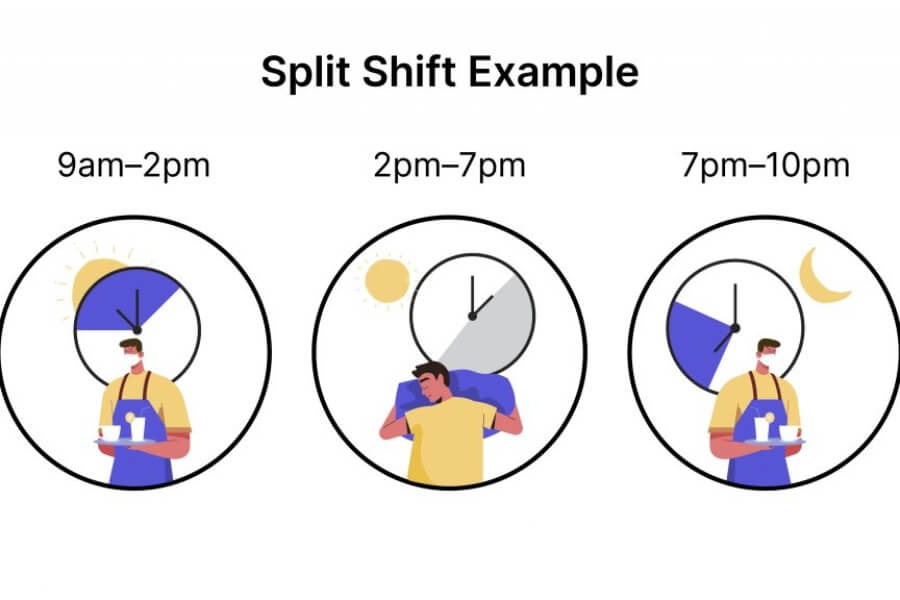
What is a split shift? A split shift is a work arrangement within a day that is not a continuous 8 hours. Instead, employees work during two different periods of the day, which helps ensure customer service during peak hours while allowing for a break between shifts. The timing of split shifts is flexible, depending on the specific business nature of each company.
Example: An employee might work from 10 AM to 2 PM, take a break, and then continue working from 5 PM to 9 PM, instead of working 8 consecutive hours. This arrangement allows businesses to flexibly schedule staff according to business needs.
Note on rotating shifts: Unlike split shifts, rotating shifts (shift rotation) is a work arrangement that alternates weekly or daily, for example: morning shifts on Monday-Wednesday-Friday and evening shifts on Tuesday-Thursday-Saturday. Rotating shifts help employees flexibly arrange their personal schedules while still meeting work demands.
Split shift duration: Employees may work 4 – 8 hours/day, divided into 2 periods depending on customer service needs. This organization helps businesses optimize resources during peak hours and reduce wasted manpower during off-peak times.
2. Why do businesses need to use split shifts?
When regular work shifts cannot meet actual customer demands or optimize resources, split shifts become an effective solution. Split shifts are common in the service industry for the following reasons:
- Industry characteristics: Restaurants, hotels, eateries, or cafes primarily serve customers. Customer traffic is usually concentrated during peak hours like lunch and dinner, requiring more staff. Split shifts help flexibly meet this demand.
- Reduce stress for employees: Working 8 consecutive hours can cause fatigue and reduce the performance of F&B or service staff. Split shifts provide a break in between, helping them recharge and boosting their morale.
- Optimize manpower: Businesses can proactively schedule staff according to peak and off-peak hours, avoiding overstaffing and ensuring enough employees are available to serve customers.
- Save on personnel costs: Arranging split shifts limits overstaffing, helping to reduce costs for recruitment, training, and workforce maintenance.
- Enhance performance and service quality: Well-rested employees and properly allocated resources help improve the customer experience and retain staff long-term.
- Flexibility for employees: Suitable for students, part-time workers, or employees with multiple jobs, making it easier to arrange personal schedules and reducing turnover rates.

3. Industries suitable for split shifts
Below are the industries suitable for split shifts, helping you better understand what a split shift is and which businesses should apply it:
- Restaurants and hotels: Waitstaff, bartenders, kitchen staff, receptionists, and cashiers are often scheduled on split shifts to focus on lunch and dinner times or guest check-in/check-out hours. This arrangement helps employees recharge, reduce fatigue, and maintain service quality.
- Retail and customer service: Cashiers and receptionists work split shifts to ensure staff is available during peak shopping hours, while avoiding wasted manpower during quiet periods.
- Manufacturing with automated production lines or fixed schedules: Split shifts are rarely applied; continuous or traditional rotating shifts are mainly used due to the stable and less fluctuating nature of the work.
Split shifts are suitable for students, part-time workers, or people with multiple jobs. This work arrangement provides flexibility, helping them combine studies, part-time work, or manage multiple jobs simultaneously.

4. How to schedule split shifts effectively in a business
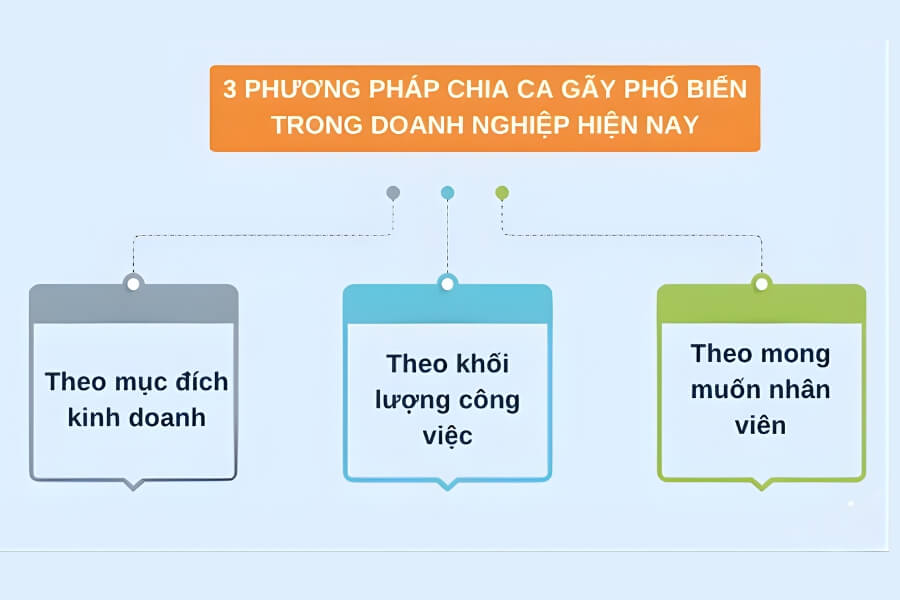
Below are methods for scheduling split shifts based on business needs, workload, and employee preferences to optimize operational efficiency:
4.1 By Business Purpose
Each establishment has a different business model and peak hours. Arranging shifts by business purpose helps ensure there is always enough staff when needed without being overstaffed during off-peak hours. For example:
- Morning shift: 7 AM – 2 PM, suitable for breakfast, brunch, or early check-in guests.
- Evening shift: 2 PM – 10 PM, serving late lunch, dinner, and guest check-in/check-out times.
- Split/rotating shift: 10 AM – 2 PM and 5 PM – 10 PM, or 9 AM – 2 PM and 5 PM – 9 PM, helps optimize staffing during peak hours while ensuring employees have a break between shifts.
Note: Shifts based on business purpose should be flexible day-to-day; for example, on weekends or holidays, you can increase the number of employees during peak hours.
4.2 By Workload
Workload varies by season, day of the week, peak hours, and number of customers. Scheduling shifts by workload helps optimize costs and staffing, while improving service efficiency.
- During peak season, it’s necessary to schedule more employees or increase the number of shifts to avoid being overwhelmed.
- For off-peak hours, you can reduce staff but still keep enough people to perform important tasks.
- Analyzing historical data on customer traffic and service usage will help predict staffing needs more accurately.
Note: For large hotels and restaurants, it’s advisable to combine administrative, rotating, and split shifts to ensure balanced staffing throughout the day.
4.3 By Employee Preference
Many service industry employees are students, part-time workers, or temporary staff. Allowing them to choose shifts that fit their personal schedules helps boost morale, reduce turnover, and retain employees long-term.
- Employees sign up for shifts, and then the manager adjusts the schedule to ensure there is always enough coverage.
- Split or flexible shifts give employees time to rest between work periods, recharge, and reduce stress.
- For part-time workers, this also allows them to combine work with studies, other jobs, or different commitments.
Note: Always balance customer needs with employee preferences to ensure service quality while maintaining team satisfaction.
5. Regulations on Split Shift Working Hours & Suggestions for the Most Popular Split Shift Types in 2026
To better understand what a split shift is and how to apply it in your business, here are the regulations on split shift working hours and suggestions for the most popular split shift types in 2026:
5.1. Regulations on Split Shift Working Hours
In practice, employees on split shifts still work a full 8 hours a day, but the time is divided into two separate work periods. Some establishments are more flexible, only requiring employees to complete 40-44 hours per week, not necessarily 8 hours every day.
Depending on the specific nature of the business, peak and off-peak hours, and the personal schedules of individual staff members, managers will arrange working times accordingly. Each branch can adjust the number of working hours per day or per week to optimize costs and ensure there is always enough staff to serve during busy periods.
5.2. Common Types of Split Shifts
Detailed 2-3-4 Rotating Shift Schedule for 2026 [Reference]
| Shift Type | Number of Shifts/Crews | Typical Time Frames |
| 2 rotating shifts (2 crews) | 2 shifts/day | 7 AM – 11 AM and 4 PM – 8 PM
9 AM – 1 PM and 5 PM – 9 PM |
| 3 rotating shifts (3 crews) | 3 shifts/day | Crew 1: 6 AM – 10 AM and 2 PM – 6 PM
Crew 2: 10 AM – 2 PM and 6 PM – 10 PM Crew 3: 10 PM – 6 AM (continuous or split depending on the production line) |
| 4 rotating shifts
(4 crews of 2 or 4 crews of 3) |
4 shifts/day | Crew A: 6 AM – 12 PM and 6 PM – 12 AM
Crew B: 12 PM – 6 PM and 12 AM – 6 AM Crew C: 6 AM – 6 PM (continuous or split) Crew D: off / weekly rotation |
2 split shifts (2 teams) – common in restaurants and supermarkets
How it works: Employees work two separate time blocks per day, usually during the two busiest periods.
Example working hours:
- 7 AM – 11 AM and 4 PM – 8 PM (restaurants)
- 9 AM – 1 PM and 5 PM – 9 PM (supermarkets – convenience stores)
Advantages:
- Concentrates workforce during peak hours.
- Reduces staffing costs during off-peak hours.
Applicable for: Restaurants – eateries – supermarkets – bubble tea shops – cinemas – gyms.
3 split shifts (3 teams) – most common in factories
How it works: Distributes the workforce into teams: morning – afternoon – evening, where one or more shifts are split shifts.
Example working hours:
- Shift 1: 6 AM – 10 AM and 2 PM – 6 PM
- Shift 2: 10 AM – 2 PM and 6 PM – 10 PM
- Shift 3: 10 PM – 6 AM (continuous or split depending on the production line)
Advantages:
- Maximizes machinery utilization.
- Ensures nearly 24/24 operation.
Applicable for: Food, electronics, and garment factories, logistics warehouses.
4 split shifts (4 teams of 2 or 4 teams of 3) – Samsung, Formosa, PouYuen
This is the most complex shift model, often applied in large corporations that require continuous operation.
Common models:
- 4 teams of 2: each team works two time blocks per day, rotating continuously.
- 4 teams of 3: divides 24 hours into 3 sessions, some sessions may be split according to production line requirements.
Example working hours:
- Team A: 6 AM – 12 PM and 6 PM – 12 AM
- Team B: 12 PM – 6 PM and 12 AM – 6 AM
- Team C: 6 AM – 6 PM (continuous or split)
- Team D: off / weekly rotation
Advantages:
- Maintains uninterrupted production.
- Staff is evenly distributed, avoiding overload during production line peak hours.
Applicable for: Large-scale industrial parks, electronics – steel – chemical – footwear factories.

6. Guide to effectively managing employees on split shifts
Below are effective ways to manage split-shift employees, from building a clear shift system and diversifying timekeeping methods to ensuring transparency in monitoring and reporting:
6.1. Build a clear and specific work shift system
To manage split shifts effectively, businesses need to establish a transparent work shift system from the outset. This includes:
- Clearly define the time for each shift: Morning, afternoon, evening, and 2-block split shifts… must all have a start time, end time, and total working hours per day.
- Standardize break times between shifts: Clearly state how long employees can rest between two shifts to ensure they understand their rights and can arrange personal matters.
- Determine staffing needs for peak and off-peak hours: This allows for reasonable shift scheduling, avoiding overstaffing during quiet times and understaffing during busy periods.
- Create weekly or monthly schedules: The shift schedule should be public and updated regularly so employees can proactively manage their time.
- Have a contingency plan: Prepare backup resources for when an employee requests unexpected leave to avoid affecting service quality.
A clearly defined work shift system from the start will help reduce confusion, increase employee proactivity, and optimize the business’s operational capabilities.

6.2. Diversify timekeeping methods
For the split shift model, especially when shifts are divided into multiple time frames within a day, businesses need to apply various flexible timekeeping methods to ensure accuracy and convenience. Some common solutions include:
- Timekeeping with fingerprint/card readers: Suitable for restaurants and stores with a stable number of employees. The device records check-in and check-out times for each shift, preventing fraud and ensuring accurate data.
- Timekeeping via mobile app (GPS/WiFi): Employees can clock in using their phones within the store or branch premises. This solution is particularly effective for part-time staff, seasonal employees, or multi-branch models.
- Timekeeping with QR codes: The business places a QR code in each work area; employees scan the QR code to record their start time, break time, and the start of the second part of their shift. This method is very suitable for F&B stores with a twice-a-day split shift model.
- Automatic timekeeping via shifts set up on the CRM/HRM system: Managers only need to create the split shift schedule; the system automatically records work hours based on the defined working times. This helps reduce errors, especially with large teams.
- Combining multiple methods: For complex operational models, businesses can combine fingerprint scanning with a mobile app to ensure both flexibility and security.
Diversifying timekeeping methods not only helps businesses manage split shifts more accurately and transparently but also reduces pressure on employees and minimizes confusion or time theft.

6.3. Transparency and clarity in management
Managing split shifts requires a high degree of transparency to avoid misunderstandings about working hours, benefits, and responsibilities. Businesses should implement the following principles:
- Publicly share work schedules and update them in real-time: Shift schedules must be announced to employees at least 3-7 days in advance, with any adjustments updated publicly on the system or internal group. Employees can track their split shifts at any time, avoiding confusion or overlapping schedules.
- Be clear about break times between shifts: Since a split shift is divided into two time frames, the business needs to clearly state the break duration, specify whether it counts as paid work time, and outline related benefits. This helps prevent disputes over salary or working hours.
- Be transparent about salary, bonus, and overtime policies: Split shifts often involve flexibility, so hourly wages, night shift allowances, overtime pay, or meal support need to be clearly defined and applied consistently. The business should publicize the calculation method so employees can easily verify it.
- Acknowledge and respond to employee feedback: Employees on split shifts often need to adjust their hours. Businesses should have a channel for receiving suggestions to support shift swaps, answer questions, or handle issues fairly and consistently.
- Periodically check and reconcile work hours: At the end of the week or month, managers and employees should reconcile the timesheet to ensure accuracy before finalizing payroll. Regular reconciliation helps minimize conflicts and unnecessary errors.
Transparency in management not only helps the team work with peace of mind but also builds trust, improves morale, and reduces turnover rates—a crucial factor for the split shift model, which requires high flexibility.

7. Considerations when implementing the split shift model
Applying split shifts is not just about reallocating work hours; it also requires a robust operational system to ensure efficiency and compliance with labor regulations. Businesses can refer to the following important considerations to manage the split shift model smoothly:
- Maintain a unified communication channel: Use an internal chat group or management software to update shift schedules, announce changes, and handle issues quickly. Clear communication helps limit confusion when employees work in two separate time frames.
- Clearly define how salary, work hours, and allowances are calculated: There should be detailed guidelines for employees on how to calculate work hours, overtime, and allowances for night shifts or split shifts. Transparency from the beginning will help reduce conflicts and increase team trust.
- Consider employees’ travel costs and time: Split shifts may require employees to commute more during the day. Businesses should consider providing a travel allowance or adjusting shifts flexibly to reduce the burden on workers.
- Establish a handover process between shifts: Set up a process for taking notes, handing over tasks, or using software to ensure the next shift is aware of the previous shift’s status. This is especially important in F&B and retail environments, where work is continuous.
Effective split shift management not only helps optimize staffing but also contributes to creating a fairer, more orderly, and comfortable work environment for the entire team.

8. Manage Shifts Effectively with 1Office HRM Software
1Office’s 1HRM is a comprehensive human resource management platform that helps service businesses like restaurants and hotels optimize operations, especially in environments where staff work fixed shifts, split shifts, or rotating shifts.
- Comprehensive management of shift-based teams: 1HRM allows you to store, track, and update all employee information, including job titles, departments, and work schedules. Any changes to shifts, leave, or overtime are updated automatically, helping managers stay informed about staffing levels at any time of day.
- Automated alerts and reminders: The system automatically sends reminders for upcoming shifts, expiring contracts, or training certificates that need renewal. Both employees and managers receive timely notifications, reducing the risk of operational disruptions during peak hours.
- Accurate timekeeping by shift: By connecting with various time clocks (fingerprint, FaceID) and mobile app timekeeping (GPS), 1HRM accurately records working hours for employees on morning, afternoon, evening, or split shifts. Timesheets are automatically compiled in real-time, and employees can check them directly on the app, reducing disputes over work hours.
- Automated payroll and allowance calculation by shift: The system uses confirmed timekeeping data and shift schedules to automatically calculate payroll, including special allowances for night shifts, holiday work, and peak-hour bonuses. Payroll formulas are flexible and can be easily adjusted to fit each company’s policies.
- Recruitment and training support: 1HRM integrates AI to screen CVs and quickly find suitable employees for each shift. Additionally, the training module (LMS) helps establish competency frameworks, create personal development roadmaps, and manage courses, thereby retaining talent and improving customer service quality.
With 1HRM, F&B and hotel businesses can manage their shift-based teams effectively, reduce administrative costs, optimize staffing during peak hours, and enhance the customer experience.
Frequently Asked Questions about Split Shifts
Who are split shifts for?
Split shifts are suitable for employees in service industries such as restaurants, hotels, and retail, where staffing needs fluctuate with peak hours. Common positions include receptionists, housekeeping staff, servers, bartenders, cashiers, security guards, etc. Additionally, split shifts are also ideal for students, side-hustlers, or part-time workers who need time flexibility, allowing them to rest between shifts and work effectively. Conversely, split shifts are less suitable for manufacturing or jobs that require continuous shifts.
What are the hours for a split shift? How long is a split shift?
A split shift is typically divided into 2 separate blocks of time during the day, for example:
- 6 AM – 10 AM and 2 PM – 6 PM
- 12 PM – 4 PM and 6 PM – 10 PM
- 10 AM – 2 PM and 5 PM – 9 PM.
The total working time is usually around 8 hours/day (can be flexible from 4-8 hours), adhering to a maximum of 8 hours/day and 48 hours/week, with at least a 12-hour break between shifts and a rest break of 30-45 minutes for shifts of 6 hours or more.
Why do split shifts exist?
Split shifts were created to optimize human resources in service industries like restaurants, hotels, and retail, where labor demand fluctuates with peak hours. They allow employees to rest between work periods, maintaining performance and service attitude, while also offering flexibility for students or part-time workers. This enables businesses to allocate staff efficiently, save costs, and avoid wasting labor.
What are the effects of split shifts?
Split shifts have the following positive and negative effects on employees and businesses:
| Positive impacts | Negative impacts |
|
|
Are split-shift workers entitled to a 13th-month salary?
Split-shift workers may be entitled to a 13th-month salary if it is stipulated in their labor contract or company policy. The law does not require businesses to pay a 13th-month salary for split shifts; this bonus is typically based on job performance and business results, applying similarly to all types of work shifts.
Can the mid-shift break be taken at the end of the work shift?
No, the mid-shift break cannot be scheduled at the end of the shift. According to Vietnamese law, the mid-shift break (at least 30 minutes for a day shift, 45 minutes for a night shift) must occur during the work shift to allow employees to recover. The break time must be reasonably arranged by the business, ensuring no one works more than 6 consecutive hours without a break. The rest period between shifts (shift change) must be a minimum of 12 hours and does not replace the mid-shift break.
Where does the employer specify the rest period between shifts?
The employer specifies the rest period between shifts in the labor contract, collective bargaining agreement, internal regulations, or the announced work schedule. By law, the rest period between two consecutive shifts must be a minimum of 12 hours, which can be extended depending on the specific nature of the business. This time is not counted as working hours and must be announced in advance to avoid disputes.
Clearly understanding “what a split shift is” helps businesses optimize resources, improve service quality, and protect employee health. A reasonable split-shift and rotating-shift schedule not only reduces personnel waste but also helps employees flexibly arrange their personal lives, ensuring maximum work performance.
To manage split shifts and your workforce more effectively, your business can explore the 1Office HRM software—an intelligent human resource management platform that supports shift scheduling, timekeeping, automated payroll, and transparent HR operations. Contact 1Office today for a consultation on the right solution for your business.
















