


 10/05/2026
  6981 views
A termination decision template is an important administrative document that ensures the process of terminating a labor contract complies with legal regulations and clearly defines the responsibilities of all parties. In this article, 1Office provides you with the most common termination/resignation decision templates in Word/PDF format, along with detailed drafting instructions and important notes for use. The content is presented completely and accurately, making it easy for you to apply in specific cases such as dismissal, voluntary resignation, or contract expiration.
Mục lục
- 1. What is a termination decision?
- 2. What content should a termination decision template include?
- 3. Instructions on how to fill out the termination decision template
- 4. The latest standard resignation decision templates
- 5. In which cases is a resignation decision template used?
- 6. Legal regulations related to resignation decisions
- 7. Important notes when using a resignation decision template
- Ensure compliance with legal regulations
- The content of the resignation decision must be clear and detailed
- Provide full rights and obligations to the employee
- Work handover process
- Signature confirmation and notification to relevant parties
- Update information in the human resource management system
- Ensure information confidentiality
- Legal consultation when necessary
- 8. Simplify HR information management with 1Office
- 9. Frequently Asked Questions (FAQ)
- 9.1. Does a decision to terminate employment require the employee’s consent?
- 9.2. Who signs the termination of employment decision?
- 9.3. When does a termination of employment decision take effect?
- 9.4. In which cases is termination of employment permitted?
- 9.5. Can I apply for unemployment benefits without a termination of employment decision?
- 9.6. Within what timeframe must an employee receive the termination of employment decision?
1. What is a termination decision?
A termination decision is a document issued by the employer to confirm the termination of a labor contract with an employee, in accordance with the conditions and regulations stipulated by labor law. This document ensures transparency, formalizes the end of the employment relationship, and protects the rights of both parties.
Legal basis:
- Article 34, Labor Code 2019: Regulates cases of labor contract termination.
- Article 48, Labor Code 2019: Requires employers to notify and settle the rights of employees upon contract termination.
Purpose and significance:
- Ensuring legality: The document confirms the termination of the employment relationship, serving as a basis for related procedures such as social insurance, severance pay, or dispute resolution (if any).
- Transparency and clarity: Helps all parties clearly understand their rights and responsibilities when the labor contract ends.
- Minimizing disputes: It is an official document proving that the termination complies with legal regulations, avoiding legal risks for the business.
2. What content should a termination decision template include?
A termination decision template (decision to terminate a labor contract) typically includes the following mandatory content:
- Company information: company name, address, tax code, document number.
- Legal basis: Labor Code 2019, signed labor contract, related resolutions/minutes (if any).
- Employee information: full name, position, department, labor contract number, start date.
- Reason for termination: termination by mutual agreement, unilateral termination, contract expiration, restructuring, disciplinary violation, etc.
- Effective date: the date the decision takes effect and the employee’s last working day.
- Remaining rights & obligations:
-
- Payment of salary, allowances, annual leave
- Handover of assets and documents
- Finalizing social insurance book, returning the social insurance book/confirming the social insurance contribution period
- Compensation (if any)
- Responsibilities of related departments: HR, accounting, direct manager.
- Signature and seal: legal representative or authorized person.
3. Instructions on how to fill out the termination decision template
The termination decision template is an administrative document that must be presented clearly and in compliance with legal regulations to ensure the rights and obligations of both the employee and the business. Below are detailed instructions to help you prepare a termination decision template:
Title
- National emblem and motto
- Document title: DECISION ON THE TERMINATION OF LABOR CONTRACT
- Name of the company or business issuing the decision.
- Decision number: Usually recorded in chronological order for the year.
Main content of the decision
- Legal basis: Clearly state relevant legal documents such as the Labor Code, company regulations, and the labor contract.
- Employee information: Full name, position, and department of the employee.
- Reason for termination: Clearly state the reason, such as contract expiration, employee resignation, violation of regulations, or company restructuring.
- Termination date: Clearly state the official date of labor contract termination.
- Rights and obligations: Detail the employee’s entitlements (if any), including salary, allowances, social insurance, handover duties, etc.
- Effectiveness of the decision: Clearly state when the decision takes effect and the implementation requirements for all parties.
Conclusion
- Signature and confirmation: The company representative (Director or authorized person) signs, writes their full name, and affixes the company seal.
- An employee signature section can be added to confirm receipt of the decision.
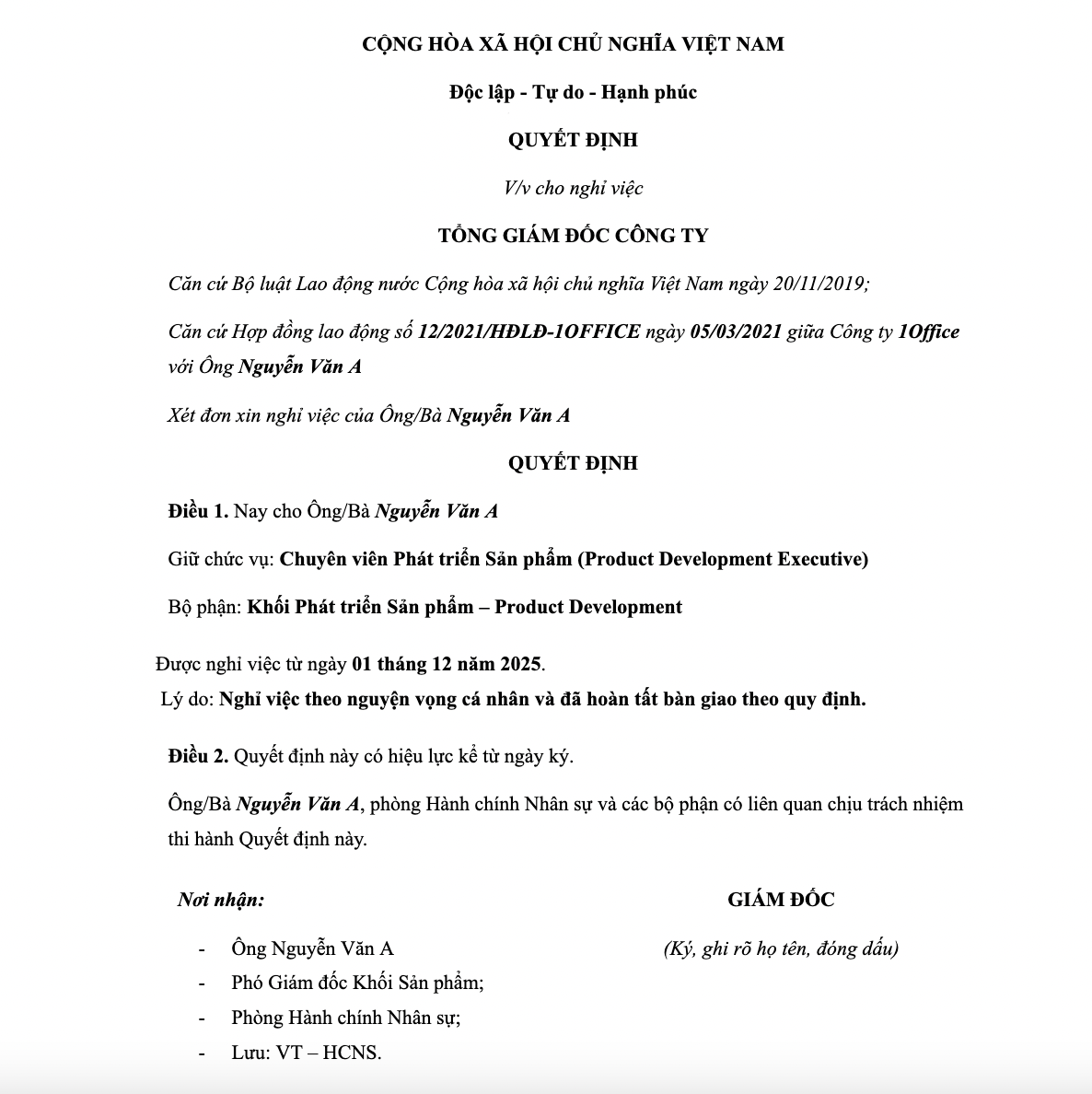
Below is a guide on how to fill out the resignation decision template, which is fully completed, properly formatted, and can be used as an official document:
4. The latest standard resignation decision templates
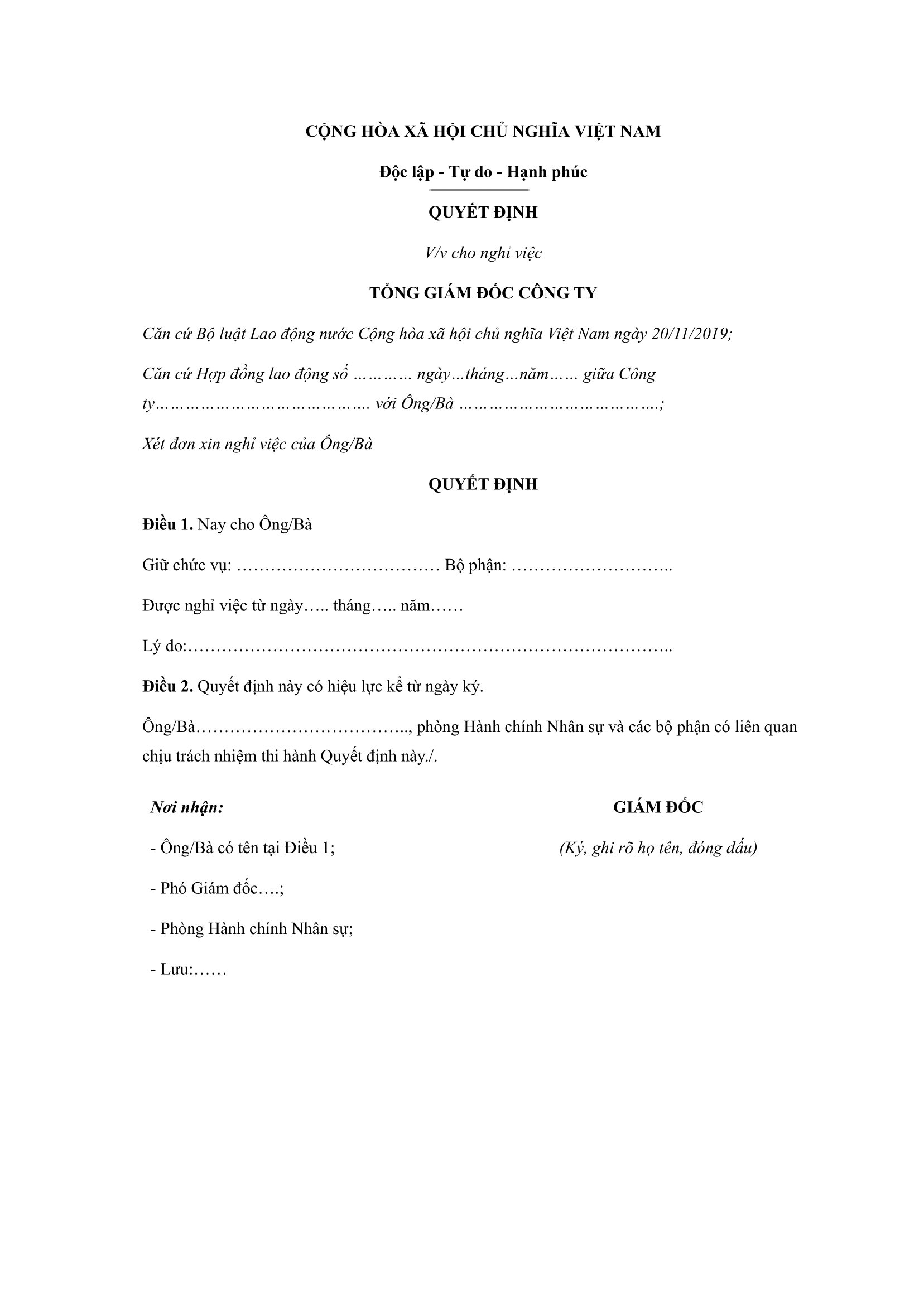
4.1. Template 1: Resignation Decision Template
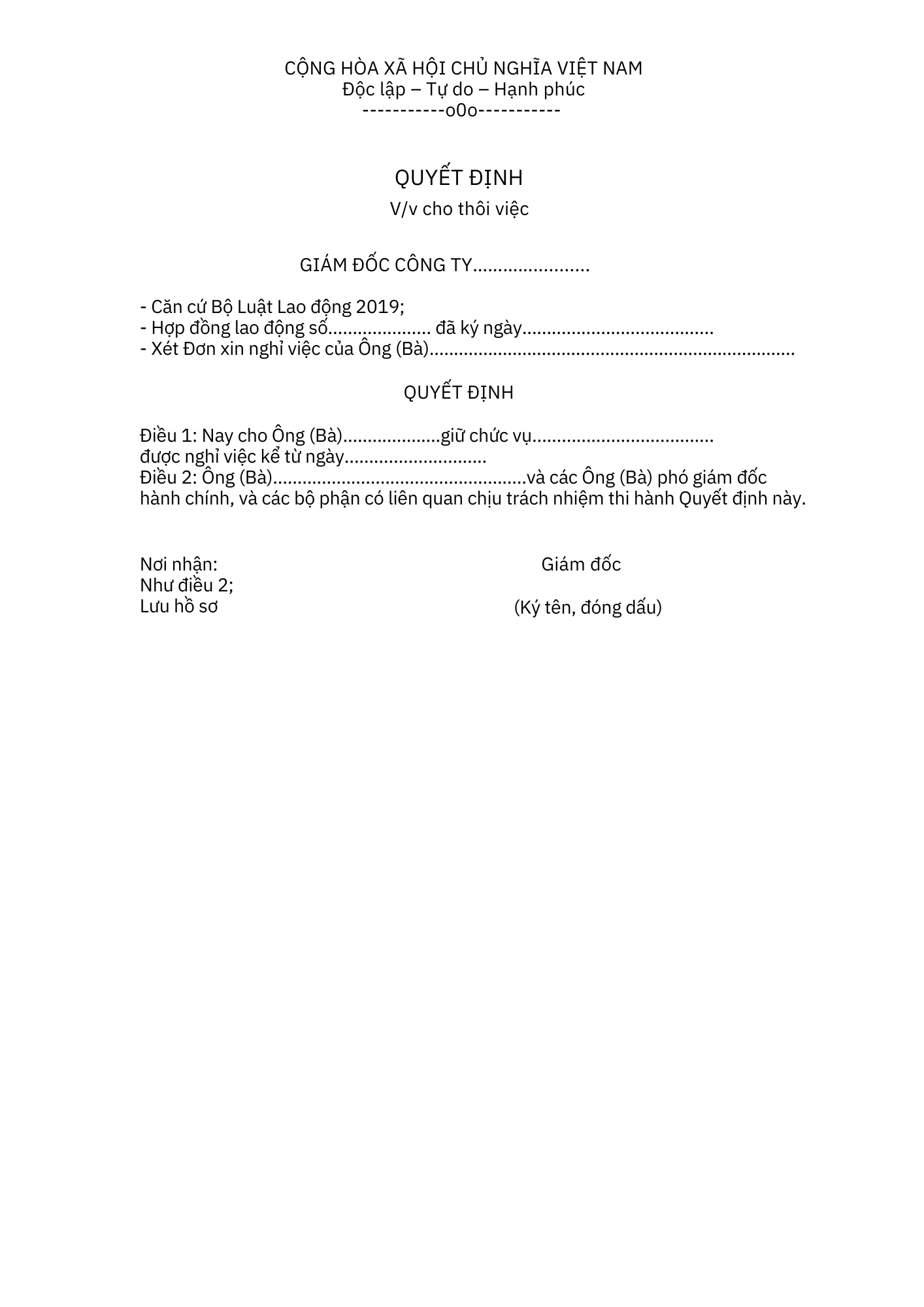
4.2. Template 2: Termination Decision Template
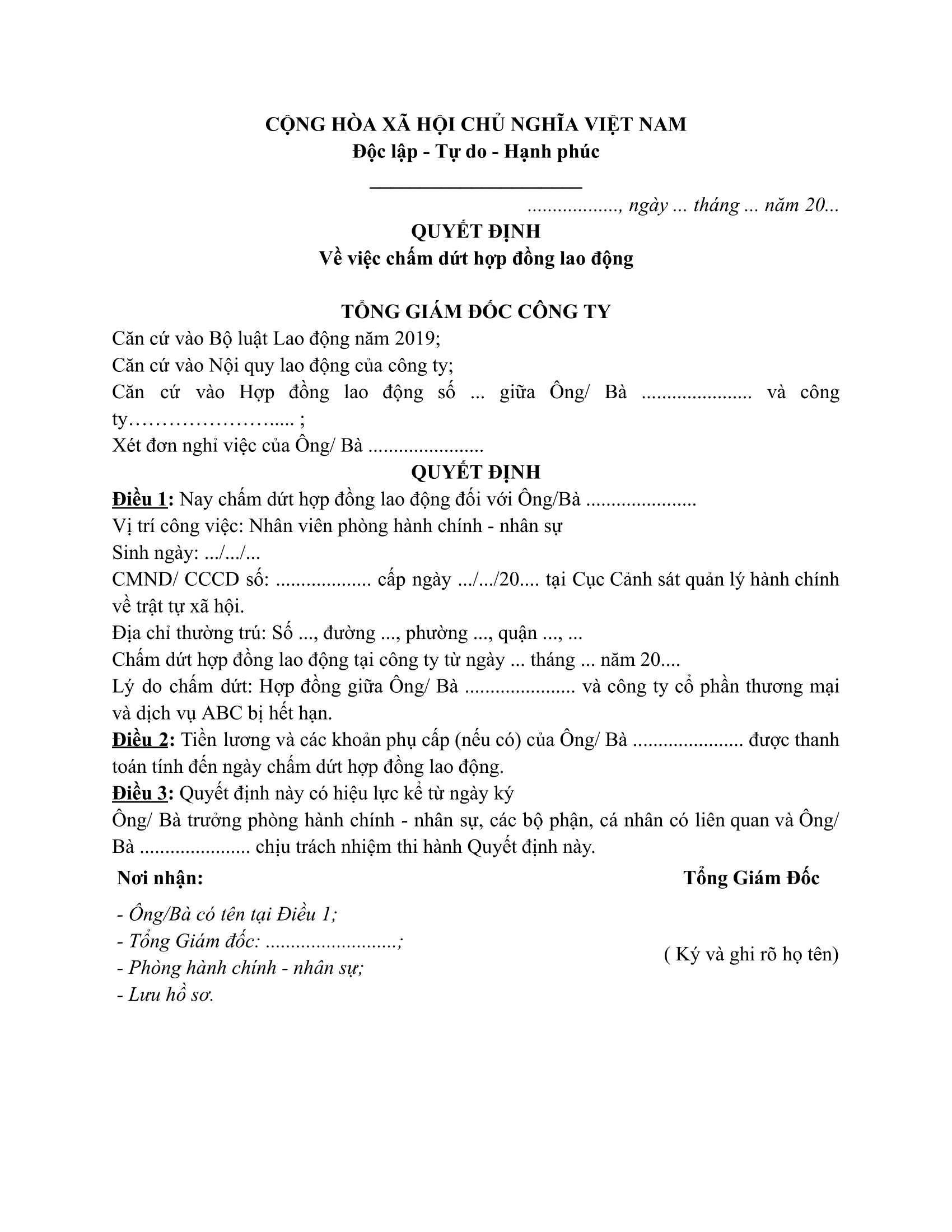
Template 3: Labor Contract Termination Decision Template
5. In which cases is a resignation decision template used?
A resignation decision template is an administrative document created by a business (represented by the employer) to announce the termination of a labor contract with an individual. A resignation decision is used in the following cases:
Unilateral termination of the labor contract by the employee
- When an employee resigns in accordance with regulations, a termination decision template is created to formalize the contract termination.
- The content typically includes the reason for resignation, the contract termination date, and any remaining benefits (if any).
Unilateral termination of the labor contract by the business
- This applies when an employee violates regulations, fails to meet job requirements, or when the business undergoes restructuring and cannot continue the labor contract.
- This decision must comply with the Labor Code’s regulations regarding advance notice and legitimate reasons.
Expiration of the labor contract
- When a fixed-term labor contract ends and neither party wishes to renew it, the business will issue a resignation decision to terminate the employment relationship.
Mutual agreement to terminate the labor contract
- When the business and the employee mutually agree to terminate the labor contract.
Special cases
- Employee retirement: When an employee reaches retirement age or receives a retirement decision according to regulations.
- Dismissal: When an employee commits a serious violation of company regulations or the law.
A resignation decision is a significant action in an employment relationship and must comply with relevant legal regulations to protect the rights of both the employee and the employer. Below are the basic legal regulations related to issuing a resignation decision:
2019 Labor Code
The Labor Code is the key legal document governing all matters related to labor relations in Vietnam. Some provisions related to resignation decisions include:
Article 34. Termination of labor contract
The Labor Code clearly stipulates the cases in which a labor contract can be terminated, including:
- The employee unilaterally terminates the labor contract.
- The employer unilaterally terminates the labor contract.
- The labor contract expires.
- Termination of the labor contract in case the employee retires or passes away.
Article 36. Rights and obligations of the employer when unilaterally terminating a labor contract
The employer must have a valid reason and provide advance notice before unilaterally terminating a labor contract. The notice period depends on the type of contract (fixed-term, indefinite-term, or seasonal contract).
- Indefinite-term labor contract: at least 45 days’ notice.
- Fixed-term labor contract from 12 months to 36 months: at least 30 days’ notice.
- Fixed-term labor contract of less than 12 months: at least 3 days’ notice.
Article 47. Severance allowance
If the labor contract is terminated, the employee is entitled to a severance allowance if they have worked for the company for 12 months or more. The severance allowance is calculated as half a month’s salary for each year of service.
Decree 145/2020/ND-CP guiding the 2019 Labor Code
This Decree provides detailed guidance on the termination of labor contracts and regulations related to employee benefits upon resignation. Some relevant contents include:
Article 13. Procedures for terminating a labor contract
The Decree requires employers to notify employees of the termination decision at least a certain period in advance, depending on the type of labor contract.
- The employer must prepare a written notice of the termination decision and deliver it to the employee. This document must be clear and complete regarding the reason, date of termination, and benefits.
Article 14. Employee benefits upon resignation
In addition to the severance allowance, employees are entitled to receive other benefits (salary, insurance, maternity benefits, etc.) up to the official date of termination.
Circular 47/2015/TT-BLDTBXH
Circular 47/2015/TT-BLDTBXH This circular provides detailed regulations on the documents and procedures for terminating a labor contract, including:
- Documents for labor contract termination: The company needs to store documents such as the termination decision, work handover minutes, statement of employee benefits payment, social insurance, health insurance, and other papers related to the labor contract termination.
- Social insurance (SI): Employees are entitled to receive social insurance benefits upon resignation if they have fully participated in the insurance scheme. After termination, employees may receive unemployment benefits if they meet the conditions.
- Health insurance: Employees who resign will no longer have health insurance benefits from the company, unless they switch to insurance at a new workplace or participate in voluntary insurance.
Other regulations
- Unilateral termination of a labor contract: Employees have the right to unilaterally terminate their labor contract if the company violates the terms of the contract, the working environment is unsafe, or if they are not paid on time. However, the employee must provide advance notice for a certain period and not violate any contractual obligations.
Summary of key points
- The termination decision must be made in writing and signed by a representative of the company as well as the employee (if necessary).
- The company must provide notice of the termination decision within the specified time frame.
- Employee benefits upon resignation must be paid in full and on time.
- Cases such as retirement, contract expiration, dismissal, and unilateral termination each have separate regulations regarding benefits and procedures.
Note that legal regulations may change over time, so it is necessary to monitor amendments and supplements to always apply the latest regulations correctly.
7. Important notes when using a resignation decision template
When creating and using a resignation decision template, there are several important notes to ensure legality, fairness, and transparency in the process of terminating a labor contract. Below are the points to remember:
Ensure compliance with legal regulations
- Notice period: The resignation decision must comply with the notice period stipulated by the Labor Code. Depending on the type of labor contract, the employer must provide at least 3 days’ notice (for contracts under 12 months), 30 days’ notice (for contracts from 12 to 36 months), or 45 days’ notice (for indefinite-term contracts).
- Reasonable grounds for resignation: The resignation decision must have a reasonable and lawful reason. If it is the employer’s decision, the reason must be clearly stated and based on the terms agreed upon in the labor contract or legal regulations (such as contract violation, company restructuring, or other reasons).
- Employee’s benefits: It is necessary to ensure that the employee receives all their benefits upon resignation, including salary, severance pay (if any), social insurance, health insurance, bonuses, and other benefits as per the labor contract and legal regulations.
The content of the resignation decision must be clear and detailed
- Complete employee information: The decision template must clearly state the employee’s personal information (full name, position, department, tenure at the company, etc.).
- Reason for resignation: The reason for resignation must be clearly stated, whether it is the employee’s or the employer’s decision. This helps ensure transparency and avoid future disputes.
- Effective date: The resignation decision needs to specify the effective date of resignation, including the official last day of the labor contract and the conditions for contract termination.
Provide full rights and obligations to the employee
- Payment of benefits: Before the resignation, the company must fully pay the employee’s benefits, including salary, severance pay (if any), and other remaining payments such as annual leave pay, insurance, etc.
- Social and health insurance: If the employee participates in social or health insurance, the company needs to process the procedures to terminate the insurance at the company and guide the employee on their subsequent insurance benefits (if any).
Work handover process
- Handover of assets and work: The resignation decision should require the employee to complete the handover of work and company assets. This helps prevent omissions or work disruptions after the employee leaves.
- Work handover report: There should be a clear work handover report, documenting unfinished tasks and the person who will take over the work.
Signature confirmation and notification to relevant parties
- Confirmation signature: The resignation decision needs to be signed by the employer and, if applicable, the employee should also sign to confirm. This ensures that both parties have understood and agreed to the terms in the decision.
- Notification to relevant departments: After the resignation decision is signed, the company needs to notify relevant departments (such as HR, accounting, insurance, etc.) to carry out necessary procedures like closing insurance, paying salary and allowances.
Update information in the human resource management system
- Update the HR system: After the resignation decision takes effect, the company needs to update the employee’s status in the human resource management system to ensure accuracy in reporting and human resource management.
Ensure information confidentiality
- Information security: The company needs to store and protect information related to the resignation decision confidentially. Documents such as the resignation decision, work handover report, and papers related to benefit payments must be properly protected to avoid legal or security risks.
Legal consultation when necessary
- Legal consultation: In cases where the decision to resign involves complex legal issues such as labor contract disputes, wrongful termination, or when an employee’s request for severance pay is not met, the business should seek advice from legal experts to avoid legal risks.
8. Simplify HR information management with 1Office
Managing HR information and employee status in medium and large enterprises always requires accuracy, speed, and security. With 1Office, tracking and managing the entire employee lifecycle, from recruitment to termination, is simplified and automated, helping the HR department save time and minimize errors.
1Office provides powerful features to help you easily manage important HR information, including termination decisions, work handover processes, and other employee statuses. Below are the key features related to HR information and status:
When an employee decides to resign, the termination decision must be processed accurately and completely. 1Office helps you manage all termination decisions automatically and quickly. Each termination decision will be stored in the system, with complete information such as the reason for leaving, the termination date, and the necessary steps to be taken after termination.
- Manage termination decisions: All termination decisions are created and tracked through the system. You can easily search for and reference any decision related to an employee.
- Work handover process: 1Office supports the work handover process when an employee leaves, ensuring that work is not disrupted and company assets are returned correctly.
- Track and pay benefits: The software helps ensure that employee benefits upon termination are fully paid, including salary, severance pay, insurance, and other entitlements as regulated.
Track employee status throughout their employment lifecycle
Each employee has a “lifecycle” within the company, from joining, through stages of promotion, job changes, training, to termination. 1Office helps you easily track the status of each employee through every stage.
- Automatic employee status updates: From joining the company, changes in position, promotions, transfers, to termination decisions, all employee statuses are automatically updated in the system.
- Comprehensive HR information management: The system helps you track all employee-related information, from labor contracts and training processes to termination or promotion decisions. All changes are recorded and easily retrievable.
Integrated notification and termination status management process
When an employee leaves, steps such as notification, work handover, and benefit payments need to be carried out synchronously and quickly.
- Termination decision notification: After a termination decision is approved, the system will automatically send notifications to relevant departments such as accounting, human resources, and others.
- Track and store termination decisions: All termination decisions are stored in the system with complete details and the employee’s work status. This helps ensure transparency and minimize errors in handling termination procedures.
1Office provides detailed reports and statistics on employee status, helping managers easily make strategic decisions.
- Termination status report: You can view a summary of employees who have left within a specific period, their reasons for leaving, and other related data.
- Statistics on promotions and job changes: Reports on changes in position, department, or employee promotion stages will be compiled and presented clearly.
The continuous resignation of talented employees is a common challenge for most large enterprises. One of the main reasons is that employees are always seeking development and innovation for career advancement, while the company seems to be “stagnating” and unable to meet their needs.
9. Frequently Asked Questions (FAQ)
9.1. Does a decision to terminate employment require the employee’s consent?
According to Article 37 of the 2019 Labor Code, the decision to terminate employment for an employee can be made by either party: the employer or the employee. However, in cases where the employer unilaterally terminates the labor contract, the employee has the right to claim compensation if this decision is unreasonable or unlawful.
Specifically:
- If the decision to terminate the contract is made unilaterally by the employee, the employee does not need the employer’s consent, but must provide advance notice for a certain period.
- If the decision to terminate employment is made by the employer, they must comply with regulations on advance notice and have a valid reason.
9.2. Who signs the termination of employment decision?
The termination of employment decision is usually signed by the employer, specifically the director or an authorized representative of the company or organization. This is the person who decides and is responsible for terminating the labor contract with the employee.
Legal basis: Article 38 of the 2019 Labor Code regulates the rights and obligations of the employer in terminating a labor contract.
9.3. When does a termination of employment decision take effect?
The effective date of a termination of employment decision can depend on the form of termination and the agreement between the parties. Typically, the decision takes effect immediately if the employee and employer have mutually agreed to terminate the contract. However, if the employee has not completed the handover procedures or fulfilled their obligations, the decision will take effect after those steps are completed.
Legal basis: Article 36 of the 2019 Labor Code regulates the notice period for unilateral termination of a labor contract.
9.4. In which cases is termination of employment permitted?
Termination of employment is permitted in the following cases:
- Unilateral termination of the labor contract: The employee has the right to resign if they meet the conditions regarding advance notice and a valid reason as stipulated by regulations.
- Termination at the employer’s request: This is when the employer decides to terminate the labor contract, for example, due to restructuring, downsizing, or a breach of the labor contract.
- Termination by mutual agreement: These cases involve an agreement between the employee and the employer to end the labor contract.
Legal basis: Articles 36 and 37 of the 2019 Labor Code.
9.5. Can I apply for unemployment benefits without a termination of employment decision?
According to the law on unemployment insurance, to receive unemployment benefits, an employee must have a legal termination of employment decision from the employer, or proof of legal termination of the labor contract (e.g., an expired contract that was not renewed).
Legal basis: Article 49 of the 2013 Law on Employment and Article 1 of Decree 28/2015/ND-CP, which regulate the benefits for employees in case of labor contract termination.
9.6. Within what timeframe must an employee receive the termination of employment decision?
According to Article 34 of the 2019 Labor Code, the employee must receive the termination decision within 7 days of its issuance. If the employee does not receive the decision within this period, the employer must still store the decision and can send it through other means (such as by post, email, etc.).
Legal basis: Article 34 of the 2019 Labor Code on the notification of labor contract termination.
To manage human resources more effectively, many businesses now choose to use 1Office’s HRM software. Not only does it support timekeeping, payroll, and performance tracking, but 1HRM also integrates a feature for creating and approving leave requests online. As a result, the entire resignation process becomes transparent, saves time, and reduces errors in personnel management.
















