


 10/05/2026
  132 views
What is an HR Specialist and what is their role in a business? So, what tasks does an HR Specialist handle, and what skills are needed to develop human resources effectively? Let’s explore with 1Office in the article below.
Mục lục
- 1. What is an HR Specialist? Differentiating HR Specialists from other positions
- 2. HR Specialist Job Description
- 3. Skills & Expertise Required for an HR Specialist
- 4. What are the Pros and Cons of being an HR Specialist?
- 5. Salary and Career Opportunities for an HR Specialist
- 6. Frequently Asked Questions about HR Specialists
- 7. Conclusion
1. What is an HR Specialist? Differentiating HR Specialists from other positions
To fully understand what an HR Specialist is, we first need to grasp the concept and distinguish it from other HR positions in a company:
1.1. What is an HR Specialist?
HR Specialist (Human Resources Specialist), also known as an HR professional, recruitment specialist, or HR expert. An HR Specialist is someone who focuses on a specific area within human resources, such as recruitment, compensation and benefits, or employee relations, and possesses in-depth knowledge and solid experience in that field. They handle complex issues within their area of expertise and provide professional guidance to management and other members of the HR team.
An HR Specialist not only performs basic HR tasks but also develops deep expertise in their responsible area. While HR Basic Skills help newcomers ‘understand and get the job done,’ HR Advanced Skills enable an HR Specialist to plan, analyze, and solve problems systematically. At this level, the specialist understands the reasoning behind processes and is capable of proposing solutions and strategic direction for their field.

1.2. Differentiating HR Specialists from other positions
To better understand the concept of an HR Specialist, let’s briefly explore some common positions within the HR department and the scope of work for each:
- HR (HR Staff): The entry-level position for newcomers, providing an overview of HR tasks and basic processes. They perform duties like posting job ads, screening candidates, managing records, and preparing payroll using existing guidelines, tools, and templates. This is the ‘understand and get the job done’ stage.
- HR Specialist (Specialized HR Professional): Focuses on a specific area within HR, such as recruitment, training, compensation and benefits, or employee relations, with deep knowledge and specialized skills.
- HR Generalist: Manages the comprehensive needs and rights of employees while communicating company policies and direction. This role involves both HR management and ensuring compliance with labor laws and maintaining the company’s workforce.
- HR Executive: Carries out recruitment, training, policy support, and management of records and contracts. This position is responsible for the direct implementation of HR activities within the department.
- HR Assistant: Supports the HR Manager or Head of HR with daily administrative and HR tasks such as recruitment, timekeeping, salary calculation, benefits, record-keeping, and reporting.

Among HR positions, HR Specialist and HR Executive are often confused because they both participate in HR activities, but their scope of responsibility, roles, and required skills differ. Clearly distinguishing between these two roles helps in understanding the correct career development path and choosing a suitable professional direction.
| Criteria | HR Specialist | HR Executive |
| Expertise | Specializes in a specific field, narrow focus. | Understands multiple industries and fields, broad expertise. |
| Responsibilities | Responsible for professional tasks within their field; highly valued for their professional competence. | Makes strategic decisions; responsible for the overall success of the business. |
| Role | Expert in a specific field. | Manages the operations of a department or the entire business. |
| Duties | Performs specialized tasks; provides professional support to colleagues and other departments. | Sets goals, creates plans, and develops overall operational strategies. |
| Skills | Proficient in professional skills, problem-solving, and quick learning and adaptation. | Proficient in leadership, management, and strategic thinking skills. |
2. HR Specialist Job Description

An HR Specialist is responsible for managing and executing specialized HR activities, particularly related to recruitment and personnel development. The main responsibilities of an HR Specialist include:
- Developing recruitment plans: After receiving a request from the business, the HR Specialist identifies the target candidates, creates a search strategy, and selects appropriate recruitment channels such as social media, LinkedIn, or job platforms.
- Sourcing and screening candidates: Receives applications, evaluates them based on set criteria, creates a list of potential candidates, and then schedules interviews.
- Preparing detailed job descriptions: Develops a list of tasks, requirements, and benefits for the position, presenting the information in an attractive and easy-to-understand way to attract candidates.
- Guiding and managing the recruitment process: Assists and guides candidates as needed, participates in interviews, and assesses the candidate’s suitability against company standards.
- Reporting recruitment results: Compiles the number of CVs, interview results, and candidate feedback, and reports recruitment progress to management.
- Coordinating with internal departments: Works directly with the hiring department to develop plans and detailed job descriptions, while also managing and approving changes related to employee benefits.
- Supporting employees: Meets with, discusses, and resolves issues or complaints from employees, and disseminates company regulations and guidelines to new hires.
- Managing HR data: Stores profiles of potential candidates, tracks personnel information, and supports other internal processes as they arise.
Note: The HR Specialist role requires flexibility and the ability to handle high pressure due to a heavy workload and frequent interaction with multiple departments. This demands effective organizational, time management, and problem-solving skills.
3. Skills & Expertise Required for an HR Specialist
What skills does an HR Specialist need?
An HR Specialist is a role that involves direct interaction with people. Therefore, in addition to professional knowledge, they need to be equipped with various professional and soft skills to complete their work effectively. Some important skills include:
- Effective communication skills: An HR Specialist needs to communicate clearly, intelligently, and perceptively. The ability to listen and empathize with employees helps in understanding their needs, resolving issues, and creating a positive work environment.
- Recruitment and personnel assessment skills: Knowing how to create recruitment plans, professionally evaluate candidates, and build an employer brand to attract talent that fits the business.
- Problem-solving and conflict resolution skills: The ability to handle complex situations and resolve conflicts between employees and departments, thereby maintaining a stable and effective work environment.
- Time management and organizational skills: Creating reasonable work plans, prioritizing tasks, and tracking progress to ensure HR projects run smoothly.
- Analytical and decision-making skills: The ability to evaluate candidates and employees based on data, observation, and psychological analysis to make appropriate decisions regarding recruitment, training, or improving HR policies.
- Mediation and relationship-building skills: The ability to negotiate, persuade, and build good relationships with employees at all levels, helping to increase mutual understanding and collaboration at work.
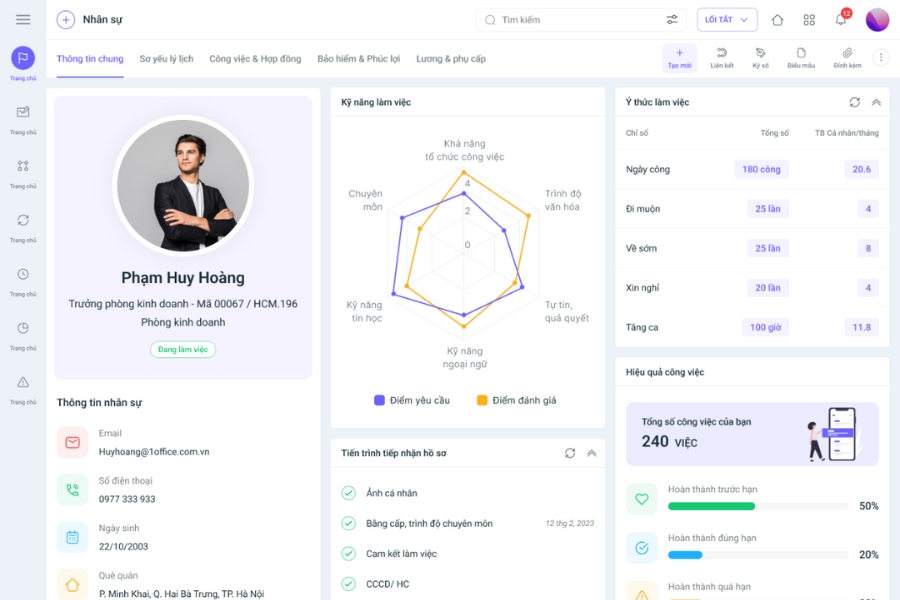
- Proficiency in HR technology and software: Knowing how to proficiently use HR management software to track employee information, generate reports, and simplify HR processes. Among them, 1Office’s AI-integrated HRM software is trusted by many HR Specialists for its ability to automate timekeeping, payroll, profile management, and performance evaluation on a single platform. The system helps HR save time on manual processing and provides visual analytics for faster, more accurate decision-making.
| >>> Learn more: What is HRM software? Role and benefits for businesses |
Professional knowledge required for an HR Specialist:
In addition to skills, an HR Specialist also needs to have solid professional knowledge to manage, evaluate, and develop human resources effectively.
- Professional knowledge of human resource management: Understanding of organizational structure design, resource management, interview processes, and employee training and development. The ability to build a competency framework helps distinguish between trainable skills and necessary competencies to recruit the right person for the right job.
- Foreign languages: English or other languages are an advantage, especially in international companies or multicultural work environments.
4. What are the Pros and Cons of being an HR Specialist?

Below are the common pros and cons an HR Specialist faces in their work:
| Benefits | Drawbacks |
|
|
5. Salary and Career Opportunities for an HR Specialist

Regarding the salary of an HR Specialist (for reference):
In Vietnam, the average salary for an HR Specialist ranges from 10-20 million VND/month, depending on their area of expertise, experience, and the company’s size. Specialized positions such as senior-level recruitment, training & development, or compensation and benefits management in large enterprises often command higher salaries, potentially exceeding 25 million VND/month. Additionally, bonus policies, benefits, and compensation packages also play a significant role, especially in multinational corporations or large-scale enterprises.
Regarding career opportunities for an HR Specialist:
The human resources industry is experiencing high demand, opening up many development opportunities for HR Specialists. After gaining experience, they can be promoted to HR Manager or HR Director with attractive compensation packages. Furthermore, HR Specialists can also specialize in areas such as recruitment, training, personnel management, benefits, labor relations, and more.
6. Frequently Asked Questions about HR Specialists

Question 1: Are HR Specialists in high demand?
HR Specialists are in high demand, with recruitment needs projected to increase by about 5% between 2018-2028 (according to a report by the U.S. Bureau of Labor Statistics). Fields such as professional, scientific, and technical services particularly require specialized personnel, offering attractive salaries. Additionally, with the changes in work models post-COVID-19, the demand for HR Specialists knowledgeable in labor laws and benefits is also increasing
Question 2: How does one become an HR Specialist?
To become an HR Specialist, candidates typically need a bachelor’s degree in human resource management, business, or a related field. Those who wish to specialize can study subjects relevant to their chosen area; for example, training & development specialists might study psychology or education, while compensation specialists might study accounting. Practical work experience, combined with HR certifications, will help you develop the necessary skills and professional knowledge without needing a second degree.
Question 3: Is being an HR Specialist a good career choice?
Whether you are just starting out, returning to work, or looking to move into a strategic role, becoming an HR Specialist is a career step that allows you to apply and expand your knowledge while contributing to the management of a company’s most valuable asset – its people
7. Conclusion
Understanding what an HR Specialist is will help you grasp the important role of this position and guide your career development in this field. Don’t forget to follow other articles from 1Office to stay updated on HR knowledge and effective human resource management software for businesses.
















