


 11/05/2026
  1034 views
An MOU is often known as the first stage in forming a formal contract later on. The term MOU is also very common and used for domestic purposes and agreements or between countries. However, not everyone clearly understands the concept of what an MOU is and how to distinguish between an MOU and a formal contract. Let’s learn about the Memorandum of Understanding (MOU) with 1Office in the following article.
Mục lục
- 1. What is an MOU?
- 2. How does an MOU work?
- 3. What is the difference between a contract and an MOU?
- 4. The legal standing of an MOU in business
- 5. Pros and Cons of MOUs in Business Practice
- 6. When Should a Business Use an MOU Instead of a Contract?
- 7. Standard Memorandum of Understanding (MOU) Templates
- 8. Frequently Asked Questions about Memorandums of Understanding (MOU)
- 9. Conclusion
1. What is an MOU?
An MOU (short for “Memorandum of Understanding”) is a type of non-binding legal document between two (bilateral) or more (multilateral) parties, often used in business, politics, and cooperation between organizations or countries. An MOU is generally understood as a document that expresses agreement, a temporary arrangement, or a commitment to specific issues between parties, but it is not legally binding.

The main purposes for parties to sign an MOU include:
- Defining the intention to cooperate: An MOU helps parties express their agreement to cooperate in one or more specific areas. This helps create a basis for future negotiations and joint activities.
- Expressing commitment: Although not highly legally binding, an MOU often includes temporary commitments from the parties, while also expressing a common intention to maintain a good relationship.
- Planning and setting direction: An MOU can be used to define a specific schedule or work plan for future activities. This helps the parties know what they need to do and when.
- Showing common intent: An MOU can also be used to express a common intention to negotiate more detailed agreements or treaties in the future. It is a first step in the negotiation process.
The main objective of an MOU is to establish a common understanding between the parties. An MOU is a type of non-binding agreement, signed between two or more parties to express a general consensus on cooperative goals and activities. By documenting the main goals and roles of each party, an MOU helps the parties understand each other and the cooperative activities to be undertaken. This helps minimize potential misunderstandings and disputes in the future.
2. How does an MOU work?
In business, an MOU functions as a pre-contractual memorandum, establishing a general framework and confirming the goodwill of cooperation between parties before proceeding to formal, legally binding commitments.
Operationally, the process of implementing a memorandum of understanding (MOU) typically goes through the following stages:
Step 1: Define cooperation objectives
The parties discuss and clearly define the specific goals or areas in which they want to cooperate in the future. This may involve joint product development, conducting research, market expansion, or even merging two companies.
Step 2: Draft the MOU
The parties proceed to write the MOU to express their commitment and intention to cooperate. The MOU typically includes information about the participating parties, a description of specific objectives, expected benefits, and the timeline or conditions for cooperation.
Step 3: Negotiate and agree
The parties negotiate to ensure that the MOU accurately reflects their intentions and meets specific requirements. The terms and conditions need to be discussed and agreed upon.
Step 4: Sign the MOU
After the terms have been agreed upon, the parties sign the MOU. Once signed, the MOU becomes an official document and expresses a temporary agreement between the parties to cooperate.
Step 5: Implement and evaluate
After the MOU is signed, the parties carry out specific activities according to the plan outlined in the MOU. During this process, they monitor and evaluate progress to ensure that objectives and commitments are met.
Example of how an MOU works in business:
An electronics manufacturing company (Company A) wants to expand its market into a new country. They approach a local company (Company B) that is already present in that country and want to cooperate to jointly develop products and conduct marketing. Both companies meet and define the cooperation objective as developing and selling electronic products in that market.
Then, they draft an MOU to express their commitment to this cooperation, including terms on sharing research materials, profit sharing, and the projected timeline for the project. Once the MOU is signed, both companies begin to implement the product development and marketing plan in that country under the guidance of the MOU.
3. What is the difference between a contract and an MOU?
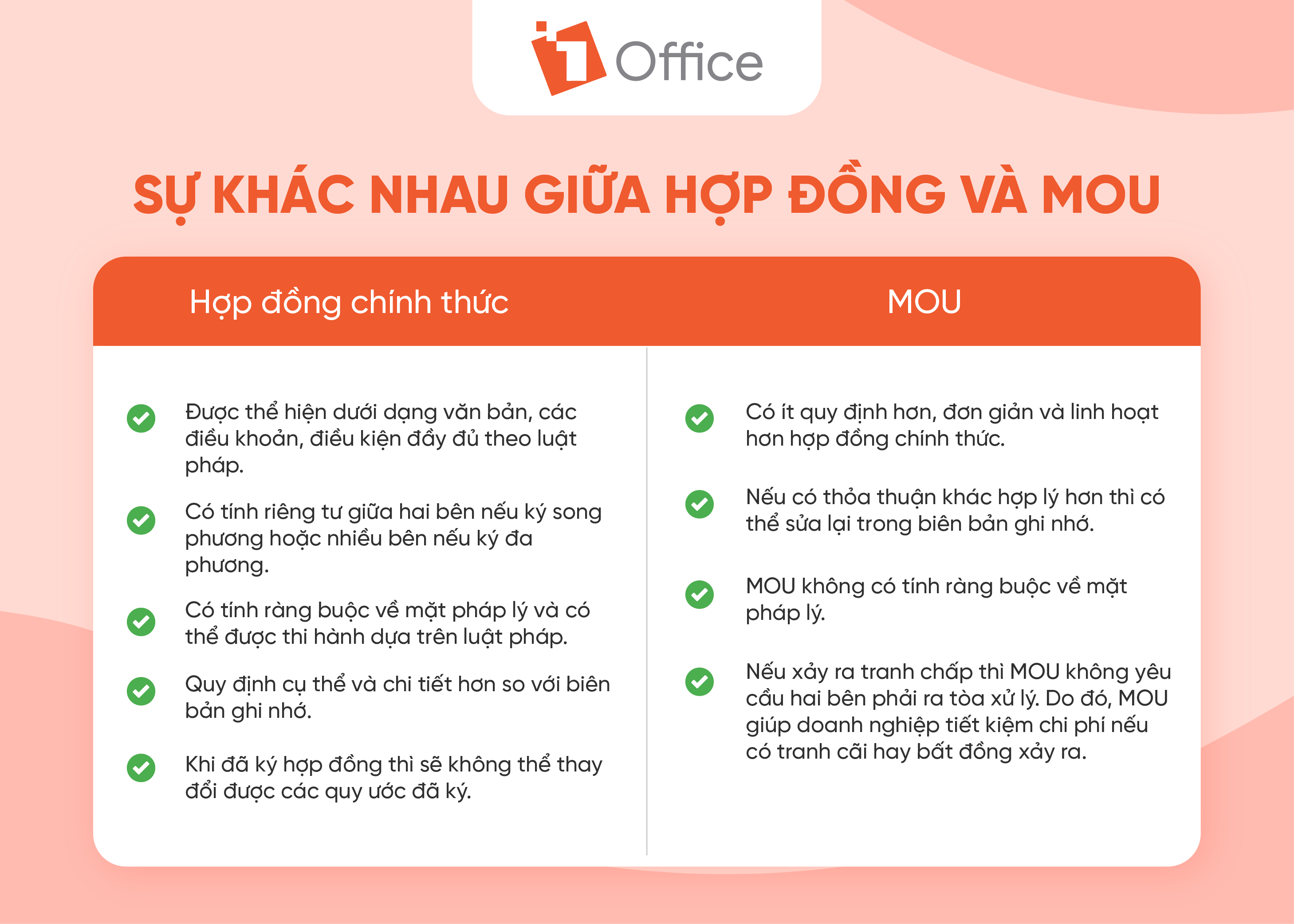
The core difference lies in legal binding: While a contract is a document that legally obligates parties to fulfill their duties under the protection of the law, an MOU primarily serves as a commitment of goodwill and a guide for cooperation.
Below is a detailed comparison table between a formal contract and an MOU:
4. The legal standing of an MOU in business
Firstly, regarding concerns about the validity of a memorandum of understanding, an MOU can become a legally binding document if it meets the following conditions:
- The MOU clearly expresses the covenants of the participating parties
- The purpose and content of the MOU are acknowledged and recorded for implementation by the parties.
- All terms in the MOU are mutually agreed upon by the signing parties.
- It contains the full signatures of all participating parties.
In the commercial and business legal system, the validity of an MOU is not specifically regulated. However, in practice, an MOU still has legal value if it is fully and properly executed. Parties can use an MOU instead of a contract to record their agreements. This is useful if any disputes arise, as it will help determine the responsibilities of the parties.
Secondly, contracts and memorandums of understanding are two closely related types of legal documents. A contract is a legally binding agreement between parties, while a memorandum of understanding is a document that records the general terms of an agreement.
When two parties are trying to reach an agreement to achieve a common goal, they may start by negotiating a memorandum of understanding. The MOU will state what each party expects from the other and set the basic rules for the working relationship.
After the memorandum of understanding is signed, the parties can sign a contract to detail the specific agreements. The contract will include more detailed terms and conditions, such as pricing, duration, and termination clauses. If there are any changes to the terms, both parties need to amend and agree before they take effect. If any disputes arise over the changes, they can be resolved in a new contract.
A legally binding agreement means that the participating parties must adhere to the terms of the agreement. If a dispute arises, the law will decide who is right and who is wrong. However, if one party does not want to go to court, they can sign a memorandum of understanding (MOU) with the other party. An MOU is a non-legally binding agreement, but it can help parties resolve disputes amicably.
5. Pros and Cons of MOUs in Business Practice
An MOU (Memorandum of Understanding) is often used as a “pre-contract” step, creating a foundation for cooperation between parties. However, like any tool, an MOU has both advantages and limitations that businesses should consider before using it.
Advantages:
- Quick and flexible: Drafting an MOU is much simpler than a contract, helping parties easily start cooperating without spending too much time.
- Builds trust and initial commitment: Although not as legally binding as a contract, an MOU still demonstrates goodwill and seriousness between the parties.
- Suitable for the trial phase: For research projects, new strategic partnerships, or when two parties need to “test” their ability to cooperate, an MOU is an effective tool.
Disadvantages:
- Limited legal value: In many cases, an MOU is not considered strictly legally binding, which can easily lead to disputes when conflicts arise.
- Prone to misunderstanding: Some businesses or partners mistakenly believe an MOU has the same value as a contract, leading to incorrect expectations.
- Difficult to enforce when legal issues arise: If a dispute occurs, an MOU often does not provide sufficient grounds for a court to resolve it definitively.
In other words, an MOU is like a “formal promise”—useful for getting started, but not sufficient to replace a formal contract.
6. When Should a Business Use an MOU Instead of a Contract?
A business should use an MOU when it wants to establish goodwill and a preliminary framework for cooperation during stages where specific terms regarding financial rights and obligations have not yet been clarified or do not require strict legal binding.
Prioritizing the use of a memorandum of understanding (MOU) over a formal contract is often applied in the following practical situations:
Preliminary or trial cooperation phase: When two parties are just getting to know each other and want to cooperate on a trial basis for a short period (e.g., co-organizing a seminar, testing a new product), an MOU provides a sufficient level of commitment without creating legal pressure.
Long-term strategic partnerships without finalized detailed terms:
For example, if a foreign corporation wants to invest in Vinamilk but has not yet agreed on all terms, the parties can sign an MOU to confirm the initial commitment before proceeding to a formal contract.
Research projects, academic collaborations, or non-profit partnerships: In scientific, educational, or medical research projects, an MOU is often used to record the intent to cooperate rather than to bind parties to profit-related terms.
When complex multi-party agreements are needed: An MOU is more flexible than a contract when multiple parties are involved, helping to create a general framework before delving into legal details.
In summary, a business should use an MOU when it needs a commitment based on principle, for a trial period, or for initial strategic direction, before formalizing it with a binding contract.
7. Standard Memorandum of Understanding (MOU) Templates
Structure and Content of an MOU
A Memorandum of Understanding (MOU) is a document that records the agreement between two or more parties on a specific issue. A standard MOU should include the following main contents:
- Information of the participating parties: Company name, address, contact methods, etc.
- Subject of negotiation: The parties need to clearly specify the issue they want to negotiate, such as capital contribution, international trade, training, etc.
- Additional clauses: The parties can add supplementary clauses depending on the purpose of the memorandum, such as confidentiality, legal liability to third parties, etc.
- Division of responsibilities: Clearly define the responsibilities of each party in implementing the MOU and the specific tasks they need to perform.
- Termination period: Define the validity period of the MOU, and provisions for terminating or extending the MOU (if necessary).
- Signatures and date of signing: Determine the time the memorandum of understanding is established and officially takes effect with the consent of the involved parties.
You can refer to and download some memorandum of understanding templates for specific cases below.
General MOU Template
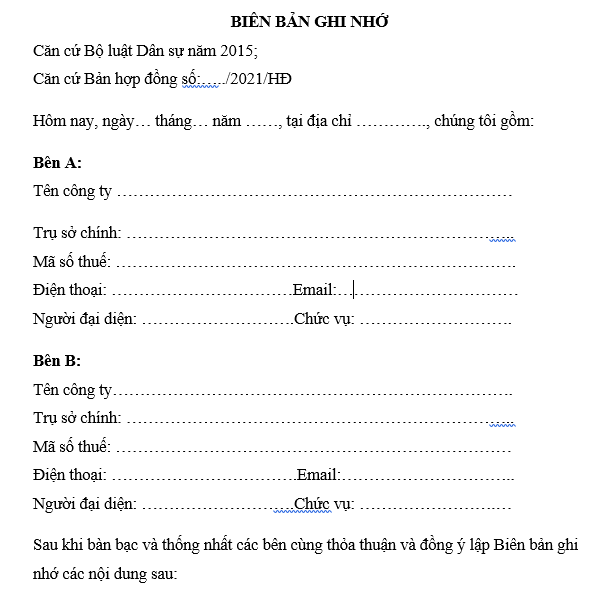
Download the general memorandum of understanding template
Business Cooperation MOU Template
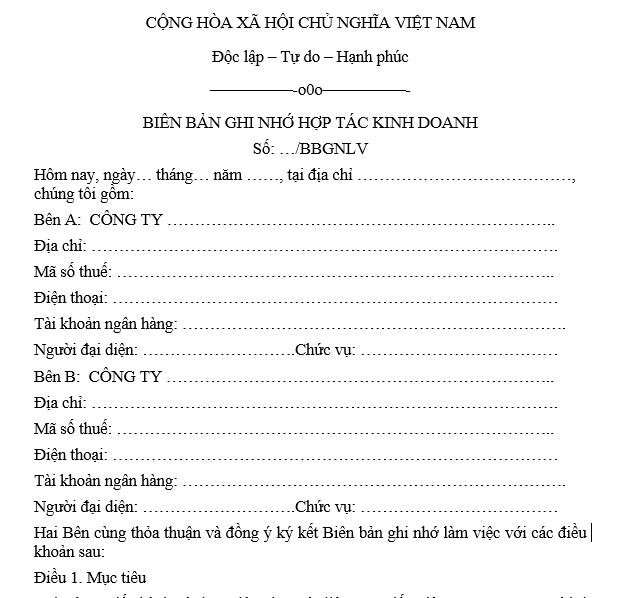
Download the business cooperation MOU template
Investment Cooperation MOU Template
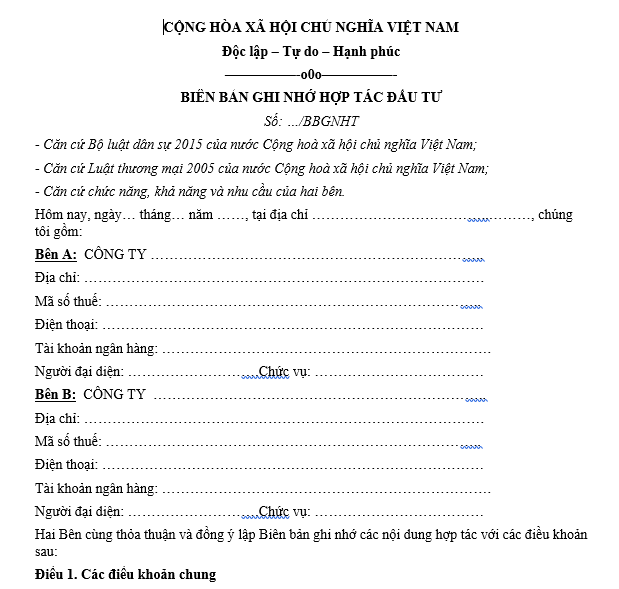
Download the investment cooperation MOU template
8. Frequently Asked Questions about Memorandums of Understanding (MOU)
Can an MOU replace a business contract?
No. An MOU is only a document recording the intention to cooperate and is not legally enforceable like a contract. If you want legal bindings regarding payments or penalties for violations, you must sign a formal contract.
Who bears the costs incurred during the MOU phase?
Typically, each party covers its own costs (such as travel, surveys) unless otherwise agreed in the MOU. Businesses should clearly state the cost-sharing terms to avoid financial disputes before signing a contract.
What should be done if a partner violates the commitments in an MOU?
Since an MOU is not legally binding, you cannot sue the partner in court to enforce their obligations. The main course of action is to negotiate or terminate the cooperation early to find a more reputable partner and avoid prolonged damages.
How long is an MOU valid for?
The validity period is mutually agreed upon by both parties, typically ranging from 6 to 12 months. After this period, if the parties do not proceed to sign a formal contract, the MOU will automatically expire unless there is a written extension.
Is an overlapping seal required for an MOU?
It is recommended. Although not legally required, applying an overlapping seal across the pages and the legal entity’s stamp helps authenticate the document, ensuring its content has not been altered and building maximum trust between the parties in the initial stage of cooperation.
Additionally, instead of managing scattered paperwork, businesses should use a comprehensive management platform like 1Office, which helps you approve and sign electronically (1Sign) through to implementing actual tasks (1Work) on a single platform, ensuring consistency and absolute security.
9. Conclusion
The article above has provided information on what an MOU is and the differences between an MOU and a formal contract. Depending on your business field and objectives, you should choose the appropriate form of agreement to avoid unnecessary damages. 1Office hopes this article has helped answer your questions.
















