11/05/2026
  680 views
Fixed assets are a group of high-value assets that directly affect a business’s production and business operations. But what are fixed assets, how are they classified, when are they recognized, and how can they be managed effectively? This article will help you understand everything from the concept to its practical application in business.
Mục lục
- 1. What are fixed assets?
- 2. What types of fixed assets are there in a business?
- 3. Conditions for Recognizing Fixed Assets
- 4. Fixed Asset Depreciation Framework Regulations
- 5. Common Mistakes to Avoid When Identifying Fixed Assets
- 6. How to Effectively Manage Fixed Assets in an Enterprise
- 7. Trends in Fixed Asset Management in the Digital Transformation Era
- 8. Some concepts related to fixed assets
- 9. Frequently Asked Questions about Fixed Asset Management
- 10. Conclusion
1. What are fixed assets?
Fixed assets are high-value assets that are used in multiple business cycles and are not consumed or destroyed during the production process to generate economic benefits for the business. Fixed assets consist of two main types: tangible and intangible, such as land, buildings, machinery, equipment, etc.
According to current regulations, Circular 45/2013/TT-BTC regulates the management, use, and depreciation of fixed assets, but it does not provide a specific definition for the concept of fixed assets.
Fixed assets play a crucial role in a business’s production and business operations. The correct and complete recognition of fixed assets is significant for determining the value of the business’s assets, calculating production and business costs, and preparing financial statements.
2. What types of fixed assets are there in a business?
The fixed asset system in a business includes economic resources with high value and long useful lives, divided into two main groups based on their physical characteristics: tangible assets and intangible assets.
Below is a detailed classification to help businesses easily manage and calculate depreciation:
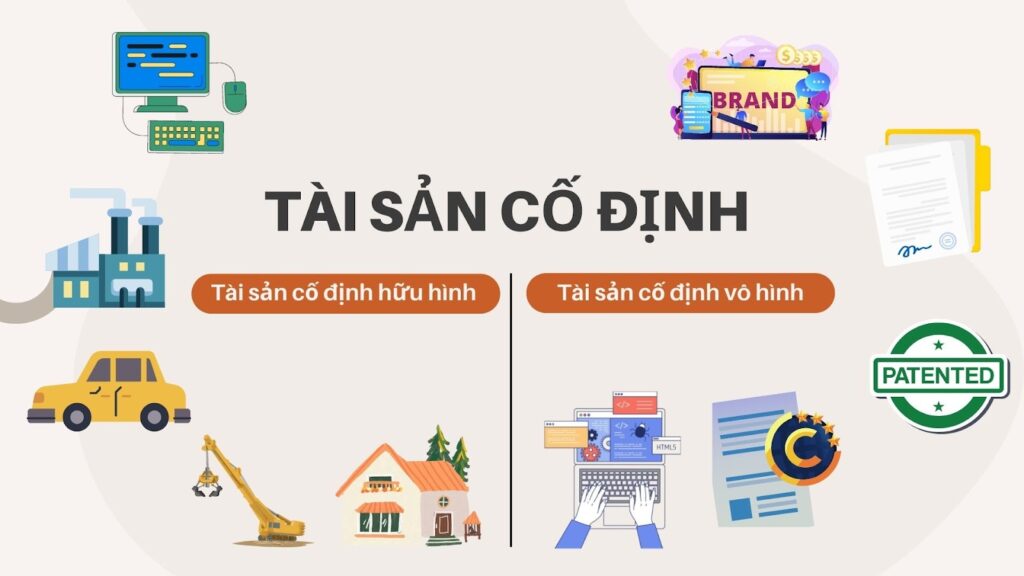
- Tangible fixed assets: These are assets that have a physical form, can be seen and touched. Examples: buildings, structures, machinery, equipment, vehicles, etc.
- Intangible fixed assets: These are assets that do not have a physical form but represent an invested value and bring economic benefits to the business. Examples include inventions, patents, trademarks, copyrights, etc.
Additionally, depending on the needs and purposes of each business, fixed assets can be classified according to other criteria such as: classification by economic use (used in production/business and outside of production/business), classification by ownership (owned or leased), classification by usage status (in use, not yet in use, pending liquidation), etc.
2.1. Types of tangible fixed assets
Tangible fixed assets are assets that have a physical form, can be seen and touched. Examples: buildings, structures, machinery, equipment, vehicles, etc.
Tangible fixed assets are classified into 6 groups as follows:
| Group | Classification Criteria | Example |
| Type 1 | Buildings, Architectural Structures | Headquarters, warehouses, production workshops, offices, etc. |
| Type 2 | Machinery, Equipment | Specialized machinery, work equipment, technology production lines, etc. |
| Type 3 | Means of Transportation | Cars, motorcycles, boats, airplanes, etc. |
| Type 4 | Transmission Equipment | Information systems, electrical systems, water pipes, conveyor belts, etc. |
| Type 5 | Perennial Gardens Working Animals |
Coffee, tea, rubber, fruit tree gardens, etc. Herds of horses, cattle, buffalo, elephants, etc. |
| Type 6 | Other Types of Fixed Assets | Includes other fixed assets not listed in the five types above, such as paintings and works of art. |
Depending on each business’s management needs, managers can further classify these tangible fixed assets into more appropriate groups.
2.2. Types of Intangible Fixed Assets
Intangible fixed assets are assets that do not have a physical form, represent an invested value, and bring economic benefits to the business. For example, inventions, patents, trademarks, copyrights, etc.
Intangible fixed assets are classified into 3 groups as follows:
| Group | Classification Criteria | Example |
| Type 1 | Land use rights | Residential land use rights, agricultural land use rights,… |
| Type 2 | Intellectual property rights | Invention patents, patents, trademarks, copyrights,… |
| Type 3 | Other intangible assets | Value of unpaid land use rights, software development costs,… |
In general, classifying fixed assets is essential for businesses to manage, track, inventory, and use assets effectively. Intangible fixed assets play a crucial role in business valuation, especially for major brands whose operations rely heavily on intellectual property, technology, and brand reputation. Here are some examples of intangible fixed assets from major brands:
-
Apple – Brand and Intellectual Property: According to Interbrand’s 2023 report, the Apple brand is valued at over $500 billion, making it the company’s largest intangible asset. Additionally, its software ecosystem, including iOS, the App Store, and proprietary technology patents, are also extremely valuable intangible assets.
-
Coca-Cola – Formula Secret & Brand: Although Coca-Cola’s tangible assets are not extensive, its proprietary formula and brand value constitute the majority of its business value. The Coca-Cola formula is considered a strictly protected trade secret, helping to solidify its global position for over 100 years.
-
Google – Algorithm System and Database: With its core technology being search algorithms, AI systems, and user data, Google possesses a massive portfolio of intangible assets. These elements cannot be measured in physical terms, yet they generate billions of dollars in advertising revenue each year.
-
Disney – Character Copyrights and Creative Content: Disney holds the copyrights to hundreds of famous characters like Mickey Mouse, Elsa, Marvel, etc. These intangible assets not only help Disney build its film and theme park product lines but also serve as the foundation for generating billions of dollars in revenue from merchandise.
-
Microsoft – Software and Operating System Copyrights: Windows, Microsoft Office, and cloud platforms like Azure are extremely valuable intangible assets that generate consistent annual cash flow. This is also a competitive advantage that has helped Microsoft maintain its position in the tech industry for decades.
3. Conditions for Recognizing Fixed Assets
According to the provisions of Circular 45/2013/TT-BTC, a fixed asset is recognized when it simultaneously meets the following conditions:
- It is certain that future economic benefits will be obtained from the use of that asset.
- The fixed asset is used in multiple business cycles and has a useful life of 1 year or more.
- The historical cost of the asset must be determined reliably and have a value of VND 30,000,000 or more.

In addition, fixed assets must also meet other conditions as prescribed by law, such as:
- The fixed asset must have complete and valid records and documents.
- The fixed asset must be owned by the business or leased by the business under a finance lease.
- The fixed asset has an independent structure or is a system of multiple individual asset components linked together to perform certain functions.
4. Fixed Asset Depreciation Framework Regulations
The fixed asset depreciation framework is the basis for businesses to determine the depreciation period for their fixed assets. Below is the depreciation period for new fixed assets of the same type, determined according to Appendix 1 issued with Circular 45/2013/TT-BTC:
| Category | Fixed Asset Groups | Minimum Depreciation Period (years) | Maximum Depreciation Period (years) |
| A – Power Machinery and Equipment | 1. Power generators | 8 | 15 |
| 2. Generators: hydroelectric, thermoelectric, wind, combined cycle gas. | 7 | 20 | |
| 3. Transformers and power supply equipment | 7 | 15 | |
| 4. Other power machinery and equipment | 6 | 15 | |
| B – Working Machinery and Equipment | 1. Machine tools | 7 | 15 |
| 2. Machinery and equipment for the mining industry | 5 | 15 | |
| 3. Tractors | 6 | 15 | |
| 4. Machinery for agriculture and forestry | 6 | 15 | |
| 5. Water and fuel pumps | 6 | 15 | |
| 6. Metallurgical equipment, surface treatment for rust and corrosion prevention | 7 | 15 | |
| 7. Specialized equipment for chemical production | 6 | 15 | |
| 8. Specialized machinery and equipment for producing construction materials, ceramics, and glass | 10 | 20 | |
| 9. Specialized equipment for producing electronic components, optics, and precision mechanics | 5 | 15 | |
| 10. Machinery and equipment for leather production, printing of stationery and cultural products | 7 | 15 | |
| 11. Machinery and equipment for the textile industry | 10 | 15 | |
| 12. Machinery and equipment for the garment industry | 5 | 10 | |
| 13. Machinery and equipment for the paper industry | 5 | 15 | |
| 14. Machinery and equipment for food production and processing | 7 | 15 | |
| 15. Cinematographic and medical machinery and equipment | 6 | 15 | |
| 16. Telecommunications, information, electronics, IT, and television machinery and equipment | 3 | 15 | |
| 17. Machinery and equipment for pharmaceutical production | 6 | 10 | |
| 18. Other working machinery and equipment | 5 | 12 | |
| 19. Machinery and equipment for the oil refining and petrochemical industry | 10 | 20 | |
| 20. Machinery and equipment for oil and gas exploration and extraction. | 7 | 10 | |
| 21. Construction machinery and equipment | 8 | 15 | |
| 22. Cranes | 10 | 20 | |
| C – Measuring and Testing Instruments | 1. Equipment for measuring and testing mechanical, acoustic, and thermal quantities | 5 | 10 |
| 2. Optical and spectroscopic equipment | 6 | 10 | |
| 3. Electrical and electronic equipment | 5 | 10 | |
| 4. Physicochemical measurement and analysis equipment | 6 | 10 | |
| 5. Radiation measurement equipment and instruments | 6 | 10 | |
| 6. Special-purpose equipment | 5 | 10 | |
| 7. Other measuring and testing equipment | 6 | 10 | |
| 8. Molds used in the casting industry | 2 | 5 | |
| D – Transportation Equipment and Vehicles | 1. Road transport vehicles | 6 | 10 |
| 2. Rail transport vehicles | 7 | 15 | |
| 3. Waterway transport vehicles | 7 | 15 | |
| 4. Air transport vehicles | 8 | 20 | |
| 5. Pipeline transport equipment | 10 | 30 | |
| 6. Loading, unloading, and lifting equipment | 6 | 10 | |
| 7. Other transportation equipment and vehicles | 6 | 10 | |
| E – Management Tools | 1. Calculation and measurement equipment | 5 | 8 |
| 2. Information, electronic machinery and equipment, and management software | 3 | 8 | |
| 3. Other management tools and equipment | 5 | 10 | |
| G – Buildings and Structures | 1. Permanent buildings. | 25 | 50 |
| 2. Break rooms, canteens, restrooms, changing rooms, garages… | 6 | 25 | |
| 3. Other buildings. | 6 | 25 | |
| 4. Warehouses, tanks; bridges, roads, airport runways; parking lots, drying yards… | 5 | 20 | |
| 5. Embankments, dams, sewers, canals, ditches. | 6 | 30 | |
| 6. Wharves, slipways… | 10 | 40 | |
| 7. Other structures | 5 | 10 | |
| H – Livestock and Perennial Crops | 1. All types of livestock | 4 | 15 |
| 2. Industrial crops, fruit orchards, perennial crops. | 6 | 40 | |
| 3. Lawns, green carpets. | 2 | 8 | |
| I – Other tangible fixed assets not specified in the groups above. | 4 | 25 | |
| K – Other intangible fixed assets. | 2 | 20 | |
The latest fixed asset depreciation framework
According to Article 9 of Circular 45/2013/TT-BTC, some types of assets are not subject to depreciation, such as:
- Fixed assets that are fully depreciated but still in use.
- Fixed assets that are lost before being fully depreciated.
- Fixed assets under financial lease.
- Fixed assets used to serve employees at the enterprise.
- Fixed assets from non-refundable aid sources serving scientific research.
- Intangible fixed assets that are long-term land use rights.
Determining the depreciation period for fixed assets is crucial for calculating depreciation expenses, determining the remaining value of fixed assets, and preparing financial statements.
5. Common Mistakes to Avoid When Identifying Fixed Assets

When identifying fixed assets, managers should note the following to avoid errors:
- Determine the historical cost of fixed assets: This includes the total purchase cost, transportation costs, installation, trial runs, and other costs directly related to bringing the asset to a ready-to-use state. The enterprise must rely on valid documents and records to accurately determine the historical cost of fixed assets.
- Determine the depreciation period for fixed assets: Based on the fixed asset depreciation framework specified in Section 4, managers can determine the most accurate depreciation period for fixed assets.
- Determine the depreciation method for fixed assets: Choose a suitable depreciation method based on the characteristics and nature of each type of fixed asset and the enterprise’s actual situation.
- Determine the residual value of fixed assets: The residual value of a fixed asset is its value after it has been fully depreciated. Calculating the residual value ensures the accuracy of financial statements.
- Determine the recognition time for fixed assets: This is the point at which the enterprise meets the legal requirements to recognize a fixed asset. Typically, the recognition time is after the enterprise has completed the procurement, construction, manufacturing, acceptance, handover, and has put the asset into use.
6. How to Effectively Manage Fixed Assets in an Enterprise
Fixed assets (FA) often account for a large proportion of an enterprise’s total capital. Without proper management, businesses can face risks of loss, incorrect depreciation, and increased maintenance costs. Conversely, effective FA management helps optimize the asset lifecycle, save costs, and improve business and production efficiency.
So, how should an enterprise manage its fixed assets to both comply with legal regulations and maximize their useful value? Below are the principles and methods for effective fixed asset management that every business should apply:
- Create a catalog and codify fixed assets: The enterprise needs to create a complete catalog of all fixed assets, clearly stating: code, asset name, identifying features, and the using department. Codification (QR code, barcode) facilitates easy lookup, prevents loss, and supports quick inventory checks.
- Establish a tracking process and assign responsibilities: Each asset should have a person directly responsible for its management. The accounting department tracks it in the books, while the using department is responsible for its maintenance. This clear division of responsibility helps ensure proper control from use to maintenance.
- Implement fixed asset management software (This helps minimize manual errors and increase administrative efficiency):
- Automatically calculate and allocate depreciation.
- Manage the asset lifecycle from procurement to disposal.
- Generate reports quickly and accurately.
- Conduct regular and unscheduled inventory checks: Inventory checks are a crucial step to reconcile physical assets with accounting records. Businesses should conduct regular checks (annually, quarterly) and unscheduled checks in case of incidents, changes in management personnel, or before preparing financial statements.
- Perform maintenance and repairs according to schedule: Fixed assets, especially machinery and equipment, require regular maintenance to extend their lifespan. Businesses should have a clear maintenance and repair plan to avoid breakdowns that disrupt production.
- Dispose of and transfer assets reasonably: Assets that are no longer in use or are inefficient should be liquidated or sold to recover capital. If an asset is still usable but not suitable for its current department, it can be transferred internally to maximize its utility.
- Comply with legal regulations and accounting standards: All operations related to fixed assets must be based on legal grounds (Circular 45/2013, Circular 200/2014, Circular 133/2016, etc.). Adherence to standards helps businesses maintain transparency and facilitates audits and tax finalization.
7. Trends in Fixed Asset Management in the Digital Transformation Era
Digital transformation is changing how businesses manage all their operations, including fixed asset (FA) management. While management previously relied on manual books and reports, digital technology now helps businesses track, inventory, depreciate, and optimize the FA lifecycle more automatically and transparently.
So, in the context of digitalization, what trends should businesses pay attention to in order to manage fixed assets effectively and keep up with the times? Here are the prominent trends:
- Using fixed asset management software: Specialized software helps automate recording, depreciation, and reporting, reducing manual errors and saving time.
- Integration with ERP systems: Fixed assets are not managed in isolation but are synchronously connected with finance, accounting, HR, and procurement. This ensures seamless information flow and reduces data duplication.
- Application of QR codes, Barcodes, and RFID: Identification technology helps with quick inventory checks, limits fraud, and increases accuracy in the physical management of assets.
- Management on a cloud platform: Fixed asset data is updated in real-time and accessible anytime, anywhere, which is especially suitable for businesses with multiple branches.
- Data analysis and predictive AI: AI can analyze wear and tear, predict when maintenance or replacement is needed, helping to optimize maintenance costs and extend the lifespan of fixed assets.
- Digitizing the inventory process: Instead of manual inventory checks, businesses use mobile apps to scan assets directly on-site, synchronizing data immediately with the central system.
8.1. Original cost of fixed assets
The original cost of a fixed asset is the total expenditure incurred by the business to acquire the asset, including: purchase price, transportation, installation, trial run costs, and other costs directly related to bringing the asset into a ready-to-use state.
- Read more: What is the original cost of a fixed asset? How to determine the original cost of a fixed asset
8.2. Accumulated depreciation of fixed assets
Accumulated depreciation of a fixed asset is the decrease in its value due to usage, natural wear and tear, obsolescence, or force majeure events.
8.3. Fixed asset depreciation methods
Fixed asset depreciation methods are ways to allocate the depreciable value of a fixed asset to production and business expenses. Some common depreciation methods today include:
- Straight-line depreciation method.
- Declining balance depreciation method (with adjustments).
- Units of production depreciation method.
8.4. Leased fixed assets (Finance Lease)
A leased fixed asset (finance lease) is a fixed asset that a business leases from a financial leasing company. According to the provisions in Clause 3, Article 2 of Circular 45/2013/TT-BTC, a leased asset is classified as a fixed asset if it meets the following conditions:
- The total lease payment for an asset as specified in the finance lease contract must be at least equivalent to the value of that asset at the time the contract is signed.
- At the end of the lease term, the lessee has the option to purchase the leased asset at an agreed-upon price or to continue leasing it under the agreed-upon conditions.
8.5. Similar fixed assets
A similar fixed asset is a fixed asset with a similar use and value in the same line of business.
9. Frequently Asked Questions about Fixed Asset Management
When is an asset valued at over 30 million VND NOT considered a fixed asset?
These are goods, finished products, or tools and supplies in inventory awaiting sale or not yet put into production/business use, and do not meet the condition of having a useful life of over 1 year.
Is a business allowed to change its fixed asset depreciation method midway?
Yes, but the change can only be made once for each asset, and a written notification and clear explanation of the reason must be sent to the managing tax authority before implementation.
Do fixed assets purchased with welfare funds need to be depreciated?
No. Fixed assets used for employee welfare purposes (such as break rooms, canteens, shuttle buses, etc.) are not depreciated as business expenses by the company.
What should be done when a fixed asset is fully depreciated but still in use?
The business must stop recording depreciation but must continue to track and manage the asset in its books and fixed asset records until the asset is actually liquidated or disposed of.
Why does managing fixed assets with Excel often lead to tax data discrepancies?
Because Excel does not automatically update new regulations on depreciation schedules, is prone to manual formula errors, and makes it difficult to track the history of transfers and major repairs that change the original cost. To overcome this, businesses should use 1Office management software to automate depreciation calculations and synchronize accounting and asset data in real-time.
10. Conclusion
The above is all the information about fixed assets that the accounting department in particular and the business in general need to understand. We hope that through this article, 1Office has helped you better understand the concept and regulations regarding the recognition criteria and depreciation schedule for fixed assets. We wish your business success