


 12/05/2026
  408 views
Successful recruitment helps businesses gain the best and most qualified employees. Does a business need to build a strong EVP to attract talented candidates? So, what is EVP and why is it so important in recruitment? Let’s find out with 1Office in the following article!
Mục lục
1. What is EVP?
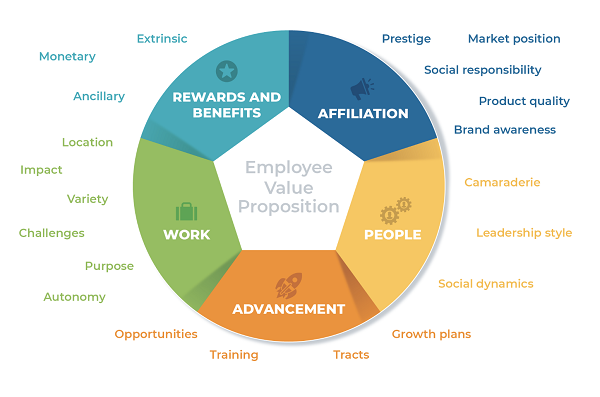
EVP (Employee Value Proposition) is a term that refers to a set of material and non-material benefits that a business/organization can use to attract employees. EVP can include tangible things like salary, compensation packages, and training programs. EVP can also include intangible elements related to corporate values, such as a stable work environment, internal cohesion, corporate culture, etc.
However, this concept has recently been updated.
EVP is an ecosystem of support, recognition, and values that a business/organization must provide to employees to help them reach their highest potential at work.
The key point is that EVP should not be seen as a two-way transaction. It must be a comprehensive set of offerings from the employer. This will increase employee engagement and optimize the workforce’s capabilities.
2. Why must EVP be closely linked to employer branding?
Most of the Employee Value Proposition is conveyed through job postings and content that enhances website interaction. Most importantly, it is conveyed through the company’s employer brand (Employer Branding). In fact, over 80% of business leaders admit that employer branding plays a crucial role in attracting talent (According to LinkedIn’s Global Talent Trends report)
This report also indicates that while nearly 70% of recruitment budgets are allocated to job boards, recruiting tools, and headhunting firms, many leaders believe Employer Branding is the key area they regret not investing more in.
Effectively attract potential candidates by applying Talent Acquisition in your business
>> Learn more: What is Talent Acquisition? The hybrid of a Recruiter and a Headhunter
3. Benefits of EVP (Employee Value Proposition) for businesses
Understanding what EVP is will help you easily grasp its importance and answer the question of why businesses need to build a professional EVP. A company’s EVP is like a product’s USP (“Unique Selling Point”). These characteristics help you attract more potential candidates and retain individuals who align with the company’s ideals and values. This is similar to creating a product that hits the customer’s insight.

According to a study by Gartner, successfully building an Employee Value Proposition can help organizations reduce their annual turnover rate by up to 69% and increase commitment levels by 29%. As a result, your employees will stay with the company longer. Furthermore, they will likely want to refer other candidates to the business.
A well-built EVP can help you:
- Impress candidates from different groups: Each position has specific requirements and characteristics, so candidates have their own needs and preferences. A strategic EVP impresses candidates with not only its breadth but also its depth. For example, the benefits to attract a developer candidate do not need to be the same as for a sales position.
- Reach passive candidates: A good EVP will increase your ability to reach passive candidates by elevating your company’s brand in the labor market. The power of an EVP will solidify your position in the eyes of candidates as a “promised land.”
- Strengthen corporate culture: The process of building a company’s EVP includes listening to employees. Employees get to express what is most important to them. This helps to re-inspire employees, building trust and a strong commitment.
- Reduce competition on compensation: Many candidates, especially younger ones, are willing to be flexible on salary if they find your company’s EVP highly valuable. This means that even if you don’t offer the highest salary on the market, you can still compete with rival companies to have candidates join your team.
| Read more: Common mistakes to avoid in the recruitment process! |
4. 4 Steps to Build an EVP to Enhance Your Company’s Employer Brand
Every business has different recruitment needs, so their hiring plans also have distinct characteristics. You can approach an effective recruitment strategy through the following 4 steps to build an Employee Value Proposition (EVP) for your business:
Step 1: Propose Human Resources Supplementation
After understanding what an EVP is and the significance of an employer brand, you can start building your EVP. First, review the company’s overall operational situation. Identify departments and positions that are underperforming or need additional personnel. Prioritize the recruitment positions and discuss them thoroughly with senior management. Leaders need to understand why more people are needed to avoid future complications.
You can refer to some necessary content when creating a personnel requisition form:
- Department and units needing recruitment, proposing new personnel: you need to clearly state which unit in the company needs to hire new people.
- Job title to be recruited: clearly state the job title your business is proposing to fill.
- Number of positions to be filled: detail the exact number of new personnel the business needs to recruit for each specific position.
- Projected probation period: fill in the form with the expected start date for the probationary period. According to labor law, the probation period is 2 months. In special or exceptional cases, the company has the right to prioritize.
- Probationary salary: the form should state the proposed probationary salary. This salary must comply with the regulations set by the company or corporation. According to current regulations, the probationary salary for a new employee is 85% of the basic salary.
- Official salary: also state this clearly, similar to the probationary salary.
- Recruitment standards: the person creating the form must clearly list the general recruitment standards for the positions the company needs to fill. Ensure that the hired personnel meet the most basic requirements of the position.
- Summary of the job responsibilities for the position to be filled.

Step 2: Create a JD (Job Description) for Candidates
a. Planning
Planning is the first crucial element in creating a complete JD. To build this step, you must determine:
- What is the purpose of creating this job?
- What are the responsibilities of the person performing this job?
- How will the work results be monitored and evaluated?
To better understand what potential candidates want and need, conduct some research. Try using an online tool to create an internal survey or conduct group interviews. You can ask employees what they expect from the company. What do they hope to achieve while working in their position? Their answers often represent the broader labor market.
Some questions you can ask employees during your research:
- What salary and benefits do you expect?
- Which benefit do you find most valuable at the company?
b. Analyze results by group
Next, analyze the results by segmenting them according to different employee groups, such as Marketing, Sales, Developer, etc. Then, identify the most common trends across all these groups. This is what you should aim for when posting a job for a similar position.
c. Research competitors
Don’t forget to research your competitors. If the Employee Value Proposition in your JD is similar to your competitors’, it won’t leave a lasting impression on candidates. Create a distinction to make your company an ideal place to work. You can research competitors by looking at their career websites and job postings. You can even talk to an employee who previously worked for a competitor.

d. Synthesize information and draft the candidate’s job description
You need to draft a JD that aligns with the previously analyzed data. This gives you an overview of the upcoming new job and its scope. For the person taking on the role, the draft job description will help them define their responsibilities and position within the department.
e. Approve the JD
The final part of this step is to get the job description approved. The job description must be agreed upon by the person holding the position and the manager. After the job description is approved, any questions or requests from the employee to change the JD must go through the manager to be proposed to higher-ups.
Step 3: Research and screen potential CVs (Curriculum Vitae – Candidate Profiles)
After the job announcement is posted, many candidates will submit their applications. Screening candidate profiles typically involves a 3-step process based on the minimum and preferred criteria for the position. Both types of criteria need to be relevant to the position being recruited. Ideally, they should match the job description. These criteria may include:
- Work experience
- Academic achievements
- Skills and knowledge
- Personality traits
- Competencies
First, screen candidate profiles based on minimum criteria:
Minimum criteria are the mandatory requirements a candidate must meet to be considered for the position. A simple example of a minimum criterion is that the candidate must be of legal working age. These types of criteria are often considered “qualifiers.” Candidates who meet these criteria will advance to the next round, while the rest will be eliminated at this stage.

Next, screen candidates based on preferred criteria
Preferred criteria are not mandatory, but they are things that make a candidate stand out. A common example of a “preferred criterion” is work experience relevant to the position. Candidates who possess these criteria are often of higher quality than those who only meet the minimum criteria. Candidates who meet both minimum and preferred criteria will be added to the CV shortlist.
Finally, create a shortlist of candidates based on minimum and preferred criteria
Your hiring needs will determine which candidates are shortlisted for an interview. Use the candidate conversion rate from previous rounds to determine the number of candidates to invite for an interview.
>> See more: 5 Steps to Create a Job Description with Standard Templates for All Positions and Roles
Step 4: Build the interview process
The interview process is the candidate’s first impression of the company and also a “meet and greet” to determine mutual suitability. A mistake or unprofessional behavior from HR can be misinterpreted by the candidate and complained about to their acquaintances, thereby damaging the company’s Employer Branding and reducing its ability to attract talent. A basic interview process will consist of 4 rounds:
Round 1: Send confirmation emails to selected candidates
You should only send interview invitations when you have a filtered list of potential candidates. Don’t send them out en masse, or you might risk sending an invitation to a candidate you just rejected last week.
Ensure the email meets the following 4 criteria:
- Complete information: Include the job position, working hours, benefits, salary, and bonuses. Also, attach a soft copy of the contract and a list of documents to prepare for the first day/week of work. This allows candidates to review and understand their position, making it easier for them to make a decision.
- Clear information: Being complete isn’t enough; the information you send to candidates must be clear to minimize the need for them to send multiple follow-up emails with questions.
- Professional presentation: To make your email look cleaner and more professional: always leave a blank line between paragraphs, keep paragraphs to no more than 4 lines, sentences to no more than 1.5 lines, and choose a modern, sans-serif font.
- Tone and language: Personalize the email, make it suitable for all audiences, and maintain a distinct tone that aligns with your company’s brand image (e.g., professional, friendly, open, etc.).

Round 2: Online Interview
After receiving responses from candidates, prepare a script for the online interview round. Unlike offline/in-person interviews, online interviews may not allow you to observe a candidate’s expressions, gestures, or demeanor, but they are an excellent tool for testing their responsiveness. Many candidates can become passive and flustered when interviewing over the phone or Skype. This can help HR get more honest answers from them.
Keep the following principles in mind to ensure a smooth online interview:
- Look at the camera, not the screen.
- Be mindful of potential interruptions around you.
- Pay attention to your background.
- Avoid wearing patterned clothing that might distract the candidate.
- Do a test run beforehand and ensure your audio and video are working properly.
Round 3: Interview Letter
After the online interview round, prepare an Interview Letter template to send to the candidate. In addition to the criteria from round 1, clearly state the location and time in the email. Highlight this text to ensure the candidate sees this information as soon as they open the email.
If necessary, call the candidate 1-2 hours before the in-person interview to avoid being stood up.
Round 4: Offer Letter
An Offer Letter is a “job offer letter” drafted by HR and sent to a suitable candidate after the interview to inform them that their application was successful and to express the company’s desire to hire them.
When sending the Offer Letter, confirm the information with the candidate one more time to make any necessary adjustments. This helps avoid potential conflicts when they officially start working.
Keep in mind that a potential candidate may receive more than one Offer Letter at the same time. Therefore, even if your company doesn’t have or has an EVP comparable to other companies, a well-timed Offer Letter can increase your chances of “winning” that candidate for your company.

See more: A compilation of 12+ most effective recruitment methods in 2022 for all businesses
5. Build a professional EVP with – 1Office Recruitment Software
In reality, if a business does not build a strong EVP, very few quality candidates will apply, and employees will not stay for long. Building a recruitment process requires not only a long-term investment but also patience and a certain amount of knowledge.
Understanding this challenge, 1Office has launched a platform that integrates artificial intelligence (AI) into the recruitment process, helping businesses build and standardize the process of sourcing and selecting new hires. 1Office Recruitment Management Software will integrate with recruitment emails, automatically retrieve candidate profiles to sync to the system, and extract data & segment information clearly. The software can create and schedule interviews efficiently, helping the recruitment department improve productivity.
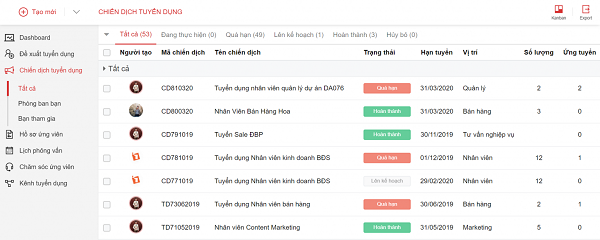
A plus point of this software is its ability to save candidate care history and all unsuccessful CVs for future nurturing in other campaigns. In addition, 1Office automatically updates reports, helping managers evaluate the effectiveness of each recruitment channel and the performance of each recruiter, making the recruitment process much easier and more time-saving.
If you are facing difficulties with recruitment, sign up for a trial to receive a consultation. 1Office will help you solve your challenges quickly!
Contact us:
- Hotline: 083 483 8888
- 1Office Fanpage: https://www.facebook.com/1officevn
- Youtube: https://www.youtube.com/c/1OfficeNềntảngquảnlýtổngthểDoanhNghiệp
















