1. Overview of Saigon Real Estate Joint Stock Company
Saigon Real Estate Joint Stock Corporation (Saigonres Group), formerly a state-owned enterprise, was equitized in 1999 under Decision No. 108/1999/QD-TTg dated April 23, 1999, by the Prime Minister. On January 15, 2018, Saigonres Group became a public company with the stock code SGR, listed on the Ho Chi Minh City Stock Exchange.
With nearly 40 years of operation, Saigonres Group has always been committed to enhancing its competitiveness by assessing the market, seizing investment opportunities, and distributing high-quality products with complete legal documentation, delivering optimal value to customers, partners, and investors.
To date, in the real estate investment and business sector alone, Saigonres Group has successfully implemented dozens of large-scale projects that are now in operation. Additionally, Saigonres Group is developing many other projects in several provinces across the country. Currently, Saigonres Group has grown strong with 12 member companies and nearly 200 employees.
CORE BUSINESS AREAS OF SAIGONRES GROUP
– Investment, project development, and real estate business.
– Consulting, real estate brokerage, and land use rights.
– Management and operation of buildings, apartments, and hotels.
– Consulting on planning, architectural design, and construction design.
– Construction of civil, industrial, and infrastructure projects…
– Manufacturing and distribution of interior products and aluminum/iron products.
– Investment and operation of culinary and restaurant services.
– Providing 4.0 technology transportation solutions for businesses.
– Providing freight transportation services.
2. Challenges Saigon Real Estate Faced Before Implementing Digital Transformation in Operations
The increasingly dynamic and fiercely competitive real estate market requires businesses to constantly innovate to adapt. However, Saigon Real Estate was facing many difficulties as it had not yet embarked on digital transformation. The manual, outdated management system was hindering the company’s growth, leading to inefficient work and a loss of competitive advantage.
Inefficient Manual Management
Paperwork: Manual management using Excel and paper documents was cumbersome, prone to loss, and time-consuming to search and process.
Timekeeping: Manual timekeeping was inaccurate, making it difficult to monitor employee hours, leading to tardiness and early departures, which affected work efficiency.
Request Approvals: The manual approval process for requests lacked transparency, was prone to favoritism, and did not ensure fairness.
Payroll Calculation: Manual payroll calculation was time-consuming, error-prone, and made it difficult to track and manage costs.
Work Reporting: Work reports in Excel were not updated in real-time, preventing management from effectively tracking work progress.
Project Management: The lack of effective project management tools made it difficult to track progress, materials, and finances, leading to errors and impacting project efficiency.
Security Risks and Data Loss
Manual Data Management: Storing data in Excel and on paper posed risks of loss and information leaks, affecting the company’s reputation and operations.
Access Permissions: Granting access to work files on Excel and Google Sheets was not secure, leading to the risk of leaking personal information of employees and customers.
Difficulties in Scaling
Manual Management: Manual management became overwhelming as the business scaled, leading to a decrease in work efficiency.
Lack of a Unified System: The absence of a unified management system made it difficult to manage multiple projects and branches.
Challenges in Attracting and Retaining Employees
Manual Work Environment: A manual, unprofessional work environment failed to attract young, dynamic employees.
Inefficient Workflows: Inefficient workflows with cumbersome procedures discouraged employees, affecting work performance and retention rates.
With a large number of employees and operating under a traditional management model, digital transformation was an urgent need for Saigon Real Estate to:
Improve operational efficiency, increase productivity and profits.
Enhance transparency and accountability in management.
Boost competitiveness in the market.
Minimize risks and secure data.
3. Saigon Real Estate “Joins Hands” with 1Office for HR Digital Transformation
The dynamic real estate market presents many opportunities but is also fraught with challenges. Recognizing the importance of applying technology, Saigon Real Estate “joined hands” with 1Office for digital transformation. This was a turning point that marked a spectacular breakthrough for the company, bringing positive changes to every aspect of its operations.
Positive Changes in HR Management
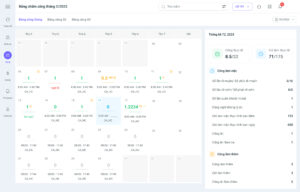
Automated Timekeeping: Employees can automatically check in and out through various methods: Fingerprint, FaceID, GPS, etc., and easily track their own attendance. The system automatically calculates working hours, business trip expenses, annual leave, etc., saving time and effort for the HR department.
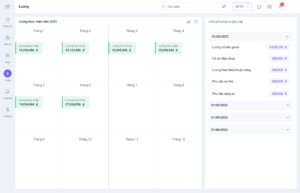
Automated Payroll: Salaries are calculated automatically based on pre-set formulas, ensuring accuracy and transparency. Employees and managers can view their own salaries directly on the system. The director can view departmental salaries over many years and access detailed reports when needed.
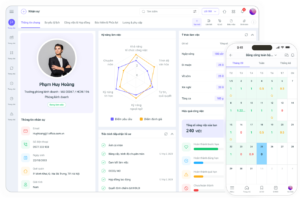
Employee Profile Management: The system stores complete and secure employee profiles, making them easy to search for when needed.
Automated timekeeping provides transparency and easy tracking
The payslip is configured with a pre-set formula
HR records are stored securely and are easy to search
Improved Efficiency in Work and Project Management
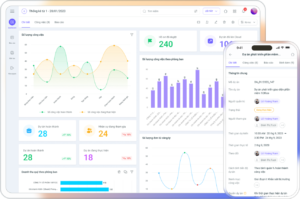
Work Digitization: Over 90% of tasks were digitized on the software, enabling effective work management and easy progress tracking.
Professional Project Management: The system provides a full suite of tools for project management, including planning, progress tracking, financial management, materials management, and more.
Visual Reports: The system provides visual reports, helping management quickly and accurately grasp the company’s operational status.
90% of work is digitized on the software
Transparent and efficient operational processes
Online processes: Operational processes are brought onto the software, enhancing transparency and efficiency.
Process automation: Some simple processes are fully automated, saving time and effort.
Error reduction: The system helps minimize errors during process execution.
Digital transformation with 1Office has brought significant benefits to Saigon Real Estate Company:
Improved operational efficiency: The company saves 30% of time and effort on management tasks.
Enhanced transparency: The system helps the management board grasp the company’s operational status transparently and accurately.
Strengthened competitive position: The company enhances its competitiveness in the highly competitive real estate market.
Increased employee satisfaction: Employees are satisfied with the professional and modern working environment.
Digital transformation with 1Office is a significant turning point in the development of Saigon Real Estate Company. The modern management system has helped the company achieve much success and look towards a bright future.
Digital transformation is an inevitable trend for all businesses in the digital age. 1Office is proud to accompany businesses on their digital transformation journey, helping them improve operational efficiency, enhance competitiveness, and achieve sustainable success.
Apply management knowledge in practice with the 1Office all-in-one management solution
Thank you for scheduling a consultation!
1Office has received your consultation request. Our consultant will contact you as soon as possible. For any questions, please contact Hotline: 083 483 8888



 12/05/2026
  216 views