


 12/05/2026
  445 views
Implicit cost is an important concept that managers need to understand clearly. A solid understanding of implicit costs will help businesses make more effective business decisions. In this article, 1Office will explore everything about Implicit Cost with you: its concept, classifications, examples, and the formula for calculating implicit costs in a business.
Mục lục
1. What is an implicit cost?
Implicit Cost refers to costs that a business does not pay for with cash but that still affect business performance. Implicit costs are also known as opportunity costs or imputed costs. This is a concept commonly used in accounting and business, arising from the use of a company’s internal resources.
In other words, an implicit cost represents the sacrifice of an opportunity that a business must accept when using its internal resources to create a product/service.
Implicit costs are often difficult to measure and are not recorded in a company’s financial statements, so managers often do not consider them when making business decisions. However, a solid understanding of implicit costs will help managers ensure accuracy, provide a comprehensive view, and make more effective business decisions.
2. Common types of implicit costs in a business
In business, implicit costs appear in various forms and are not always obvious on the balance sheet. Below are some common types of implicit costs in a business that managers should be aware of:

2.1. Opportunity cost
This is a common implicit cost found in businesses across various activities. Opportunity cost is the value of the benefit lost when a business chooses an alternative option. For example, if a business uses a factory to produce product A, the opportunity cost is the value of the benefit the business could have gained from renting out that factory.
2.2. Cost of using fixed assets (depreciation cost)
The cost of using fixed assets is the depreciation value of those assets. Fixed assets such as factories, machinery, equipment, etc., can be used to produce many different products. When a fixed asset is used to produce a specific product, the business forgoes the profit it could have earned from using that asset to produce another product.
2.3. Management cost
Management cost is the expense incurred to maintain the business’s operations. This cost includes items such as salaries, bonuses, office expenses, etc. This is considered an implicit cost because it is often not directly tied to any specific product or service.
2.4. Risk cost
Risk cost is the cost associated with the risks a business faces, including insurance costs, compensation costs, contingency costs, etc. This is an implicit cost that does not occur regularly.
3. Examples of implicit costs in a business
Some examples of implicit costs in a business include:
- Opportunity cost of time: When a business spends time on non-beneficial activities, it misses the opportunity to use that time for beneficial activities.
- Cost of inefficient management: Inefficient management processes can lead to wasted resources, reduced labor productivity, etc. This can make it difficult for the business to compete in the market.
- Cost of inefficient resource use: When a business uses its fixed assets improperly, it fails to fully leverage the value of those assets. This increases depreciation costs and reduces investment efficiency.
4. How to calculate implicit costs correctly

To calculate implicit costs accurately, a business needs to identify the types of implicit costs that arise in its operations. After identifying the types of implicit costs, the business needs to use appropriate calculation methods to determine the value of each type. Below are some common methods for calculating implicit costs:
Quantitative method: This method relies on actual data to calculate implicit costs. For example, a business can use the following quantitative methods for calculation:
- Activity-Based Costing (ABC): This method breaks down costs into activities and determines the cost of each activity.
- Time valuation method: This method identifies implicit costs by calculating the value of time for wasted resources.
Qualitative method: This method is often based on the subjective assessments of experts or employees within the company. Some qualitative methods a business can use to calculate implicit costs include:
- Interview method: This method involves interviewing employees to gather information about implicit costs.
- Focus group method: This method organizes group discussions to gather information about implicit costs.
Accurately calculating hidden costs will help businesses make precise business decisions, improve operational efficiency, and minimize risks. Therefore, when calculating hidden costs, businesses need to consider the following:
- Hidden costs are often difficult to identify and calculate accurately. Businesses need to use methods appropriate to their actual situation.
- Hidden costs can arise from many different sources. Businesses need to identify all sources of hidden costs to calculate them accurately.
Hidden costs and explicit costs are two important concepts in business. They have the following fundamental differences:
| Characteristics | Implicit Costs | Explicit Costs |
| Concept | Costs that are incurred but not explicitly stated, which the company forgoes when deciding to use internal resources. | Costs that are incurred and recorded in the company’s financial statements. |
| Examples | Opportunity costs, time costs, waste costs, etc. | Raw material costs, labor costs, depreciation costs, etc. |
| Calculation Method | Uses qualitative or quantitative methods. | Uses traditional accounting methods. |
| Impact | Can have a positive or negative impact on the business. | Has a direct impact on the business. |
Comparison table of hidden costs and explicit costs
Controlling hidden costs is a complex task that requires effort from all departments within the business. Businesses need to build a specific plan that is appropriate for their actual situation.

- Identify types of hidden costs: The first step to controlling hidden costs is to identify the types of hidden costs that arise in the business’s operations. Businesses need to analyze their business activities and determine which activities may be causing waste.
- Calculate hidden costs: After identifying the types of hidden costs, businesses need to calculate the cost of each type. Calculating hidden costs helps businesses better understand their impact on business performance.
- Establish a hidden cost control system: Businesses need to establish a hidden cost control system to prevent and minimize waste. The hidden cost control system should include policies, processes, and procedures to ensure efficient resource utilization.
- Raise employee awareness: Regarding the importance of cost savings. Businesses can implement training programs and internal communications to raise employee awareness about hidden costs.
- Use technology: Technology can help businesses improve the effectiveness of hidden cost control. Enterprise resource planning (ERP) software can help businesses collect data, analyze costs, and generate reports on hidden costs.
- Automate processes: This is a smart solution that helps businesses minimize errors and waste. Businesses can automate processes such as sales, purchasing, revenue and expenditure management, etc.
- Regularly optimize processes: Businesses need to optimize their business processes to eliminate unnecessary activities. Process optimization helps businesses use resources more efficiently and reduce hidden costs.
7. Conclusion
Hidden costs are expenses that arise but are not obvious, which a business incurs when deciding to use internal resources. Therefore, these are costs that need to be managed and monitored regularly by the business to optimize business performance.
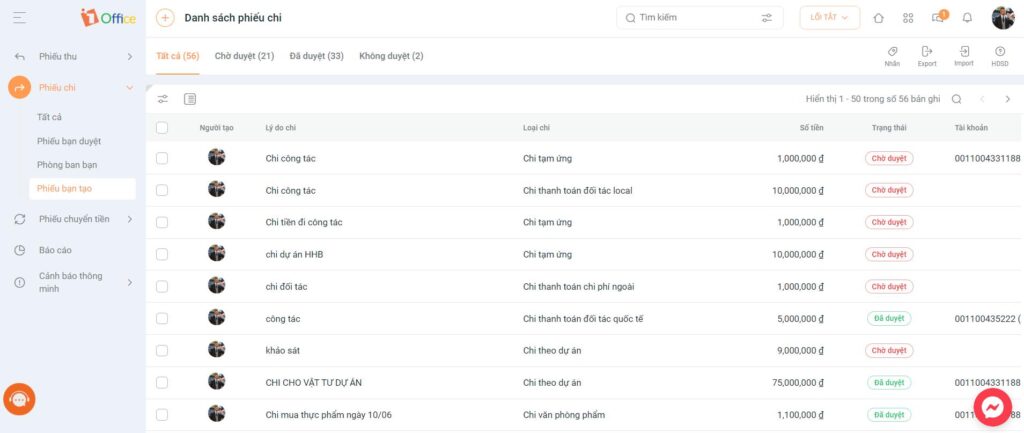
1Office’s revenue and expenditure management software is a technology solution that can help businesses effectively control hidden costs. The software has many useful features, helping businesses automate revenue and expenditure processes, track cash flow in real-time, provide alerts and reminders for due payments, monitor reports on revenue and expenditure fluctuations, and more.
With over 5,000 business customers who have been and are using 1Office software. Experience the revenue and expenditure management feature for free today!
The above is all the content that 1Office wants to share with you about the concept, classification, and examples of hidden costs. If you have any further questions or need advice on the 1Office revenue and expenditure management software, please contact us via:
- Hotline: 083 483 8888
- Facebook: https://www.facebook.com/1officevn/
- Youtube: https://www.youtube.com/@1office-chuyendoisodn
















