


 13/05/2026
  327 views
New trends in modern management require businesses to constantly transform and innovate their organizational structure to keep pace with the flexible changes of the market. The emergence of the inverted pyramid model has broken the framework of traditional organizational structures, creating breakthrough innovations in corporate governance. So, what is the inverted pyramid management model? How does this model differ from the traditional pyramid model? How can the inverted pyramid model be effectively applied in an organization? Let’s find out with 1Office in the following article.
Mục lục
- 1. What is the inverted pyramid model? The transition from traditional management to the inverted pyramid model
- 2. Designing an Organizational Structure Based on the Inverted Pyramid Model
- 3. The Key to Successfully Implementing the Inverted Pyramid Model
- 4. Examples of Businesses Successfully Applying the Inverted Pyramid Model
- 5. Optimizing the 4.0 Business Management Model with 1Office Software
1. What is the inverted pyramid model? The transition from traditional management to the inverted pyramid model
1.1. Limitations of the traditional pyramid management model
The traditional pyramid management model is a typical hierarchical system widely applied in almost every organization. According to this model, positions and roles are hierarchically arranged from top to bottom, with the highest concentration of power belonging to the head of the organization.
Subordinate employees are responsible for reporting and explaining to their superiors and carrying out assigned tasks. Similarly, higher-level managers have the authority to receive reports and make decisions for their subordinates. The higher a manager’s position on the pyramid, the greater their authority.
The advantage of this corporate organizational structure model is that decisions are clearly directed from the top down, creating uniformity in operations.
However, in the context of the constantly fluctuating market and innovations in management methods, the traditional pyramid model is gradually revealing many limitations:
- Lack of flexibility
In the context of a rapidly changing socio-economic landscape, businesses that want to survive cannot remain static with a fixed model. They must flexibly innovate in culture, organization, and people to create new values that meet market demands. Meanwhile, the traditional pyramid organizational model is too rigid and limits employee autonomy. All activities must follow top-down directives, leaving no room for creativity.
Furthermore, reporting to leadership is time-consuming as it must go through multiple levels. This operational method carries too many potential risks, as even a one-second delay in response can cause the business to be left behind.
- Information flow “bottlenecks”
In one of his studies, consultant Sidney Yoshida concluded: “Approximately 100% of an organization’s frontline problems are known by employees. 74% are known by supervisors. 9% are known by managers, and only 4% are known by top-level leadership.
These figures highlight an alarming reality about how the top-down hierarchical system operates. The traditional pyramid model inadvertently creates “barriers” that cause information flow within the business to become “congested.” The resulting consequence is flawed decision-making because leaders do not receive all the necessary information.
- Lack of employee motivation
The division of ranks and the limitation of employee authority reduce their motivation and productivity. Because when employees simply follow orders from superiors, they may feel constrained, forced, or easily develop a dependency on their superiors, only working when instructed. This significantly affects how they treat your customers, and as a result, your customers will receive less value.
1.2. The inverted pyramid model and breakthroughs in corporate governance
To overcome the limitations of the classic pyramid-style business management model, the inverted pyramid model was created, completely “flipping” the traditional organizational structure and ushering in an era of lean organizations. This lean management style completely abandons the traditional top-down approach.
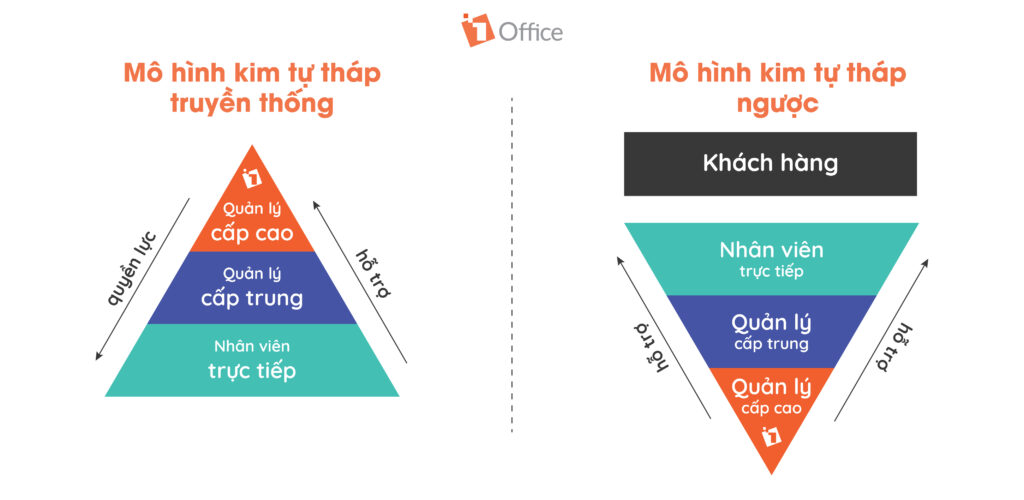
Essentially, the inverted pyramid model in modern management is the “reversed version” of the traditional hierarchical model as analyzed above. This means that employees are at the top level of the pyramid, and managers are at the lower levels. Executive leadership is no longer the most important element in the organization.
With this hierarchical approach, the inverted pyramid focuses more on the employees who directly add value for customers. They become the core force in the company’s operational machinery. This stems from the fact that the interaction between customers and employees is the decisive factor in whether customers will continue to stay with the company.
The operating principle of the inverted pyramid in management is to maximize the role of the staff. This department is empowered to be more autonomous in their work and decision-making processes without waiting for requests from superiors. In this way, the inverted pyramid model maximizes communication among organization members and creates a more flexible, responsive team. This, in turn, helps to increase the spread of innovative ideas throughout the entire organization.
2. Designing an Organizational Structure Based on the Inverted Pyramid Model
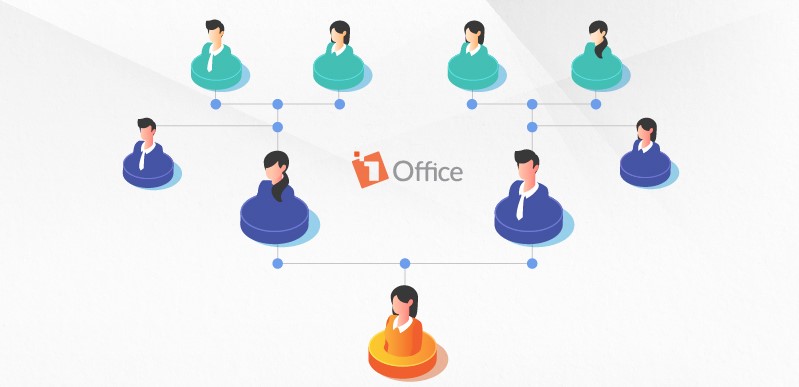
The Highest Level – Customer Satisfaction
The highest level in the inverted pyramid model is customer satisfaction. This means that all activities within the organization are aimed at optimizing the experience and satisfying customer needs. This also serves as the “guiding star” that coordinates the operational flow within the organization, from service delivery and customer care to maintaining customer relationships.
Level 2 – Frontline Employees
The second level in the management pyramid model is the employees – the organization’s frontline staff. Employees act as the “link” between customers and the business. They are responsible for fully communicating the organization’s mission, vision, and values to customers. To perform their roles effectively, employees must be provided with all the necessary knowledge, skills, and tools for their work.
Level 3 – Middle Management
Middle management, at the third level, plays a supportive role for employee activities. They must set an example for employees to follow. Managers are responsible for ensuring their employees meet the set objectives. If an employee’s performance is lower than expected, middle managers need to ask whether they have provided the employee with all the appropriate tools to perform the task. From there, they will develop suitable strategies to motivate employee behavior.
The Final Level – Senior Leadership
The role of the organization’s head in this model is to empower all levels by delegating authority and acting as a mentor to employees. Leaders act as partners to employees, guiding them to have the opportunity to solve their own problems, while focusing on strategic direction and skill development. This is crucial in creating an environment where everyone is dedicated to their work and ready to take responsibility when necessary.
An environment that promotes mutual accountability and ensures that everyone’s voice is heard, whether they are a senior executive, a manager, or a junior employee. However, it is important to remember that a true leader knows how to balance direction and support.
Read more: What is the Business Model Canvas? How to build a BMC model from A-Z
3. The Key to Successfully Implementing the Inverted Pyramid Model
Today, many organizations have chosen to invert their management pyramid model to try to harness the full potential of their employees. However, transforming an organization’s structure is not simple, especially for organizations that have been accustomed to traditional operating methods for a long time. Without a specific and decisive strategy, the new model could very well backfire.
To effectively transition to the inverted pyramid model, leadership must be willing to delegate decision-making authority to employees and be consistent in its implementation. Whatever resources employees need to develop the necessary skills for the change, management must provide them promptly. Managers should also coach and mentor employees to help them easily adopt and adapt to the new operating method.
Ultimately, the key to successfully implementing the inverted pyramid model is trust and a willingness to share authority with employees. This spirit will help maintain a strong and cohesive organization.
4. Examples of Businesses Successfully Applying the Inverted Pyramid Model
Many businesses around the world have successfully applied the pyramid model in business to optimize their organizational structure and have achieved certain successes. Keeping pace with the global trend of transformation, Vietnamese businesses are also gradually inverting the pyramid model in corporate management. A typical example is The Gioi Di Dong (Mobile World).
This model is highly favored by the CEO of TGDĐ. Accordingly, he built the organizational structure with the motto, “The customer is number one. The employee is number two. The people who invest $1 billion in stocks are number three.” He also shared that “Two investments that are never wasted are employees and customers.” Therefore, the CEO of TGDĐ always prioritizes focusing all resources on supporting employees to help them bring the most value to customers. In addition, TGDĐ also has policies that prioritize protecting the rights of its employees.
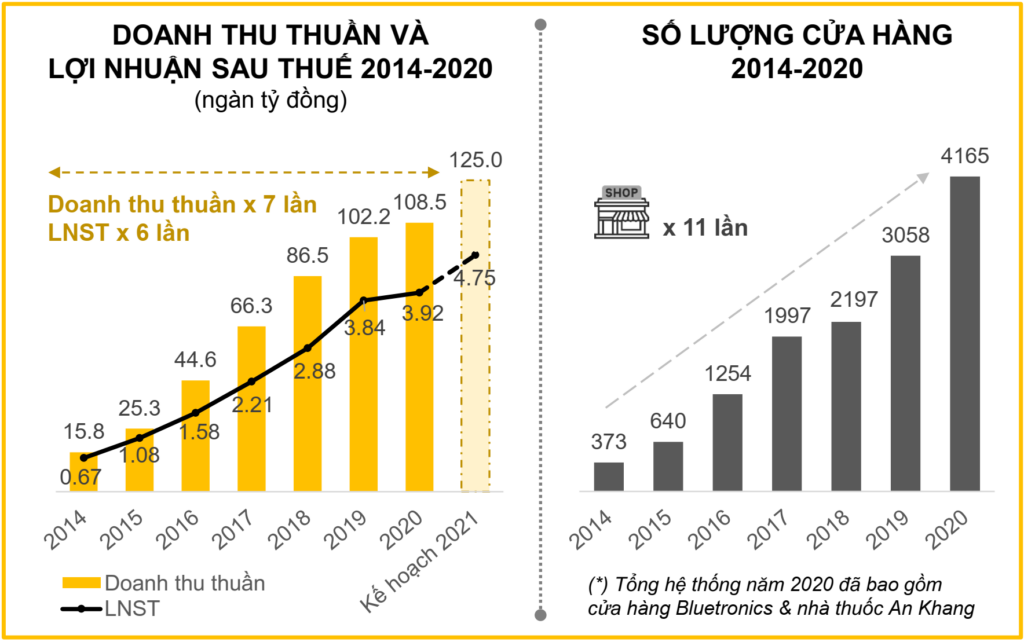
It is precisely because of the flexibility gained from this business pyramid model that TGDĐ has not faced a “crisis” in managing a large-scale system of thousands of stores nationwide.
By applying the inverted pyramid model in their sales system, TGDĐ’s store managers are empowered to handle arising situations promptly and quickly without having to wait for instructions from their superiors.
This helps TGDĐ improve business efficiency and optimize the customer experience thanks to a flexible operational process that closely follows customer needs. As a result, TGDĐ’s revenue is consistently among the top in the retail industry.
5. Optimizing the 4.0 Business Management Model with 1Office Software
In the storm of digital transformation, if a business cannot build a solid and flexible organizational structure, it can be “drowned” by competitors. Therefore, optimizing the organization’s management model and operational processes should be a top priority.
Today, with technological advancements, business management software has emerged as a “powerful assistant” helping businesses transform and adapt quickly to the environment. Among them, 1Office is proud to be one of the pioneering business management platforms in digital transformation, trusted by over 450,000 users from more than 5,000 Vietnamese businesses.
With its superior work management module and powerful features, WORKPLACE 1Office helps solve all the complex problems in business operations, including:
- Automate 90% of business operational processes, eliminating all repetitive tasks.
- Assign tasks and manage employees directly on the software, specifying which members are responsible for the work.
- Track work and project progress 24/7, closely monitoring the business’s operational status.
- Smart alerts for task deadlines, helping employees be more autonomous and avoid forgetting or missing tasks.
Through the article above, 1Office has provided readers with essential knowledge about the inverted pyramid model in management as well as the skills to apply the model effectively to enhance the business’s competitive capabilities. For a free consultation and a trial experience of the leading business management software today, please contact us using the information below:
For more details, please see:
- Hotline: 083 483 8888
- Fanpage: https://www.facebook.com/1officevn/
- Youtube: https://www.youtube.com/channel/UCeTIRNqxaTwk0_kcTw6SxmA
















