


 13/05/2026
  231 views
The Employee Journey is a very new concept for most businesses in Vietnam, but it is a very familiar concept around the world.
The employee journey is an important factor in evaluating employee satisfaction with the business and building trust so that employees feel secure in their contributions. In the first article of 1Office’s “Complete HRM” series, let’s explore the employee journey!
Mục lục
What is the Employee Journey?
According to digital HR tech, the Employee Journey is understood as the time an employee spends with a company. This period is calculated from when the employee is a candidate applying for a position until they leave the company. The knowledge, experience, and relationships gained during this time create the Employee Experience.
The Employee Journey Map of a Typical Employee
1. Awareness of the Business
Before applying, candidates need to have a certain understanding of the business. This understanding can come before or after seeing the job posting. The company’s image at this stage has a significant impact on the candidate’s decision.
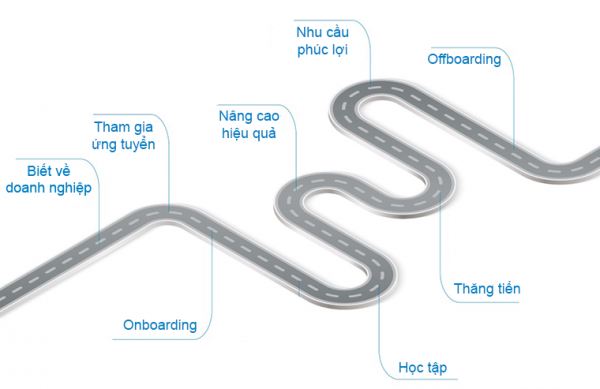
2. Application
This is the first time the two parties interact. While the candidate presents themselves to impress the company, the company also needs to maintain its image and demonstrate professionalism to the candidate.
3. Onboarding
This is the process where the employee gets acquainted with the new environment and job. This stage will determine whether the two parties can have a long-term commitment. It is also the stage where the most employees “drop off.”
4. Learning – Improving Performance
This dual stage is often repeated continuously until the employee is offboarded. During this process, employees are trained, learn on their own, or draw from their own experiences and apply them to improve work efficiency.

5. Advancement
The common goal of every employee is advancement. Besides bringing more authority and higher compensation, promotion also represents the company’s recognition of its employees.

6. Need for Benefits
When an employee reaches a high position and finances are no longer an issue, other benefits such as family insurance, travel, etc., become important factors in retaining talent.
7. Offboarding
After this step, the journey between the two parties ends, but it can happen at any time, even before onboarding is complete. This step also opens up new journeys with new companies or marks the beginning of the employee’s retirement.
Benefits for the Business with an Optimized Employee Journey
As the saying goes, “substance over style,” and in this case, the Employee Journey is the “substance” that the company needs to upgrade. The current main workforce is Gen Y, and in the near future, Gen Z. Both generations share the characteristic of adapting very quickly but also getting bored easily. Therefore, along with compensation and benefits, the Employee Experience is extremely important.
An optimized employee journey will create a great experience for employees. This will be the deciding factor in retaining, developing, and fully utilizing employees’ abilities. Employees who leave the company will also have a good impression, helping to spread the company’s brand.
Optimizing the employee journey also helps to comprehensively evaluate work processes, identify gaps, and improve the efficiency of the entire system. Business administrators will then have a more holistic view of the company and its employees.
A Few Suggestions to Improve the Quality of the Employee Journey
1. Personalize the Employee Experience
Each employee has different needs, abilities, positions, etc., so they will require different journeys to work effectively. The HR department should build journeys for groups first, then move on to individuals if resources or time are limited. This is a difficult task that requires a lot of time and is not suitable for businesses with a high rate of personnel change.
2. Survey Employees
Don’t build one-sided journeys. Employee surveys are not just about understanding employee needs. They are also a tool to show employees they are respected and will stay with the company longer.

3. Build a strong internal culture
Internal culture greatly influences the employee journey, especially for young employees. Building a culture is a multi-purpose strategy. This is also a trend in large enterprises today.
Quick tip: If you are having difficulty connecting with your employees or building an internal culture, 1Office is an excellent tool to assist you. Experience 1Office now by registering at the button below!
Read more articles at:
Personnel Classification – The First Step in a Company’s Human Resources Strategy
















