


 09/05/2026
  664 views
When a lease agreement ends—whether through expiration, early agreement, or unilateral termination—many people often overlook the most crucial step: liquidating the contract. The lease termination agreement is the key legal document where both parties (the lessor and the lessee) confirm the cessation of obligations, the handover of the property in its proper condition, the settlement of the security deposit, and a commitment that there will be “no further claims or disputes.” This is not just an administrative procedure but also a “shield” that protects your rights, helping to avoid financial risks and prolonged litigation over security deposits, property damage, or delayed handovers. In this article, we will clearly explain what a lease termination agreement is, its purpose, importance, and legal basis under the 2015 Civil Code and the 2023 Law on Housing—along with cases where it is necessary and why you should not skip this step in 2026!
Mục lục
- 1. What is a Lease Termination Agreement?
- 2. Cases Requiring a Lease Termination Agreement
- 3. House Rental Agreement Termination Process
- 4. Standard House Rental Agreement Termination Record Template
- 5. Common Issues When Terminating a House Rental Agreement
- 5.1. Disputes over the security deposit
- 5.2. Disputes over the property’s condition
- 5.3. Issues with service fees (electricity, water, internet)
- 5.4. Uncooperative tenant/landlord
- 5.5. Original contract not notarized/certified: How does this affect termination?
- 6.3. Consult a lawyer when facing complications
- 6.4. Read and fully understand the terms before signing
1. What is a Lease Termination Agreement?
A lease termination agreement is a written agreement established between the lessor (landlord) and the lessee (tenant) to formally confirm the termination of the lease agreement and the fulfillment of all obligations and rights arising from it.
This document clearly records that:
- The parties have fully performed their obligations (the lessee has paid all rent, utilities, and service fees; the lessor has returned the security deposit after deducting any reasonable expenses).
- The condition of the property at the time of handover (the state of furniture, fixed equipment, and any existing or new damage).
- There are no further claims or disputes related to the lease agreement after the agreement is signed.
Under Vietnamese law, a lease termination agreement is a document that terminates a contract (a supplementary agreement). It is used when the contract expires, both parties agree to an early termination, or one party lawfully terminates it unilaterally, in order to “cleanly conclude” the lessor-lessee relationship.

1.1. Purpose and Importance
A lease termination agreement holds significant legal and practical importance. It is not just an administrative procedure but an essential tool for protecting the rights of both parties:
- Confirms the termination of obligations and rights for all parties: It officially ends the lessor-lessee relationship. The lessee is no longer obligated to pay rent, and the lessor no longer has the right to demand more rent or unreasonably withhold the security deposit. The deposit is returned or used to cover reasonable costs (such as repairing damage caused by the lessee).
- Serves as a legal basis for resolving disputes (if any): This is the most crucial piece of evidence in court or before a mediation body in case of conflicts over the security deposit, property damage, delayed handover, or disputes about the property’s condition upon return. Many lease-related lawsuits in Vietnam fail due to the lack of a termination agreement or one that is poorly drafted.
- Protects the rights of both the lessee and the lessor:
- The lessor avoids unreasonable claims for the security deposit or lawsuits for compensation.
- The lessee avoids having their security deposit withheld or being sued for damages that are not their fault (e.g., pre-existing damage).
- Avoids future legal and financial risks: Failing to create a termination agreement can lead to prolonged disputes, costly litigation, the lessee being charged for overdue rent, or the lessor being penalized for breach of contract. The agreement helps to “close the books” cleanly, minimizing long-term financial and legal risks.
1.2. Legal Basis
The lease termination agreement is based on the following legal provisions (updated to 2026):
- The 2015 Civil Code (as amended and supplemented):
- Article 422: A contract is terminated in cases of: fulfillment of obligations, expiration of the term, agreement of the parties, or lawful unilateral termination. The termination agreement is a document that records the agreement to terminate the contract (Clause 2, Article 422).
- Article 428: The right to unilaterally terminate a contract in case of a serious breach of obligations (e.g., the lessee fails to pay rent, the lessor fails to ensure the safety of the housing).
- The 2023 Law on Housing (effective from January 1, 2025):
- Article 172: Unilateral termination of a residential lease agreement – clearly specifies cases where the lessor or lessee has the right to unilaterally terminate the contract (serious breach of obligations), the required notice period (30 days), and the responsibilities for payment and property handover.
- Article 173: Requires a property handover record upon termination of the lease, documenting the property’s condition, settlement of the security deposit, and other arising costs. The termination agreement is an important supplementary document to confirm the handover and the complete cessation of all obligations from the lease agreement.
A lease termination agreement is an essential legal document that helps both parties “cleanly conclude” the lessor-lessee relationship, maximally protect their rights, and avoid prolonged disputes over security deposits, property damage, or delayed handovers. It is an indispensable final step after a contract expires or is terminated early in accordance with the 2015 Civil Code and the 2023 Law on Housing.
2. Cases Requiring a Lease Termination Agreement
A lease termination agreement is an indispensable document to “cleanly conclude” the lessor-lessee relationship, confirming the cessation of obligations, the handover of the property, and the settlement of the security deposit. Creating this document helps both parties avoid prolonged disputes over rent, property damage, the security deposit, or future legal liabilities. According to Vietnamese law (the 2015 Civil Code and the 2023 Law on Housing), here are the common cases that require a lease termination agreement:
2.1. Contract Expiration
When the lease term specified in the contract has ended (e.g., a 12-month contract expiring on December 31, 2025) and the parties do not agree to extend or sign a new contract, this is the most common scenario requiring a termination agreement.
- Purpose: To confirm that the lessee has handed over the property in its proper condition, paid all rent, and the lessor has returned the security deposit (after deducting reasonable costs, if any).
- Importance: Without this agreement, the lessor might unreasonably withhold the security deposit, or the lessee could be charged for overdue rent. The agreement helps to “close the books” on the tenancy relationship transparently, avoiding future disputes.

2.2. Early Termination by Mutual Agreement
Both parties (lessee and lessor) voluntarily agree to terminate the contract before its expiration date for personal reasons (relocation, job change), economic reasons (financial difficulties), or other reasons that do not constitute a breach of contract.
- Purpose: To confirm the early termination by mutual agreement, the handover of the property, payment of rent up to the termination date, and settlement of the security deposit.
- Importance: This is the most amicable scenario. The termination agreement helps both parties document their consensus, preventing one party from later changing their mind and demanding the contract be continued or seeking compensation.
2.3. Unilateral Termination of the Contract
One party (the lessee or the lessor) unilaterally terminates the contract based on legal grounds, but a termination agreement is still necessary to confirm the handover and the cessation of obligations.
- The lessee or lessor seriously breaches the contract terms (according to Article 428 of the 2015 Civil Code):
- Lessee: Fails to pay rent for more than 3 months, uses the property for a purpose other than that agreed upon, or makes major unauthorized alterations.
- Lessor: Fails to ensure the property is safe for habitation, undertakes major repairs without notice, or unlawfully increases the rent.
- Special cases as stipulated by law (according to Article 172 of the 2023 Law on Housing):
- The property is severely damaged and no longer safe to live in (e.g., collapsed roof, severe water leakage).
- The property is subject to recovery, clearance, or appropriation for public purposes.
- The lessor unreasonably increases the rent or violates legal regulations.
- Purpose: To confirm the lawful termination of the contract, the handover of the property, payment of rent up to the termination date, and settlement of the security deposit.
- Importance: The agreement helps prove that the unilaterally terminating party had legal grounds, avoiding lawsuits for breach of contract.
2.4. Other Force Majeure Cases
When a force majeure event occurs (according to Article 156 of the 2015 Civil Code) that makes it impossible to continue the contract, a termination agreement is needed to end the contract and handle the consequences:
- The property is appropriated or demolished for redevelopment (urban planning, public projects).
- Natural disasters, fires, or epidemics render the property unusable (e.g., severe flooding, fire).
- Other cases: The property is confiscated due to a legal dispute, or the landlord loses legal capacity.
- Purpose: To confirm that the contract is terminated due to force majeure, to arrange for the handover of the property (if possible), to settle rent up to the termination date, and to handle the security deposit.
- Importance: The agreement helps both parties agree that neither is liable for compensation due to force majeure, thus avoiding prolonged litigation.
A house rental agreement termination record is a mandatory document in most cases of contract termination (expiration, early agreement, lawful unilateral termination, force majeure). Creating this record helps both parties achieve a “clean break,” protects their interests (security deposit, liability for damages), and serves as the most crucial legal evidence in case of disputes under the 2015 Civil Code and the 2023 Law on Housing.
3. House Rental Agreement Termination Process
Terminating a house rental agreement is the final and most crucial step to end the landlord-tenant relationship cleanly, transparently, and legally, avoiding prolonged disputes over security deposits, property damage, overdue rent, or future legal liabilities. The legally compliant termination process (according to the 2015 Civil Code and the 2023 Law on Housing) consists of 4 main steps, ensuring the rights of both the tenant and the landlord are fully protected.
3.1. Preparation Before Termination
This is the foundational stage, determining 70–80% of the termination process’s success.
- Review the original House Rental Agreement: Carefully check the clauses regarding the contract term, termination conditions, security deposit (number of months, refund method), repair and maintenance responsibilities, property handover, and penalty clauses for breaches (if any). Determine if the contract has expired, met the conditions for early termination, or if one party has the right to unilaterally terminate (Article 172 of the 2023 Law on Housing).
- Inspect the property’s condition and record any damages: Both parties should jointly inspect the house: fixed furniture (kitchen cabinets, air conditioners, wooden floors), equipment (lights, sockets, faucets), walls, ceilings, windows, and the main door. Record pre-existing damages (already noted in the initial handover record) and new damages that have occurred (caused by the tenant or due to natural wear and tear). Take photos and videos of the current condition as evidence.
- Reconcile payments made and outstanding balances: Check:
- Rent up to the termination date.
- Electricity, water, internet, management fees, and cleaning fees (with invoices).
- The initial security deposit and any reasonable deductions (for repairing damages caused by the tenant).
- Any outstanding debts (if any).
3.2. Negotiation and Agreement
After the inspection, both parties negotiate to agree on the remaining issues before signing the termination record.
- Clearly define the reason for termination and the effective date: For example: The contract expires on December 31, 2025, and termination is effective from the handover date (or the agreed-upon date).
- Agree on the property handover: The tenant hands over the property in the same condition as recorded in the initial handover record (excluding natural wear and tear), and the landlord inspects and accepts it.
- Agree on the security deposit refund: The landlord refunds all or part of the security deposit after deducting reasonable costs (repairs for damages caused by the tenant, outstanding electricity/water bills). Clearly state the refund amount, method (bank transfer, cash), and deadline (usually within 7–15 days).
- Determine the remaining responsibilities of each party: The tenant commits to making no further claims regarding the property after the handover; the landlord commits to refunding the security deposit on time.
3.3. Drafting and Signing the Termination Record
This is the core step, requiring the use of a standard template to ensure legal validity.
- Use a standard template: Include the national emblem and motto, information of the parties, legal basis, and termination details (property handover, security deposit settlement, commitment of no disputes).
- Record information fully and accurately:
- Condition of the house (walls, floors, furniture, equipment).
- Electricity and water meter readings at the time of handover.
- Amount of security deposit to be refunded and any deductions (if any).
- A commitment clause: “There are no further claims or disputes related to the house rental agreement after signing this record.”
- Confirm the completion of obligations and absence of disputes: A standard clause: “The parties agree to confirm that all obligations under the house rental agreement have been fulfilled, and there are no further claims or disputes after signing this record.”
- Number of copies and who holds them: Prepare 03 copies of equal legal value:
- Copy 1: Held by the landlord.
- Copy 2: Held by the tenant.
- Copy 3: For records (if required to be submitted to a housing management authority).
3.4. Notarization (If Necessary)
- When should the termination record be notarized? It is not legally mandatory, but notarization is recommended when:
- The security deposit is large (tens of millions of VND or more).
- There is a potential for disputes (property damage, delayed handover).
- The original rental agreement was notarized (to enhance legal validity).
- Notarization procedure at a Notary Office:
- Both parties bring the original termination record to a Notary Office (or have the signatures authenticated at the ward/commune People’s Committee).
- The notary verifies the legal capacity and voluntariness of the parties.
- Sign for confirmation and apply the notary seal.
- Fee: Approximately 50,000–200,000 VND depending on the transaction value (according to Circular 257/2016/TT-BTC). → A notarized copy holds much higher evidentiary value in court if a dispute arises.
A legally compliant house rental agreement termination process includes thorough preparation, clear negotiation, detailed record-keeping, and notarization when necessary. Following these 4 steps correctly helps both parties achieve a “clean break,” fully protects their interests (security deposit, liability for damages), and prevents prolonged disputes under the 2015 Civil Code and the 2023 Law on Housing.
4. Standard House Rental Agreement Termination Record Template
When a house rental agreement ends—whether due to expiration, early agreement, or unilateral termination—the termination record is the most crucial legal document to cleanly “close the books” on the landlord-tenant relationship, record the property’s condition, settle the security deposit, and commit to no further disputes. A standard template helps both parties avoid legal risks and prolonged disputes over the security deposit or property damage. In this section, we provide the most up-to-date (2026) standard house rental agreement termination record template, compliant with the 2015 Civil Code and the 2023 Law on Housing. It features a complete structure, a property condition checklist, detailed security deposit settlement, and specific instructions for filling it out—easily editable in a Word file to help you terminate your contract quickly, transparently, and with maximum legal safety!
4.1. Template for termination of an expired house rental agreement:
The expiration of a house rental agreement is the most common scenario requiring a termination record to confirm that the tenant has handed over the property in the correct condition, paid all rent due, and the landlord has refunded the security deposit (after deducting reasonable costs, if any). This template focuses on recording the property’s condition at the time of expiration, electricity and water meter readings, security deposit settlement, and a commitment of “no further claims or disputes”—helping both parties end the tenancy amicably and avoid future disputes over the deposit or damages, as stipulated by the 2023 Law on Housing.
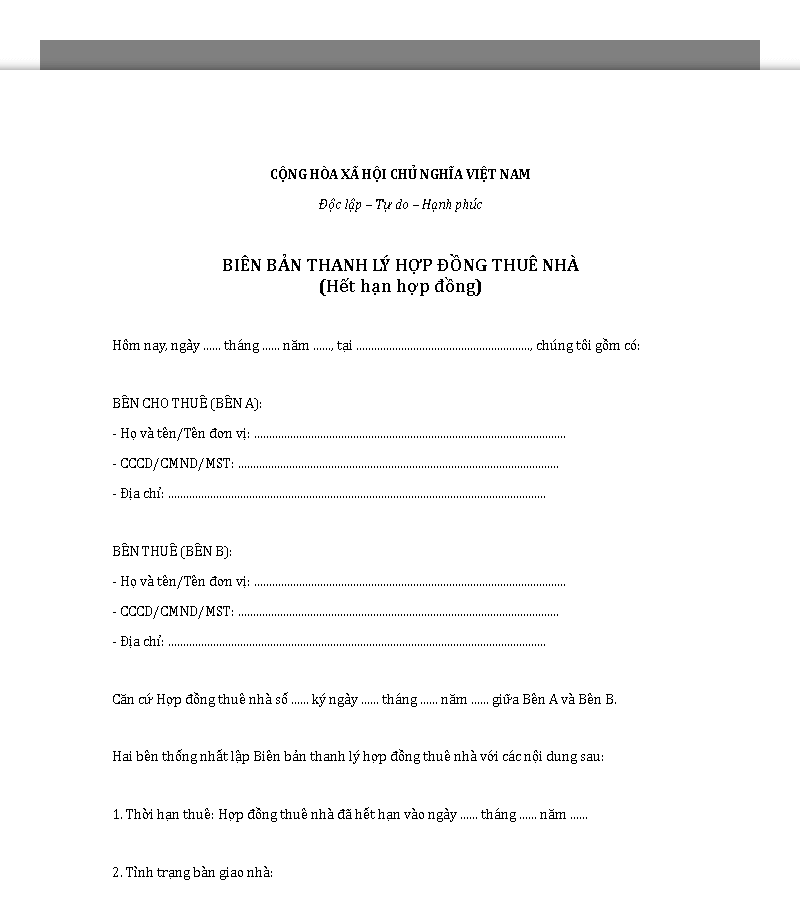
Download the Expired House Rental Agreement Termination Template Now
4.2. Template for early termination of a house rental agreement:
When both parties agree to terminate a house rental agreement before its expiration date (due to a job change, financial difficulties, or personal reasons), a termination record is an essential document to confirm the early termination, property handover, payment of rent up to the termination date, and settlement of the security deposit. This template is designed with detailed special agreement clauses, a commitment of no disputes, and settlement of any incurred costs, ensuring high legal validity and protecting the rights of both the tenant and the landlord under Article 422 of the 2015 Civil Code.
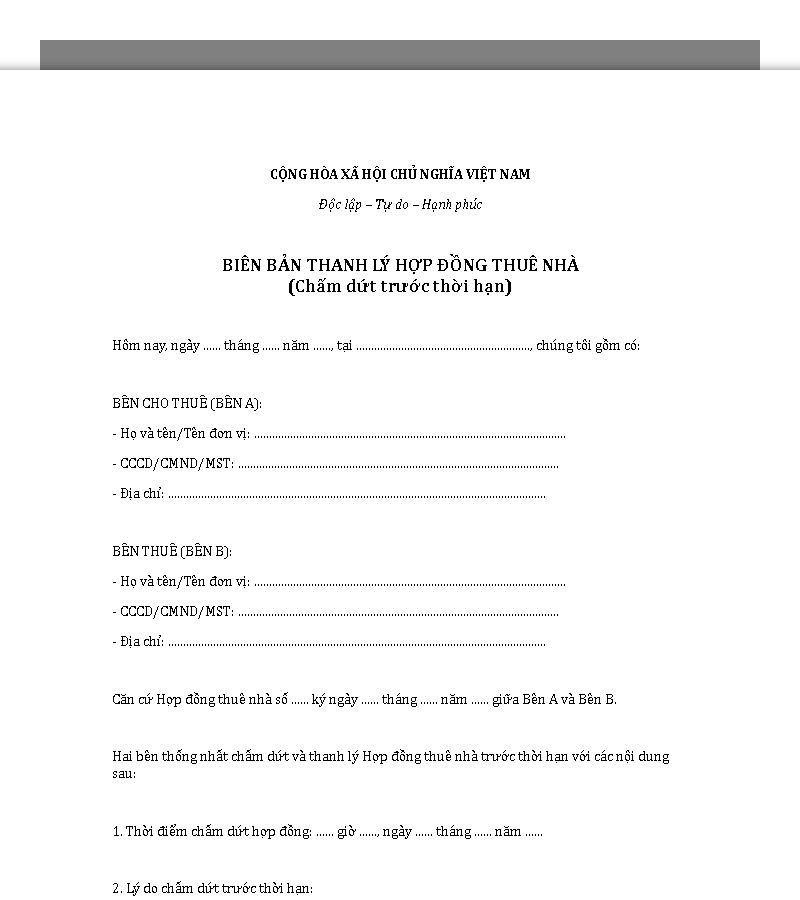
Download the Early House Rental Agreement Termination Template Now
5. Common Issues When Terminating a House Rental Agreement
Terminating a house rental agreement is often the stage most prone to disputes, especially concerning the security deposit, property condition, service fees, and the cooperation of the parties. Below are the most common issues in Vietnam (based on legal practice and complaints from 2025–2026) along with legally compliant solutions (under the 2015 Civil Code and the 2023 Law on Housing).
5.1. Disputes over the security deposit
This is the most common dispute when terminating a rental agreement.
- Cases where the landlord can retain the security deposit (according to Article 173 of the 2023 Law on Housing and Article 428 of the 2015 Civil Code):
- The tenant causes damage to the house, furniture, or equipment (not due to natural wear and tear).
- The tenant has not fully paid rent, utilities, or service fees up to the handover date.
- The tenant seriously breaches the contract (using the property for the wrong purpose, making major unauthorized repairs, subletting without permission).
- The cost of repairs and cleaning exceeds the security deposit (with supporting invoices).
- Cases where the tenant is entitled to a deposit refund:
- The property is damaged due to the landlord’s fault (water leaks, electrical issues, unsafe conditions).
- There is no damage caused by the tenant, and the tenant has paid all amounts due.
- The contract expires or is legally terminated without any breach by the tenant.
- Resolution process when an agreement cannot be reached:
- Direct negotiation, comparing the initial handover report with current photos/videos of the property’s condition.
- Draft a written agreement for security deposit deductions (if an agreement is reached).
- If no agreement is reached: The landlord retains the deposit → the tenant can file a lawsuit at the People’s Court of the district where the property is located (statute of limitations is 3 years according to Article 429 of the 2015 Civil Code).
- The court will base its ruling on the termination agreement, the initial handover report, photos, and repair invoices.
5.2. Disputes over the property’s condition
Disputes over damage to the house and furniture are the main cause of litigation during termination.
- How to accurately record the handover condition?
- Both parties should jointly inspect the property before signing the termination agreement.
- Take photos and videos, both wide shots and close-ups (walls, floors, ceilings, appliances, outlets, faucets).
- Note details in the report: “Living room wall has a pre-existing 5cm crack,” “Air conditioner is functioning normally.”
- Attach photos/videos as an appendix to the report (clearly stating “See photo appendix dated…”).
- Clearly determine damages and liability for compensation:
- Damage from natural wear and tear: The landlord is responsible (no deduction from the deposit).
- Damage due to the tenant’s fault: The tenant is responsible (deducted from the deposit or requires additional compensation).
- If there are repair invoices → the tenant bears the actual cost.
- Asset depreciation value:
- Furniture and equipment used for a long time: Apply depreciation based on usage duration (e.g., a 5-year-old air conditioner → 50–70% depreciation).
- Both parties should agree on the depreciation rate in the termination agreement to avoid disputes.
5.3. Issues with service fees (electricity, water, internet)
- How to finalize readings and payments:
- Clearly record the electricity and water meter readings at the time of handover (e.g., Electricity: 1,250 kWh, Water: 45 m³).
- The tenant pays all fees up to the handover date (with supporting invoices).
- If the final bill is not yet available: Both parties should agree on a later payment deadline (usually 7–15 days).
- Procedure for transferring meter/service contracts:
- The tenant notifies the electricity, water, and internet companies to transfer or cancel the contract.
- The landlord assists by providing necessary documents (rental agreement, termination agreement) for the meter transfer.
- State in the agreement: “The tenant commits to completing the procedure for transferring/canceling service contracts before [date]…”.
5.4. Uncooperative tenant/landlord
- Formal notification procedure:
- Send a written notice (email with read receipt, registered mail) stating the reason for termination, the handover date, and the request to sign the termination agreement.
- Notice period: 30 days (according to Article 172 of the 2023 Law on Housing) for unilateral termination.
- Applicable legal measures:
- If the tenant does not hand over the property: The landlord can sue to reclaim the property and for overdue rent.
- If the landlord does not refund the deposit: The tenant can sue for the return of the deposit and late payment interest.
- Mediation at the People’s Committee of the ward/commune before filing a lawsuit (highly effective, cost-saving).
- Statute of limitations for filing a lawsuit: 3 years from the date the rights were violated (Article 429 of the 2015 Civil Code).
5.5. Original contract not notarized/certified: How does this affect termination?
- Rental agreementsTip: Create a separate folder named “Lease Agreement [address]” for easy reference when needed.
6.3. Consult a lawyer when facing complications
Don’t try to handle complex issues yourself – a legal consultation can save you tens of millions of dong and prevent lengthy lawsuits.
- You should especially consult a lawyer when:
- Disputes over a large security deposit (>20–30 million VND).
- The other party refuses to hand over the property or return the deposit despite no damages.
- Unilaterally terminating the contract and being asked for compensation.
- The contract contains unfavorable or ambiguous clauses.
- Consultation fees: Usually 500,000–2,000,000 VND/hour, but this is much more cost-effective than litigation (lawyer fees, court costs, time).
- Reputable sources: Contact law firms, the Bar Association, or online legal consultation platforms (LuatVietnam, Thư viện Pháp luật).
6.4. Read and fully understand the terms before signing
Before signing any termination agreement, spend at least 10–15 minutes to carefully read:
- The amount of the security deposit to be returned and any deductions (are there invoices to prove them?).
- Whether the recorded property condition matches reality (are any pre-existing damages overlooked?).
- The “no further claims or disputes” commitment – ensure you agree 100% with this content.
- The deadline for returning the deposit and the payment method.
Tip: Read the agreement aloud before signing, and ask the other party if anything is unclear. If you are unsure, request to “let me read it more carefully and sign later” – no one has the right to force you to sign immediately.
In summary: Terminating a lease agreement is not difficult if you prioritize good faith, keep all documents, consult a lawyer when needed
- You should especially consult a lawyer when:
















