


4+ Construction Contract Liquidation Templates [Word File Included]


A construction contract liquidation minute is an important legal document that confirms the termination of a contract’s validity after a project is completed or concluded. However, not every case can use the same liquidation template.
In this article, we have compiled 4+ legally compliant construction contract liquidation minute templates applicable to various real-life scenarios such as: project completion, early contract termination, contracts with addendums or adjustments, and small-scale projects. Each template comes with an easy-to-edit Word file, along with detailed instructions to help investors and contractors use them correctly, completely, and to mitigate legal risks.
Mục lục
- I. What Is a Construction Contract Liquidation Minute?
- 1. Definition of a construction contract liquidation minute
- 2. The role and legal significance of a construction contract liquidation minute
- 3. Differentiating between contract liquidation and contract settlement in construction
- 3. Hậu quả pháp lý khi không lập hoặc chậm trễ lập biên bản thanh lý
- III. Cơ Sở Pháp Lý Cho Việc Lập Biên Bản Thanh Lý Hợp Đồng Xây Dựng
- IV. Hướng Dẫn Chi Tiết Cách Lập Biên Bản Thanh Lý Hợp Đồng Xây Dựng Chuẩn
- VI. Important Notes When Drafting & Signing Construction Contract Liquidation Minutes
- VII. Frequently Asked Questions About Construction Contract Liquidation Records
- 1. Does a construction contract liquidation record need to be notarized or authenticated?
- 2. What should be done if one party refuses to cooperate in signing the liquidation record?
- 3. Can the liquidation record replace the original contract?
- 4. What are the tax obligations related to the liquidation of a construction contract?
- 5. What responsibilities arise after the liquidation of a construction contract?
I. What Is a Construction Contract Liquidation Minute?
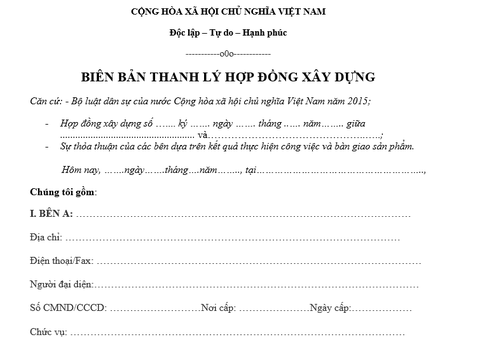
1. Definition of a construction contract liquidation minute
A construction contract liquidation minute is a document created between the parties to the contract (investor, contractor, consultant, or related parties) to confirm the termination of the construction contract’s validity after all obligations have been fully performed or when both parties have mutually agreed to terminate it.
This document represents the final agreement of the parties regarding the entire contract execution process, including the scope of work, payment value, outstanding responsibilities, and commitments after the contract is no longer valid. The liquidation minute does not replace the construction contract but serves as the document that concludes the contract’s legal lifecycle.
Typically, a construction contract liquidation minute will record the following main contents:
-
Information on the signed construction contract
-
Scope of work and completion level
-
Value of the contract performed and paid
-
Remaining debt (if any)
-
Warranty and maintenance responsibilities for the project
-
Commitment to no complaints or disputes after liquidation
2. The role and legal significance of a construction contract liquidation minute
In construction activities, a contract liquidation minute is not just a procedural document but also holds significant legal and risk management value. It is a crucial basis for determining whether the contract has been completed or legally terminated, while also clarifying the responsibilities of the parties after the project concludes.
In legal and practical terms, a construction contract liquidation minute has the following main roles:
-
Confirms the contract has been completed or terminated in accordance with regulations
-
Serves as the basis for ending legal obligations between the parties
-
Supports project settlement, auditing, and inspection
-
Records warranty and maintenance responsibilities after handover
-
Mitigates the risk of future disputes and lawsuits
For many construction projects, especially those with state capital, large corporate capital, or projects under strict financial control, the contract liquidation minute is a mandatory document to complete the project’s legal file.
3. Differentiating between contract liquidation and contract settlement in construction
Contract liquidation and contract settlement are two closely related but distinct concepts in terms of nature and purpose. Confusing these two procedures can lead to errors in the legal and financial management of a construction project.
In essence, the difference between the two concepts is as follows:
-
Contract liquidation is a legal procedure aimed at terminating the contract’s validity
-
Contract settlement is a financial and accounting procedure aimed at determining the actual value of work performed
More specifically:
- <p data-
Việc chậm thanh lý trong các dự án này có thể dẫn đến việc hồ sơ quyết toán không được chấp nhận hoặc bị yêu cầu bổ sung, điều chỉnh.
Đối với hợp đồng xây dựng có quy mô lớn
Đối với các hợp đồng có giá trị lớn, thời gian thực hiện dài hoặc nhiều giai đoạn, các bên thường quy định rõ thời hạn thanh lý ngay trong hợp đồng. Thời điểm lập biên bản thanh lý thường rơi vào:
-
Sau khi hoàn thành toàn bộ nghĩa vụ hợp đồng
-
Sau khi xử lý xong các tồn đọng, công nợ và bảo hành bước đầu
-
Phù hợp với kế hoạch tài chính và kiểm toán nội bộ của dự án
Trường hợp các bên tự thỏa thuận
Trong phạm vi pháp luật cho phép, các bên hoàn toàn có thể chủ động thỏa thuận thời hạn thanh lý hợp đồng, miễn là không trái quy định pháp luật và phù hợp với tính chất hợp đồng. Thỏa thuận này thường được ghi nhận trực tiếp trong điều khoản thanh lý của hợp đồng xây dựng.
3. Hậu quả pháp lý khi không lập hoặc chậm trễ lập biên bản thanh lý
Việc không lập hoặc chậm trễ lập biên bản thanh lý hợp đồng xây dựng có thể gây ra nhiều hệ quả pháp lý và rủi ro quản trị, đặc biệt đối với chủ đầu tư và nhà thầu.
Một số hậu quả thường gặp bao gồm:
-
Hợp đồng chưa được coi là kết thúc về mặt pháp lý
-
Khó khăn trong công tác quyết toán, kiểm toán và thanh tra
-
Phát sinh tranh chấp về công nợ, trách nhiệm bảo hành
-
Rủi ro bị quy trách nhiệm khi xảy ra sự cố sau thời điểm hoàn thành công trình
-
Ảnh hưởng đến việc đóng hồ sơ dự án và ghi nhận chi phí hợp lệ
Trong thực tiễn, nhiều tranh chấp xây dựng phát sinh không phải do thi công, mà do không thanh lý hoặc thanh lý không rõ ràng, dẫn đến việc các bên không xác định được trách nhiệm pháp lý sau khi hợp đồng kết thúc.
III. Cơ Sở Pháp Lý Cho Việc Lập Biên Bản Thanh Lý Hợp Đồng Xây Dựng
Việc lập biên bản thanh lý hợp đồng xây dựng không phải là thỏa thuận mang tính tùy nghi, mà được đặt trên nền tảng của nhiều văn bản pháp luật quan trọng điều chỉnh hoạt động đầu tư xây dựng và quan hệ hợp đồng. Mặc dù pháp luật không ban hành một mẫu bắt buộc chuyên biệt, nhưng các quy định hiện hành đã xác lập nguyên tắc, điều kiện và trách nhiệm pháp lý liên quan trực tiếp đến việc thanh lý hợp đồng xây dựng.
1. Luật Xây dựng 2014 và Luật sửa đổi, bổ sung một số điều của Luật Xây dựng
Luật Xây dựng là đạo luật chuyên ngành điều chỉnh toàn bộ hoạt động đầu tư xây dựng, trong đó hợp đồng xây dựng được xác định là căn cứ pháp lý trung tâm để triển khai dự án. Luật không quy định trực tiếp về “biên bản thanh lý hợp đồng”, nhưng thông qua các quy định về:
-
Thực hiện hợp đồng xây dựng
-
Quyền và nghĩa vụ của chủ đầu tư, nhà thầu
-
Nghiệm thu, bàn giao và kết thúc công trình
đã gián tiếp xác lập yêu cầu phải kết thúc hợp đồng bằng một hình thức pháp lý rõ ràng, mà trên thực tế chính là biên bản thanh lý hợp đồng xây dựng.
Luật sửa đổi, bổ sung một số điều của Luật Xây dựng tiếp tục khẳng định nguyên tắc quản lý chặt chẽ hợp đồng xây dựng, đặc biệt với các dự án sử dụng vốn nhà nước, qua đó làm rõ hơn trách nhiệm của các bên trong giai đoạn kết thúc hợp đồng.
2. Bộ luật Dân sự 2015
Bộ luật Dân sự 2015 là nền tảng pháp lý chung điều chỉnh mọi quan hệ hợp đồng, bao gồm cả hợp đồng xây dựng. Theo quy định của Bộ luật Dân sự, hợp đồng chấm dứt trong các trường hợp như:
-
Hợp đồng đã được thực hiện xong
-
Các bên thỏa thuận chấm dứt hợp đồng
-
Hợp đồng bị hủy bỏ hoặc đơn phương chấm dứt theo quy định pháp luật
Trên cơ sở đó, biên bản thanh lý hợp đồng xây dựng được xem là văn bản ghi nhận việc chấm dứt hợp đồng, thể hiện sự thống nhất ý chí của các bên về hậu quả pháp lý phát sinh sau khi hợp đồng không còn hiệu lực.
Bộ luật Dân sự cũng là căn cứ để xác định:
-
Hiệu lực của thỏa thuận thanh lý
-
Trách nhiệm dân sự còn tồn tại sau khi thanh lý
-
Nghĩa vụ bồi thường, thanh toán, bảo hành nếu có tranh chấp phát sinh
3. Nghị định số 37/2015/NĐ-CP và Nghị định số 50/2021/NĐ-CP sửa đổi, bổ sung
Nghị định số 37/2015/NĐ-CP là văn bản pháp luật trực tiếp điều chỉnh hợp đồng xây dựng, quy định chi tiết về:
-
Nội dung hợp đồng xây dựng
-
Thực hiện, điều chỉnh và chấm dứt hợp đồng
-
Quyết toán, thanh toán và trách nhiệm các bên
Nghị định số 50/2021/NĐ-CP sửa đổi, bổ sung một số điều của Nghị định 37 tiếp tục hoàn thiện khung pháp lý về hợp đồng xây dựng, trong đó nhấn mạnh việc quản lý chặt chẽ các giai đoạn cuối của hợp đồng.
Từ các quy định này, có thể xác định rõ rằng việc lập biên bản thanh lý hợp đồng xây dựng là bước cần thiết để ghi nhận việc chấm dứt hợp đồng, làm cơ sở cho quyết toán, thanh tra, kiểm toán và xử lý trách nhiệm pháp lý liên quan.
4. Thông tư 02/2023/TT-BXD hướng dẫn về hợp đồng xây dựng
Thông tư 02/2023/TT-BXD là văn bản hướng dẫn mới, đóng vai trò quan trọng trong việc chuẩn hóa thực tiễn áp dụng hợp đồng xây dựng. Thông tư tập trung hướng dẫn:
-
Hình thức và nội dung hợp đồng xây dựng
-
Quản lý thực hiện hợp đồng
-
Quyết toán, thanh toán và xử lý các vấn đề phát sinh
Mặc dù không ban hành mẫu biên bản thanh lý bắt buộc, Thông tư này là căn cứ quan trọng để các bên:
-
Xây dựng nội dung biên bản thanh lý phù hợp thực tế
-
Đảm bảo tính thống nhất giữa quyết toán và thanh lý hợp đồng
-
Phù hợp với yêu cầu quản lý của cơ quan nhà nước có thẩm quyền
5. Các văn bản pháp luật liên quan khác
Tùy theo tính chất dự án, nguồn vốn và lĩnh vực xây dựng, việc lập biên bản thanh lý hợp đồng còn có thể căn cứ vào một số văn bản pháp luật liên quan khác, bao gồm:
-
Pháp luật về đầu tư công, quản lý vốn nhà nước
-
Pháp luật về kế toán, kiểm toán, thanh tra
-
Các quy chuẩn, tiêu chuẩn kỹ thuật trong xây dựng
-
Điều khoản cụ thể đã được thỏa thuận trong hợp đồng xây dựng
Trong thực tiễn áp dụng, biên bản thanh lý hợp đồng xây dựng chỉ thực sự có giá trị khi được lập phù hợp với toàn bộ hệ thống pháp luật liên quan, đồng thời phản ánh trung thực quá trình thực hiện hợp đồng giữa các bên.
IV. Hướng Dẫn Chi Tiết Cách Lập Biên Bản Thanh Lý Hợp Đồng Xây Dựng Chuẩn
Việc lập biên bản thanh lý hợp đồng xây dựng cần được thực hiện một cách cẩn trọng, có hệ thống và tuân thủ chặt chẽ quy định pháp luật. Một biên bản được soạn thảo đúng chuẩn không chỉ giúp hợp đồng kết thúc hợp pháp, mà còn là căn cứ quan trọng để phòng ngừa tranh chấp, phục vụ quyết toán, kiểm toán và thanh tra sau này.
1. Nguyên tắc chung khi soạn thảo biên bản thanh lý hợp đồng xây dựng
Trước khi đi vào nội dung chi tiết, các bên cần thống nhất và tuân thủ một số nguyên tắc nền tảng trong quá trình soạn thảo biên bản thanh lý. Đây là cơ sở để đảm bảo giá trị pháp lý và tính hiệu lực của văn bản.
Các nguyên tắc chung bao gồm:
-
Đảm bảo tính chính xác, rõ ràng, minh bạch trong toàn bộ nội dung
-
Tuân thủ đầy đủ quy định pháp luật và các điều khoản của hợp đồng xây dựng gốc
-
Thể hiện sự đồng thuận của tất cả các bên tham gia hợp đồng
-
Nội dung không mâu thuẫn với hồ sơ nghiệm thu, quyết toán và chứng từ liên quan
Việc vi phạm các nguyên tắc này có thể khiến biên bản thanh lý bị vô hiệu một phần hoặc toàn bộ khi xảy ra tranh chấp.
2. Các nội dung chính cần có trong biên bản thanh lý hợp đồng xây dựng
A construction contract liquidation record is considered complete and valid when it covers all core information related to the subjects, object, implementation process, and legal consequences of the contract.
Information about the participating parties
The record must fully and accurately state the legal information of the parties, including:
-
Company name, head office address
-
Tax code
-
Legal representative or duly authorized person
-
Title, basis of authorization (if any)
This information must match the original construction contract and the legal records of the parties.
Information about the original contract being liquidated
The liquidation record needs to clearly identify which contract is being liquidated, through the following content:
-
Contract number, date of signing
-
Name of the construction contract
-
Object and scope of work under the contract
Accurately identifying the original contract helps avoid confusion and ensures the legal validity of the record.
Reason for contract liquidation
The reason for liquidation must be stated clearly, consistent with reality and legal grounds, for example:
-
Completion of all work under the contract
-
The parties agree to terminate the contract
-
The contract is terminated or canceled prematurely
This content serves as the basis for determining the time of termination of contractual obligations.
Confirmation of the performance of obligations and rights of the parties
The record needs to clearly state that the parties have:
-
Completed or terminated the obligations under the contract
-
Fully exercised the arising rights and responsibilities
-
No other complaints or requests other than the content stated
Acceptance of the volume and quality of work performed
This content aims to confirm the level of work completion, including:
-
Volume of work that has been accepted
-
Quality of the project or item according to contract requirements
-
Basis for acceptance attached (acceptance record, technical documents)
Confirmation of payment status
The liquidation record needs to clarify financial issues, specifically:
-
Total contract value
-
Value already paid
-
Remaining value or debt (if any)
-
Deadline and method of payment for the remaining amount
<h4 data-end
Differences from Template 1
-
Includes a section specifying the reason for early contract termination
-
Records the actual volume of work completed up to the termination date
-
Clarifies responsibilities for compensation and penalties for violations (if any)
-
Determines outstanding financial obligations
Important notes when filling out
-
The reason for termination must be consistent with the original contract and legal regulations
-
The payment value must be clearly defined to avoid disputes
-
It is advisable to reference the termination clause in the original contract
Download Link for Template 2 (Word):
[Download Early Termination Contract Liquidation Minutes Template – Word File]
Template 3: Construction Work Contract Liquidation Minutes
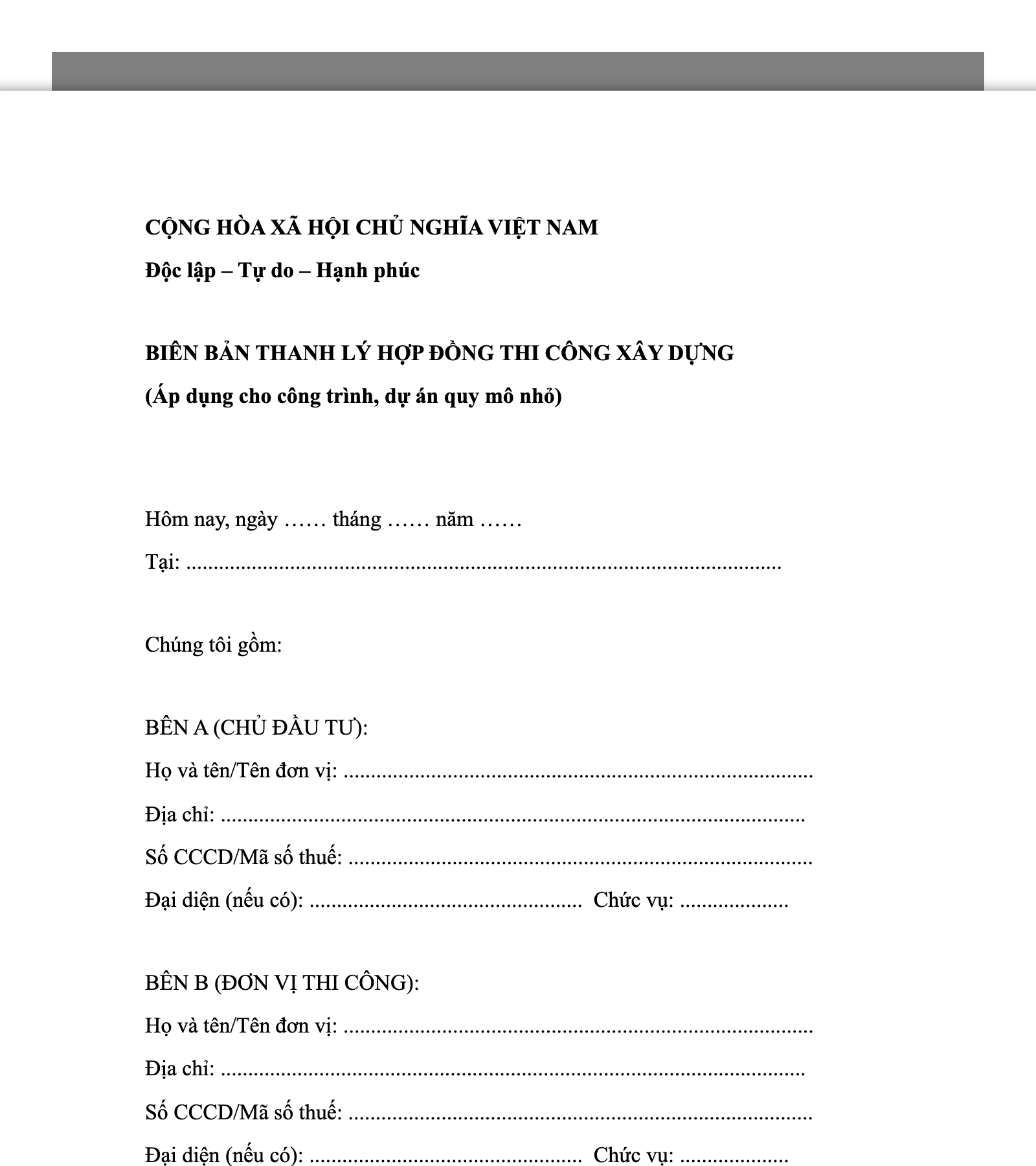
This template is designed to be simple and easy to use, suitable for small-scale projects, contracts between individuals, or between an individual and a small contractor.
Template features
-
Concise content, focusing on core information
-
Does not require complex legal documents
-
Easy to print and sign directly
When to use
-
Construction of private residences
-
Renovation and repair of small projects
-
Construction contracts not using state capital
[Download Construction Work Contract Liquidation Minutes Template – Word File]
Template 4: Construction Contract Liquidation Minutes with Additions or Adjustments
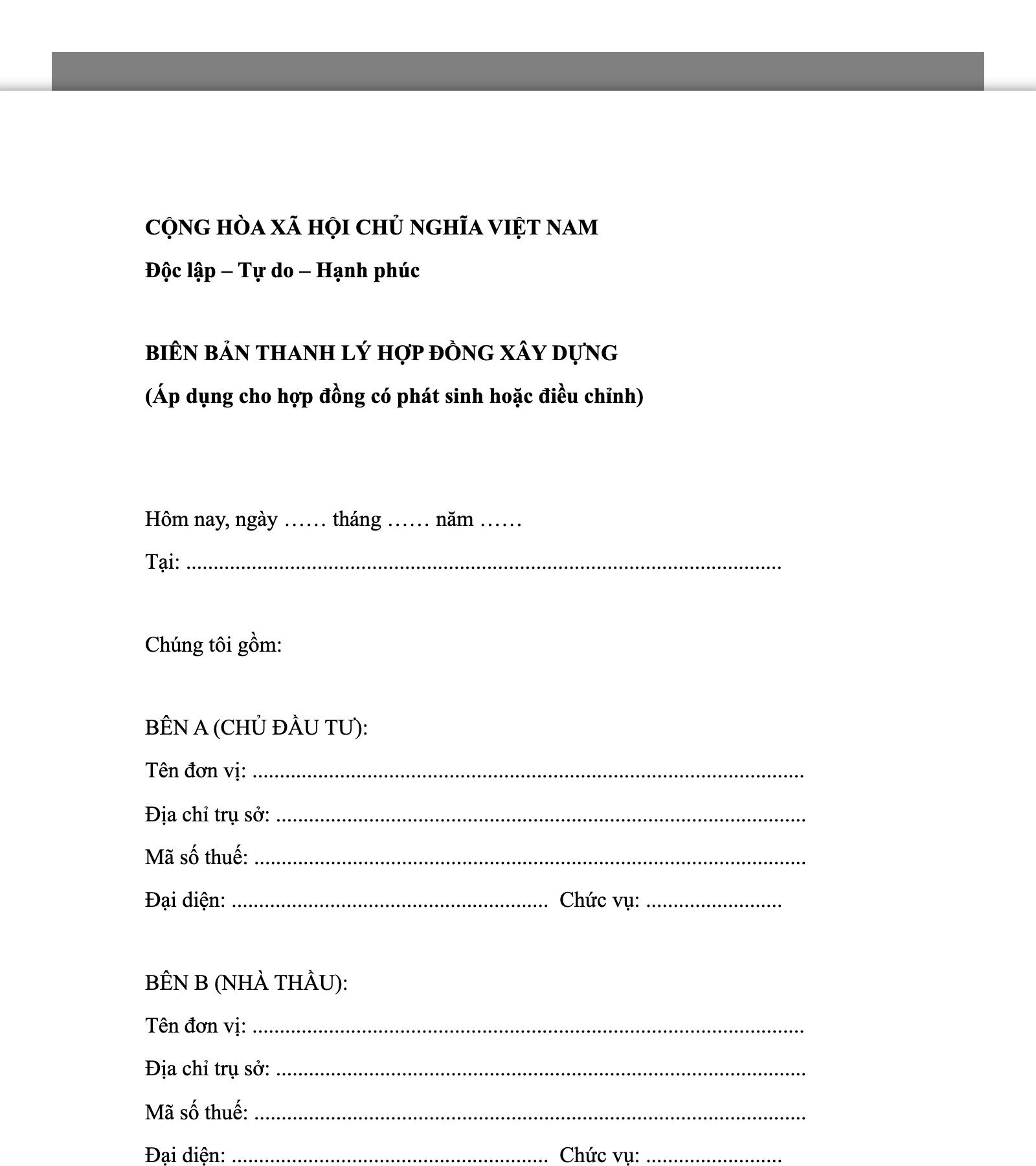
This template is applicable for contracts that have incurred additional work volume, unit price adjustments, or changes in the scope of work compared to the original contract during execution.
Content requiring special attention
-
Reference signed contract addendums and adjustment minutes
-
Clearly separate the original contract value and the value of additions
-
Summarize the final payment value after adjustments
-
Record the agreement of all parties on all additions
Download Link for Template 4 (Word):
[Download Contract Liquidation Minutes Template with Additions – Word File]
VI. Important Notes When Drafting & Signing Construction Contract Liquidation Minutes
The construction contract liquidation minutes is the document that concludes the legal lifecycle of a contract. Therefore, any errors during its drafting and signing can lead to disputes, legal risks, or requests from audit or inspection agencies to redo the documentation. In reality, many disputes arise not during the construction phase but from a poorly executed liquidation process.
1. Thoroughly check information and figures before signing
Before signing the liquidation minutes, all parties must review the entire document to ensure its accuracy and consistency with the actual records. In particular, information related to the contract value, payment value, and outstanding debts must be carefully cross-referenced with the final settlement documents and financial vouchers.
The content that needs to be carefully checked includes:
-
Legal information of the parties (name, address, tax code, representative)
-
Number, signing date, and content of the original contract
-
Contract value, value of additions, and value already paid
-
The effective termination date of the contract
Signing the minutes when figures have not been agreed upon can cause a party to lose the right to claim payment or compensation later.
2. Ensure all accompanying documents and vouchers are complete
Construction contract liquidation minutes are only truly valid when based on complete and legal documentation. In many cases, liquidation minutes are rejected or require adjustment due to insufficient documents proving the contract execution process.
The documents to be prepared and cross-referenced include:
-
Minutes of acceptance of work volume and quality
-
Contract final settlement documents
-
Invoices and payment vouchers
-
Contract addendums, adjustment minutes (if any)
Missing or inconsistent accompanying documents is a common reason for the final settlement not being accepted.
3. Clearly define the warranty responsibility for the project after liquidation
A common mistake is to assume that all obligations end after signing the liquidation minutes. In reality, the project warranty obligation often remains in effect after the contract is liquidated.
The liquidation minutes should clearly state:
-
The remaining warranty period
-
The scope of the warranty
-
The specific responsibilities of the contractor
-
The procedure for handling defects that arise during the warranty period
Clearly recording this content helps avoid disputes when technical issues occur after the project has been handed over.
4. Clearly agree on dispute resolution (if any)
In cases where disputes have arisen or are likely to arise, the liquidation minutes must clearly state the resolution method or the scope of the remaining dispute. Vague or general terms should not be used if the parties have not reached a genuine agreement.
The following content should be clarified:
-
Issues that have been definitively resolved
-
<p data-end="3106
-
Missing information about the original contract
-
Discrepancy in figures between the liquidation record and the final settlement documents
-
No reference to legal basis or contract addendums
-
Unauthorized signatory
-
The effective date of the record is not specified
These errors are often only discovered during disputes or when inspection and audit agencies review the documents, causing time and cost overruns for reprocessing.
VII. Frequently Asked Questions About Construction Contract Liquidation Records
During the execution and completion of construction contracts, many investors and contractors still have concerns about the legal validity, procedures, and obligations related to the liquidation record. Below are frequently asked questions and the correct interpretations based on legal practice.
1. Does a construction contract liquidation record need to be notarized or authenticated?
According to current law, a construction contract liquidation record is not required to be notarized or authenticated, unless otherwise agreed by the parties in the contract or specified by specialized laws.
In practice, a liquidation record is legally valid when it meets all the following conditions:
-
Based on a lawful contract
-
Content is clear and does not violate the law
-
Signed by authorized representatives of all parties
-
Stamped as required (for organizations and businesses)
Notarization or authentication only serves to strengthen the evidentiary value and is usually applied in specific transactions or when parties want to minimize the risk of disputes.
2. What should be done if one party refuses to cooperate in signing the liquidation record?
In practice, there are many cases where one party does not cooperate or intentionally delays the contract liquidation. In such situations, a liquidation record cannot be unilaterally created to replace the mutual agreement of the parties.
The commonly applied solutions include:
-
Sending a formal written request for contract liquidation
-
Creating a working record to document the non-cooperation of one party
-
Completing the acceptance and final settlement documents to serve as a legal basis
-
Initiating a lawsuit or requesting dispute resolution as per the contract
In this case, the completion of actual obligations and supporting documents will play a crucial role if the matter is brought to arbitration or court.
3. Can the liquidation record replace the original contract?
The liquidation record does not replace the original construction contract. These are two documents with entirely different legal functions.
Specifically:
-
The construction contract is the basis for establishing the rights and obligations of the parties
-
The liquidation record is a document that confirms the termination of the contract’s validity
The liquidation record is only valid for the purpose of terminating the contract and does not invalidate clauses that need to remain in effect, such as warranty, confidentiality, and liability for damages (if any).
Signing a contract liquidation record does not create new tax obligations, but it is an important basis for completing tax obligations that arose during the contract’s execution.
Some commonly related tax obligations include:
-
Value-added tax (VAT) on the completed work volume
-
Corporate income tax on the recognized revenue
-
Other tax obligations as stipulated by tax laws
The liquidation record is often used as a basis to prove revenue and valid expenses during tax finalization and audits.
5. What responsibilities arise after the liquidation of a construction contract?
A common misconception is that after signing the liquidation record, the parties have no further legal responsibilities. In reality, some obligations continue to exist post-liquidation if they were agreed upon or stipulated by law.
Responsibilities that may arise after liquidation include:
-
Warranty obligations for the project or project items
-
Liability for damages caused by faults that occurred before the liquidation date
-
Obligation to settle outstanding payments as stated in the liquidation record
-
Obligation to provide and complete documentation as required by law
Therefore, when preparing the liquidation record, the parties should clearly state the scope of the obligations that remain in effect to avoid future disputes.
-




