09/05/2026
  802 views
Creating a disciplinary record in accordance with regulations helps businesses handle labor violations transparently, fairly, and legally. In this article, 1Office will compile 4+ common Labor Disciplinary Record Templates, complete with detailed instructions and convenient DOCX/PDF downloads, to help businesses apply them immediately.
Mục lục
1. What is a Labor Disciplinary Record?
Below are the definition, role, and legal basis of a labor disciplinary record, helping businesses understand the purpose of creating the record and the legal regulations that must be followed to handle violations correctly:
1.1. Definition of a Labor Disciplinary Record
A labor disciplinary record (also known as the minutes of a disciplinary hearing) is a document that fully records the proceedings and content of a disciplinary review meeting between the employer, the employee who committed the violation, and relevant parties (such as the grassroots employee representative organization). The record is created and signed for confirmation during the meeting and serves as the basis for the business to issue a disciplinary decision in accordance with legal regulations.

Below are the differences between the documents in the labor disciplinary process, including the violation report, the disciplinary hearing record, and the disciplinary decision, to help clarify the function and timing of each type:
- Labor disciplinary violation report: Created at the time the violation is discovered to record the incident, specific behavior, and related evidence. This is the initial step in the disciplinary process.
- Labor disciplinary record: Created during the official disciplinary hearing, recording the opinions of all parties, the review process, and the conclusion regarding the violation.
- Labor disciplinary decision: A document issued by an authorized person, formally applying a disciplinary measure to the employee (reprimand, extension of the salary increase period, demotion, or dismissal).
1.3. The Importance of a Labor Disciplinary Record
The labor disciplinary record is a key document to ensure that disciplinary actions are carried out in accordance with regulations and with transparency. Specifically, the record provides the following benefits:
- Legal basis to protect the business: Proves that the business has fully complied with the disciplinary process and procedures in the event of a dispute with the employee or authorities.
- Ensures the legitimate rights and interests of all parties: The employee is allowed to present their opinion, defend themselves, and have a representative present; the business avoids the risk of being accused of subjective or arbitrary handling.
- Increases transparency and objectivity: All opinions, evidence, and conclusions are clearly recorded, helping the disciplinary process to be conducted fairly.
- Mitigates legal risks: An incomplete or non-compliant record can render the disciplinary decision invalid, leading to obligations for compensation and reinstatement of the employee’s rights.
1.4. Legal Basis
The creation of a labor disciplinary record and the organization of disciplinary proceedings must strictly comply with current legal regulations. As of 2026, the 2019 Labor Code remains the primary legal basis, as related amendments have not changed the content regarding labor discipline. Specifically:
- 2019 Labor Code (effective from January 1, 2021):
- Article 122: Principles, order, and procedures for handling labor discipline (mandatory disciplinary hearing, proof of fault, participation of the employee representative organization).
- Article 123: Statute of limitations for handling labor discipline.
- Article 124: Forms of labor discipline.
- Article 125: Cases where dismissal is applied.
- Article 126: Cases of temporary work suspension.
- Decree 145/2020/ND-CP:
- Article 70: Detailed guidance on the disciplinary process, including creating a violation report, notifying of the meeting, creating a disciplinary hearing record (which must be approved and signed before the meeting concludes), and issuing a disciplinary decision.
Strict adherence to the above legal bases is a mandatory condition for a labor disciplinary decision to be valid, and it also helps businesses minimize the risk of legal disputes.
2. The Legally Compliant Labor Disciplinary Process
For labor disciplinary actions to be legally valid and to mitigate dispute risks, businesses must correctly and fully follow a mandatory 4-step process. The process can be summarized as follows:
Create Violation Report → Hold Disciplinary Hearing → Create Hearing Record → Issue Disciplinary Decision.
Step 1: Create a Disciplinary Violation Report
This is the initial and crucial step in the entire disciplinary process.
- Timing of report creation: The report can be created at the moment the violation is discovered or immediately after, once the incident has been clearly verified. Creating it as early as possible helps ensure objectivity and the completeness of evidence.
- Reprimand:<span style="fontDetailed note-taking guide
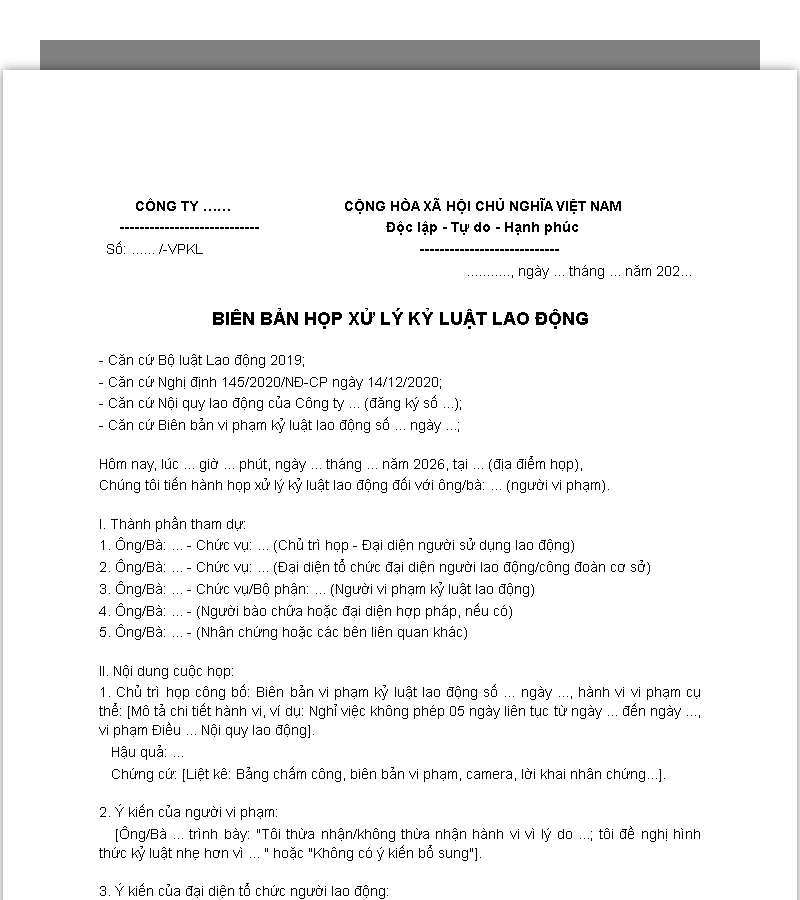
- Attendees: The employee under disciplinary review, a representative of the employee representative organization at the grassroots level, and the meeting chair (the employer or an authorized person) are mandatory.
- Meeting proceedings: Record in a logical sequence: announcement of the violation report → employee’s presentation and explanation → presentation and clarification of evidence → opinion of the employee representative organization → discussion.
- Opinions of the parties: Record honestly, verbatim, without speculative summaries.
- Conclusion: Only state the proposed disciplinary action, not replace the official disciplinary decision (the decision issued by the competent authority after the meeting).
- Note: The absence of mandatory attendees or failure to follow proper notification procedures can render the minutes and the disciplinary decision invalid.

Minutes of a labor disciplinary meeting ->> Download the Labor Disciplinary Violation Report Template Now
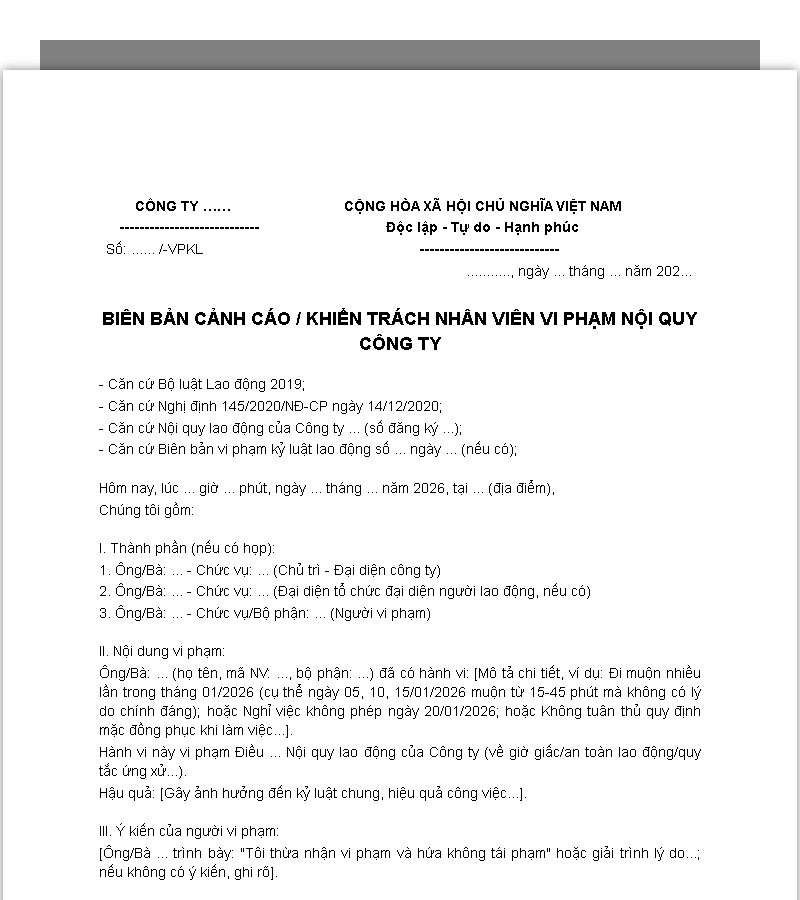
Template 3: Warning letter for an employee violating company rules
Purpose and when to use: This report is used for minor disciplinary actions, such as a reprimand or warning, typically for first-time or minor violations. The goal is to officially record the reminder and create a basis for monitoring to prevent reoccurrence.
Basic structure and filling instructions
- National emblem, company name, date of report
- Information of the violating employee: full name, department, position
- Violating act: describe specifically, objectively, including consequences if any
- Disciplinary action: “Written reprimand” or “Warning”
- Basis and reason: cite company rules, relevant regulations
- Violator’s opinion: explanation or admission
- Signatures: authorized leader and violating employee
Detailed filling instructions
- Describe the violation concisely, clearly, and avoid speculation.
- Record direct consequences if any (e.g., project delays, minor damages).
- Emphasize the employee’s commitment not to re-offend.
Warning letter for an employee violating company rules ->> Download the Labor Disciplinary Violation Report Template Now
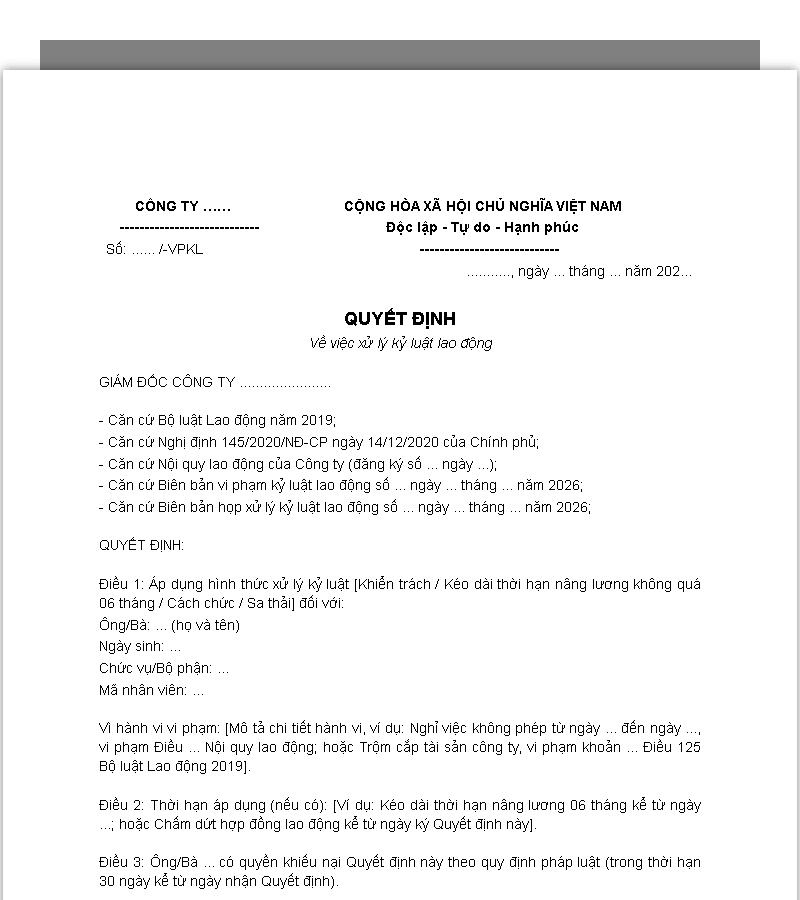
Template 4: Labor disciplinary action decision
Purpose and time of issuance: This decision is the final official document issued by the competent authority (Director or authorized person) after the disciplinary meeting minutes have been recorded. It officially applies the disciplinary action to the employee and must be sent within the prescribed time limit (Clause 4, Article 70 of Decree 145/2020/ND-CP).
Template structure and filling instructions
- National emblem, company name, decision number, date of issuance
- Legal basis: Labor Code 2019, Decree 145/2020, labor regulations, minutes of the disciplinary meeting
- Information of the violator: full name, department, position
- Violating act: describe accurately and objectively
- Disciplinary action: reprimand, extension of salary increase period, demotion, dismissal (applied in accordance with Article 125 of the 2019 Labor Code)
- Application period, effective date
- Employee’s right to appeal
- Signature of the Director or authorized person
Detailed filling instructions
- Record the act and disciplinary action truthfully and in compliance with the law.
- Dismissal is only applicable in serious cases as stipulated in Article 125.
- Present the document clearly, coherently, and understandably, ensuring transparency and legal validity.
Labor disciplinary action decision template ->> Download the Labor Disciplinary Violation Report Template Now
6. Important notes when creating a disciplinary record
When creating a labor disciplinary record (minutes of a disciplinary meeting), businesses must strictly adhere to the provisions of Article 122 of the 2019 Labor Code and Article 70 of Decree 145/2020/ND-CP – which remain the primary legal basis applicable until 2026. Any errors in the process or content of the record can render the disciplinary decision invalid, leading to the obligation to reinstate the employee and compensate for related benefits. Some important notes include:
- Ensure accuracy and objectivity: The record must truthfully reflect the meeting’s proceedings, evidence, and opinions of all parties. The content should be based on clear evidence, avoiding speculation, bias, or emotional or offensive language.
- Adhere to the statute of limitations for disciplinary action: Disciplinary action can only be taken within the time limit specified in Article 123 of the 2019 Labor Code (06 months; 12 months for violations related to finance, assets, or business secrets). After the statute of limitations expires, even after the maximum 60-day extension, no disciplinary meeting can be held or decision issued.
- Ensure the employee’s right to explain: The business must provide written notice at least 05 working days in advance, allowing the employee to present their opinions, defend themselves, and provide evidence. If the employee is absent for a legitimate reason, the meeting must be postponed.
- Ensure full attendance as required by law: The disciplinary meeting must be attended by the employee (or their legal representative), a representative of the employee representative organization at the grassroots level, and the employer or an authorized person. The absence of a mandatory attendee can invalidate the record and the disciplinary decision.
- Legal and public evidence: Documents and evidence (violation reports, legal camera footage, witness statements, etc.) must be collected in accordance with regulations and presented at the meeting to allow the employee to respond.
- Form and language of the record: The record should be presented clearly, in the proper administrative format, and fully record the time, location, attendees, proceedings, opinions, and conclusions. The record must be approved and signed at the meeting before it concludes.
- Handling cases where the employee refuses to sign: If the employee refuses to sign the record or disciplinary decision, the reason must be clearly stated, and at least two witnesses must sign to confirm the refusal. Refusal to sign does not invalidate the document if the disciplinary process was conducted correctly according to the law.
- Prohibited acts during disciplinary action (Article 127 of the 2019 Labor Code):
- Infringing upon the body, honor, or dignity of the employee.
- Imposing fines or cutting wages instead of disciplinary action.
- Disciplining for acts not specified in the labor regulations.
<li style="font-weightQuestion 6: Do employees have the right to keep a copy of the disciplinary record?
Yes. Employees have the right to receive a copy of the disciplinary meeting minutes and the disciplinary decision. The company is responsible for sending the disciplinary decision within the statutory processing period to ensure transparency, the right to appeal, and to protect the legal rights of the employee.
Using these standard Disciplinary Record Templates helps businesses ensure that the process for handling labor violations is lawful, transparent, and minimizes the risk of disputes. Download and apply them now for effective labor discipline management.
<li style="font-weight: 400;" aria-level
3. Forms of labor discipline and processing deadlines
Below are common forms of labor discipline and their statutes of limitations, helping businesses choose appropriate measures, comply with the law, and avoid the risk of disputes:
3.1. Forms of labor discipline
Pursuant to Article 124 of the 2019 Labor Code (effective from January 1, 2021, and applicable until 2026), for each violation, the employer may only choose one of the following four forms of discipline: