09/05/2026
  175 views
A volume confirmation record is a crucial document in construction, sales, and goods delivery, serving as the basis for acceptance, payment, settlement, and dispute resolution. However, not everyone knows how to create a standard record and use the appropriate template for each situation. In this article, we have compiled 5+ standard, easy-to-use volume confirmation record templates, with free Word files for download, along with detailed instructions on how to create them and important legal considerations to help you mitigate risks in practice.
Mục lục
- 1. What is a Volume Confirmation Record?
- 2. The Most Common Types of Volume Confirmation Records
- 3. Detailed Guide on How to Create a Quantity Confirmation Record
1. What is a Volume Confirmation Record?
Definition of a Volume Confirmation Record
A volume confirmation record is a document created between two or more parties to record and confirm the volume of work, goods, or services that has actually been completed at a specific time or during a certain period.
In practice, this record often appears in fields such as:
-
Construction and project execution
-
Manufacturing and processing
-
Sales and goods delivery
-
Logistics and warehousing
Essentially, a volume confirmation record is not an independent contract but a document that arises during the contract execution process, used to reflect the actual results compared to the agreed-upon terms.
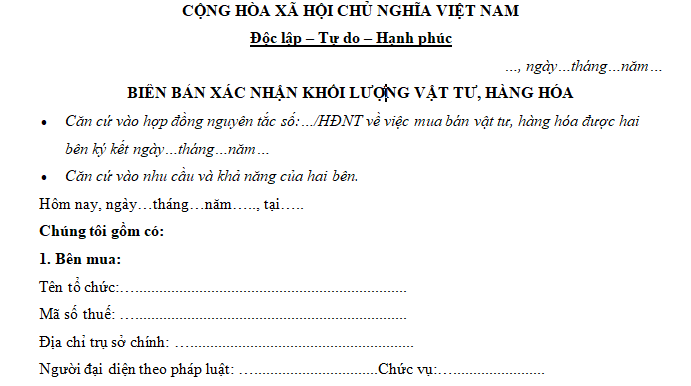
Purpose and Role of a Volume Confirmation Record
During the process of work implementation or goods delivery, the actual volume often does not perfectly match the initial plan or contract. A volume confirmation record is created to accurately document the completed portion, thereby ensuring transparency and agreement between the parties.
This record plays a crucial role in:
-
Accurately recording the volume of work/goods completed or delivered
-
Serving as a basis for payment, settlement, or advances according to progress
-
Controlling and adjusting for any deviations from the original contract
-
Minimizing disputes related to quantity and scope of work
-
Serving internal management, accounting, auditing, or inspection purposes
Especially in construction projects or high-value contracts, the volume confirmation record is often considered a mandatory document in the payment file.
Legal Basis for Volume Confirmation Records in Vietnam
Current Vietnamese law does not issue a unified template for volume confirmation records. However, the creation and use of this document are indirectly regulated by provisions on contracts, obligations, and evidence.
The relevant legal basis may include:
-
Regulations on the performance of civil obligations and contracts
-
Regulations on construction contracts, acceptance, and volume payment
-
Regulations on accounting and documents for payment and settlement
-
Specific agreements recorded in the contract between the parties
In principle, a volume confirmation record is legally valid when:
-
It is created based on a legal contract
-
Its content accurately reflects the actual work performed
-
It is signed by authorized parties
Therefore, using the correct template at the right time and for the right purpose is key to ensuring the volume confirmation record is effective in practice.
2. The Most Common Types of Volume Confirmation Records
During contract execution and practical work implementation, volume confirmation records are not limited to a single type but are divided into various categories corresponding to different fields, phases, and specific purposes.
Classifying volume confirmation records helps the parties to:
-
Select the correct type of record to create
-
Record the volume at the right time and for the right purpose
-
Complete the documentation for payment, acceptance, and settlement
In practice, volume confirmation records are often categorized by the nature of the work, the time of creation, and the purpose of use, with the most common group being those used in construction.
2.1. Construction/Execution Volume Confirmation Record
The construction/execution volume confirmation record is the most commonly used type, designed to document the actual volume of work completed on-site during the construction, installation, renovation, or repair of a project.
This type of record plays a crucial role in:
-
Tracking construction progress
-
Controlling the completed volume against the contract
-
Serving as a basis for acceptance, payment, and settlement
Depending on the timing and purpose, construction volume confirmation records are typically divided into the two main templates below.
Template 1: Daily/Weekly Construction Volume Confirmation Record
This template is created to record the construction volume over a short period, usually daily or weekly. Creating periodic records helps parties closely monitor progress and promptly identify any additional volumes.
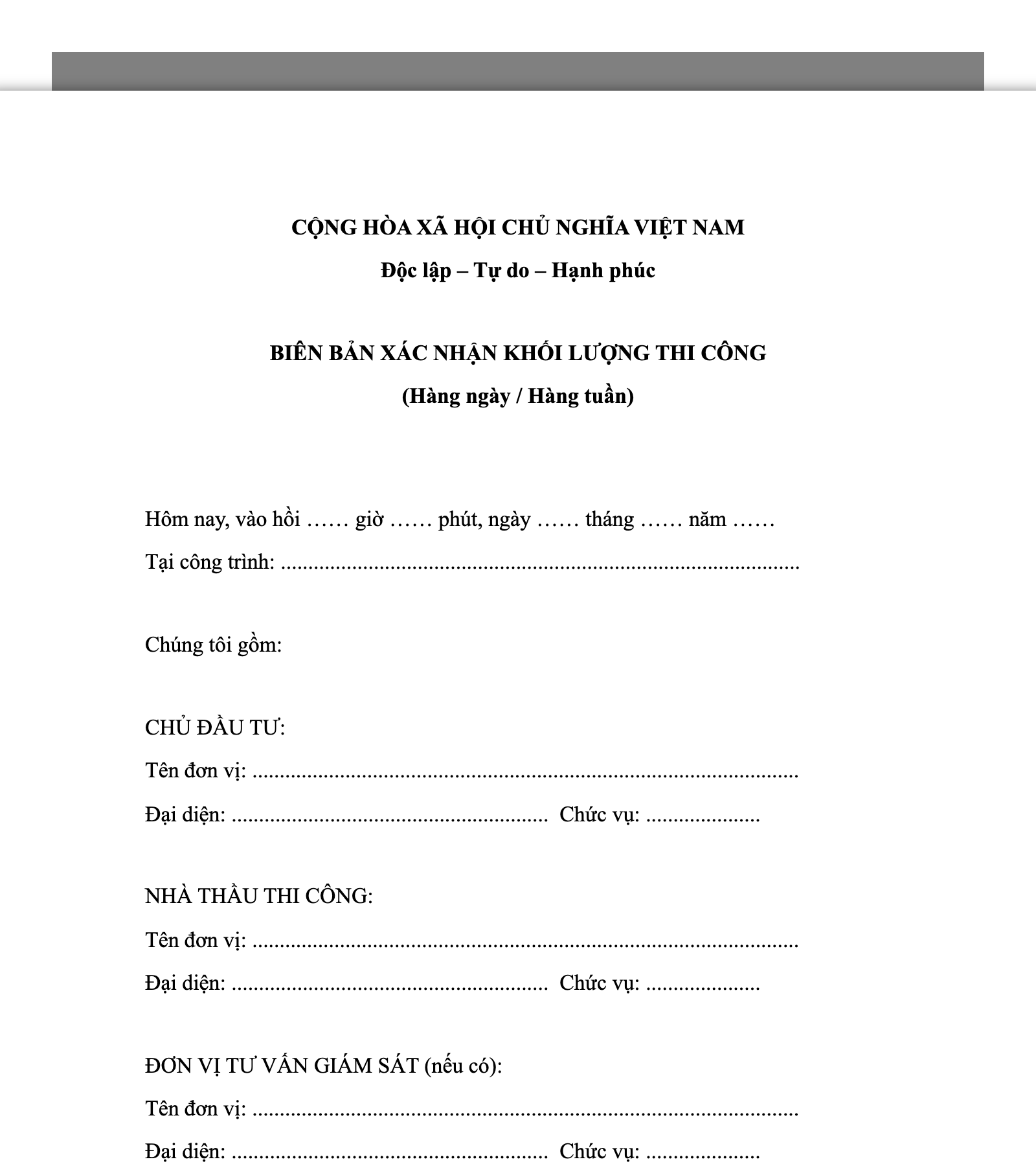
This record is typically used in the following cases:
-
Large-scale projects with continuous construction
-
When frequent monitoring of progress and volume is required
-
As a basis for internal management and summarizing volume by phase
The main content of the record includes:
-
Project name, construction site
-
Confirmation period (day/week)
-
List of tasks performed
-
Actual volume for each task
-
Signatures of relevant parties for confirmation
Template 2: Volume Confirmation Record for Completion by Item/Phase
This template is created at the end of a project item or a specific construction phase and is often used as a direct basis for acceptance and payment.
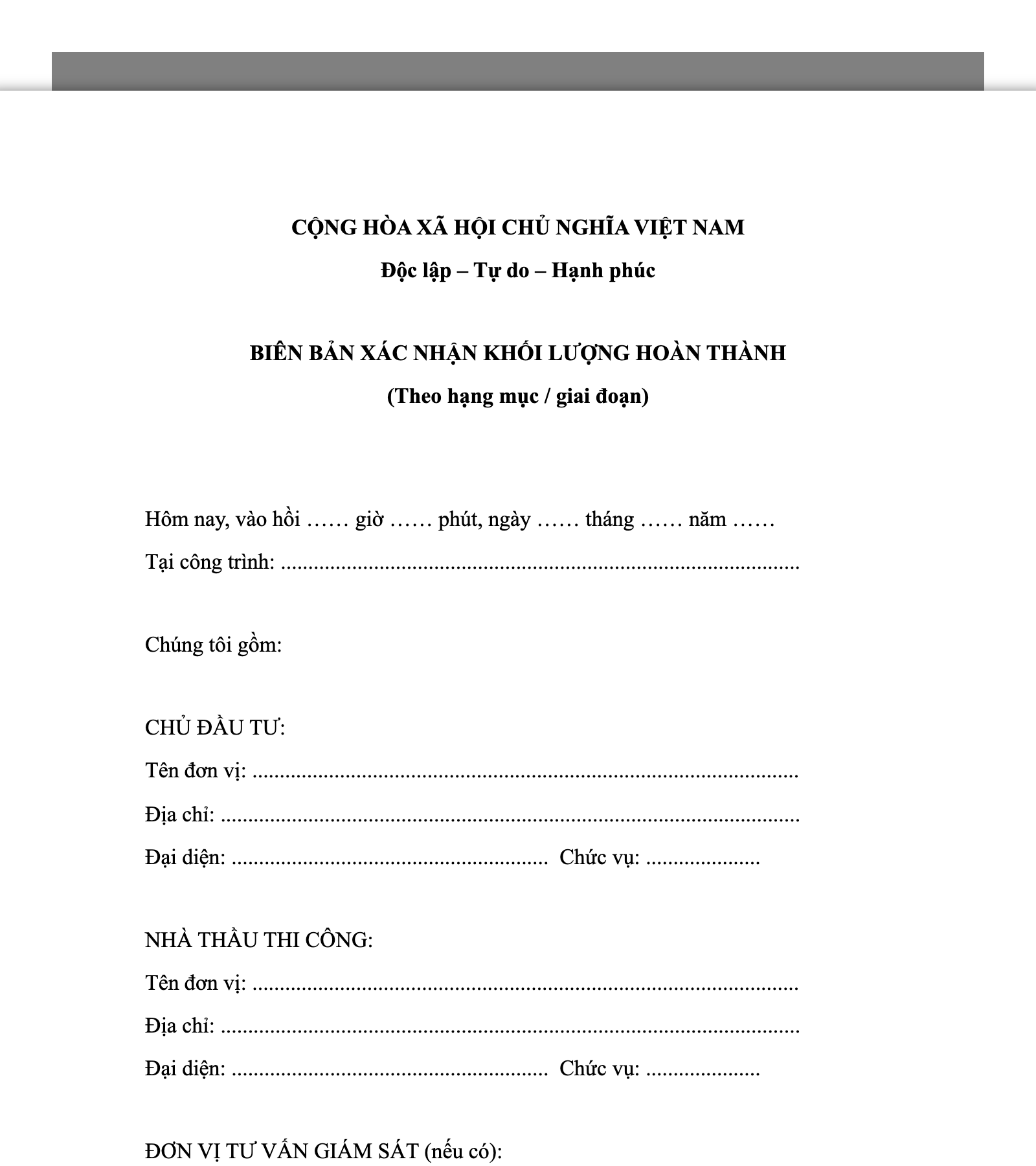
Compared to the daily/weekly record, this template is more detailed and has higher legal value because it reflects the completed volume at a “phase-end” level.
The volume confirmation record for completion by item/phase typically includes:
- <p data-start="2
-
Conclusion serving as a basis for acceptance and payment
This record template is usually signed by:
-
The investor
-
The construction contractor
-
The supervision consultant (if any)
2.2. Confirmation Record of Additional Work Volume (In Construction & Projects)
A confirmation record of additional work volume is a document created to record any increased, changed, or out-of-scope work volumes during the construction or project implementation process. This type of record is particularly important because additional work volume is often the main cause of disputes over payment and final settlement if not recorded promptly and correctly.
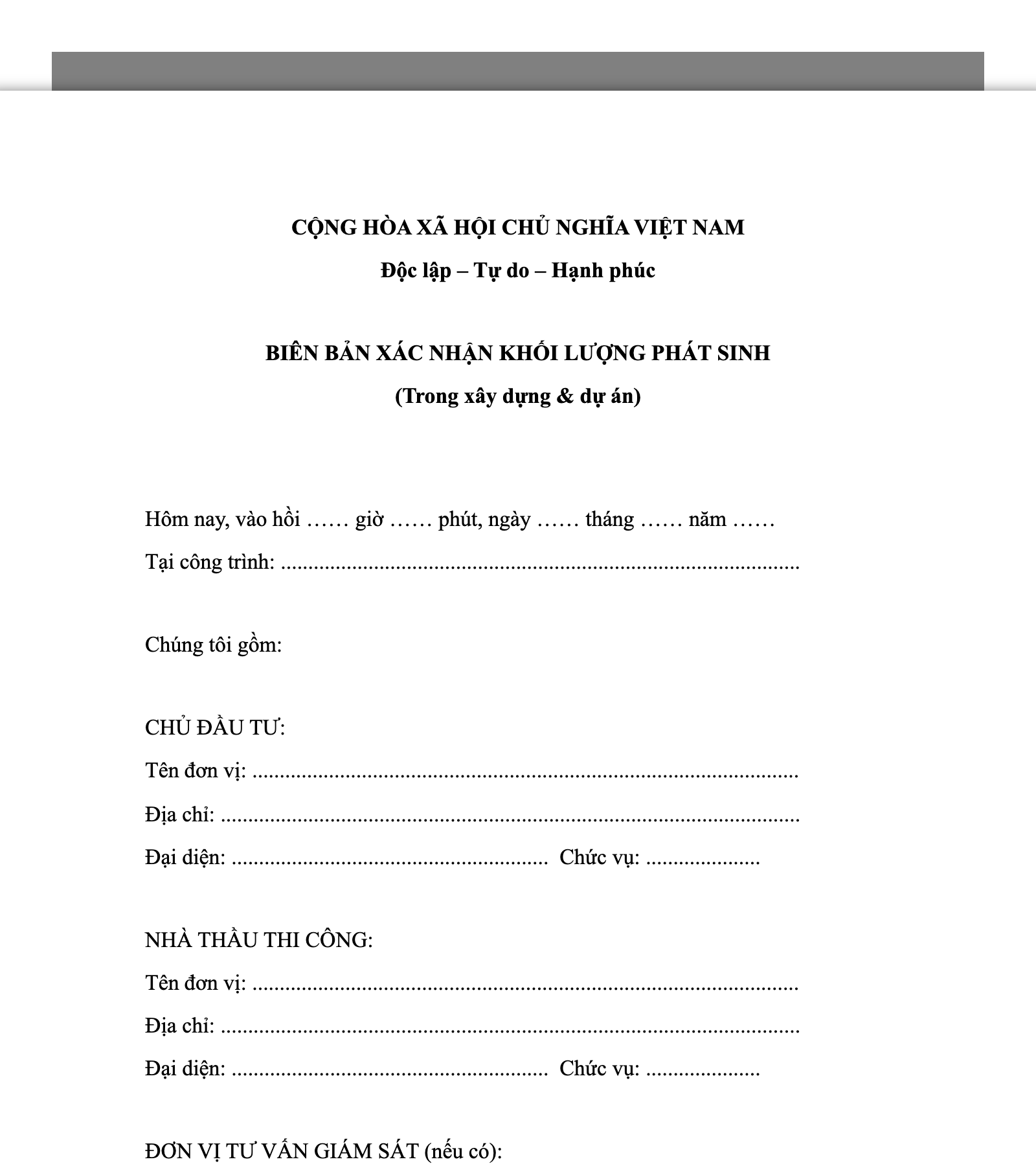
Essentially, this record serves as a legal basis for adjusting the contract value or making additional payments, helping to protect the interests of both the investor and the contractor.
Purpose of Use
The confirmation record of additional work volume is created to:
-
Accurately record the content and scope of the additional work
-
Serve as a basis for considering adjustments to the contract or contract addendums
-
Legalize the additional work volume for payment purposes
-
Minimize disputes arising during the final settlement phase
When is it necessary to create a confirmation record of additional work volume?
The record should be created immediately when out-of-contract work arises, especially in the following cases:
-
There are design changes compared to the original documents
-
There are additional requests from the investor
-
Actual site conditions differ from the design or estimate
-
Additional volume arises due to objective, technical, or safety factors
Creating the record promptly helps ensure the additional work volume is legally recognized, avoiding payment refusal later on.
Parties Involved in Signing the Record
Similar to construction work volume confirmation records, the confirmation record of additional work volume usually involves the participation of:
-
The investor or the investor’s representative
-
The construction contractor
-
The supervision consultant (if any)
Full confirmation from all relevant parties ensures the record is valid for use in payment and final settlement documents.
Required Content in a Confirmation Record of Additional Work Volume
A complete and rigorous confirmation record of additional work volume must clearly state the following:
-
Reason for the additional volume
-
Detailed description of the additional work
-
Actual additional volume
-
Applicable unit price (as per the contract, supplementary estimate, or provisional calculation)
-
Timeframe for completing the additional volume
-
Confirmation signatures of the relevant parties
Important Notes When Creating the Record
To ensure the confirmation record of additional work volume is accepted for payment and to avoid dispute risks, please note:
-
Do not create retroactive records without a basis
-
The record must be closely linked to the original contract and design documents
-
Clearly state the legal basis for the unit price and payment value
-
Prioritize creating the record before or immediately upon performing the additional work
2.3. Confirmation Record of Work Volume for Payment Request
A confirmation record of work volume for payment request is a document created to confirm the value of work completed at a specific time or during a specific period, serving as a basis for the contractor to request payment from the client according to the contract.
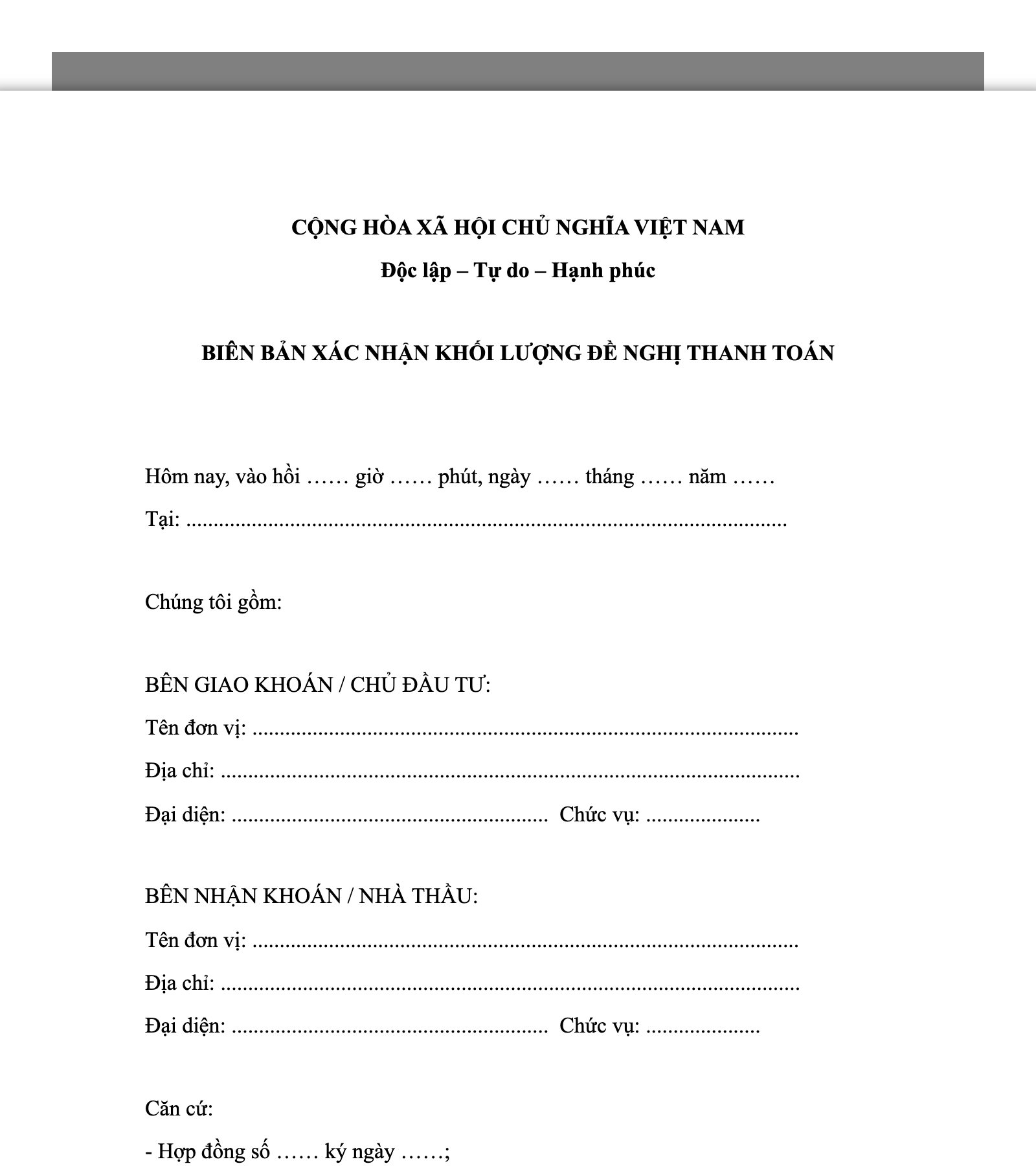
In the payment documentation chain, this record plays a crucial role, linking the completed work volume, acceptance records, and financial documents (invoices, vouchers).
Purpose of Use
The confirmation record of work volume for payment request is created to:
-
Summarize and confirm the volume of work completed
-
Serve as a basis for preparing periodic payment requests
-
Reconcile the amount paid with the remaining balance
-
Reduce disputes related to progress and payment value
When is it necessary to create a confirmation record of work volume for payment request?
The record is usually created according to the payment milestones agreed upon in the contract, commonly in the following cases:
-
Payment by construction phase
-
Payment by completed volume
-
Periodic payment (monthly, quarterly)
-
Before preparing payment documents to send to the investor
Creating the record at the right time helps the approval and disbursement process proceed quickly and clearly.
Parties Involved in Signing the Record
The confirmation record of work volume for payment request usually involves the participation of:
-
The client (investor or main contractor)
-
The contractor
-
The supervision consultant (if stipulated in the contract)
Having the full signatures of all parties helps the record be accepted in the payment documents.
Required Content in a Confirmation Record of Work Volume for Payment Request
A complete and rigorous confirmation record of work volume for payment request must clearly state:
-
Contract information serving as the basis for payment
-
Value of the work volume completed up to the time of the request
-
Value paid in previous periods
-
Remaining value requested for payment in this period
-
List of accompanying documents and vouchers:
-
Work volume confirmation record
-
Acceptance record
-
Related invoices and vouchers
-
2.4. Confirmation Record of Goods Quantity
A confirmation record of goods quantity is a document created to record the actual quantity and condition of goods at the time of delivery and receipt. This is a common type of record in sales, logistics, warehousing, and internal goods transfer activities.
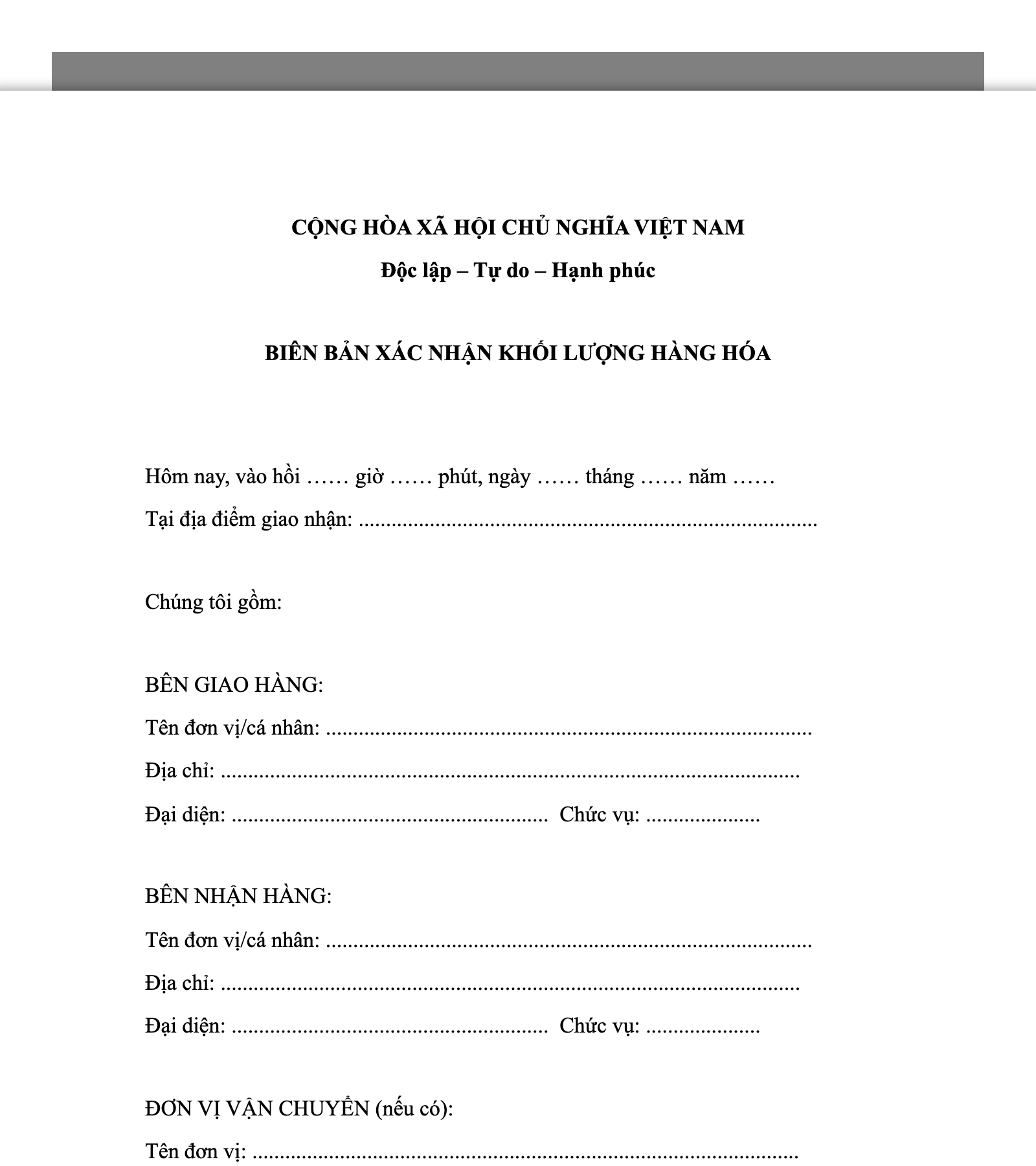
This record plays a crucial role in defining responsibilities between parties, especially in cases of shortages, damages, or discrepancies compared to the original documents.
Purpose of Use
The goods quantity confirmation record is created to:
-
Accurately record the actual quantity of goods delivered/received
-
Determine the condition of the goods at the time of handover
-
Serve as a basis for comparison with invoices and warehouse receipts/issue slips
-
Serve for resolving complaints and compensation claims (if any)
-
Support warehouse management and inventory control
When is it necessary to create a goods quantity confirmation record?
The record should be created immediately at the time of goods delivery and receipt, especially in the following cases:
-
Delivery from supplier to customer
-
Transferring goods between warehouses
-
Delivery via a shipping carrier
-
Receiving high-value or fragile goods
Creating the record at the right time helps protect the interests of all parties and avoid future disputes.
Parties Involved in Signing the Record
Depending on the delivery method, the goods quantity confirmation record typically involves the participation of:
-
The delivering party
-
The receiving party
-
The shipping carrier (if any)
The signatures of the involved parties give the record legal validity in case of complaints or disputes.
Required Content in a Goods Quantity Confirmation Record
A complete and thorough goods quantity confirmation record must clearly state:
-
Product name, product code (if any)
-
Quantity as per documents (invoice, warehouse issue slip)
-
Actual quantity delivered/received
-
Condition of goods (intact, damaged, dented, etc.)
-
Quantity of shortage/surplus/damage (if any)
-
Preliminary cause and proposed solution (if any)
2.5. Completed Work Acceptance Record
The completed work acceptance record is a document with high legal value, created to officially confirm that the volume of work or project item has been completed according to quality and technical requirements and is eligible for use or for payment and final settlement.
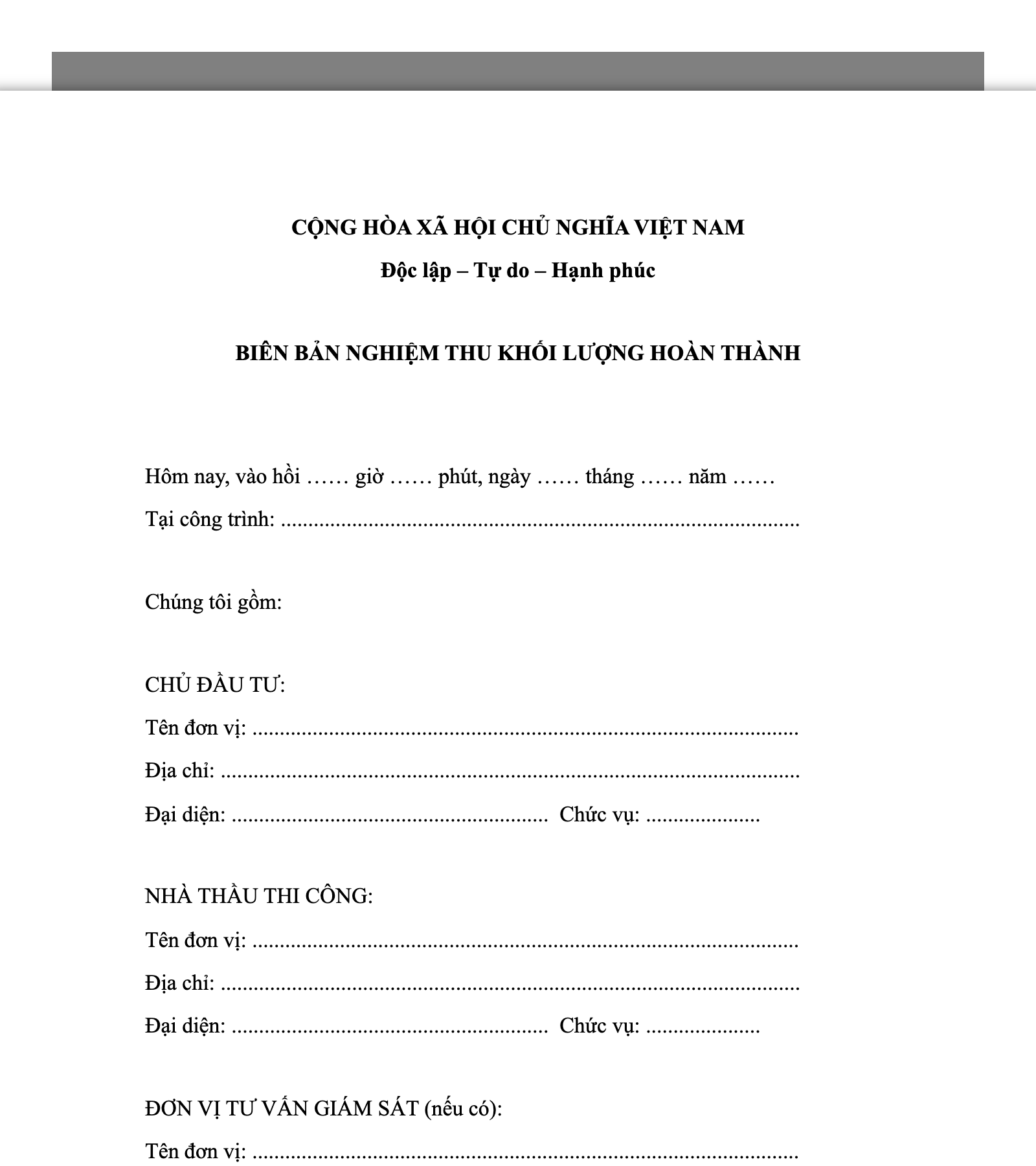
This is the final and most crucial step in the quantity surveying documentation of a construction project, directly affecting contract settlement, warranty obligations, and the legal responsibilities of the parties.
Purpose of Use
The completed work acceptance record is created to:
-
Officially confirm that the completed work meets requirements
-
Serve as a basis for final payment and settlement
-
Determine the start date of the warranty obligation
-
Serve as a basis for putting the project/item into operation
When is an acceptance record needed?
A completed work acceptance record is created when:
-
The entire construction project is completed
-
A major item or contract package is completed
-
Work eligible for acceptance according to the contract is finished
Acceptance is only carried out when the work is fully completed and meets all technical, safety, and quality requirements.
Parties Involved in Acceptance
The acceptance record typically involves the full participation of all relevant parties, including:
-
The investor or the investor’s representative
-
The construction contractor
-
The supervision consultant
-
The acceptance committee (for large projects)
The full participation of all parties ensures the acceptance record has legal validity and is accepted in the final settlement documents.
Required Content in a Completed Work Acceptance Record
A complete and standard completed work acceptance record must clearly state:
-
Name of the project, item for acceptance
-
Time and location of acceptance
-
Participants in the acceptance
-
Volume of work completed
-
Assessment of quality and compliance with technical requirements
-
Acceptance conclusion (pass/fail)
-
Outstanding issues and recommendations for correction (if any)
3. Detailed Guide on How to Create a Quantity Confirmation Record
A quantity confirmation record is one of the key documents for accurately recording the actual volume of work performed or goods delivered/received. Creating a record with the correct procedure and complete content not only ensures data transparency but also serves as a crucial legal basis for acceptance, payment, settlement, and dispute resolution. Below is a detailed, step-by-step guide to creating a standard and practical quantity confirmation record.
Before creating the record, all parties must review and prepare a complete set of documents and materials to serve as the basis for quantity confirmation. This is a crucial step to ensure the data recorded is well-founded, preventing discrepancies or future disputes.
The documents typically required include:
-
The signed contract and any appendices (if any)
-
Approved cost estimates, quotations, and unit prices
-
Construction logs, partial acceptance records (for construction)
-
Warehouse issue slips, warehouse receipt slips, invoices, delivery documents (for goods)
-
Related design documents, drawings, and technical specifications
Preparing a complete set of documents helps the record creation process to be quick, consistent, and legally valid.
Step 2: Complete the administrative components of the record
The introductory section of the record must follow official administrative formatting and provide all basic information. This helps to clearly identify the parties, time, and scope of application.
When filling out the main components, please note:
-
The title of the record must clearly state its type (quantity confirmation, acceptance, change order, etc.)
-
Record the full date and location where the record is created
-
Information of the participating parties must be absolutely accurate (name of the organization/individual, address, representative, position)
-
Clearly state the basis for creating the record (contract number, signing date, related documents)
This information must be consistent with the contract and accompanying legal documents.
<h3 data-start="2