


 10/05/2026
  158 views
Terminating a labor contract is one of the most critical tasks in human resource management. A decision issued improperly can lead to labor disputes, complaints, or require the business to compensate the employee. This article provides all the necessary information about the decision to terminate a labor contract, including: its definition, legal basis, cases for termination under the 2019 Labor Code, standard procedures, employee benefits, document templates, and answers to frequently asked questions.
Mục lục
- 1. What Is a Labor Contract Termination Decision?
- 2. Cases of Labor Contract Termination According to the Latest Legal Regulations of 2026
- 3. Most Common Labor Contract Termination Decision Templates (Downloadable Files Included)
- 4. Guide to Drafting a Legally Compliant Labor Contract Termination Decision Template
- 5. The Legal Process for Terminating an Employment Contract & Avoiding Disputes
- Phase 2: Issuing the Termination Decision
- Phase 3: After Termination
- 6. Employee Rights & Obligations Upon Contract Termination
- 7. Common Mistakes When Terminating a Labor Contract
- 7.1. Failure to Comply with the Legal Notice Period
- 7.2. Using Non-Compliant Reasons for Termination
- 7.3. Failure to Prepare Complete Records and Minutes Before Termination
- 7.4. Failure to Pay Full Benefits to the Employee
- 7.5. Failure to Return the Social Insurance Book and Related Documents on Time
- 7.6. Legal Consequences of Improper Termination
- 8. Questions & Answers (FAQ)
- Does the employee need to sign the termination decision?
- What should be done if the employee refuses to receive the termination decision?
- Is a termination decision required during the probationary period?
- What should the company do if the employee does not hand over their work?
- What if the employee does not come to collect their final payment and social insurance book after leaving?
1. What Is a Labor Contract Termination Decision?
1.1. Definition
A labor contract termination decision is a document issued by the employer to confirm the end of the employment relationship with an employee in accordance with legal grounds. This is an administrative document with significant legal value, serving as the basis for:
- The employee to carry out procedures for receiving unemployment benefits, claiming a lump-sum social insurance payout, or finalizing their social insurance book.
- The business to fulfill its responsibility for paying related amounts, settling final salaries, and handling the work handover.
1.2. Role and Purpose
- To confirm that the labor contract termination is legal and compliant with regulations.
- To help minimize disputes between the employee and the business.
- To serve as a basis for determining the remaining rights and obligations of both parties, including salary, severance/job loss allowance, insurance, and asset handover.
- To be a mandatory document in the application file for unemployment benefits.
1.3. Distinction from Other Documents
| Document | Purpose | Legal Validity |
| Decision to Terminate Labor Contract | Officially confirms the termination | Mandatory for the business |
| Notice of Labor Contract Termination | Provides advance notice to the employee as required by law | Does not replace the decision |
| Minutes of Labor Contract Liquidation | Confirms both parties have fulfilled their obligations | Is a supporting document, not a decision |
2. Cases of Labor Contract Termination According to the Latest Legal Regulations of 2026
According to the 2019 Labor Code (effective January 1, 2021), the 2019 Labor Code clearly specifies the cases for terminating a labor contract, the right to unilateral termination, and the applicable conditions. Businesses need to understand these regulations clearly to avoid cases of “unlawful dismissal.”
2.1. Termination of Labor Contract by Mutual Agreement
- Both parties agree to terminate the employment relationship
- A written agreement or email confirmation is required.
- Benefits: the employee is entitled to full payment of salary, annual leave, and severance allowance (if eligible).
2.2. Termination of Labor Contract Due to Expiration
- When a fixed-term contract expires, the business must provide at least 15 days’ prior notice.
- If the employee continues to work, the contract converts to an indefinite-term contract, except in special cases.
2.3. Termination of Labor Contract by the Employer’s Decision
Cases include:
Employee fails to complete assigned tasks
- There must be a clear performance evaluation policy.
- The evaluation process must be transparent, with notifications and meeting minutes.
Due to structural or technological changes, or for economic reasons
- Examples: workforce reduction due to automation, changes in business models, or a decrease in orders.
- A labor utilization plan and payment of job loss allowance are required.
Due to merger, consolidation, division, or separation of the business
- The employee may be assigned a new job; if it is not suitable, the business is permitted to terminate the contract.
When the employee is subject to disciplinary dismissal
Applicable when:
- Theft, embezzlement, gambling, or use of narcotics at the workplace
- Intentionally causing serious damage
- Unauthorized absence from work for 5 days in a month or 20 days in a year
Due to illness or accident with no prospect of recovery
- An employee has undergone treatment for 12 months (for an indefinite-term contract) or 6 months (for a fixed-term contract) without recovery → the business has the right to terminate.
- However, prior notice must be given and severance allowance must be paid.
Other special cases
- Expiration of the work permit for foreign employees
- The employee is sentenced to imprisonment without a suspended sentence
- The employee is deported by a decision of a state authority
2.4. Termination of Labor Contract at the Employee’s Request
Cases where no prior notice is required
- Being mistreated or sexually harassed
- Not being paid on time
- The job position or working conditions are not as agreed
- Being forced to perform illegal work
Cases where prior notice is required
| Contract Type | Notice Period |
| Indefinite term | 45 days |
| Definite term | 30 days |
| Seasonal | 03 days |

2.5. Other reasons for termination
- The employee dies, is declared missing, or loses civil act capacity
- The employer (an individual) dies or is declared missing
- The company is dissolved, goes bankrupt, or ceases operations

3. Most Common Labor Contract Termination Decision Templates (Downloadable Files Included)
- Download the general labor contract termination template HERE
- Download the template for termination due to contract expiration HERE
- Template for termination by mutual agreement HERE
- Template for unilateral termination by the employer HERE
- Template for termination due to dismissal HERE
- Template for termination during the probationary period HERE
4. Guide to Drafting a Legally Compliant Labor Contract Termination Decision Template
Drafting a labor contract termination decision requires businesses to strictly adhere to legal regulations and internal procedures to minimize the risk of disputes. A well-drafted document not only helps the business prove the legality of the termination but also serves as a crucial basis for employees to claim their post-employment benefits (such as unemployment benefits and receiving their social insurance book). Below is a comprehensive guide for businesses to draft a compliant decision.
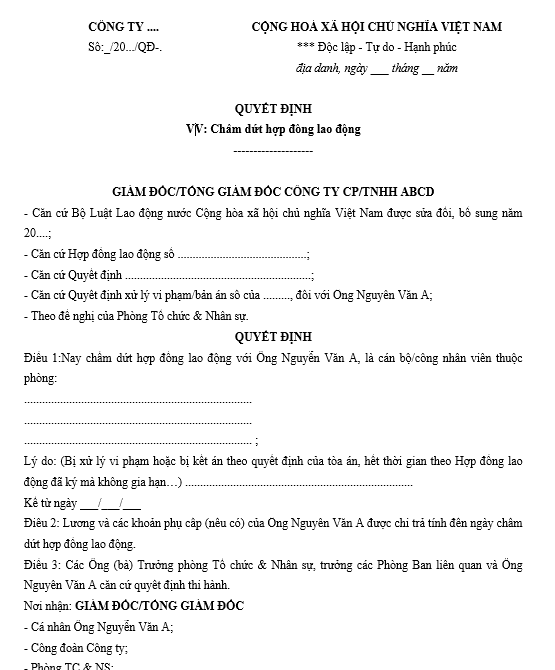
4.1. Necessary Legal Bases in the Decision
When issuing a labor contract termination decision, the business must fully cite all relevant legal bases. This not only demonstrates transparency but also serves as the foundation for ensuring the decision’s validity.
2019 Labor Code
This is the “backbone” that governs all labor activities in Vietnam. All reasons for termination, unilateral rights, notice periods, and related policies are based on the provisions of this Code.
Internal Labor Regulations & Collective Labor Agreement
Internal labor regulations clearly define the responsibilities and obligations of employees. If the termination is related to disciplinary action or a violation of these regulations, the business must cite the specific content from this document.
The collective labor agreement may provide additional benefits beyond the legal requirements → this should also be considered when issuing the decision.
Labor Contract and Contract Appendices
The contract helps determine the type of contract (fixed-term, indefinite-term, etc.), which in turn allows for the correct application of regulations regarding notice periods and termination benefits.
Meeting Minutes, Violation Reports (if disciplinary action is involved)
If an employee is terminated due to dismissal or failure to complete their work, meeting minutes are mandatory evidence to prove that the business followed the correct procedure.
Resignation Letter or Termination Agreement
When an employee voluntarily resigns or both parties mutually agree to terminate, the business must retain this document and cite it in the decision.
4.2. Important Notes When Drafting a Labor Contract Termination Decision
A legally compliant decision must not only contain all the required content from the template but also ensure accuracy, clarity, and transparency.
Information Must Be Absolutely Accurate
The full name, personal information, job title, length of service, and social insurance number must match the employee’s records. Any incorrect information can render the decision invalid or affect the employee’s ability to receive benefits.
The Reason for Termination Must Be Clear, Specific, and Lawful
Businesses should avoid subjective or unsubstantiated reasons. For example, “not a good fit for the company” is not a valid reason. Instead, the correct provision of the Labor Code must be cited.
Determine the Correct Contract Termination Date
The termination date directly affects the employee’s benefits (salary, annual leave, social insurance contributions). Businesses need to determine the correct date to avoid disputes or compensation claims.
Clearly List Remaining Rights and Obligations
The decision needs to specify:
- Payments to be made (salary, annual leave, allowances)
- Responsibility for handing over work and assets
- Responsibility for finalizing and returning the social insurance book
Clear wording helps both parties avoid misunderstandings and fulfill their obligations correctly.
Who has the authority to sign the decision?
- Director/General Director
- Legal Representative
- A person legally authorized via a power of attorney
The business must ensure the signatory has the proper authority; otherwise, the decision may be considered invalid.
Conditions for the decision to be valid
- Must be signed by an authorized person
- Must have the company seal (unless a digital signature is used as regulated)
- The content must be clear, complete, and follow the proper administrative document format
5. The Legal Process for Terminating an Employment Contract & Avoiding Disputes
A standard process helps businesses mitigate legal risks, protect the rights of both parties, and avoid employee lawsuits.

Phase 1: Before Making the Decision
In this phase, the business needs to carefully prepare all documents and evidence and ensure all notification obligations are met.
- Gather documents and evidence
This includes: the contract, violation reports, email exchanges, resignation letters, medical conclusions, etc., to prove the legality of the termination.
- Follow the disciplinary procedure
For dismissal or serious violations, the business must hold a disciplinary meeting according to regulations. Any procedural errors can render the decision void.
- Provide advance notice to the employee
Depending on the contract type, the notice period can be 45, 30, or 03 days. The notification must be in writing, with proof of delivery (email/postal service).
Phase 2: Issuing the Termination Decision
- Draft and sign the decision
The decision must follow the correct template, format, and have a complete legal basis. After signing, the business must affix the company seal and officially issue it.
- Send the decision to the employee
- In person
- Via email
- Via Zalo/Viber
- Via registered mail
It is crucial to have proof of delivery to avoid future disputes.
Phase 3: After Termination
- Make full payment of all amounts owed to the employee
Within 14 days (or a maximum of 30 days in special cases), the business must pay:
- Salary
- Payment for unused annual leave
- Severance pay/job loss allowance
- Any deductions or compensation
- Return the social insurance book and confirm the contribution period
This is a mandatory obligation. Delaying the return of the book can result in fines for the business and cause damages to the employee.
- Conduct the handover of work and assets
The employee must hand over all documents, equipment, and assigned assets (such as laptops, phones, access cards, etc.). The business should require a handover report to confirm the condition of the assets.
6. Employee Rights & Obligations Upon Contract Termination
Understanding their rights and obligations helps employees protect their legal interests while fulfilling their duties to the business.
6.1. Employee entitlements
Salary and allowances
Employees are entitled to their full salary up to the last working day, including allowances and overtime pay.
Payment for unused annual leave
According to regulations, employees must be paid in cash for any unused annual leave days.
Severance pay
- Applies when the employee has worked for 12 months or more
- Half a month’s salary for each year of service
Job Loss Allowance
In cases of business restructuring, economic reasons, etc.
- One month’s salary for each year of service
- A minimum of two months’ salary
Unemployment Benefit & One-time Social Insurance Payout
Employees have the right to apply for unemployment benefits within 3 months from their last day of work or apply for a one-time social insurance payout as regulated.
6.2. Employee’s Obligations
- Hand over documents, data, and company assets
- Settle any outstanding advances or debts
- Complete the handover process within the timeframe required by the company
7. Common Mistakes When Terminating a Labor Contract
Terminating a labor contract is a process prone to legal risks if the company does not follow regulations correctly. Below are the most common mistakes many businesses make, along with their consequences.
7.1. Failure to Comply with the Legal Notice Period
The most common mistake is when the employer or employee fails to provide advance notice within the required period (45 – 30 – 3 days, depending on the contract type).
- This violation can lead to the company’s termination being deemed unlawful unilateral termination.
- For employees, they may have to compensate half a month’s salary or training costs.
7.2. Using Non-Compliant Reasons for Termination
Many businesses use reasons like “unsuitability for the job,” “voluntary termination,” or “internal conflicts,” but these are not legal grounds for termination under the 2019 Labor Code.
- If the reason is not based on statutory provisions → the decision may be declared invalid.
- The company must reinstate the employee, pay their salary, and make social insurance contributions for the period they were not working.
7.3. Failure to Prepare Complete Records and Minutes Before Termination
In cases of dismissal, failure to complete tasks, or disciplinary violations, the company must have:
- Minutes of the disciplinary meeting
- Violation report
- Work performance evaluation documents
- Properly issued meeting notices
Missing any of these steps → the decision will be considered invalid.
7.4. Failure to Pay Full Benefits to the Employee
Companies often forget or incorrectly pay the following amounts:
- Salary for days worked
- Payment for remaining annual leave
- Severance allowance / job loss allowance
- Outstanding allowances
- Compensation (if the company’s unilateral termination is unlawful)
Incomplete payment → The employee has the right to sue, demanding payment and compensation.
By law, the company must return the social insurance book and confirm the contribution period for the employee immediately after contract termination.
- If delayed, the employee cannot receive unemployment benefits → the company must provide compensation.
- The company may be fined according to Decree 12/2022/ND-CP.
7.6. Legal Consequences of Improper Termination
If a company unlawfully unilaterally terminates a contract, the consequences can be severe:
- Being forced to reinstate the employee.
- Paying salary and social insurance contributions for the period the employee was not working.
- Paying compensation of at least 2 months’ salary as per the contract.
- Refunding any amounts the employee has paid (if any).
- May face administrative fines from 20 to 75 million VND, depending on the severity.
Errors in the labor contract termination process not only cause financial damage but also affect the company’s reputation.
8. Questions & Answers (FAQ)
Does the employee need to sign the termination decision?
No.
The law does not require the employee to sign the decision.
However, the company should send it to the employee and have proof of delivery to avoid disputes regarding the employee not knowing about or not receiving the decision.
What should be done if the employee refuses to receive the termination decision?
The company should still issue the decision as usual. Then, take the following steps:
- Send via email
- Send via registered mail
- Record with a delivery-receipt report
As long as there is proof that the company has sent it → the decision is still valid.
Is a termination decision required during the probationary period?
The law does not require a formal decision to terminate a labor contract during the probationary period.
However, it is advisable to have a written notice or decision to:
- Keep in the personnel file
- Avoid disputes regarding the probationary period
- Easily provide explanations during labor inspections
What should the company do if the employee does not hand over their work?
In case the employee intentionally fails to hand over their work:
- The company should create a non-handover report with witnesses.
- Send a written request for the handover to the employee.
- If the employee still does not cooperate → the company has the right to handle the situation according to its internal regulations or report to the authorities if damages occur.
Having sufficient records will help the company protect itself in case of a dispute.
The company needs to:
- Create a report titled “Employee did not come to collect documents and payment”
- Send a reminder notice via email or mail
- Safeguard the social insurance book and salary until the employee comes to collect them
The company is not allowed to hold the social insurance book beyond the deadline without a valid reason and must prove that the employee has been notified.
















