


 10/05/2026
  26824 views
Attracting potential customers is one of the most crucial stages in marketing, determining the long-term survival and growth of a business. However, many businesses struggle to find suitable methods to expand this customer base, leading to low conversion rates and stagnant leads. Understanding this, 1Office will suggest 8 of the most effective strategies for attracting potential customers in the following article.
Mục lục
- 1. Who are potential customers?
- 2. Why do businesses need to attract potential customers?
- 3. Factors affecting the effectiveness of attracting potential customers
- 4. 8 Effective Ways to Attract Potential Customers
- 4.1. Create a Unique Brand Identity
- 4.2. Use Advertising and Marketing
- 4.3. Research Competitors and Their Customer Base
- 4.4. Apply appropriate incentive and promotion programs
- 4.5. Always update and reinvent yourself
- 4.6. Maintain interaction with existing customers
- 4.7. Improve customer service quality
- 4.8. Apply a CRM system to double the effectiveness of attracting potential customers
- 5. Things to note when attracting potential customers
1. Who are potential customers?
Potential customers, also known as Leads, can be understood as a group of individuals who have the ability to pay and have a need for or are interested in the products and services that a business provides, but have not yet made a transaction with your business.
Unlike existing customers, this group of customers are those who have a need for the product but still need time to research information about the service, quality, and reputation of the business in the market before making a final decision.
Typically, businesses can identify and classify potential customers into the 3 groups below:
- People who are interested in the products or services the business offers but are not yet aware of the brand.
- People who are interested in the products or services the business offers but are still considering other competitors in the market.
- People who are currently using products or services from a competitor.
2. Why do businesses need to attract potential customers?
The ultimate goal of all businesses is always to increase profits. To generate profit, a business must sell the products and services it provides to customers. A business cannot survive long-term by relying solely on its existing customer base, as this base is prone to attrition. Therefore, potential customers play a very important role in the long-term survival of a business.
First, potential customers are the group that brings direct profit to the business. This group has a very high conversion rate because they already have a need for the products and services the business provides. Consequently, they are willing to pay and become actual customers.
The potential customer group is the key to helping businesses expand their market share. The larger this customer base, the wider the business’s reach. Additionally, the conversion rate for this group is very high. Once a potential customer successfully converts into an actual customer, the process of persuading them to become a loyal customer becomes much easier. From there, they can become a free marketing channel for the business through word-of-mouth.

It is a criterion for businesses to evaluate their marketing strategies. As mentioned above, a larger base of potential customers indicates that the business has successfully expanded its brand reach to a wide audience. This proves that the business’s marketing strategies have been effective. Conversely, if this customer base is small, it shows that the business has shortcomings in its marketing strategies.
3. Factors affecting the effectiveness of attracting potential customers
Before investing budget into advertising or marketing campaigns, businesses need to understand clearly: why with the same customer attraction strategy, some succeed outstandingly – while others fail.
The reason lies in the internal foundational factors of the business that directly affect the effectiveness of attracting potential customers.
Below are the 4 most important groups of factors that determine whether a strategy will attract the right target audience.
3.1. Quality of content and brand message
Content is the “first gateway” for customers to recognize a brand. If an article, video, advertisement, or email doesn’t address the customer’s actual pain points or needs, it will be difficult to generate conversions, no matter how strong the ad campaign is.
Businesses need to:
-
Build content around “insights” – the issues that customers truly care about.
-
Use clear, authentic language, focusing on value rather than just product features.
-
Maintain a consistent brand message to help customers easily recognize and trust the brand.
For example: A software company shouldn’t just say “Automate processes,” but should emphasize “Save employees 30% of their manual work time every day.”
3.2. Suitability of Customer Acquisition Channels
Each group of potential customers has different behaviors and interaction channels. Choosing the wrong platform or communication channel can make a campaign ineffective, even with excellent content.
For example:
-
Business customers (B2B) are often active on LinkedIn, email, webinars, and seminars.
-
Consumer customers (B2C) are more easily reached through Facebook, TikTok, Zalo, or Google Ads.
Businesses should analyze the customer journey to select the right “touchpoints” and appropriate messages for each stage: awareness – consideration – action.
3.3. Brand Credibility and Experience
An often-overlooked factor that determines the actual conversion rate is the level of customer trust in the brand.
Potential customers may be interested in your product, but they will only leave their information or proactively contact you when they feel secure.
Businesses can increase credibility by:
-
Building a professional image on the website, social media, and communication channels.
-
Providing real feedback, real case studies, and reviews from previous customers.
-
Ensuring a seamless experience: from advertising → landing page → consultation → after-sales service.
A good experience helps build customer trust, and they themselves will become natural “brand ambassadors” for the business.
3.4. Technology Adoption and Data Analysis Capabilities
In the digital age, technology and data are “weapons” that help businesses understand and attract customers more accurately.
Without a tracking and measurement system, it’s difficult for a business to know which customer sources are most effective and which behaviors lead to the highest conversions.
Popular supporting technologies:
-
CRM (Customer Relationship Management): manage, classify, and nurture potential customers.
-
Marketing Automation: send emails, remarket, and provide automated care based on behavior.
-
Data analysis tools (Google Analytics, Meta Pixel, Hotjar…): track visitor behavior and measure the effectiveness of each campaign.
For example: By integrating a CRM, a business can know which channel a customer came from and what stage of the conversion funnel they are in — thereby optimizing advertising costs and doubling acquisition effectiveness.
The effectiveness of attracting potential customers depends not only on the budget or marketing campaign but also on the business’s strategic foundation, technology, and overall experience.
By ensuring these four factors work in sync – good content, the right channels, a credible brand, and supporting technology – a business can easily generate a steady, long-term stream of high-quality potential customers.
4. 8 Effective Ways to Attract Potential Customers
4.1. Create a Unique Brand Identity
In today’s vast and fiercely competitive market, to capture attention and stand out to customers, businesses must identify their unique selling points. A business needs to find and highlight a specific feature of its product, whether it’s quality, design, functionality, etc.
If the business’s product is very common in the market, focus on upgrading service quality, personnel, etc., to build a positive brand image in the minds of customers.
4.2. Use Advertising and Marketing
This is the most straightforward way for a business to attract potential customers. However, to do this well, managers need to clearly understand market needs and tastes, as well as their own business, to develop suitable advertising strategies that yield the greatest benefits.
Some popular forms of advertising and marketing today include promotion through KOLs and celebrities, television advertising, and mass media… Managers should carefully consider and choose the marketing form that best suits the company’s financial situation.
4.3. Research Competitors and Their Customer Base
Learning from and researching competitors is a smart way for a business to grow. Of course, learning does not mean copying. Studying competitor behavior not only helps a business draw lessons for itself but also provides visual data to serve as a basis for future planning. By understanding rival companies, managers can potentially convert their competitors’ potential customers into their own.
4.4. Apply appropriate incentive and promotion programs
In reality, most parties involved in the buying and selling process prioritize maximizing their own benefits. In today’s price-saturated market, businesses need to offer some promotional policies to attract customers. For the same amount of money, if the benefits of choosing your business are higher, it will attract more new customers. At the same time, this approach can also retain existing customers, creating a foundation for building a loyal customer base in the future.
4.5. Always update and reinvent yourself
In a race, the leader always gets the most attention. Similarly, a market-leading business will attract more new customers than one that never reinvents itself. With the continuous development of the current market, for a business to survive long-term, managers must stay updated on market changes to innovate the business promptly.
4.6. Maintain interaction with existing customers
Businesses can maintain interaction with existing customers by periodically sending promotional messages about their new products, sending greetings and appreciation on special occasions like birthdays, or offering exclusive incentives for loyal customers.
As mentioned above, customers themselves are an effective advertising channel for the business. Maintaining interaction with customers not only helps increase the loyal customer rate but also helps the business reach more new customers through word-of-mouth. Even if customers no longer need the product the business is selling, they can still recommend it to friends or relatives who do.
4.7. Improve customer service quality
Customer service is sometimes the key factor that changes a customer’s purchasing decision. Being welcomed and advised by a professional and courteous team will increase customer satisfaction and trust, thereby improving the customer conversion rate. Even if the customer has not yet decided to buy, they will still have a good impression of the business and will prioritize your company in their future choices.
4.8. Apply a CRM system to double the effectiveness of attracting potential customers
Today, CRM software has become a powerful tool helping businesses optimize their sales processes and achieve breakthrough growth. A customer relationship management system will support businesses in effectively approaching and attracting potential customers by:
- Aggregating customer data from multiple marketing sources, analyzing customer information to categorize them into groups: in need, potential, researching, from which to develop appropriate sales promotion strategies.
- Supporting the classification and filtering of customer data to build suitable care scenarios, helping to optimize the customer experience at every touchpoint.
- Automated marketing tools that follow customers throughout their buying journey help accelerate the decision-making process and shorten the time to close a sale.
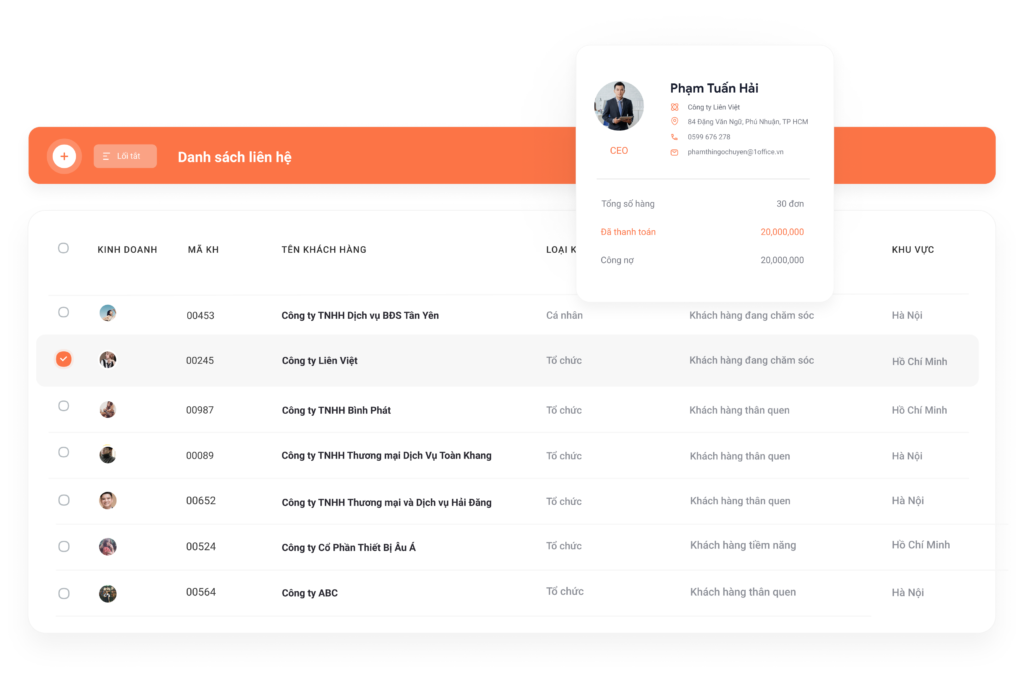
1Office CRM is the most superior sales management system on the market today. With 7 years of experience in digital transformation consulting and implementing business management systems for enterprises, 1Office is a platform that provides quality, professional CRM solutions, verified by more than 5,000 corporate clients.
5. Things to note when attracting potential customers
5.1. Understand your customers
To dominate the market, the crucial factor that businesses must master is understanding their customer base. Only by clearly understanding customers’ “pain points” and knowing how to “soothe” them with your own products and services can a business successfully win over customers.
Therefore, before implementing any marketing campaign, ensure that you have outlined the customer persona:
- Know who they are
- Understand their goals and challenges
- Know what problem your product solves for them
5.2. Be honest in advertising
Businesses need to be careful not to over-exaggerate their products and services, as this can be a double-edged sword that severely damages the company’s reputation and honor.
Conversely, if a business can deliver on what it promises to customers, it will bring a good reputation to the company, increasing its credibility and customer trust.
5.3. Be cautious with media platforms
This is one of the most important advertising channels for a business. It can be considered the face of your company. However, media is easily manipulated, so it can become a weapon that rival companies use to discredit your business. Managers need to be cautious and wise when using these platforms to avoid unnecessary damage.
In the article above, 1Office has shared effective strategies for attracting potential customers. When combined with sales management software, these methods will help optimize business efficiency and double the conversion rate. For a free consultation and a trial of the most professional customer management & care software available today, please contact us using the information below:
For more details, please see:
- Hotline: 083 483 8888
- Fanpage: https://www.facebook.com/1officevn/
- Youtube: https://www.youtube.com/channel/UCeTIRNqxaTwk0_kcTw6SxmA
















