


 13/05/2026
  185 views
In today’s digital world, digital transformation is an inevitable development trend that businesses cannot ignore. When exploring it, we recognize the undeniable role of data systems – digitization. What can people do with data? What role does data play in digital transformation, and in the long run, what do data systems contribute to business promotion? As a Chief Information Officer, holding important strategies to drive the business, what must you do? The answers are all in this article by 1Office. This article has referenced sources from raconteur.net.
Mục lục
I. In Today’s World: Every Employee is a Data Analyst
A large amount of data is being “poured into” business systems every day through internal discussions, business plans, and even simple daily personal activities. It flows continuously every day like the “lifeblood” that nourishes the organization and is also the foundation for the company’s digital transformation journey. It is where data reflecting the needs of the company’s internal staff and customers is collected – what customers want, what their experience with the service is like, etc. Then, to get output data, employees will use their professional skills and specific tools to analyze the data, applying it effectively to their work based on the actual situation. This creates competitive advantages for the business in the era of digital transformation 4.0.

There is a growing and clear division in the work capabilities of employees within businesses between those who can analyze data and those who are not interested. Accordingly, technology trends originating from Silicon Valley have contributed to the idea of building a data-providing system with the goal of helping businesses grow faster. They realized that they should not stop at simple data analysis; in the long run, it needs to become part of the business style and eventually a part of the company culture. With these goals, businesses will not need to require everyone to be a data analysis expert; it will be more effective if all employees can access data through simple processes and intuitive solutions.
With the contribution of a large workforce, an increase in data collection means that understanding the organization’s responsibilities and risks becomes everyone’s shared responsibility. However, how can employees meet these demands – higher skills and greater agility when handling data? For those unfamiliar with data processing, they might easily dismiss this as it’s no different from changing jobs or following a completely different process. However, they should see this as an opportunity to enhance their own skills and those of the people around them.”
1.1 An In-depth Look at Data Systems
There are more and more tools and platforms aimed at helping employees achieve the goal of using data better. Previously, data was primarily in the hands of experts with the skills and knowledge to process and interpret it for the organization. This approach was not ideal because the majority of business staff – the direct users of the data – were not trained on how to work effectively with the increasing volume of data. But the advent of technology has made it easier to share, interpret, and work with data across the entire system, and since then, everything has changed. First, these tools and technologies need to ensure the right data is available to the right people at the right time. This helps ensure that bottlenecks in the operations department are reduced before they become problems. Finally, and most importantly, is to increase the level of access and allow people to interact regularly, gradually becoming more familiar with that data. When this happens, people begin to grasp the true value of data, they are more motivated to maintain its quality, and are more likely to make better decisions.
Data collected and stored by different departments must be centralized, accessible, and importantly, usable. This is the key to the quality of the data system within the organization. Organizations often spend heavily on data collection teams and developing broader skills but neglect to invest in the necessary infrastructure to collect, channel, and manage information. The result is a lot of wasted time ‘cleaning’ data and dealing with inaccurate, incomplete, and inaccessible information.

1.2 The Help of Technology
Today, it is believed that information technology (IT) can do much more to support an organization than simply creating and integrating new tools and platforms. There are countless tools and technologies that can do many things our imagination aims for. The next step, is for the IT team to work with business leaders to understand what they want to achieve and start thinking about how to make the most of the tools and technologies they already have. Additionally, hiring a Chief Digital Officer (CDO) – who will be responsible for the company’s data ownership – can also be a smart move for some businesses. The CDO is one of the best-positioned individuals to make data an integral part of an organization’s daily life and create opportunities to increase data literacy throughout the enterprise.
Ultimately, it seems that a deep understanding of data is something all employees desire. Even if you are just searching the Internet or using social media, you need a basic level of literacy to properly understand what you are doing. Similarly, organizations can help facilitate this by providing training and raising data awareness for employees to help them understand that there is no need to fear data and that, if used correctly, data can make their jobs much easier.
II. Data Systems – The Way to Power Digital Transformation
Digital transformation has significantly changed the way many businesses work over the past year. Countless businesses have shifted from in-office workplaces to remote work—a change that could have taken years to plan and implement before the pandemic. However, it was rushed and rapidly executed in just two years, 2020-2021. Although the transition was not always smooth, businesses found that digital transformation made it easier to adapt to the new world of work. In fact, digital transformation is now considered essential for long-term survival. But to successfully transform and grow, businesses also need to ensure they remain agile throughout the journey. And the foundation of this agility, and also the foundation for digital transformation, is data.
Digital transformation without data is like a car without fuel—it simply won’t work. Therefore, it is believed that problems often arise when data and digital transformation are treated as two separate areas. In reality, these two go hand in hand and should be considered two parts of a business’s entire journey.
2.1 Building Clear Objectives
For many businesses, the transformation journey can only begin properly when they have a clear idea of what they want to achieve. Therefore, for data to truly power a successful digital transformation, the IT team must accurately reflect their business goals. With their capabilities, they can consider what data they will need to reduce and ultimately automate tasks. This will lead to reduced implementation time for new projects or features, ultimately resulting in a faster, more agile business.
Data transformation is a critical part of any digital transformation program. Without a “clean” dataset—data that has been curated—you won’t know where your data gaps are. Once you identify those gaps, fixing them becomes easier and is a fundamental part of keeping the digital transformation project moving forward. Even when businesses have “clean,” real-time data, they still need the right technology, processes, and culture to make sense of it. Therefore, agility in business transformation is more of a mindset than a destination, which data can help shape.
2.2 Making Decisions Quickly
Responsibility for digital transformation progress often falls to project managers, who can benefit from the insights that data provides. With the right data, project managers can also ensure that their team’s processes and activities remain efficient, accurate, and within scope. It’s like a leader’s right hand, as in-depth datasets can be easily broken down for stakeholders, helping them better understand the business impact and return on investment for every project, which can help them plan for future initiatives and make critical strategic decisions.
To be flexible in data sharing and expand data storage capacity, some companies are moving to a data-storage-as-a-service model. By “freeing up space”—using cloud systems—organizations can quickly scale to accommodate changing data volumes and demands. They have seen this approach work effectively when dealing with the pandemic, as data can be shared anytime, anywhere, with greater storage capacity.
III. “Drowning” in Data
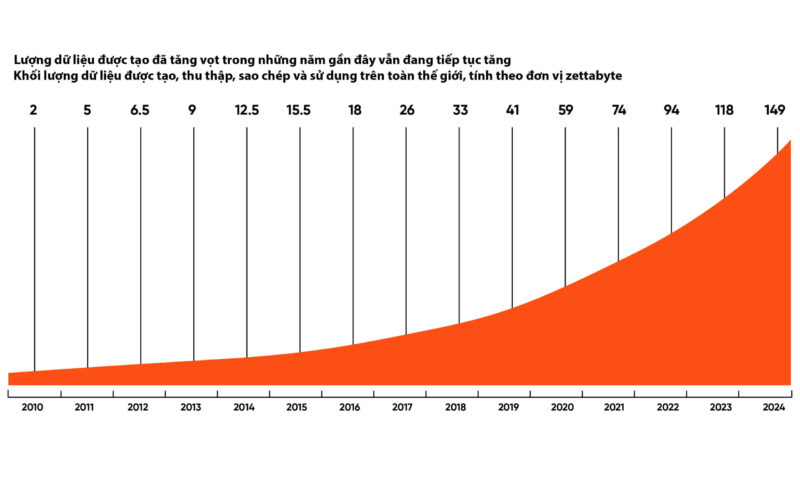
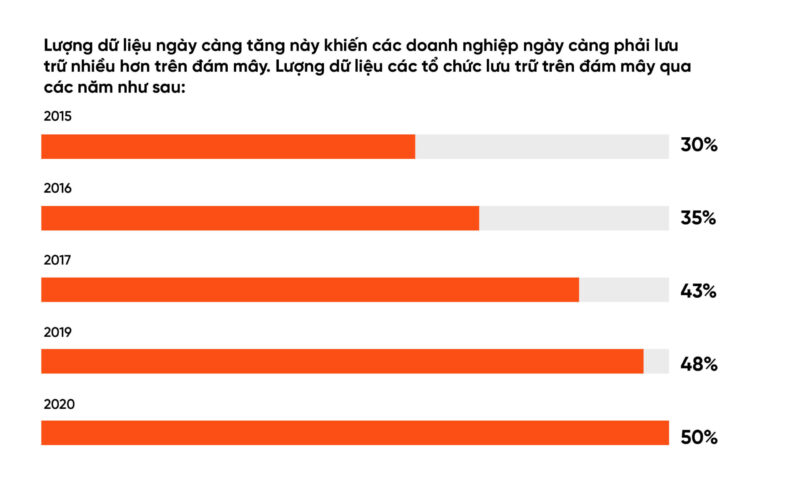
The first part of this series provided an in-depth look at data systems and the prevalence of systematically organized data in today’s life. In the next part, the article will discuss the role of Chief Information Officers (CIOs)—a strategic factor that significantly determines the success of the digital transformation process. Stay tuned.
















