11/05/2026
  491 views
In a constantly changing business environment, accurately assessing employee competency plays a crucial role in resource management and strategic business development planning. For management and leadership teams, this is not just a tool for measuring work performance, but also a critical basis for making decisions about training, promotions, and talent retention. The article below provides a comprehensive overview of employee competency assessment: from its concept, criteria, and implementation methods to tools that help optimize the evaluation process. Additionally, you will be introduced to practical templates and modern technology solutions that help standardize the process effectively and sustainably.
Mục lục
- 1. What is employee competency assessment?
- 2. Why is employee competency assessment necessary?
- 2.1. Clearly understand the strengths and weaknesses of each individual
- 2.2. Provide a basis for creating training and development plans
- 2.3. Increase transparency and fairness in human resource management
- 2.4. Support accurate personnel decisions
- 2.5. Align individual goals with organizational strategy
- 3. Methods for assessing employee competency
- 4. Employee competency evaluation criteria
- 5. Standard Employee Competency Assessment Process
- 6. Employee Competency Assessment Template
- 7. Applying Technology in Employee Competency Assessment
- 8. Common Evaluation Mistakes and How to Fix Them
- 9. Conclusion
1. What is employee competency assessment?
Employee competency assessment is the process of identifying, measuring, and analyzing an individual’s ability to meet job requirements based on three core factors: Knowledge, Skills, and Attitude—commonly known as the ASK model. The goal of this assessment is not just to identify an employee’s current competencies, but also to uncover their potential for growth, thereby enabling informed decisions regarding training, promotions, or job adjustments.
Unlike performance reviews (which are typically based on job results), competency assessments focus on core capabilities and professional behaviors. This is a crucial foundation for building employee development roadmaps, promotion systems, and a systematic human resource management strategy within the enterprise.
Implementing a systematic competency assessment system will help the organization improve operational efficiency, increase management transparency, and foster long-term team development.
2. Why is employee competency assessment necessary?
Employee competency assessment is not just a step in the human resource management process; it is the foundation for building a strong team, optimizing work performance, and enhancing the company’s competitive edge. Conducting systematic and professional assessments brings many practical benefits to both the organization and its employees.
2.1. Clearly understand the strengths and weaknesses of each individual
Through competency assessments, managers can accurately identify each employee’s strengths to leverage and weaknesses to address. This forms the basis for assigning suitable tasks, building effective teams, and avoiding resource wastage.
2.2. Provide a basis for creating training and development plans
Assessment results help identify the gap between current competencies and job requirements, thereby enabling the creation of suitable training plans. Training the right people with the right content helps save costs and increases the return on investment in human resource development.
2.3. Increase transparency and fairness in human resource management
Assessments based on clear criteria help limit subjectivity in employee evaluations. This contributes to building a fair, transparent work environment and motivates employees to strive for development.
2.4. Support accurate personnel decisions
Data from the competency assessment process is a crucial basis for the company to make reasonable and effective decisions regarding recruitment, promotions, transfers, or retention of key personnel.
2.5. Align individual goals with organizational strategy
When employees’ competencies are accurately assessed and their development paths are clearly defined, they will be motivated to stay long-term and contribute to the organization’s overall goals. This is a key factor in building corporate culture and achieving sustainable growth.
3. Methods for assessing employee competency
| Method | Key Advantages | Limitations | Suitable For |
| Competency Framework | Standardized, transparent, long-term orientation | Time-consuming initial setup | The entire organization, especially large enterprises |
| 360-Degree Feedback | Multi-dimensional, improves feedback culture | Can be subjective, requires confidentiality | Managers, team leaders |
| KPI/OKR | Easy to measure, drives performance | Doesn’t reflect core competencies | Sales, operations, marketing |
| Situational/Simulation | Reflects practical abilities | High cost, complex to organize | Potential candidates, succession planning |
| Behavioral Interview | Effective, easy to implement | Depends on interviewer’s skills | Recruitment, in-depth competency assessment |
3.1. Competency Framework Assessment
This is an assessment method based on a set of competency standards designed specifically for each job position within the organization. This framework includes core competencies, functional competencies, and leadership competencies.
Practical Application:
- Often implemented in large corporations and businesses focused on sustainable development and systematic human resource management
- Can be integrated with performance management systems (PMS), learning management systems (LMS), or career path systems
Advantages:
- Standardizes assessments across departments, eliminating subjectivity
- Provides a foundation for building individual development plans and succession planning
Implementation Notes:
- Building a competency framework requires close collaboration between the HR department and subject matter experts
- Requires periodic reviews (every 6–12 months) to stay updated with organizational changes
3.2. 360-Degree Feedback
This method involves collecting feedback from multiple sources: supervisors, peers, subordinates, and self-assessment. The goal is to ensure comprehensiveness and objectivity.
Practical Application:
- Often used for managers, team leaders, or high-potential employees before promotion
- Can be combined with leadership competency assessments or succession training programs
Advantages:
- Provides a multi-dimensional perspective, reducing bias
- Increases self-awareness and improves employees’ soft skills
Implementation Notes:
- Requires a clear process to ensure confidentiality and honesty
- Participants need to be trained on how to provide constructive feedback
3.3. Assessment via KPIs and OKRs
Based on a system of metrics established at the beginning of a period, KPIs (Key Performance Indicators) and OKRs (Objectives and Key Results) help measure work results linked to organizational goals.
Practical Application:
- Common in results-oriented business environments, especially in sales, marketing, and operations
- Used to measure an individual’s execution capabilities and contribution to the organization
Advantages:
- Clear, easy to track, and transparent
- Encourages employees to work towards specific goals
Implementation Notes:
- KPIs do not reflect all foundational competencies such as thinking, leadership, and innovation
- OKRs are suitable for agile, creative, and continuously innovating organizations
3.4. Assessment through Situational and Work Simulation (Assessment Center)
This method uses case studies, simulation projects, or skills tests to observe how employees react, think, and make decisions in an environment that closely resembles reality.
Practical Application:
- Used to assess candidates for management positions or high-potential employees
- Applied in promotion exams and succession planning
Advantages:
- Reflects behavioral competencies, problem-solving skills, and teamwork
- Less affected by subjective factors
Implementation Notes:
- High cost, requires thorough preparation time
- Requires a team of professional, well-trained assessors
3.5. Behavioral Competency Interview

An interview method based on past behavior to infer future competency. It applies the STAR model (Situation – Task – Action – Result) to deeply explore a candidate’s skills and attitude.
Practical Application:
- Used in recruitment, pre-promotion assessments, or competency reviews for key personnel
- Suitable for both professional and managerial roles.
Advantages:
- Leverages practical experience and situation handling
- Easy to implement, does not require a complex system.
Implementation notes:
- Requires training interviewers in behavioral analysis skills
- Not suitable for large-scale assessments or when time is limited
>>> See more: Detailed, professional employee evaluation template for managers
4. Employee competency evaluation criteria
In modern human resource management, competency is not just measured by output results, but must also be assessed through behavior, skills, attitude, and organizational fit. Building a clear and consistent set of competency evaluation criteria is the foundation for implementing objective and effective assessment methods.
The criteria are often divided into 4 main groups:
4.1. Professional Knowledge
The level of understanding and mastery of knowledge directly related to the employee’s job, industry, and professional field.
Example evaluation criteria:
- Level of updating new knowledge, regulations, or industry standards.
- Correct and complete understanding of the company’s processes, operations, and products.
- Ability to apply knowledge to solve practical problems.
Application:
Very important in positions requiring deep expertise such as finance, engineering, R&D, legal, healthcare, etc.
4.2. Execution Skills
The ability to apply knowledge to practical work to produce results. Includes both hard skills and soft skills.
Example evaluation criteria:
- Skills in planning, organizing work, and using professional tools.
- Communication, presentation, and teamwork skills.
Problem-solving, decision-making, and time management skills.
Application:
This is a key group of criteria in modern competency assessment models (e.g., ASK framework, 70-20-10 model).
4.3. Work Attitude & Behavior
Definition:
Reflects the employee’s level of commitment, sense of responsibility, and professional ethics during the work process.
Example evaluation criteria:
- Proactiveness, willingness to learn, and receptiveness to feedback.
- Adherence to company rules and organizational culture.
- Team spirit, supporting colleagues.
- Response to pressure, change, or conflict.
Application:
This criterion is often included in periodic reviews, behavioral KPIs, or 360-degree feedback assessments, and is a crucial foundation for building corporate culture.
4.4. Thinking & Growth Potential
The ability to analyze, innovate, create, and the willingness to develop oneself to meet future requirements.
Example evaluation criteria:
- Systems thinking, critical thinking.
- Ability to learn quickly and absorb new things.
- Self-development, setting personal goals.
- Potential leadership ability (for succession planning groups).
Application:
Especially important when evaluating mid to senior-level personnel, candidates for promotion, or for succession planning.
An effective evaluation system needs to ensure a balance between professional competence, execution skills, work attitude, and growth potential. The criteria should be:
- Personalized for each position.
- Closely linked to strategic goals and organizational culture.
- Have a clear rating scale to ensure quantifiability and transparency.
5. Standard Employee Competency Assessment Process
5.1. Define Assessment Objectives
The business needs to clearly define the objectives of the assessment, as this determines the scope, methods, and evaluation criteria.
Some common objectives include:
- Periodic reviews (quarterly, annually) to summarize work performance
- To inform decisions on promotions, salary increases, and bonuses
- Team restructuring or workforce reduction
- Identifying potential for building a succession team
- Determining training and personal development needs
Each different objective will require a different approach and level of assessment.
5.2. Develop a Competency Framework and Evaluation Criteria
Based on each job title and its requirements, the HR department and management need to build a specific competency framework, including the following competency groups:
- Professional competence: knowledge, professional understanding
- Execution skills: soft skills and technical skills
- Attitude and behavior: responsibility, professional ethics, teamwork spirit
- Thinking ability and development potential: critical thinking, learning, leadership
Each competency needs to be quantified into specific criteria with corresponding behavioral descriptions, helping evaluators make objective judgments and avoid subjectivity.
5.3. Choose Suitable Assessment Methods
Depending on the objectives and job specifics, businesses can choose one or a combination of the following assessment methods:
- 1-on-1 evaluation from a direct supervisor
- 360-degree feedback (including supervisor, peers, subordinates, and self-assessment)
- Behavioral Event Interview (BEI)
- Tests, hypothetical situations, or work simulations
- Using KPI, OKR performance results
Choosing the right method helps increase the reliability and effectiveness of the assessment results.
6. Employee Competency Assessment Template
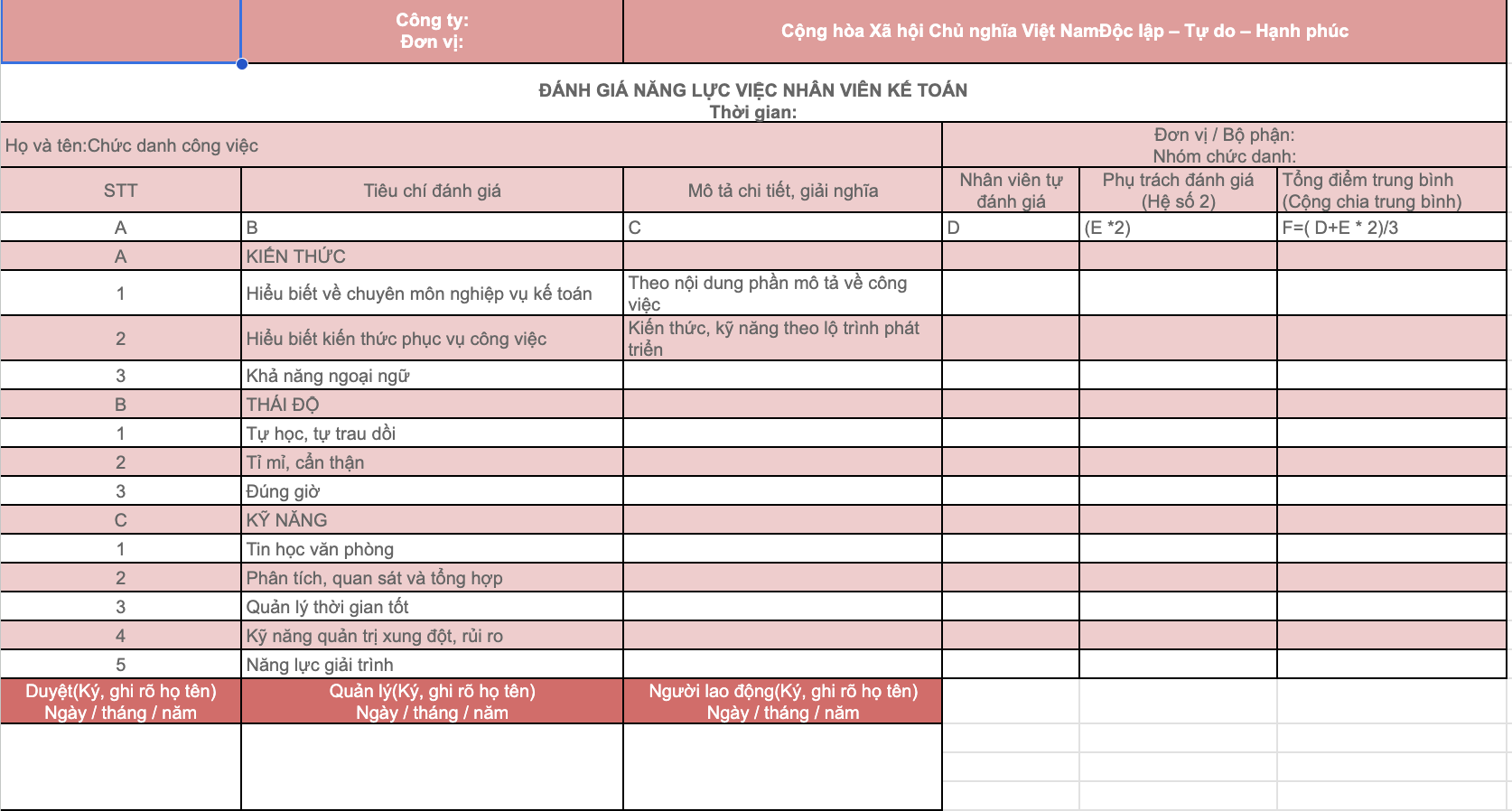
Sales Employee Competency Assessment Template
Accountant Competency Assessment Template
Business Development Employee Competency Assessment Template
Marketing Employee Competency Assessment Template
7. Applying Technology in Employee Competency Assessment
The process of employee competency assessment is increasingly optimized thanks to the powerful support of modern technology solutions. The 1Office HR management software stands out with its in-depth features that help businesses implement an effective, transparent, and scientific assessment process.
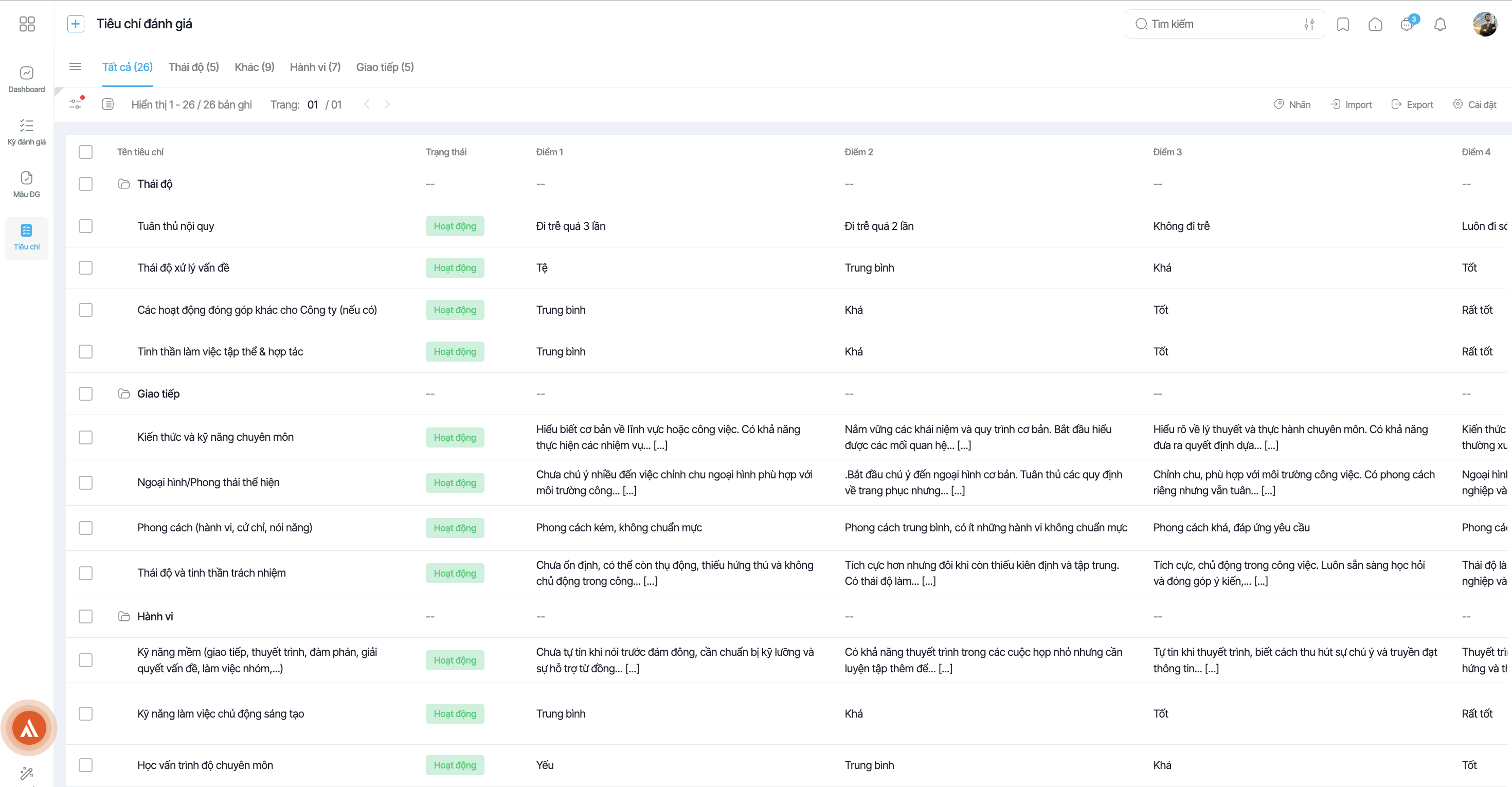
The employee competency assessment features of 1Office include:
- Flexible evaluation criteria setup: Businesses can easily customize evaluation criteria for each job position, department, or specific project. This helps align the assessment closely with actual job responsibilities and strategic goals.
- Multi-dimensional (360-degree) assessment: 1Office supports collecting feedback from various sources such as supervisors, peers, subordinates, and the employees themselves, providing a comprehensive reflection of their competency and work performance.
- Automated KPI evaluation: The integrated KPI evaluation system allows for tracking progress and work results against predefined goals. 1Office automatically aggregates and compares KPI data to provide accurate feedback on each individual’s work performance.
- Detailed reports and analysis: The software provides diverse, visual reports in the form of charts and tables, helping managers quickly identify employees’ strengths and weaknesses to build suitable training and development plans.
- Notably, as an AI & Low-Code platform, 1Office supports intelligent analysis of assessment data, helping to predict performance trends and employee development potential. AI helps automate the processing of complex information, detect factors affecting work efficiency, and propose improvement solutions.
8. Common Evaluation Mistakes and How to Fix Them
8.1. Subjective and Non-Objective Evaluations
Many managers rely on emotions or personal impressions rather than clear evaluation criteria, leading to unfair and inaccurate results.
Solution: Establish a set of specific, transparent, and consistent evaluation criteria for all employees. Increase the collection of multi-dimensional feedback from various sources to ensure objectivity.
8.2. Lack of Feedback or Non-Constructive Feedback
Evaluation results are not clearly communicated, leaving employees unaware of their strengths and areas for improvement needed for development.
Solution: Conduct direct and detailed feedback sessions. Feedback should be constructive, specific, and accompanied by a clear improvement plan.
8.3. Cumbersome and Time-Consuming Evaluation Process
A complex process with many manual steps makes evaluations time-consuming, reducing efficiency and employee satisfaction.
Solution: Simplify the evaluation process by eliminating unnecessary steps. Apply automation technology to reduce manual workload, shorten completion time, and increase accuracy.
9. Conclusion
Employee competency assessment is not just a tool for measuring work performance but also a crucial foundation that helps businesses discover potential, develop personnel, and enhance organizational effectiveness. When implemented correctly, competency assessment becomes a bridge between corporate objectives and individual development paths.
To achieve maximum effectiveness, businesses need to establish clear, transparent evaluation criteria, limit subjectivity, and ensure constructive feedback. The application of technology—especially solutions that integrate AI and flexible processes—will help optimize the entire evaluation process, reduce errors, and save time.
Ultimately, what matters is not a one-time evaluation, but building a culture of continuous, fair, and development-oriented assessment. When assessment becomes a natural part of human resource management, the business will possess a team that is increasingly mature, proactive, and aligned with long-term development goals.