


 09/05/2026
  15175 views
Investing in employee training has become a top priority for organizations to ensure sustainable growth and achieve optimal work performance. Therefore, a training needs assessment survey is essential to help training programs meet the specific desires of individuals. In this article, let’s explore the basic content of a survey form and reference sample files with 1Office. Follow along!
Mục lục
- 1. Why do businesses need to conduct training needs surveys?
- 2. What content is included in a basic training needs survey form?
- 3. Training Needs Survey Questions for Each Department
- 4. Employee Training Needs Survey Form Templates
- 5. Key Considerations When Creating an Employee Needs Survey
- 6. Common Mistakes When Designing a Training Needs Survey Form
- 7. 1Office HRM Employee Training Management Software
- 8. Frequently Asked Questions
1. Why do businesses need to conduct training needs surveys?
Conducting a training needs survey within a business is an essential step to ensure that training programs are designed and implemented effectively and are personalized. Below are some reasons why businesses should conduct a survey before deciding to train employees:
- Accurately identify the needs and desires of participants so that training sessions reflect the knowledge and skills they require.
- Estimate the number of learners so the business can prepare materials, instructor resources, and decide how to organize and classify learning groups appropriately.
- Arrange the most suitable time for everyone, avoiding waste of financial and human resources within the business.

Additionally, employees will be more inclined to participate actively if the training programs align with their schedules and desires. This also helps create a positive environment for sharing knowledge and experience among learners. Businesses need to organize regular employee training sessions because:
- Identify gaps in knowledge, skills, and competencies within the workforce to design appropriate training programs.
- Help the business better understand the development goals of each individual and their alignment with the organization’s overall strategy.
- Retain talented employees by giving them a clear view of advancement opportunities and encouraging them to stay with the company.
- Respond to market changes and new trends, ensuring employees are always at their best to face new challenges.
2. What content is included in a basic training needs survey form?
A training needs survey form can be designed with various structures, but the following components are fundamental for collecting opinions and desires from employees:
| No. | Component | Content |
| 1 | Personal Information | – Full name, Position, Division, Department
– Tenure at the company |
| 2 | Survey Purpose | – Explain the reason and objectives of the survey form.
– This helps participants understand the importance of sharing their information. |
| 3 | Current Knowledge and Skills | – Assess their confidence in a range of job-related skills.
– Identify areas where they feel they are strong and weak. |
| 4 | Needs and Desires | – Identify the skills and knowledge they want to improve or newly develop.
– List the courses or training programs they want to attend. |
| 5 | Training Format | – Choose a suitable training format: in-person classes, online learning, self-study, learning from books, articles, websites, or other methods. |
| 6 | Participation Time | – Determine the time and duration they can participate in training programs. |
| 7 | Other Opinions & Suggestions | – Allow them to share their own opinions, ideas, or suggestions about training programs they think would be useful for their job and personal development. |
Basic content table of a training needs survey form
3. Training Needs Survey Questions for Each Department
Below are some sample employee training needs survey questions for specific departments that HR can refer to:

Survey Questions for the Sales Department:
- What communication and persuasion skills do you feel need improvement to increase sales performance?
- Do you have sufficient knowledge of our products/services to effectively advise customers?
- Do you feel you need to further develop your negotiation and bargaining skills to achieve better deals?
- Would you like to learn how to leverage digital tools to optimize the sales process?
- Do you feel the need to improve your time management skills to handle multiple customers simultaneously?
Survey Questions for the Accounting Department:
- Do you feel the need to improve your ability to work with accounting software and financial tools?
- Do you want to enhance your ability to analyze financial reports to make more accurate financial decisions?
- Are you interested in mastering the latest tax and accounting regulations to ensure legal compliance?
- Do you feel the need to develop personal and corporate financial management skills to ensure financial efficiency?
- Do you want to improve your understanding of management accounting to help the company optimize its financial resources?
Survey Questions for the Human Resources Department:
- Do you feel the need to improve your skills in interviewing and selecting the most suitable candidates for job positions?
- Do you want to learn how to build and maintain a positive work environment to boost morale?
- Do you feel the need to develop skills in performance management and guiding employee development within the company?
- Are you interested in mastering employee management processes such as payroll, timekeeping, etc.?
- Do you want to learn how to promote diversity and equality in the workplace?
Survey Questions for the Marketing Department:
- Do you want to improve your marketing strategy development skills to create more effective advertising plans?
- Do you feel the need to develop your ability to capture market trends and customer needs?
- Do you want to learn how to use digital tools to optimize online campaigns?
- Are you interested in mastering methods for measuring marketing performance to ensure KPIs are met?
- Do you feel the need to improve your interaction and communication skills to work effectively with partners and other teams?
Survey Questions for the Product Development Department:
- Do you want to enhance your ability to create new products or services by applying research and analysis methods?
- Do you feel the need to develop skills for working in a multi-project environment to ensure product timelines and quality?
- Do you want to learn how to foster creativity and innovation in the product development process?
- Are you interested in mastering tools and techniques related to managing research and development projects?
- Do you feel the need to improve your ability to work in a dynamic and changing environment to ensure flexibility in the product development process?
4. Employee Training Needs Survey Form Templates
An employee training needs survey form is a tool that helps businesses gather information about skill gaps, career development aspirations, and suitable training content for each department. Through systematic surveys, managers can not only identify the right training focus but also optimize budgets and enhance the effectiveness of human resource development. Below are popular training needs survey templates that businesses can reference and apply.
4.1 Individual Training Request Form Template
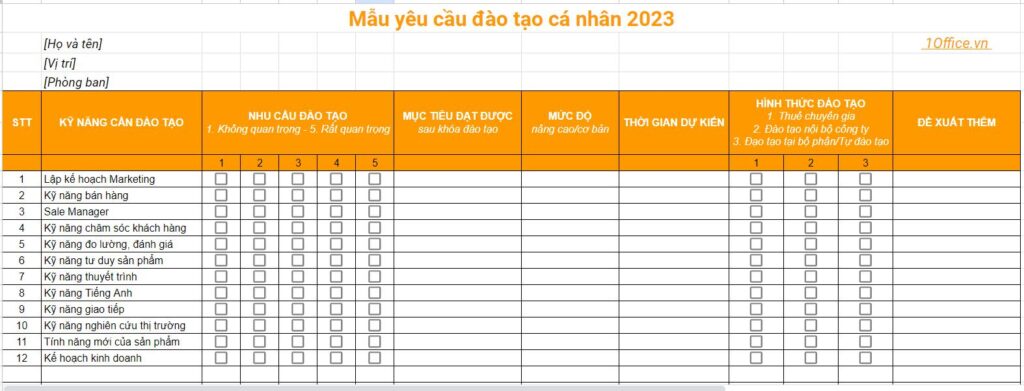
This individual training request form is used by employees to propose their participation in specific training courses. It can be a great tool for documenting individual training needs and creating opportunities for personal development.
Download template: [1OFFICE] Individual Training Request Form Template
4.2 Training Needs Survey Form
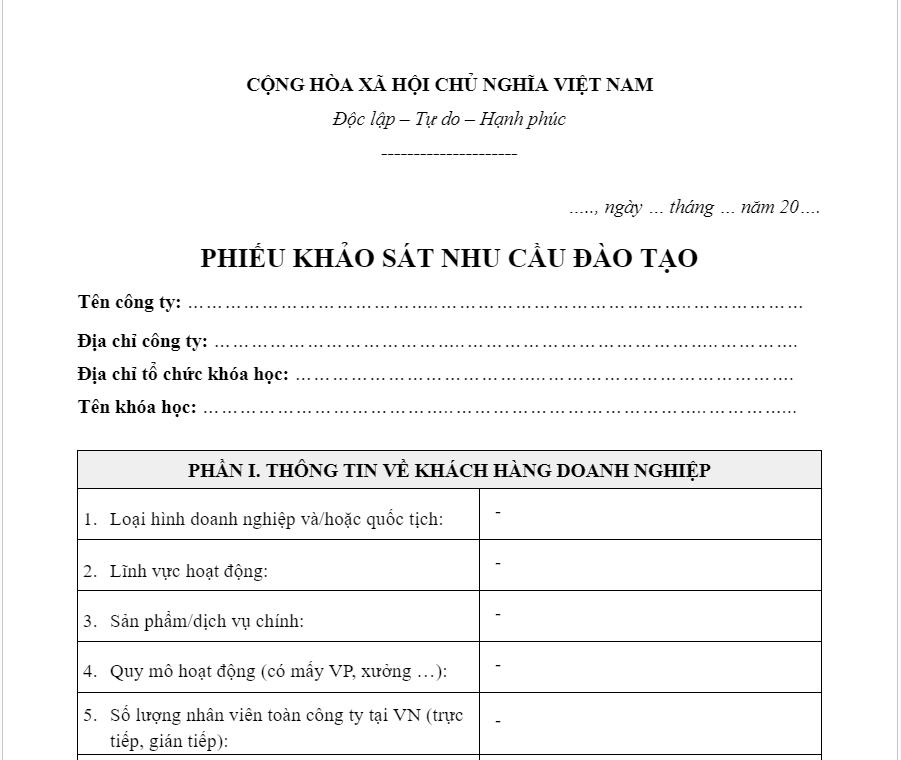
This template is used to collect information from employees about their training needs. The survey helps focus on the common goals of all employees in a department or organization to plan effective training.
Download template: [1OFFICE] Training Needs Survey Form.docx
5. Key Considerations When Creating an Employee Needs Survey
When creating an employee needs survey, there are several important points to consider to ensure you collect valuable and useful information. Here are some key considerations:
- Survey Objective: Clearly define the survey’s objective. What information do you want to gather about employee needs? This could include benefits, perks, career development, or any other factors important to them.
- Ensure Privacy: Protect employee privacy by ensuring their personal data will be kept confidential and not used for other purposes.
- Clear and Specific Questions: Use simple language and specific questions to avoid misunderstanding or confusing participants.
- Use a Rating Scale: Use a specific scale to measure the level of importance of factors, for example: ‘Very Important,’ ‘Important,’ ‘Not Important.’
- Ask About Needs and Opinions: Don’t just ask about employee needs; also ask for their opinions and suggestions on how to improve the current situation.
- Communicate the Results: Announce the survey results and potential improvement measures to employees so they know their opinions have been heard and addressed.
6. Common Mistakes When Designing a Training Needs Survey Form
When creating a training needs survey, many businesses make mistakes that lead to inaccurate results and, consequently, ineffective training program design. Below are the 4 most common errors, along with detailed analysis and solutions.
A common mistake is designing generic questions that do not specify the skill or behavior to be measured. For example: ‘Do you need soft skills training?’ – this is a vague question that doesn’t help HR understand which specific skills employees need training in, or to what extent.
Consequences:
-
The survey data cannot be translated into a specific training program.
-
It can easily lead to broad, unf
-
Add short open-ended questions for employees to describe real-life examples of difficulties they face at work.
Example: “Do you often use PivotTables or advanced functions in Excel? Please rate your proficiency level (1–5).”
6.2 Lack of classification by level and position
Many businesses use a single survey form for all employees, regardless of whether they are new hires, specialists, or managers. This approach results in data that does not accurately reflect the needs of each specific group.
Consequences:
-
Training programs become “one-size-fits-all” – the content is too basic for managers or too advanced for staff.
-
Difficulty in identifying priority groups for training.
How to fix:
-
Design segmented survey forms based on:
-
Level (Employee – Team Leader – Manager).
-
Department or competency group (Sales, Marketing, Technical, HR, etc.).
-
-
Develop a set of common questions + separate modules for each target group.
-
Tag data (metadata) such as department, position, seniority, etc., for easier statistical analysis later.
6.3. Failure to synthesize and analyze data scientifically
Many businesses collect survey data but fail to standardize and analyze it systematically. Manual compilation using separate Excel files makes the results difficult to compare and prevents the identification of priority needs.
Consequences:
-
Training decisions are based on intuition or “majority request” rather than data.
-
Inability to measure the return on investment (ROI) of training.
How to fix:
-
Standardize a common rating scale (e.g., 1–5) to allow for comparison between skills and departments.
-
Use support tools like Google Sheets, Excel PivotTables, or HRM software to compile data and visualize results.
-
Apply a needs analysis matrix (Urgency – Impact Matrix):
-
Axis 1: Urgency level.
-
Axis 2: Impact on performance.
-
Needs in the “High-High” quadrant should be prioritized for training.
-
-
A simple formula can be used: Score = Frequency (%) × Impact (1–5) to rank the skills that need training.
6.4. One-way surveys, lacking evaluation from direct managers
Another serious mistake is relying solely on employee self-assessments without cross-referencing feedback from managers or actual data (KPIs, performance, work errors, etc.). This can lead to employees misjudging their own abilities—either being overconfident or overly modest.
Consequences:
-
The training plan deviates from actual goals.
-
Training content fails to address the root problem, leading to wasted costs and time.
How to fix:
-
Implement two-way surveys:
-
Employees self-assess their needs.
-
Direct managers re-evaluate the necessity and recommend training.
-
-
Incorporate additional performance data such as KPIs, OKRs, customer feedback, and work error frequency for verification.
-
Apply the principle of “triangulation” (data triangulation): only when 2-3 data sources all point to the same need should it be placed on the priority training list.
7. 1Office HRM Employee Training Management Software
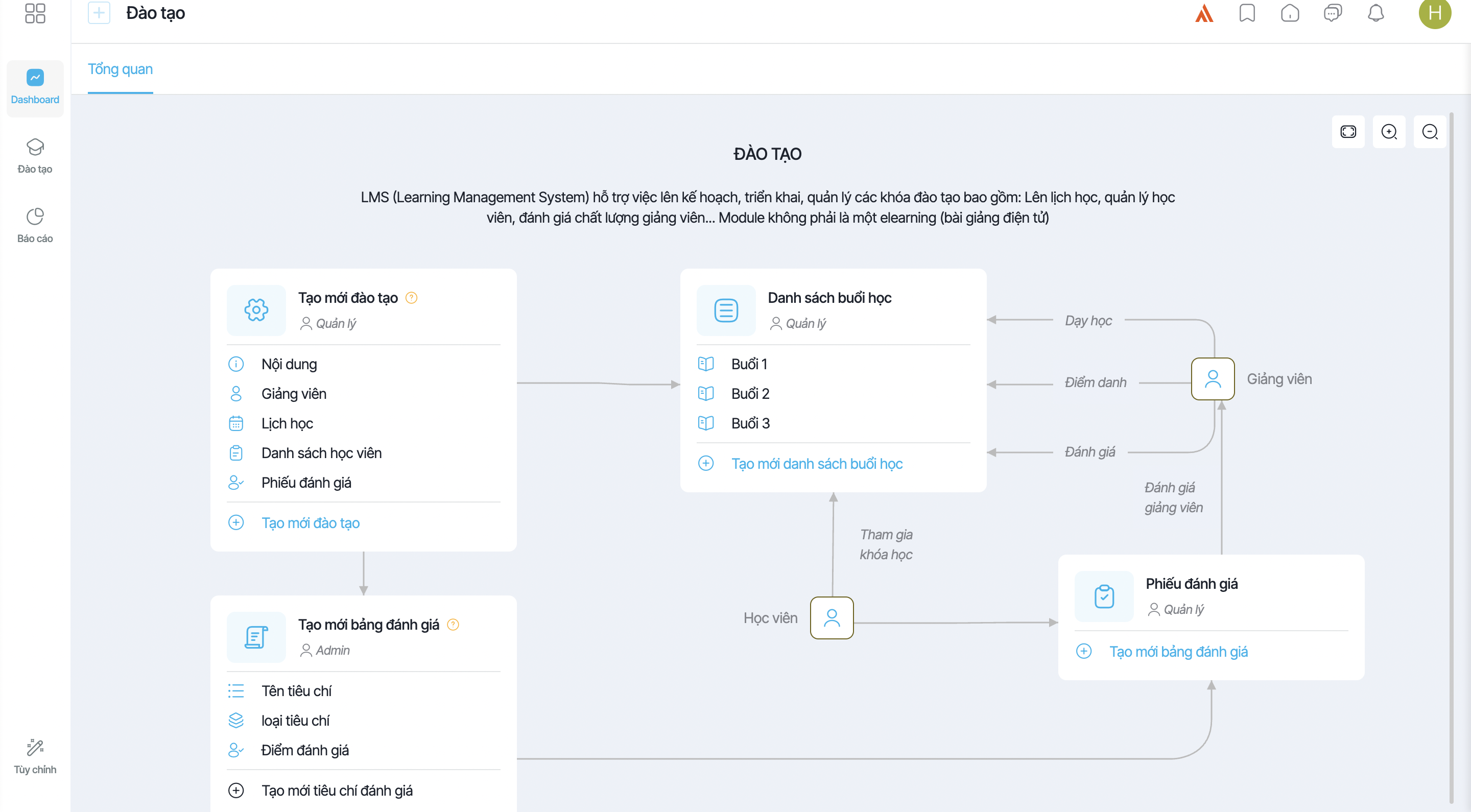
Training is always one of the key activities for building and developing the best human resources within a company. Above are some training needs survey forms we have compiled, hoping to help make the training process in your business smoother, more effective, and more successful.
At 1Office HRM, we not only provide a comprehensive human resource management platform but also support businesses in training, performance appraisal, and automating many activities such as training surveys, creating e-learning courses, organizing classes, competency assessments, and more.
If you are interested in 1Office HRM and would like more details or a consultation, you can leave your information to be contacted and assisted. The powerful 1Office HRM human resource management software helps businesses improve human resource management and create a more effective work environment.
















