


 09/05/2026
  1165 views
Are you nurturing a small startup idea, wanting to open a shop, a restaurant, or an online business but don’t know where to start? The business household registration form is the first and most crucial step to legalizing your operations. With the latest form under Circular 68/2025/TT-BTC (effective from July 1, 2025), the process has been significantly simplified. Let’s explore the standard form and how to fill it out correctly to receive your certificate in just 3 working days!
Mục lục
- 1. What is a Business Household? Who is Allowed to Establish One?
- 2. Conditions for Establishing a Business Household
- 3. Latest Application Form for Business Household Registration
- 3.1. Link Tải Trực Tiếp Mẫu Đơn Đăng Ký Hộ Kinh Doanh (File Word)
- 3.2. Cấu Trúc Chuẩn Của Giấy Đề Nghị Đăng Ký Hộ Kinh Doanh
- 3.3. Hướng Dẫn CỰC KỲ CHI TIẾT Cách Điền Từng Mục Trong Mẫu Đơn
- 3.3.1. Tên Hộ Kinh Doanh
- Ý nghĩa pháp lý của tên hộ kinh doanh
- Cách ghi tên hộ kinh doanh đúng quy định
- Ví dụ về cách đặt tên hộ kinh doanh
- 3.3.2. Địa Chỉ Trụ Sở Hộ Kinh Doanh
- 3.3.3. Ngành, Nghề Kinh Doanh
- 3.3.4. Vốn Kinh Doanh
- 3.3.5. Thông Tin Chủ Hộ Kinh Doanh
- 3.3.6. Household Member Information (If Any)
- 3.3.7. Operation Start Date
- 3.3.8. Commitment and Signature
- 3.4. The Most Important Notes When Filling Out the Form
1. What is a Business Household? Who is Allowed to Establish One?
In the context of 2026, as many individuals opt for small, flexible business models, the business household remains a popular form due to its simple procedures, low costs, and ease of management. However, to register correctly, completely, and avoid legal risks, understanding the legal nature of a business household is mandatory.
1.1. What is a Business Household? (According to Decree 168/2025/NĐ-CP)
According to Decree 168/2025/NĐ-CP (effective from 2025, replacing Decree 01/2021/NĐ-CP), a business household is defined as follows:
A business household is a business form established by an individual or members of a household, who are liable for all business activities with their entire assets and do not have legal entity status.
Some core legal points to note:
- A business household is not an enterprise
- Does not have a legal seal
- Cannot issue VAT invoices (except for using e-invoices on a case-by-case basis)
- Business operations are closely tied to personal liability

1.2. Legal Characteristics of a Business Household
A business household has distinct legal characteristics that directly affect the rights and obligations of the registrant:
No legal entity status
A business household is not considered an independent legal entity. This means:
- No separation between business assets and personal assets
- All arising obligations are the responsibility of the registered individual/household
Unlimited liability with all assets
Unlike a limited liability company (LLC) (which is only liable within the scope of contributed capital), a business household:
- Must use all personal assets (house, car, savings, etc.) to pay off debts if risks arise
- This is the biggest legal risk of the business household model
Small scale, simple management
- Not required to prepare complex financial statements
- Simple accounting and tax regime (usually applies a flat-rate tax)
- Suitable for activities: small-scale retail, restaurants, grocery stores, personal services, etc.
Can only be registered at one location
A business household is only allowed to register a single business location and cannot open branches or representative offices.
1.3. Distinguishing Between an Individual Business Household and an Enterprise (Quick Comparison)
| Criteria | Individual Business Household | Private Enterprise | Limited Liability Company (LLC) |
| Legal Entity Status | No | No | Yes |
| Founding Entity | Individual / Household | Individual | Individual / Organization |
| Asset Liability | Unlimited | Unlimited | Limited |
| Scale | Small | Medium | Medium – Large |
| Accounting – Tax | Simple | More complex | Complex |
| Opening branches | No | Yes | Yes |
| Suitable for | Small-scale retail business | Large-scale individual business | Expansion, fundraising |
1.4. Who is Permitted to Establish a Business Household?
According to current laws, the following individuals are permitted to register a business household:
Permitted individuals
- Vietnamese citizens aged 18 or older
- Having full civil act capacity
- Members of a household, who appoint one representative to register
- Individuals not currently prohibited from conducting business
Prohibited individuals
- Individuals under 18 years of age
- Individuals with limited or lost civil act capacity
- Individuals who are currently:
- Serving a prison sentence
- Prohibited from practicing a profession or conducting business by a court
- Serving a prison sentence
- Cadres, civil servants, and public employees who are not permitted to conduct business according to specialized laws
Important note: Each individual is only allowed to register one business household nationwide.
2. Conditions for Establishing a Business Household
To be granted a Business Household Registration Certificate, individuals or households must fully meet the conditions stipulated by current laws. Failure to meet the correct conditions regarding business lines, name, location, or labor may result in the application being rejected or legal risks arising during operation.
2.1. General Conditions for Establishing a Business Household
A business household can only be registered if it simultaneously meets the following conditions:
2.1.1. Business lines are not prohibited by law
The person registering the business household can only choose business lines that are permitted by law. Business lines on the list of prohibited investments and business activities according to legal regulations are not allowed to be registered in any form.
For conditional business lines, the business household is only allowed to operate after fully meeting the corresponding conditions as stipulated by specialized regulations.

2.1.2. Have a valid business household name
The name of the business household must comply with legal regulations on naming, not be identical to others, not cause confusion, and not violate prohibitions on name usage.
2.1.3. Have a legal business location
The business household must have a specific, clear business location that is permitted for business purposes according to laws on land, housing, and construction.
2.1.4. Have declared business capital
The law does not specify a minimum capital amount for establishing a business household. However, the registrant must declare the business capital and is responsible for the accuracy of this information.
2.2. Regulations on Business Household Names
The business household name is one of the most common reasons for application rejection if not declared correctly.
2.2.1. Structure of a business household name
The name of a business household must include both of the following components:
- The phrase “Business Household”
- The proper name of the business household
Example:
Business Household Minh An
Business Household Phuc Loc Food Services
2.2.2. Naming principles
The name of a business household must not:
- Be identical to the name of a business household already registered within the same district
- Cause confusion with an enterprise, company, or corporation
- Use words that violate social ethics or fine customs and traditions
- Use the names of state agencies or socio-political organizations without permission
Note: The name of a business household can be the same as that of a business household in another locality, but it cannot be identical within the same district.
2.3. Regulations on Business Location
2.3.1. Requirements for the legality of the location
The business location must have a clear, specific address, and the registrant must have the legal right to use it through ownership, lease, or loan.
2.3.2. Requirements for the purpose of use
The location registered for the business household must be permitted for business purposes according to legal regulations. Using the location for the wrong purpose may lead to the revocation of the registration certificate.
2.3.3. Note on registering at an apartment building
It is not permitted to register a business household at an apartment in a building designated for residential purposes.
Registration is only allowed if the apartment or area is part of a commercial-service block and is permitted for business according to the project’s legal documents.
2.4. Business Capital and Number of Employees
2.4.1. Business capital
- There are no regulations on minimum or maximum capital
- Capital is self-declared by the registrant
- Serves as a reference for tax authorities to determine the presumptive tax rate
The declared capital should be appropriate for the actual scale of the business to avoid difficulties when dealing with banks, partners, or explaining tax matters.
2.4.2. Number of employees (new update)
According to new regulations, business households are no longer limited in the number of employees. However, business households must still:
- Sign labor contracts as required
- Fulfill social insurance obligations if subject to mandatory participation
- Comply with current labor laws
In cases of employing many workers and having large revenue, business households may be encouraged to convert to an enterprise model.
2.5. Business Lines of a Business Household
2.5.1. Unconditional business lines
Business households are allowed to register for common business lines such as:
- Retail, small-scale trade
- Food and beverage services
- Personal services
- Online sales, e-commerce
These business lines only need to be declared in the registration application and do not require sub-licenses.
2.5.2. Conditional business lines
Some business lines require meeting additional conditions before operation, for example:
- Food business
- Beauty services, spas
- Alcohol, tobacco business
A business household is only allowed to operate once it has fully met the conditions according to specialized regulations, even after being granted a registration certificate.
2.5.3. Economic sector code
Business households are not required to declare detailed sector codes like enterprises. However, the declared business lines must be clear, true to the nature of the activity, and consistent with the Vietnam Standard Industrial Classification system.
3. Latest Application Form for Business Household Registration
(Appendix II – Circular 68/2025/TT-BTC)
The application for business household registration is the core and mandatory legal document in the registration file. It serves as the basis for the district-level business registration authority to:
- Record the legal information of the business household
- Identify the entity legally responsible
- Serve as a basis for tax authorities to manage future tax obligations
Chỉ cần một thông tin kê khai sai hoặc thiếu, hồ sơ có thể:
- Bị trả lại ngay từ đầu
- Hoặc bị yêu cầu điều chỉnh, bổ sung
- Hoặc nghiêm trọng hơn: bị xử phạt, thu hồi Giấy chứng nhận sau khi đã hoạt động
3.1. Link Tải Trực Tiếp Mẫu Đơn Đăng Ký Hộ Kinh Doanh (File Word)
Mình đã soạn 01 file Word hoàn chỉnh, có thể xem như một bản mẫu thực tế đã điền gần đầy đủ, văn phong chuẩn hành chính, bố cục đúng Phụ lục II.
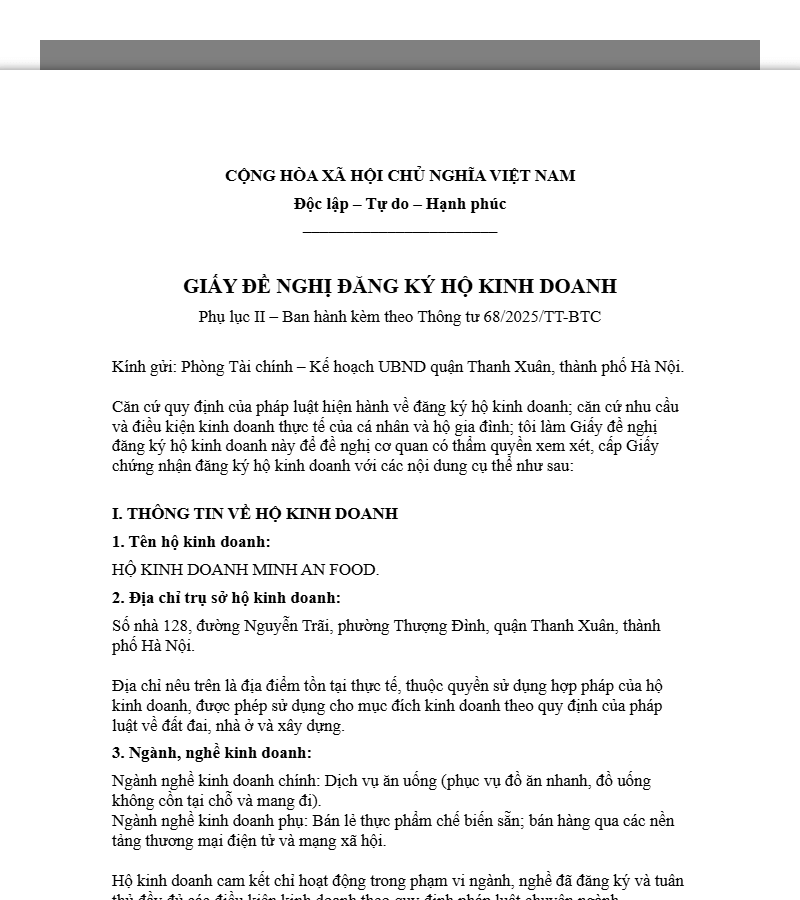
👉 Tải file Word – Mẫu đơn đăng ký hộ kinh doanh (Bản chi tiết nhất)
3.2. Cấu Trúc Chuẩn Của Giấy Đề Nghị Đăng Ký Hộ Kinh Doanh
Theo Phụ lục II – Thông tư 68/2025/TT-BTC, mẫu đơn gồm 05 nhóm nội dung chính:
- Thông tin về hộ kinh doanh
- Thông tin chủ hộ kinh doanh
- Thông tin thành viên hộ gia đình (nếu có)
- Thời điểm bắt đầu hoạt động
- Cam kết và chữ ký
Mỗi nội dung đều có ý nghĩa pháp lý riêng, không thể kê khai tùy tiện.
3.3. Hướng Dẫn CỰC KỲ CHI TIẾT Cách Điền Từng Mục Trong Mẫu Đơn
3.3.1. Tên Hộ Kinh Doanh
Ý nghĩa pháp lý của tên hộ kinh doanh
Tên hộ kinh doanh không chỉ là yếu tố nhận diện trong hoạt động kinh doanh hằng ngày mà còn mang ý nghĩa pháp lý quan trọng. Đây là căn cứ để cơ quan Nhà nước phân biệt các chủ thể kinh doanh với nhau, đồng thời là thông tin được ghi nhận xuyên suốt trên Giấy chứng nhận đăng ký hộ kinh doanh, hóa đơn, hồ sơ thuế và các giao dịch hành chính liên quan. Thông qua tên hộ kinh doanh, cơ quan quản lý xác định rõ phạm vi quản lý, trách nhiệm pháp lý và nghĩa vụ thuế của từng hộ kinh doanh cụ thể.
Cách ghi tên hộ kinh doanh đúng quy định
Khi kê khai tên hộ kinh doanh trong hồ sơ đăng ký, người đăng ký cần tuân thủ chặt chẽ quy định về hình thức và cấu trúc tên gọi. Tên hộ kinh doanh bắt buộc phải ghi đầy đủ cụm từ “Hộ kinh doanh” kèm theo tên riêng, không được rút gọn hoặc biến tấu gây nhầm lẫn với các loại hình kinh doanh khác.
- Bắt buộc ghi đủ: “Hộ kinh doanh” + Tên riêng
- Không viết tắt “HKD”
- Không sử dụng ký hiệu đặc biệt, từ ngữ nước ngoài khó hiểu hoặc gây nhầm lẫn
Ví dụ về cách đặt tên hộ kinh doanh
Một số ví dụ đúng, đáp ứng đầy đủ yêu cầu pháp lý:
- Hộ kinh doanh Minh An
- Hộ kinh doanh Dịch vụ ăn uống Phúc Lộc
Ngược lại, các cách đặt tên sau đây thường bị đánh giá là không hợp lệ hoặc dễ bị trả hồ sơ:
- Minh An Store
- Cửa hàng Minh An
- Công ty Minh An
3.3.2. Địa Chỉ Trụ Sở Hộ Kinh Doanh
Ý nghĩa pháp lý của địa chỉ hộ kinh doanh rất quan trọng vì đây là nơi cơ quan thuế trực tiếp quản lý, theo dõi và thực hiện kiểm tra thực tế khi cần thiết. Địa chỉ đăng ký cũng gắn liền với nghĩa vụ thuế khoán của hộ kinh doanh, làm căn cứ xác định phạm vi hoạt động, mức thuế và trách nhiệm pháp lý phát sinh trong quá trình kinh doanh. Do đó, việc khai báo địa chỉ phải chính xác, rõ ràng và có thể xác minh trên thực tế.
Cách ghi địa chỉ đúng quy định cần tuân thủ một số nguyên tắc sau:
- Ghi đầy đủ 5 cấp hành chính (số nhà → đường/ngõ → phường/xã → quận/huyện → tỉnh/thành phố).
- Không ghi chung chung, mơ hồ như “gần chợ”, “đối diện trường học” vì không có giá trị pháp lý.
Ví dụ địa chỉ hợp lệ:
Số 25, ngõ 120 Trần Cung, phường Cổ Nhuế 1, quận Bắc Từ Liêm, TP Hà Nội.
Một số lưu ý rất quan trọng cần tránh sai sót:
- Không đăng ký địa chỉ hộ kinh doanh tại căn hộ chung cư chỉ để ở (không có chức năng kinh doanh).
- Trường hợp kinh doanh tại nhà thuê, nên chuẩn bị hợp đồng thuê nhà để phục vụ việc giải trình khi cơ quan chức năng kiểm tra.
3.3.3. Ngành, Nghề Kinh Doanh
Nguyên tắc ghi ngành, nghề kinh doanh cần bám sát đúng bản chất hoạt động thực tế của hộ kinh doanh, phản ánh đúng những gì đang và sẽ triển khai. Khi đăng ký, hộ kinh doanh không bắt buộc phải ghi mã ngành, mà có thể mô tả trực tiếp bằng ngôn ngữ dễ hiểu, rõ ràng. Trường hợp hoạt động nhiều lĩnh vực, pháp luật cũng cho phép ghi đồng thời nhiều ngành, nghề trong cùng một giấy đăng ký, miễn là phù hợp với thực tế kinh doanh.
Ví dụ cách ghi ngành, nghề chi tiết và đúng chuẩn:
- Bán lẻ thực phẩm khô và đồ gia dụng.
- Dịch vụ ăn uống (không bao gồm kinh doanh rượu mạnh).
- Bán hàng online qua mạng xã hội.
Một số lưu ý quan trọng cần đặc biệt chú ý:
- Với ngành, nghề kinh doanh có điều kiện, hộ kinh doanh phải đáp ứng đầy đủ các điều kiện pháp lý trước khi chính thức hoạt động.
- Việc ghi sai hoặc ghi không đúng ngành, nghề thực tế có thể là căn cứ để cơ quan chức năng xử phạt khi kiểm tra.
3.3.4. Vốn Kinh Doanh
Vốn kinh doanh của hộ kinh doanh về bản chất pháp lý không phải là vốn điều lệ như trong doanh nghiệp, mà chỉ là số tiền dự kiến sử dụng cho các hoạt động kinh doanh ban đầu và trong quá trình vận hành. Thông tin này giúp cơ quan quản lý có thêm căn cứ đánh giá quy mô hoạt động, đặc biệt trong việc tham chiếu mức thuế khoán phù hợp với thực tế.
Cách ghi vốn kinh doanh đúng quy định:
- Ghi đầy đủ bằng số và bằng chữ để tránh nhầm lẫn, sai sót.
- Ví dụ: .
Khuyến nghị thực tế khi kê khai vốn:
- Không nên kê khai quá thấp nếu quy mô kinh doanh thực tế lớn, vì dễ gây vướng mắc khi cơ quan thuế kiểm tra.
- Mức vốn đăng ký thường được sử dụng làm căn cứ tham chiếu để xác định thuế khoán, nên cần kê khai hợp lý, sát với hoạt động thực tế.
3.3.5. Thông Tin Chủ Hộ Kinh Doanh
Thông tin chủ hộ kinh doanh là nội dung bắt buộc phải kê khai đầy đủ và chính xác tuyệt đối trong hồ sơ đăng ký, vì đây là căn cứ pháp lý để xác định trách nhiệm của cá nhân đứng tên hộ kinh doanh. Chỉ cần sai sót nhỏ cũng có thể khiến hồ sơ bị trả lại và phải thực hiện lại từ đầu.
Các thông tin bắt buộc phải kê khai gồm:
- Họ và tên chủ hộ (ghi IN HOA, đúng như trên giấy tờ tùy thân).
- CCCD/CMND hoặc Hộ chiếu còn hiệu lực.
- Ngày cấp, nơi cấp của giấy tờ tùy thân.
- Địa chỉ thường trú theo đúng thông tin trên CCCD/CMND.
Common mistakes to avoid:
- Entering just one incorrect digit of the CCCD/ID card number can invalidate the application.
- Entering a permanent address different from the information on the CCCD/ID card will lead to the application being immediately rejected upon submission.
3.3.6. Household Member Information (If Any)
Household member information only needs to be declared if the business household has two or more people participating in business activities, especially when there is an internal division of roles and responsibilities among members. Recording complete information helps to clearly define the scope of each person’s responsibility when legal obligations arise or when working with state agencies.
Cases where declaring member information is mandatory:
- Multiple members of the same household are directly involved in the business.
- There is an assignment of responsibilities and roles among members (management, sales, finance, etc.).
How to enter household member information:
- Full name.
- Relationship to the business household owner.
- Valid CCCD/ID card number.
3.3.7. Operation Start Date
The operation start date is a legally significant milestone, as it is the basis for tax authorities to calculate taxes and determine when the business household’s legal obligations arise. Incorrect or inappropriate entries can lead to risks of tax arrears or administrative penalties.
Some recommendations for entering the operation start date:
- It should be set 1–3 days after the application submission date to ensure timely processing.
- Do not enter a past date, even if you have conducted trial operations, to avoid unnecessary tax obligations.
3.3.8. Commitment and Signature
The commitment and signature section represents the final legal responsibility of the business household owner for all the content declared in the application. Through this commitment, the owner confirms they are legally responsible for the truthfulness and accuracy of the registered information.
Some points to note when making the commitment and signing the application:
- The commitment content does not need to be notarized or authenticated.
- Sign directly by hand; do not use a scanned signature or a seal.
- Write your full name clearly below the signature to ensure its legal validity.
3.4. The Most Important Notes When Filling Out the Form
When filling out the business household registration form, applicants must be extremely careful, as even a minor error can cause the application to be rejected or require multiple revisions. Adhering to the correct format and thoroughly checking information from the start will help the submission and processing go more quickly and smoothly.
The most important notes to remember:
- Do not erase or make corrections on the form.
- Do not use red ink when filling out the form.
- Do not use abbreviations; write everything out fully and clearly.
- Double-check your full name, CCCD/ID number, and address to ensure they match your documents.
You should make a photocopy of the application for your records before submitting it.
















