


 13/05/2026
  274 views
In today’s business environment, the Pareto principle (the 80/20 rule) is gradually becoming a golden rule that helps managers make decisions at work. So, what is the Pareto principle? Why does it have such a significant impact? Let’s find out in this article by 1Office.

Mục lục
1. What is the Pareto principle?
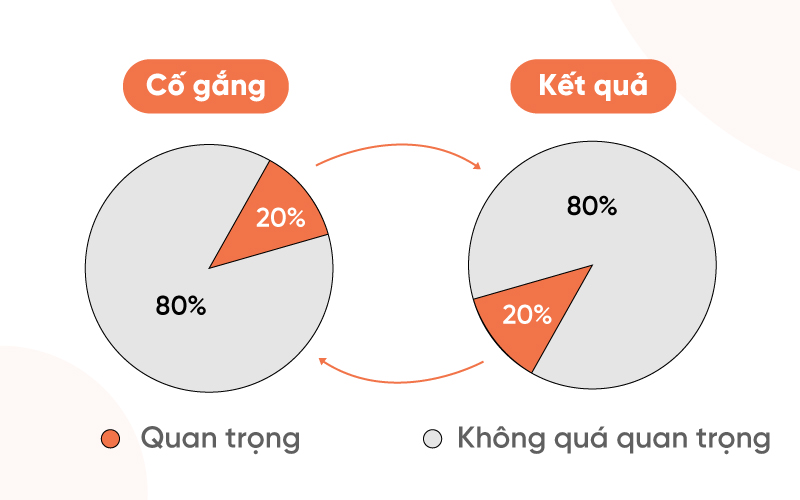
The Pareto principle (also known as the 80/20 rule) is named after the Italian economist Vilfredo Pareto. It was formulated by the economist through long-term observation and testing in his own country. The Pareto principle has been and is considered an unwritten rule (not a mandatory law) which means that the vast majority of things in life are not distributed evenly: Approximately 80% of results come from 20% of the causes.
Even in daily life, the Pareto principle is applied, for example, 80% of traffic accidents are caused by 20% of the drivers on the road, and out of 80% of clothes owned, only 20% are worn regularly.
In economics, this principle includes all the following observations:
- 20% of workers produce 80% of the results
- 20% of customers contribute to 80% of the revenue
- 20% of errors cause 80% of the incidents
- 20% of features generate 80% of the usage demand
2. The Pareto principle in business operations
Over time, the Pareto principle has become a golden rule in economics. This rule helps organizations and businesses build the motivation to focus their efforts on the 20% of critical factors that make a difference, instead of spreading them across the 80% that yield few results. By concentrating maximum resources on the necessary 20%, you will achieve more valuable accomplishments than if you tried to spread them across the remaining 80%. The Pareto principle is present in almost all business activities:
– In Marketing: The Pareto principle in marketing is understood as: “Spend 20% of your time creating content, and 80% promoting it.” Instead of spending all your time creating content 6 days a week, the best approach is to spend only 1 day creating content and the remaining 5 days finding ways to promote it. This is because in marketing, customer outreach is the main factor leading to revenue, not just the content itself. The 80/20 rule means reducing the amount of time you spend creating content, investing more in producing higher-quality content, and investing time and effort in promoting that content.
– In cash flow management: As mentioned above, according to the Pareto principle, 20% of customers contribute to 80% of the revenue, so businesses can consider offering incentives to VIP and VVIP customer groups to satisfy them. This customer group has high purchasing power, a customer journey with fewer steps but still ensuring quality, and their order value is also higher than average. This principle is also applied in a company’s pricing strategy when determining appropriate prices to target the customer market. On the other hand, the management of accounts receivable and accounts payable also needs to apply the 80/20 rule. An item that accounts for a small value can suddenly spike and bankrupt the cash flow plan if not anticipated. From being in the less important 20%, that item can shift its position to become part of the critical 80%.
– The 80/20 rule in time management: The 80/20 formula is understood as follows: You need to tackle the 20% most important tasks first without letting yourself be distracted by the 80% of tasks that can be postponed. It means focusing your time on the 20% most important tasks and completing them rather than the remaining 80% of the work. Because it is certain that no matter how much time you try to save, it is very difficult to complete 100% of the workload and achieve the desired results for all of them.
– In strategic management: In product delivery, 20% of a company’s products or services should be considered core and should receive 80% of the labor/or time investment. Focus on developing the company’s main products – this will be more beneficial than spreading efforts too thinly. This Pareto principle should also be applied to businesses with multiple business locations, if a few locations show superior business benefits. The company needs to focus on these locations (decor, management, operations, promotional programs, etc.) to achieve high profits. Sometimes, these 20% of locations can even generate more revenue than the remaining 80%.
3. Impact of the Pareto principle on businesses
By understanding the 80/20 rule, leaders and CEOs realize that at some point, they have wasted a lot of time and effort on unproductive tasks or those that didn’t yield the desired results. In an era of numerous choices and facing many challenges, this golden rule helps CEOs decide on the smartest way to work.
This rule helps businesses effectively allocate resources (time/manpower/materials) to the more important 20% to achieve the best results, instead of the 80% that doesn’t bring much benefit. For example:
- For the 20% of employees who contribute 80% of the results: Focus on rewarding and valuing these employees.
- For the 20% of errors that cause 80% of the problems: Focus on fixing these errors first to limit further issues.
- For the 20% of customers who contribute 80% of the revenue: Focus on satisfying these customers.

Finally, remember one thing: “The Pareto principle is an observation, not a law of nature.” Therefore, each business will have a different implementation approach suitable for its own model. Depending on the leader’s direction, they can choose whether or not to apply this 80/20 rule. However, the Pareto principle has become a golden rule that should be widely applied to achieve the best business results.
For more details, please visit:
Fanpage: https://www.facebook.com/1officevn/
Youtube: https://www.youtube.com/channel/UCeTIRNqxaTwk0_kcTw6SxmA
















