


 12/05/2026
  307 views
A business is formed by its leadership and departmental organization. Each department holds a specific role and contributes to maintaining the stable operation of an organization. Building a sales department structure plays a key role in increasing revenue and growth for every business. So, how can a business build a suitable and highly effective sales department organizational structure? Let’s find the answer with 1Office in the article below!
Mục lục
I. Functions of a Sales Department in a Business
The sales department includes sales staff, managers, the product development team, and support. It is the department responsible for carrying out all activities related to selling products/services, consulting with customers, and building and maintaining customer relationships.
Specifically, the sales department has the following functions:
- Researching the company’s products/services to identify strengths and weaknesses, thereby supporting improvements to make the products/services better
- Researching market expansion and potential customer segments to increase sales opportunities for the business
- The sales management and team of sales specialists are responsible for researching and developing business strategies, consulting with leadership, and implementing them.
- Monitoring and evaluating the progress and effectiveness of the implementation of the established business strategy, ensuring it stays on schedule and delivers results.
- Handling customer transactions, signing contracts, and implementing post-sales customer care strategies.
- Managing and storing customer information and records for various customer segments, such as potential customers, long-term loyal customers, and current customers.
In addition to the main tasks above, the sales team also coordinates with other departments, such as the product development team and the marketing department, to discuss and execute marketing campaigns to increase sales revenue and enhance brand awareness. To accomplish all these tasks, the leadership needs to build a clear, transparent sales department structure that is suitable for the company’s conditions.
II. Why is it necessary to build a sales department organizational structure?
For a business to grow quickly and sustainably, its personnel structure in general, and the sales department in particular, needs to be designed logically. Building a specific sales department structure involves the CEO dividing the sales team into groups with distinct tasks, all aimed at the common goal of improving sales efficiency.
Building a scientific and logical sales department is the foundation for a company’s sales activities. A solid operational foundation will lead to high work efficiency, sustain performance results, and bring long-term value to the company.
Specifically:
- The sales department organizational structure clearly displays the departmental structure and the hierarchy of job titles for the CEO to easily monitor.
- Helps leadership easily contact the manager or the person in charge when needed.
- Helps manage the number of employees in each department and allocate staff most effectively based on their abilities.
In summary, building a logical sales department allows managers to fully leverage the skills and capabilities of each sales specialist, ensuring that sales operations are run systematically and scientifically, targeting the right customers, and thereby increasing revenue for the entire business.
III. Discover the 3 most popular sales department organizational structure models
1. The Assembly Line Model for Sales Department Structure
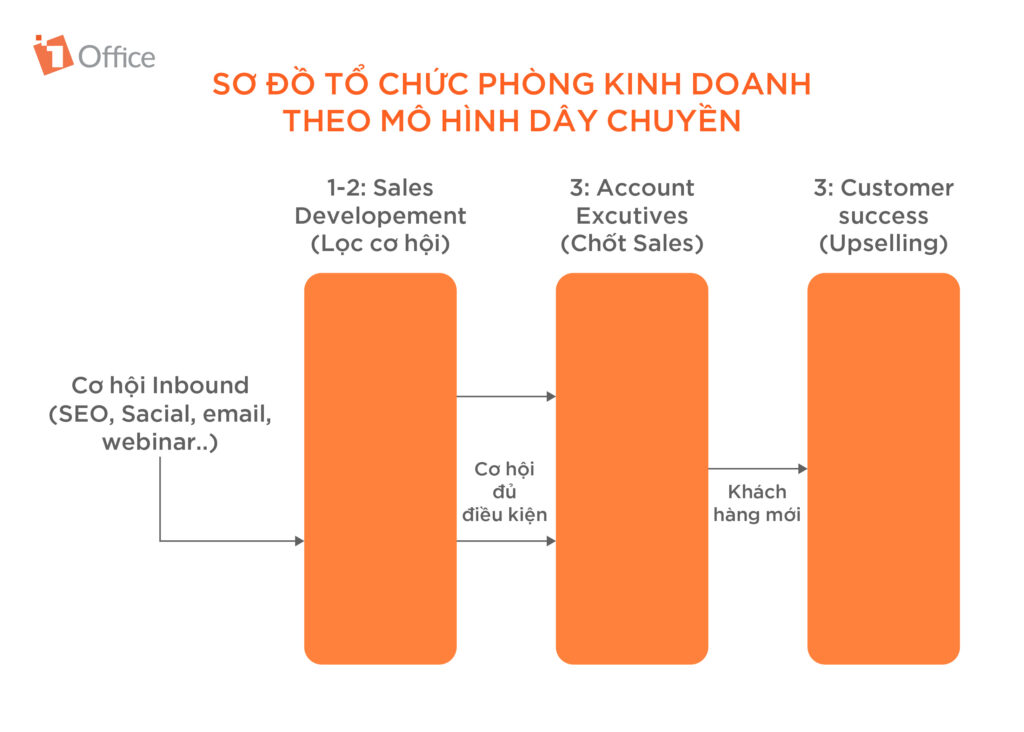
The Assembly Line, also known as the assembly line model for a sales department, is the most common departmental structure that businesses often apply. When applying this organizational model, each member holds a specific position and function in the sales process.
The organizational structure of a sales department based on the assembly line model includes the following position groups:
| Leaders | Responsible for finding potential customers, researching, and collecting information. Specifically, the needs and difficulties customers are facing. |
| Sales Development Representatives (SDRs) | Receive customer information from leaders, then assess their potential. |
| Account Executives | Responsible for managing customers, directly selling, and negotiating to close deals and increase sales. |
| Customer Service | Tasked with customer care, maintaining relationships with customers through messages, emails, or post-sales care processes. |
Advantages:
- Quite simple, easy to understand, and easy to apply
- Suitable for many different business models and fields
- Helps businesses easily scale their personnel
- The assembly line sales department model also helps improve business operational efficiency and makes it easy to identify emerging issues
- Guides members in each group to develop specialized skills
Disadvantages:
- Requires a minimum of 7 people in the sales department
- Sometimes, applying this sales department model makes it difficult to create cohesion across the entire sales system of the business.
Recommended for:
- Startups with little experience in the business field
- Businesses that need to scale their personnel frequently
2. The Island Model for Sales Department Structure
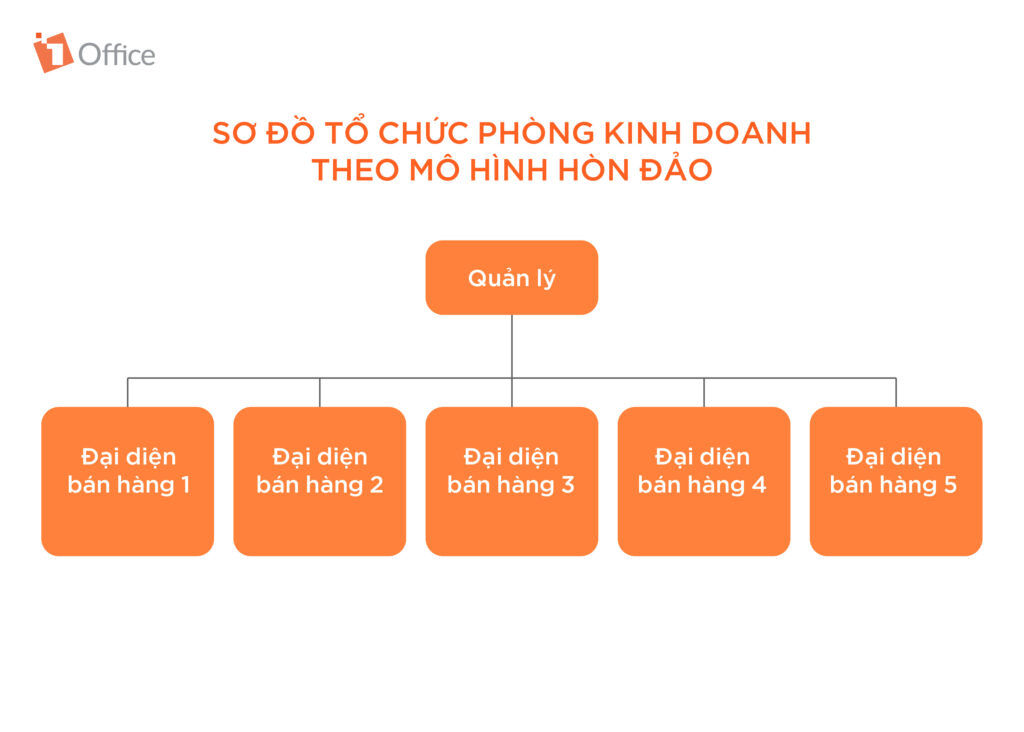
The Islands – The island model for a sales department is also one of the popular choices for businesses today. When applying this model, leadership will select a top-performing member to act as the owner/manager. This person is responsible for overseeing the general operations of the entire sales department.
Operating under the sales manager are the Sales Representatives. These representatives will handle tasks for each stage of the sales process. A sales department can be divided into many different sales representatives to perform tasks ranging from prospecting for potential customers and assessing needs to negotiating, consulting, and transacting with them to close deals and generate revenue.
Advantages:
- Simple and easy for businesses to apply
- With a sales manager, all activities are monitored and reported promptly
- Maximizes sales efficiency by creating a healthy competitive environment
Disadvantages:
- Tracking metrics can sometimes be difficult because members work independently rather than in teams
- Sometimes, the level of competition cannot be controlled, leading to negative impacts on the business
Recommended for:
- Businesses in traditional industries such as finance and real estate
- Businesses with a simple, transaction-oriented sales process
- Businesses operating in established and highly competitive markets
3. The Pod Model for Sales Department Structure
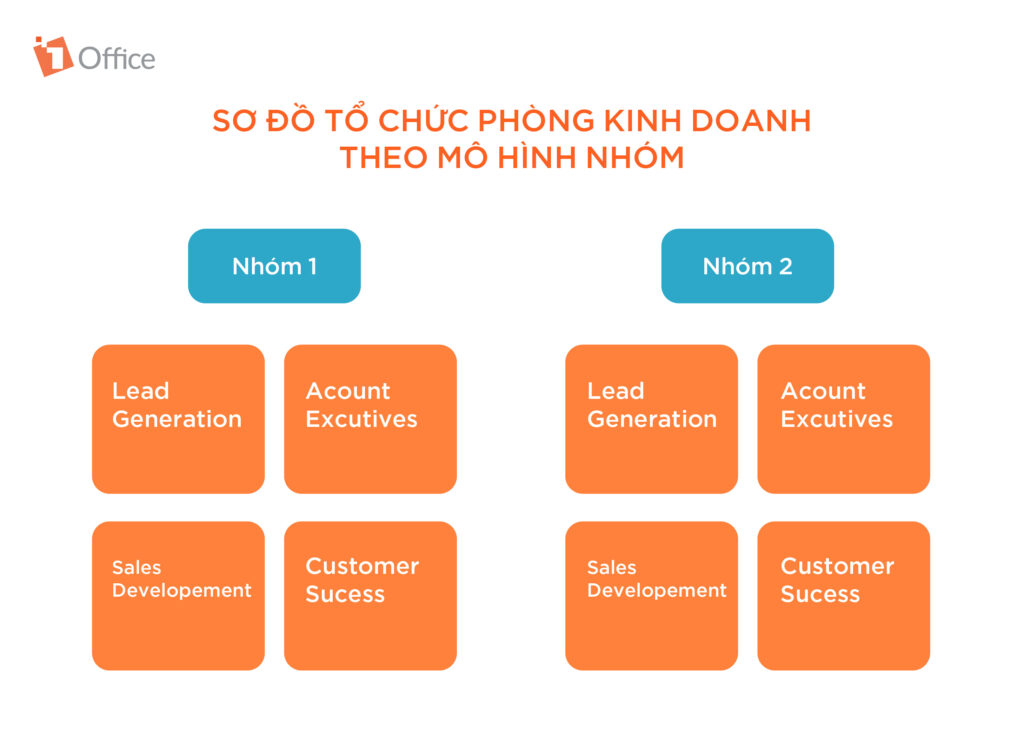
The POD is a team-based sales department structure considered optimal for helping businesses fully leverage the specialized skills of their sales team.
In terms of structure, the POD model can be imagined as an assembly line model broken down into smaller groups. This means the company’s sales department will be divided into 2-3 large groups, and the members within each large group will be further divided into 4 smaller groups: leaders, sales specialists, Account Executives, and customer care.
This model was created with the aim of increasing competition among the groups within the sales team. Each group divided according to this model will have a team leader who coordinates their team’s activities.
Advantages:
- The team-based sales department model helps limit issues that arise during work because when working in a team, members support each other, compensating for each other’s strengths and weaknesses to develop together, improve themselves, and work towards the common goal of increasing company revenue.
- The team model is highly flexible and easy to change when necessary.
Disadvantages:
Because it operates in small groups, the team-based organizational structure for a sales department will create competition among members. If not managed carefully, there is a risk of conflict within the group when members’ working styles and personalities are not compatible. These conflicts and disputes can negatively affect the team’s performance and the overall results of the entire sales force.
Recommended for:
- Businesses that are growing and need to expand their sales scale
- Successful startups aiming to optimize resources to approach the market and expand their business field
| Read more: Sharing 7+ tips for building a successful sales team |
Above are the detailed insights into the 3 most popular and easily applicable organizational structure models for a sales department. Depending on the specific characteristics and conditions of their company, managers should choose a suitable model to apply.
IV. 5 steps to build an effective sales department organizational structure
1. Identify key sales positions
The fundamental thing every employee needs to know when joining a department or a well-structured sales organization is to clearly understand their role and responsibilities. Therefore, as a manager, you need to clearly define the role of each member and position within the organizational structure to ensure business operations run smoothly, avoiding confusion or redundant positions.
2. Choose a suitable sales department organizational model
You can refer to the detailed information on the 3 sales department organizational structure models shared in the section above to select the most suitable model for your business.
Criteria for selecting a sales department organizational model can include the business sector, specific business goals, or the company’s market position.

3. Create job descriptions for each sales department position
A job description is a list created by a manager detailing the key tasks and duties for each position in the sales department. The purpose of a job description is to help the company and the sales staff clearly define factors such as job objectives, functions and tasks to be performed, job requirements, and the authority and responsibilities of the person holding that position.
4. Create a competency framework for each position
After establishing the job positions and creating job descriptions, the company will proceed to build a competency framework to serve as a basis for assigning tasks and recruiting suitable employees. The company can either build its own competency framework or choose one of the three available frameworks below:
- Core competencies group
- Functional competencies group, which are the professional skills of employees
- Management and leadership competencies group for team leaders
5. Build a scientific training environment for strong development
Once the information about jobs and positions is established, the final step for the company is to organize employee training. This is one of the core activities, serving as the foundation for the sales team to acquire selling skills and agile situation handling, ensuring the sustainable development of the business.
| Read more: The “Golden Formula” for Building a Training Process for New Sales Staff with 2X Efficiency |
Prioritize training and sharing experience. Regularly organize quality training and sharing sessions for the sales team to motivate and drive both the sales team and the business towards stronger growth.
Above are our insights on models and methods for building a suitable and effective sales department organizational structure for your business. We hope this information will be helpful as you build the sales department structure for your own business.
Additionally, applying modern technology solutions to manage sales department and sales activities has become a trend helping thousands of businesses achieve breakthrough revenue. And 1Office’s human resource management software is one of the solutions chosen by over 5,000 large enterprises to enhance HR management efficiency. With a system that automatically stores personnel information and documents, and provides comprehensive reports on competency indicators, KPIs, and employee performance, 1Office’s HRM software has helped businesses optimize their HR management apparatus, improve the performance of their sales teams, and achieve effective revenue breakthroughs.
Get a free consultation & trial
For more details, please contact:
- Hotline: 083 483 8888
- Fanpage: https://www.facebook.com/1officevn/
- Youtube: https://www.youtube.com/channel/UCeTIRNqxaTwk0_kcTw6SxmA
















