


 11/05/2026
  285 views
Have you ever wondered why some businesses easily outperform their competitors, while others struggle to survive? The answer lies in how they understand and face competition. The Five Forces Model, developed by Michael Porter – a renowned strategy expert – is the tool that helps decipher this.
Simply put, the Five Forces Model is like a “map” that helps you clearly see the 5 factors affecting a business’s profitability and growth within its industry. Let’s explore this model in detail with 1Office and discover strategies to help businesses compete through differentiation!
Mục lục
Understanding the Five Forces Model
Are you looking for a way to assess your business’s position in the market? Do you want to better understand the business environment you operate in? The Five Forces Model is the powerful tool you need to know.
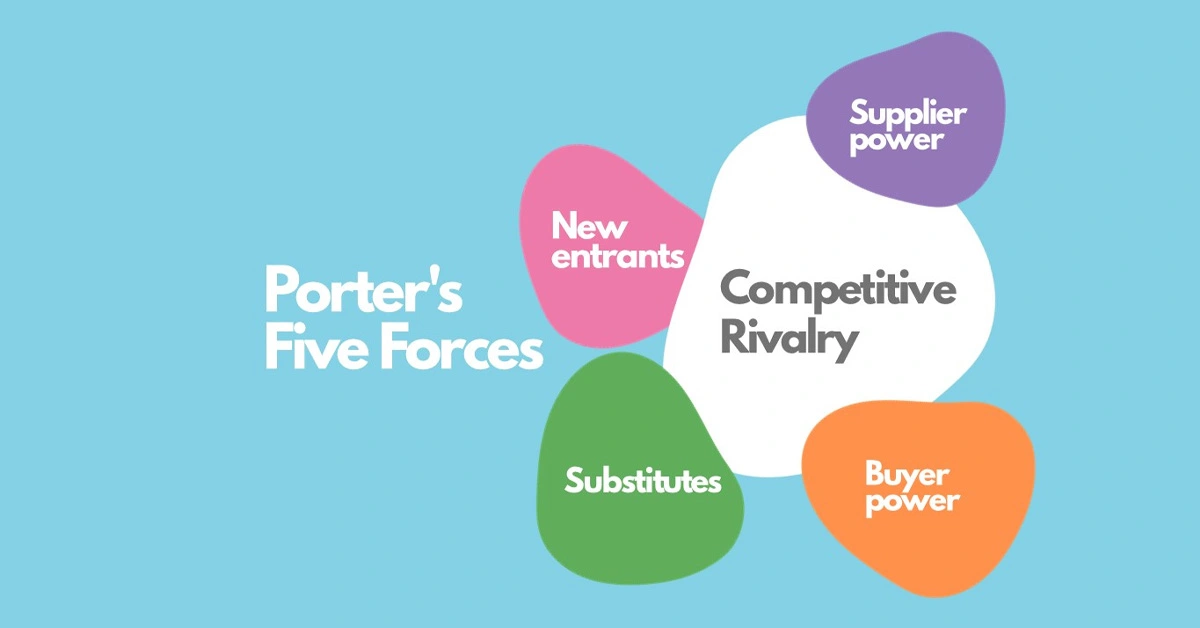
Developed by Harvard University professor Michael Porter in 1979, this model is an analytical framework that helps assess the level of competition and attractiveness of an industry. Instead of focusing solely on direct competitors, Porter pointed out that business competition also comes from four other forces: suppliers, customers, potential new entrants, and substitute products.
By understanding these five forces, a business can identify its strengths and weaknesses in its current position and build appropriate strategies to create a sustainable competitive advantage.
Why Should Businesses Analyze the Five Forces Model?
In today’s volatile business world, clearly understanding the competitive environment is no longer an option but a mandatory requirement. Analyzing the Five Forces offers many practical benefits:
1. Clearly Understand Your Competitive Position
The model helps businesses understand their position relative to other forces in the market. This is the foundation for building an appropriate strategy.
2. Identify Opportunities and Threats
Through analysis, businesses can discover untapped opportunities and potential threats that need to be addressed.
3. Build Effective Strategies

Information from the analysis helps in planning suitable strategies, from product positioning and pricing policies to distribution channels.
4. Forecast Market Trends
The model helps businesses see the big picture of the market, allowing them to predict changes and prepare accordingly.
5. Optimize Resources
Understanding the competitive environment helps businesses allocate resources reasonably, focusing on areas that deliver the highest value.
Explaining the Core Factors in the Five Forces Model
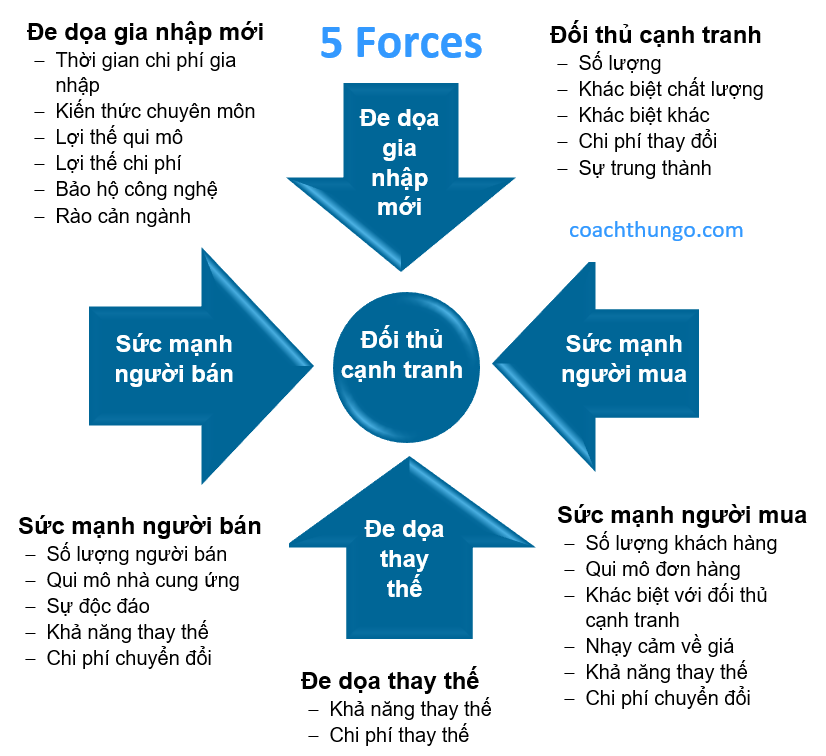
Threat of New Entrants
New entrants are businesses that are not currently competing in the industry but have the potential to join if they choose to. The level of this threat depends on the barriers to entry in the market.
Influencing Factors:
- Initial Capital Investment: Industries requiring large capital are harder to enter.
- Economies of Scale: When existing businesses can produce at a lower cost due to their large scale.
- Access to Distribution Channels: If distribution channels are already “locked up,” it will be difficult for new entrants to reach customers.
- Government Policies: Strict regulations can restrict new entrants.
- Product Differentiation: Strong brands and customer loyalty create significant barriers.
Practical Application: Startups need to assess the industry’s barriers to entry to decide whether to enter the market and what preparations are needed.
Bargaining Power of Suppliers
Powerful suppliers can raise prices or reduce the quality of products/services, thereby affecting the business’s profitability.
Influencing Factors:
- Number of Suppliers: Fewer suppliers mean they have more power.
- Differentiation of Inputs: If the inputs are unique and difficult to substitute, the supplier will have a strong position.
- Switching Costs: If changing suppliers is costly, their power increases.
- Importance of the Industry to the Supplier: If the business is a major customer, the supplier will be more dependent.
- Threat of Forward Integration: The supplier might decide to produce the final product themselves.
Practical application: Businesses need to diversify their supply sources, find alternative solutions, and build strategic partnerships with suppliers.
Bargaining power of buyers

Powerful customers can push prices down or demand higher quality, affecting the business’s profit margins.
Influencing factors:
- Number of customers: Fewer, larger customers have more power.
- Purchase volume: Buying in large quantities creates a better bargaining position.
- Switching costs: Customers who can easily switch to another product have high power.
- Product differentiation: Products with little differentiation make it easier for customers to switch.
- Customer information: Customers who are well-informed about the market can bargain more effectively.
- Backward integration capability: Customers can produce the product or service themselves.
Practical application: Businesses need to differentiate their products, build loyalty, and diversify their customer base.
Threats of substitute products or services
Substitute products are products from other industries that can meet similar customer needs. They set a price ceiling that businesses can charge.
Influencing factors:
- Price/quality performance: If a substitute product offers better value, the threat is greater.
- Switching costs: Low costs for switching to a substitute product increase the threat.
- Buyer propensity: Consumers willing to try new products create a greater risk.
- Availability of substitutes: Easy access creates higher competitive pressure.
Practical application: Businesses need to innovate continuously, increase switching costs, and enhance product value to reduce the appeal of substitutes.
Competitive Rivalry
This is the competition among existing businesses in the industry. A high level of competition often leads to reduced profits for the entire industry.
Influencing factors:
- Number and relative size: Many competitors of similar size create intense competition.
- Industry growth rate: Slow growth forces businesses to fight for each other’s market share.
- Fixed costs/storage costs: High costs create pressure to produce at high capacity.
- Product differentiation: Similar products increase the level of competition.
- Strategic commitment: When a business aims for success in a specific market.
- Exit barriers: High costs of leaving the industry force businesses to continue competing.
Practical application: Businesses need to create differentiation, avoid direct price competition, and seek untapped niche markets.
Example of Vinamilk’s 5 Forces Model
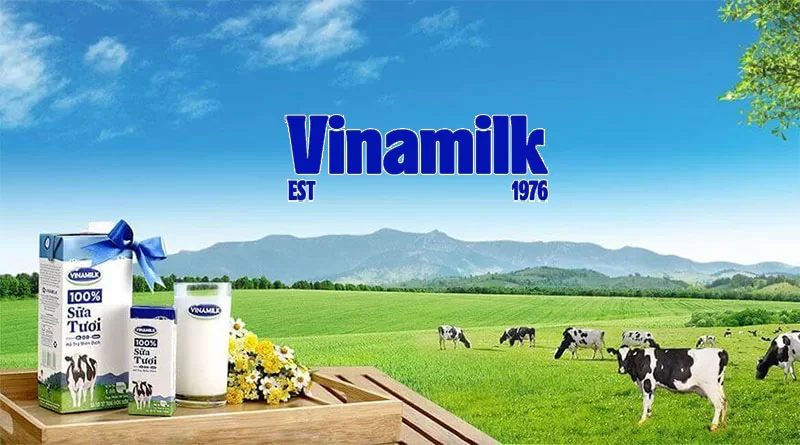
Vinamilk is a leading company in Vietnam’s dairy industry. Let’s examine how they face the 5 competitive forces:
1. Threat of new entrants
- High barriers: The dairy industry requires large capital investments for factories, farms, research, and development.
- Strong brand: Vinamilk has built consumer trust for over 45 years.
- Extensive distribution network: Over 250,000 retail points nationwide.
- Economies of scale: Low production costs due to large scale.
Vinamilk’s Strategy: Continue investing in technology, expanding the scale of farms and factories to increase barriers to entry.
2. Bargaining Power of Suppliers
- Securing Supply: Owns 13 dairy farms, supplying about 60% of raw fresh milk.
- Diversifying Supply Sources: Imports raw materials from various countries such as New Zealand, the US, and the EU.
- Partnerships: Builds long-term relationships with domestic farmers.
Vinamilk’s Strategy: Continue expanding the farm system, investing in a sustainable supply chain.
3. Bargaining Power of Buyers
- Customer Diversification: Serves all segments from mass market to premium.
- Differentiation: Develops special products like organic milk and A2 milk.
- Building Loyalty: The Vinamilk Club program with many incentives.
Vinamilk’s Strategy: Continuously innovate products and improve the customer experience.
4. Threat of Substitute Products
- Facing Plant-Based Milk: The trend of consuming nut milk and soy milk is increasing.
- Alternative Beverages: Fruit juices, other nutritional drinks.
Vinamilk’s Strategy: Diversify the product portfolio, including plant-based milk (Vegemilk) and fruit juice (Vfresh).
5. Competitive Rivalry
- Strong Competitors: TH True Milk, Dutch Lady, Nutifood, Mộc Châu Milk.
- International Competition: Nestlé, Abbott, Mead Johnson.
Vinamilk’s Strategy:
- Maintain leadership position through continuous innovation
- Expand export markets
- Invest in R&D to create differentiated products
- Optimize production costs through advanced technology
Competitive Strategy: Leading Through Differentiation
In the volatile business world, competing on price is not always effective and often leads to a “race to the bottom” with no winners. The Differentiation Strategy—also proposed by Porter as one of the three basic competitive strategies—is the path that helps businesses escape the fierce cycle of competition.
When creating differentiation, a business doesn’t just provide a better product or service, but is unique in the customer’s perception. This can be achieved through:
- Product Innovation: Developing new features and breakthrough technologies that competitors don’t have or find difficult to imitate.
- Customer Experience: Creating a superior shopping and product usage experience.
- Strong Brand: Building a unique brand story that connects with customer emotions.
- Excellent Service: Providing customer service that far exceeds industry standards.
- Disruptive Business Model: Like how Uber changed the taxi industry or Airbnb with the hotel industry.
A differentiation strategy helps businesses reduce pressure from all 5 competitive forces:
- Against Existing Competitors: Reduces direct competition because the business is operating in a “blue ocean” instead of a “red ocean.”
- With Customers: Increases loyalty and reduces price sensitivity because customers are willing to pay more for unique value.
- With Suppliers: Higher profit margins give the business more flexibility against the pressure of rising input costs.
- Against Potential Entrants: Higher barriers to entry due to the large investment required to create equivalent differentiation.
- Against Substitute Products: Customers are less likely to switch to other solutions once they are attached to your unique value.
However, a differentiation strategy requires a long-term commitment, continuous investment in innovation, and a deep understanding of customer needs. It is not about superficially “doing things differently,” but about creating real value that customers are willing to pay more for.
Apple is a prime example of a successful differentiation strategy: not competing on low prices but on beautiful design, a closed ecosystem, and an excellent user experience – factors that help them maintain their position in the volatile tech industry.
————————-
Porter’s Five Forces model is a powerful tool that helps businesses comprehensively analyze the market. Instead of focusing solely on direct competitors, businesses need to broaden their perspective to identify pressures from suppliers, customers, potential entrants, and substitute products.
















