


 13/05/2026
  162 views
How can managers build a strong workforce and optimize business operations in the new normal? Can technology bring positive changes to post-pandemic human resource management? This was the main topic of the webinar “Human Resource Management in the New Normal” held on the morning of Saturday, October 30, 2021.
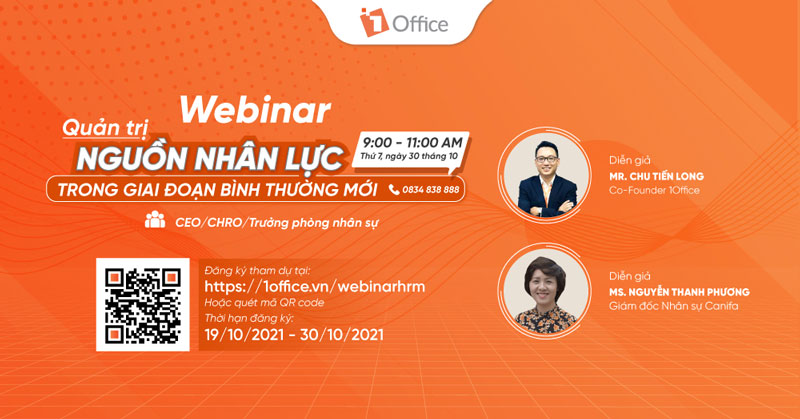
Joining this event were leading experts in human resource management and digital transformation: Ms. Nguyen Thanh Phuong, Human Resources Director of Canifa Joint Stock Company, and Mr. Chu Tien Long – Co-Founder and Business Director of 1Office.
The Current State and Solutions for Human Resource Management in the New Era
Kicking off the webinar, Ms. Nguyen Thanh Phuong, HR Director of Canifa, guided the audience through the current state of human resource management in the new normal. According to information from the investment consulting firm Dragon Capital, after the pandemic, large enterprises take about one quarter to recover, while small and medium-sized enterprises may take two quarters or even a year to restore stable operations. Additionally, Covid-19 has changed the work habits of both managers and employees, forcing businesses to adapt by shifting from offline to remote work, in-office work, or a flexible hybrid model.
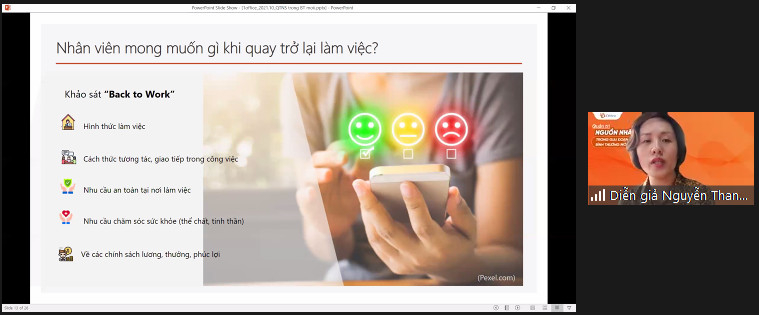
For the current new normal period, Ms. Phuong shared suggestions for what businesses should do for their employees. She said: “Managers must know how to apply human resource management methods that are suitable for their company’s scale, organizational structure, and business activities. First, managers and HR themselves need to understand what their employees want in the new context. There are five things employees desire when returning to work in the post-pandemic normal: First is a change in work format to suit the actual situation and employees’ working conditions. Second, employees want interaction and communication at work to increase engagement. Third, they want their need for safety in the workplace to be guaranteed. Fourth is the desire for both physical and mental healthcare. Finally, there are the salary, bonus, and welfare policies for employees.”
As a seasoned HR professional, Ms. Nguyen Thanh Phuong stated that leaders must listen to their employees’ desires before implementing new work methods. Based on her practical experience in human resource management, Ms. Phuong suggested four main solutions for businesses in post-pandemic personnel management:
- Returning to work safely
- Adapting flexibly
- Building a culture of engagement
- Applying information technology
Applying 1Office in Human Resource Management
Sharing about the application of technology in human resource management, Mr. Chu Tien Long provided the audience with practical experiences of the 1Office software in personnel management. Mr. Chu Tien Long said: “1Office provides the HRM and Workplace modules to solve problems related to human resource management and internal communication for businesses. These modules include useful features such as: Social, Recruitment, Training, KPI, Timekeeping – Payroll, Requests, and Digital Signature.
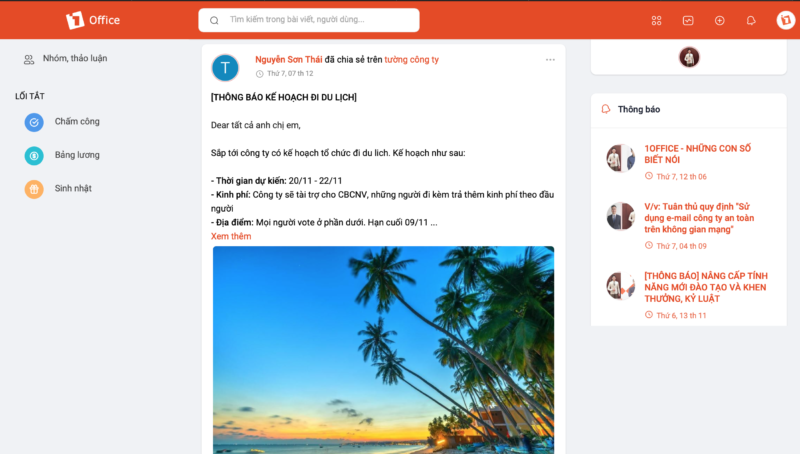
Social Feature: In the past, many companies struggled to convey information to their staff through word-of-mouth, email, or Zalo… These methods often lead to information being missed. However, 1Office has a private internal network that helps businesses post all information and tag all employees to follow, discuss, and stay updated on all activities. 1Office can create a space where everyone in the company or organization can communicate with each other. This is a tool that supports internal culture communication, and more than 3,500 customers nationwide have used the 1Office internal network.
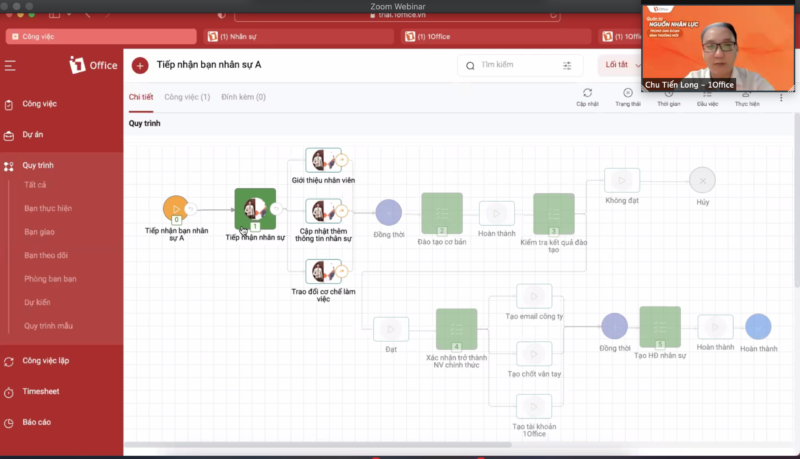
Digitizing the Recruitment Process: 1Office integrates a Recruitment feature, supporting the recruitment proposal process, clearly stating the number of hires needed and for which positions. Leaders can see who is in charge of recruitment, which candidates are applying for which positions, and evaluate candidates directly on the software, storing their entire history.
Training: When a candidate is approved, they are automatically moved to the training phase. If the candidate passes their probation, they are automatically transferred to the HR department as an official employee. In this process, leaders can see the entire employee lifecycle, who is responsible for onboarding, and who approves each step.
Employee Profiles: On the 1Office software, HR managers can track the entire work history, personal information, insurance, labor contracts, salary and bonuses, rewards, disciplinary actions, salary increase decisions, transfers, etc. All this information is stored permanently on the software, supporting the employee competency assessment framework.
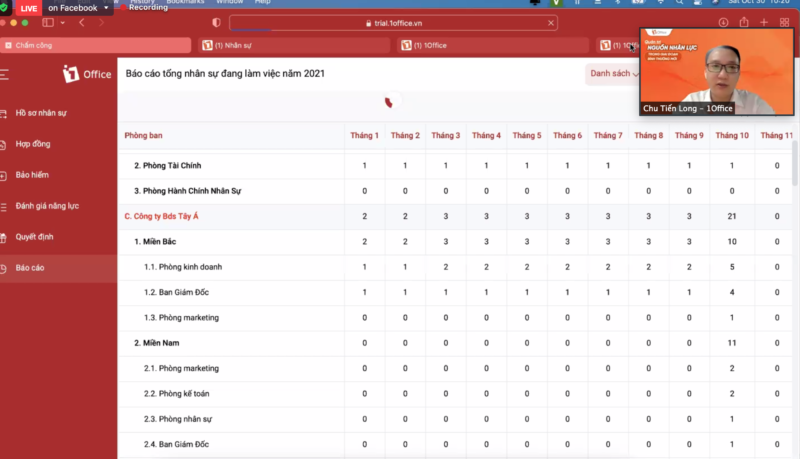
Timekeeping – Payroll: 1Office supports direct integration with time clocks. Employees can clock in via fingerprint, GPS, or Face ID, and the data is then sent to the software and appears on their timesheet. If the time clock cannot distinguish working hours, 1Office can define work shifts. Employees can track their information transparently, see if they forgot to clock in, and simply create a request for approval instead of having to explain. Leaders can monitor all employee payroll information; they just need to finalize the timesheets and payroll, and it is automatically sent to department heads and the HR department to handle procedures like paying salaries and exporting data.
Requests: Previously, when employees wanted to request leave, sick days, or business trips, they had to fill out paper forms, and HR had to manually enter the data into the timesheet, which was very time-consuming. 1Office allows employees to create their own requests and leave forms, fill in the details, and have them automatically sent to the approver.
KPI: Managers can create their own evaluation templates for employees and define the scoring formulas for the criteria. Every month or at set intervals, they can conduct evaluations and determine salaries based on the results.
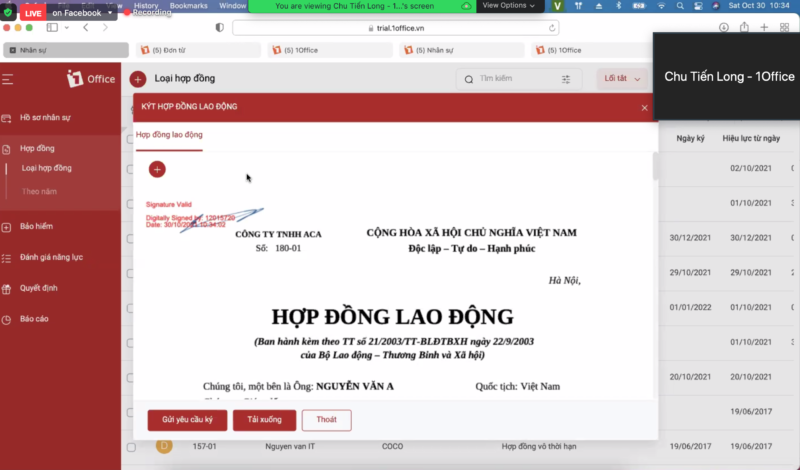
Digital Signature: If the traditional process of signing labor contracts on paper and in person is costing you time and money, 1Office integrates digital signatures directly into the contract signing process. You can choose internal signing, with two options: signing with a USB token or using an HSM signature from network providers. Using digital signatures helps businesses save on printing and shipping costs, and saves time in the approval process for documents at all levels.
Dashboard Screen: On the report screen, you can track the total number of company employees, gender ratios, recruitment candidates, and quickly search and filter HR-related reports.
Q&A: Discussion with the Speakers
During the “Human Resource Management in the New Normal” webinar, many leaders, including HR Directors and department heads/managers, directly submitted discussion questions to the speakers. Here are some of the standout questions:
Question: Regarding the Training feature, can we create privacy settings for different departments?
To answer this question, Mr. Chu Tien Long shared: “Regarding document management, 1Office allows you to create different training document folders and configure who can manage and view these documents.
As for announcements: 1Office allows posting to the company wall, where you can create different topics such as: company information, internal communications, monthly newsletters, etc. Notifications will be sent to employees related to specific topics. This allows information to be viewed in different streams.”
Question: To prepare for future stages if the pandemic strikes again, what can we do in human resource management?
Regarding this concern, Ms. Nguyen Thanh Phuong said: “The pandemic will certainly not end completely; if it’s not Covid-19, it will be another disease or issue. First, businesses need to ensure safety, vaccinate employees, adhere to the 5K message, and maintain physical sanitation and disinfection. Second is to review work objectives and identify which employees can continue or need to be reduced, and flexibly adjust the company’s variable
















