


 12/05/2026
  522 views
Net sales, also known as net revenue, is a crucial concept in the business field. It is an important metric that helps measure a company’s sales performance. Join 1Office to learn what net sales is, its role in the income statement, as well as the standard formula and calculation method for net sales in this article!
Mục lục
- 1. What is net sales? The significance of net sales for a business
- 2. What is the significance of net sales in the income statement?
- 3. How to calculate net sales correctly
- 4. How to effectively increase net sales
- 5. The difference between Net Sales and Gross Sales
- 6. Export revenue reports super simply with 1CRM
1. What is net sales? The significance of net sales for a business

Definition
Net sales, or net revenue, is the amount of money received from a company’s primary sales activities after deducting discounts, all investment costs, returns, shipping fees, and other incurred expenses. It is a key indicator of a business’s success in its operations and profit generation.
The significance of net sales for a business
First, net profit impacts the internal affairs of a business, reflecting the income level of its members through the net profit earned. Thus, it plays a crucial role in assessing the company’s development. For joint-stock companies, net profit also serves as a basis for shareholders to decide whether or not to change leadership.
Second, net profit is also a basis for other businesses to research and invest. Investors often rely on the net profit metric to evaluate the effectiveness of a company’s business operations, determining if it is performing well and growing steadily before deciding to invest in it.
Third, net profit makes it easier for a business to obtain loans. Banks typically need to assess the profit a business earns to determine its repayment capacity and secure the loan. If a business has stable net profit, banks will have more confidence in providing capital for its investment and development.
2. What is the significance of net sales in the income statement?
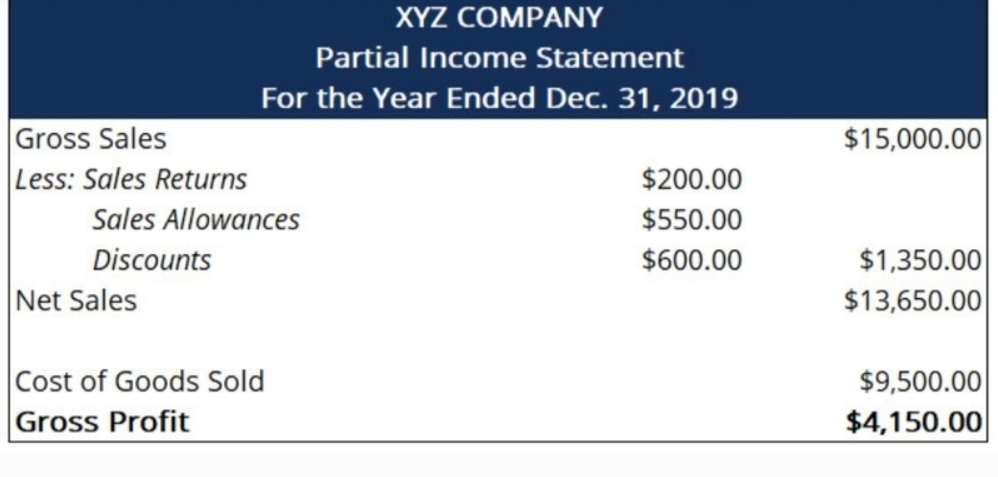
Net sales is presented in a company’s income statement. Most companies typically present net sales figures and their derivatives directly in the notes accompanying the financial statements. However, some companies report both gross sales and net sales on the same income statement. The table below shows a sample excerpt from an income statement.
The top-line figure is gross revenue, and other components are subtracted to arrive at net sales. Gross profit is calculated using net sales, not gross sales. If the difference between gross sales and net sales is large, it could be a warning sign that the company’s revenue quality is poor, possibly because they are applying discounts to the listed price of products to generate sales.
3. How to calculate net sales correctly

Net Sales Formula
Calculating net sales is quite simple and not as complicated as many people think. This calculation is typically used to determine a business’s net revenue for each month, quarter, or year as follows:
Net revenue = (Total revenue the business earns from all its current business activities) – (total investment costs, project-related expenses, company operating costs)
For example: If your business sold a total of $50,000 in goods, but you had no returns, discounts, or allowances, your gross revenue would be $50,000. This amount would be recorded at the top of the income statement.
It’s important to understand that just because you sold $50,000 worth of products, it doesn’t mean your business earned all that income from those sales, because other deductions have not yet been considered. From your gross sales calculations, you can subtract the amounts for sales returns, discounts, and allowances. Let’s say you find that this total amount is $5,000 after subtracting sales returns, discounts, and allowances. In that case, your net sales would be $45,000.
Factors affecting net sales
The net sales calculated on the income statement will be affected by various types of deductions, including:
Sales Return
Sales returns include any returns of products purchased by consumers. For example, if a customer buys a product from a retail store but later decides to return it for a refund, that is a sales return.
The refund amount is accounted for as a return when reported on the income statement and is subtracted from gross revenue to calculate net sales.
Discounts
Discounts are another type of deduction. When a discount is applied, the price of the product is reduced, usually as a percentage off the original price. Discounts are also subtracted from gross sales to calculate net sales.
There can be various types of discounts, including seasonal discounts applied at specific times of the year when price reductions are needed, cash discounts, and discounts for bulk purchases.
Sales Allowances
Similar to discounts, sales allowances are also deducted from the original price of a product. However, an allowance is deducted for a specific reason related to a particular product.
Discounts are typically applied to all customers, whereas allowances usually apply to specific issues with their product or order.
For example: If a product is defective or damaged, an allowance may be given to compensate because it does not meet the standards of other similar products ordered.
4. How to effectively increase net sales
To increase net sales and improve sales performance, businesses can apply the following strategies:
Increase the average order value
The first way to increase gross sales and net sales is to increase the average order value (AOV).
The AOV metric represents the average value of an order in a transaction and is a crucial indicator that helps businesses evaluate the effectiveness of their marketing and sales campaigns. If AOV increases, it indicates that customers are buying higher-value products or more products from the business in a single transaction.
Therefore, improving the AOV metric is important as it directly impacts sales revenue growth. Tracking AOV also helps businesses make more effective decisions in key areas such as customer service, marketing, and product pricing.
When the average order value increases, both Gross Sales and Net Sales will also increase.
Use a reasonable product pricing strategy
The next step a business can take is to apply a suitable product pricing strategy.
Product pricing is the process a business uses to determine the selling price for its products. It is also a crucial part of the business’s marketing plan.
Pricing depends on many factors such as average cost, the value the product brings to the customer, and the product’s value compared to competitors. Therefore, during the product pricing process, businesses need to carefully consider factors such as:
- Purchase costs
- Production costs
- Target market
- Competitors
- Brand
- Product quality.
The customer’s ability to pay for the product also determines whether they will buy it. Therefore, effective product pricing is a crucial part of a business’s marketing and sales strategy.
Pricing can also be used as a strategic decision to deal with competitive situations, adapt to the target market, and manage business relationships.
Improve product quality
By improving product quality, customers will perceive that the benefits and value they receive are worth their investment. This will motivate them to return for future purchases, thereby boosting the performance of Gross Sales and Net Sales.
Furthermore, with the growth of the Internet, customers have easier access to more information and tend to carefully consider the benefits and value of a product before making a purchase decision. Therefore, not only price but also quality has become more important to many customers.
5. The difference between Net Sales and Gross Sales
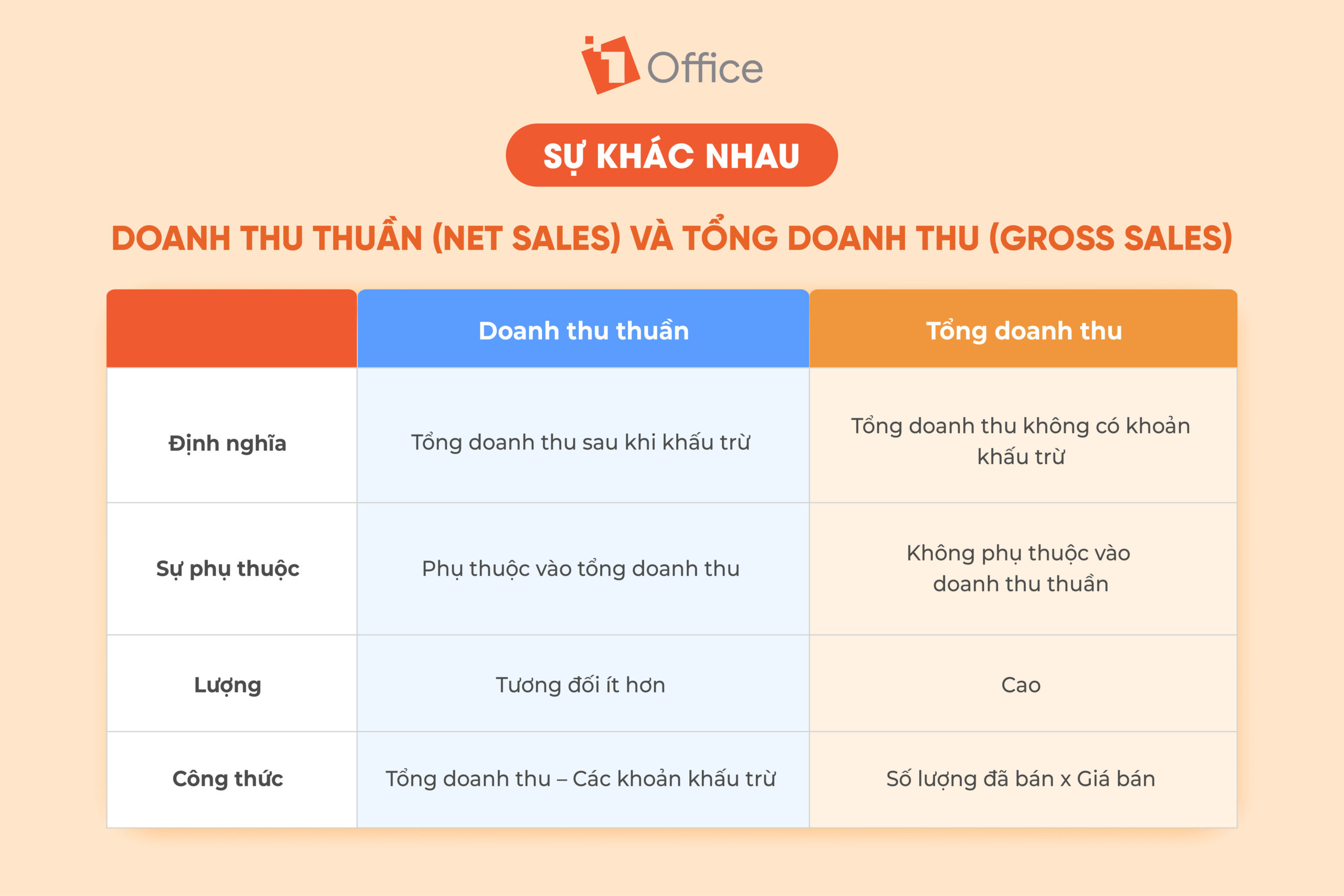
Gross sales and net sales are sometimes confused and treated as equivalent. However, net sales are derived from gross sales and are more important when analyzing a company’s sales quality.
Net sales provide a more accurate representation of a company’s actual revenue and can be used to assess the company’s true revenue level, as well as to develop strategies for the sales and marketing teams to boost future revenue.
The gross sales figure is often much higher because it does not include returns, allowances, or discounts. By removing these sales deductions from revenue, net sales more accurately reflect the company’s revenue and are used to make important decisions.
The table below highlights the key differences between net sales and gross sales:
6. Export revenue reports super simply with 1CRM
1CRM is a module within the comprehensive 1Office business management software suite, helping businesses intelligently manage operations related to sales, orders, inventory, goods, and liabilities. 1CRM is a powerful tool that helps businesses effectively track and manage their revenue information. It is a crucial part of the overall management system, providing businesses with clearer insights into their business performance.

The main features of “Export Revenue Report” in 1CRM include:
- Real-time and visual reports: 1Office CRM provides visual reports on revenue, orders, product inventory, and other business metrics, all updated in real-time. Managers can quickly track and analyze data, enabling them to make strategic decisions and adjust business plans effectively.
- Track revenue from multiple sources: 1CRM allows you to track revenue from various sources, including sales, projects, customer service, and more. This helps you better understand the origins of your revenue.
- Diverse analysis and reporting: You can generate various reports and charts to analyze revenue by different factors such as time, source, product or service, geographical area, and many other criteria. This helps you make detailed and intelligent business decisions.
- Visual information: 1CRM provides visual tools like charts, bar graphs, and diagrams so you can see and understand your revenue more clearly and easily.
The “Export Revenue Report” feature in 1CRM gives businesses a comprehensive and detailed view of their revenue, thereby supporting decision-making, tracking business performance, and optimizing financial strategies.
———————
Net sales is a crucial indicator in a company’s business operations. To increase net sales effectively, the company needs to apply appropriate strategies and monitor them closely to make adjustments when necessary. Only by accurately tracking and analyzing net sales can a company make precise and effective strategic decisions to increase revenue and grow the business.
















