What is a Direct Award Decision? Process and Standard Template under the 2026 Bidding Law


Direct contracting is a special form of contractor selection, not as widely competitive as conventional bidding. Therefore, the issuance of a Direct Contracting Decision must be carried out based on the correct grounds, in the correct order, and with the correct authority to avoid legal risks, inspections, audits, or findings of non-compliance.
Mục lục
- What is a Direct Contracting Decision Template?
- 2. Cases Where Direct Contracting Can Be Applied
- 3. Direct Appointment Implementation Process
- 4. Detailed Guide on How to Create a Legally Compliant Direct Appointment Decision
- 5. Download 4+ Direct Award Decision Templates
- 6. Important Notes When Drafting and Issuing a Direct Award Decision Template
What is a Direct Contracting Decision Template?
1.1. Definition and Legal Role of the Direct Contracting Decision Template
A direct contracting decision template is an administrative and legal document issued by a competent authority to approve the selection of a specific contractor to execute a procurement package, in cases where the package is eligible for the direct contracting method according to procurement laws.
Legally, a Direct Contracting Decision:
- Serves as the legal basis for signing a contract with the appointed contractor
- Serves as the basis for management, inspection, and audit agencies to verify the correctness of the contractor selection process
- Represents the responsibility and legal will of the project owner/procuring entity
If this decision is absent or issued on incorrect grounds, the entire signed contract may be deemed illegal.

1.2. The Importance of Preparing a Direct Contracting Decision in Accordance with Regulations
The direct contracting decision is a key legal document in the entire contractor selection process under the direct contracting method. Preparing and issuing this decision not in accordance with legal regulations can lead to many serious legal consequences, directly affecting the project owner, the procuring entity, as well as the individual with the authority to sign and issue it.
Specifically, during inspections, examinations, or audits, a non-compliant direct contracting decision can lead to:
- Findings of non-compliance, violation of contractor selection regulations;
- Inability to settle capital, especially for projects using state budget funds, ODA funds, or state-owned capital;
- The signatory of the decision being held personally accountable, which, depending on the severity, could involve administrative liability, compensation liability, or other penalties as prescribed by law.
Therefore, when drafting and issuing a Direct Contracting Decision, the project owner and the procuring entity must pay special attention to ensuring that this document fully meets all mandatory legal requirements, including:
- Correct legal basis: accurately citing the Law on Bidding, related decrees, circulars, and relevant decisions of the project owner;
- Correct authority: the signatory must be a person with authority as stipulated by law and internal regulations;
- Correct and complete mandatory content: clearly stating information about the procurement package, the appointed contractor, the value, contract type, implementation period, and related terms;
- Correct administrative document format: complying with regulations on the national emblem and motto, presentation format, layout, and document drafting techniques.
Preparing a Direct Contracting Decision in accordance with regulations not only helps ensure the legality of the contractor selection process, but also serves as an important basis for protecting the project owner and the signatory from future legal risks.
2. Cases Where Direct Contracting Can Be Applied
2.1. Overview of Legal Regulations on Direct Contracting
According to the 2023 Law on Bidding and its implementing decrees, direct contracting is defined as an exceptional form of contractor selection, only to be applied in truly necessary cases permitted by law. Unlike open bidding or limited bidding – which emphasize competition and transparency – direct contracting allows the project owner to directly select a specific contractor, thus posing many risks if not applied correctly according to regulations.
Due to this special nature, procurement law establishes the following general principles for applying direct contracting:
- Direct contracting is not the default method of contractor selection, but is only applied when other contractor selection methods are impossible or unsuitable;
- The project owner/procuring entity must clearly justify the reason for its application, including the legal basis, urgency, special nature of the procurement package, and actual conditions;
- The application of direct contracting must be appropriate for each type of procurement package, funding source, and specific project nature, and must not be applied indiscriminately or subjectively.
In fact, this is content that is frequently and carefully reviewed by inspection and audit agencies when assessing the legality of the contractor selection process.
2.2. Cases of Standard Direct Appointment
Standard direct appointment is legally permitted in some typical cases where organizing a competitive bidding process is not feasible or does not meet practical requirements, including:
- Bidding packages that need to be implemented urgently to overcome the consequences of natural disasters, epidemics, force majeure events, or to ensure the safety of people, property, and structures;
- Bidding packages with specific technical or technological characteristics, for which only a single contractor can meet the requirements for capacity, copyright, technology, or experience;
- Bidding packages that need to ensure technological synchronization and compatibility, for example, expanding or upgrading a system previously implemented by a contractor;
- Bidding packages for projects related to state secrets, national defense, or security as stipulated by specialized laws.
For these cases, the legal basis for the direct appointment must be stated clearly, specifically, and accurately in the Direct Appointment Decision, avoiding general or inappropriate citations that can easily lead to legal risks.
2.3. Cases of Simplified Direct Appointment
Besides standard direct appointment, the law also allows for the application of simplified direct appointment in certain cases to meet schedule and flexibility requirements, including:
- Small-value bidding packages within the permissible limits as regulated;
- Urgent bidding packages that need to be implemented quickly to ensure project progress;
- Bidding packages for regular, recurring procurement that are simple in nature with few changes in technical requirements.
The characteristics of simplified direct appointment are:
- The implementation process is simpler than that of standard direct appointment;
- Fewer procedural steps, helping to shorten the contractor selection time;
- However, it is still mandatory to issue a decision approving the direct appointment result to ensure the legality and transparency of the contractor selection process.
2.4. Conditions for a Contractor to Receive a Direct Appointment
Whether applying standard or simplified direct appointment, the appointed contractor must fully meet the conditions stipulated by law, including:
- Having valid legal status, established and operating in accordance with the law;
- Having capacity and experience suitable for the bidding package, demonstrated through similar contracts previously executed;
- Having the financial capacity to meet requirements, ensuring the ability to execute the bidding package;
- The proposed price is consistent with the approved budget, does not exceed the bidding package price, and ensures reasonableness.
Appointing a contractor who does not meet the required conditions is one of the most serious errors in bidding activities, often concluded by inspection and audit agencies as a violation, and can lead to legal consequences for the project owner and the decision-signer.
3. Direct Appointment Implementation Process
Step 1: Prepare, appraise, and approve the request for proposal
The request for proposal is the foundational document, clearly defining the scope of work, technical requirements, contract conditions, and evaluation criteria, serving as the basis for reviewing the contractor’s proposal.
Step 2: Identify the prospective contractor to be invited
The identification of the contractor must have a clear basis, based on capacity, experience, and suitability, avoiding subjective or emotional choices.
Step 3: Issue the request for proposal
The request for proposal is sent directly to the appointed contractor for them to prepare their proposal.
Step 4: Evaluate the proposal and negotiate
Conduct technical and financial evaluations, while also negotiating contract terms to ensure effectiveness and feasibility.
Step 5: Appraise, approve, and publicize the results
The contractor selection results are appraised, approved, and publicized as regulated, accompanied by the direct appointment decision or the result approval decision.
Step 6: Sign and manage contract execution
After a valid decision is made, the parties proceed to sign the contract and organize the management and supervision of the implementation process.
4. Detailed Guide on How to Create a Legally Compliant Direct Appointment Decision
4.1. Structure of a Complete Direct Award Decision
A valid decision must include:
- National emblem and motto
- Name of the issuing authority
- Document number and symbol
- Place and date of issuance
- Decision title
- Legal basis section
- Content of the decision (Article 1, Article 2…)
- Signature and title of the authorized person
- Recipients
4.2. Mandatory Content in the Decision
- Bidding package name, project name
- Name of the appointed contractor
- Direct award value (in numbers and words)
- Form and type of contract
- Contract execution period
- Capital source
- Implementation responsibilities
5. Download 4+ Direct Award Decision Templates
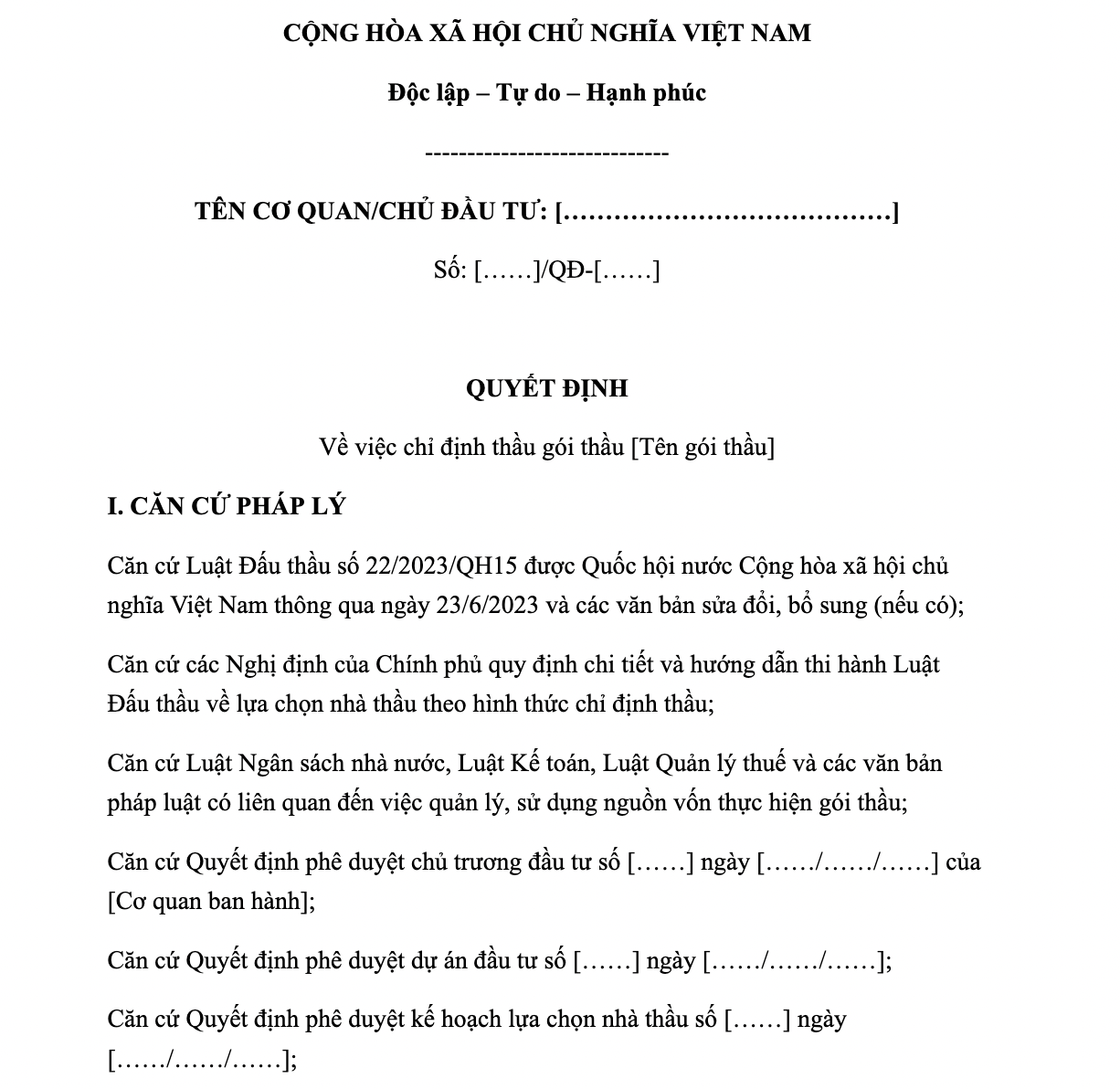
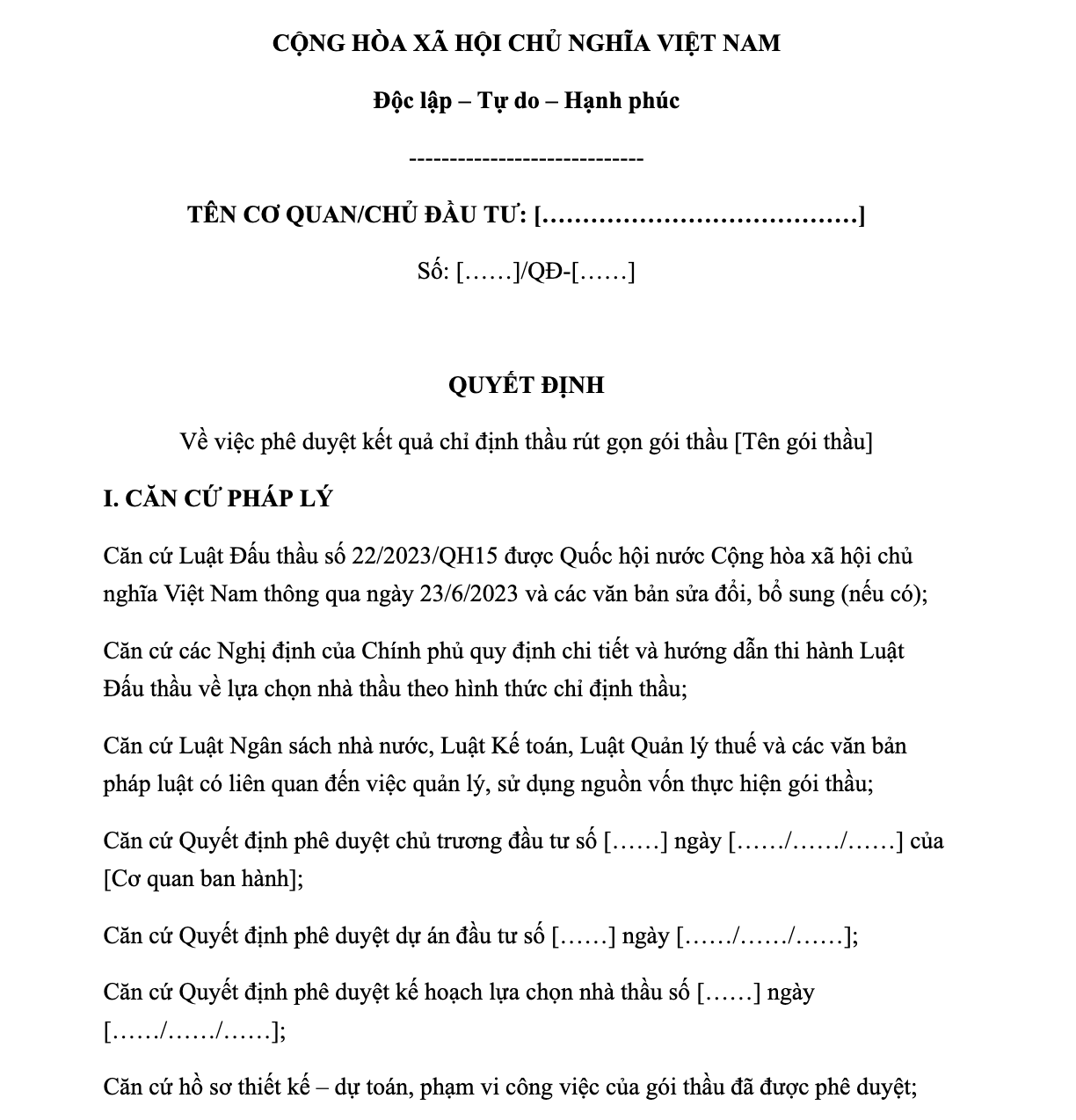


6. Important Notes When Drafting and Issuing a Direct Award Decision Template
A direct award decision is a document with direct legal value in the contractor selection process. Drafting and issuing this document requires not only the correct format but also the correct legal substance, timing, and authority. In practice, many legal risks and findings of misconduct during inspections and audits do not stem from the nature of the bidding package but from errors in the direct award decision.
6.1. Common Mistakes When Creating a Direct Award Decision
During implementation, the following errors are quite common and can lead to serious legal consequences:
- Missing or incorrect legal basis citation
The decision does not fully cite the Bidding Law, guiding decrees, or references documents that have expired or are inappropriate for the time of issuance. This is an error that is easily detected during inspections and audits. - Unclear or inconsistent bidding package information
The bidding package name, project name, capital source, and package value do not match the approved contractor selection plan or cost estimate, leading to doubts about the legality of the documents. - Signed by an unauthorized person or with an incorrect title
The person signing the decision is not authorized according to the company’s charter, internal regulations, or legal provisions; or signs with an incorrect title at the time of issuance. - Issuing the decision at the wrong time
The direct award decision is issued before the contractor selection plan is approved, or after the contract has already been signed, which nullifies the legal significance of the document.
6.2. Pre-Issuance Checklist for No-Bid Contract Award Decisions
Before signing and issuing the no-bid contract award decision, the project owner or the procuring entity should perform a check using the checklist below to minimize legal risks:
- Are all references to current legal regulations complete and accurate?
This includes the Law on Bidding, guiding decrees, and legal documents related to the specific contract package. - Is the information about the contract package and the contractor accurate and consistent?
The name of the contract package, project, funding source, value, implementation period, and contract type must match the previously approved legal documents. - Does the document follow the correct administrative format?
The national emblem and motto, name of the issuing authority, decision number, clause layout, recipients, signature, and seal must comply with regulations on administrative document formatting. - Does the signatory have the proper authority at the time of signing?
Review the appointment, decentralization, or authorization decisions (if any) to ensure the signature is fully valid.
Following this checklist helps significantly reduce the risk of being asked to supplement documents, being found in violation, or having the final settlement rejected.