09/05/2026
  849 views
A salary range is a familiar concept to HR, but not everyone understands how to build and apply it correctly in a business. If you want to clearly see the role of a salary range in recruitment and compensation, this article will help you grasp the information most accurately.
Mục lục
- 1. Overview of Salary Ranges
- 2. Differentiating Salary Range from Other Types
- 3. Factors Affecting Salary Ranges
- 4. The Candidate’s Perspective: How to Determine an Appropriate Salary Range
- 5. The HR and Business Perspective: How to Build a Salary Range and Sample Formulas for Reference
- 6. Common mistakes when applying salary ranges
- 7. Manage salary ranges more effectively with the 1HRM platform
- Conclusion
1. Overview of Salary Ranges
Below are the basic concepts to help you understand what a salary range is and why it is increasingly important in modern recruitment.
1.1. What is a salary range?
A salary range is the expected pay scale for a specific position, defined from a minimum to a maximum level, which also reflects the potential for income growth and adjustment based on performance. This information often appears in job descriptions and during the interview process.
A salary range typically consists of 3 levels:
- The lowest level
- The mid-point
- The highest level
For example, a company offers a salary range for an accountant position from 10 – 15 million VND. Candidates can negotiate a suitable salary within this range based on their competency, such as 12 million VND. After a period of employment, the salary may be adjusted up or down, but it usually remains within the defined range.
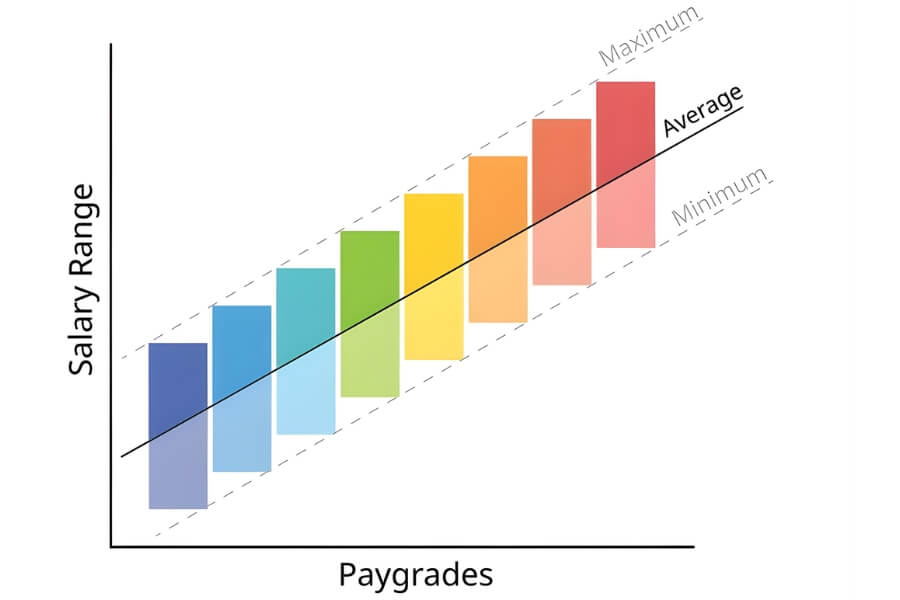
A salary range has 3 levels: The lowest level, the mid-point, and the highest level
1.2 The Role of a Salary Range
Salary ranges play a crucial role in modern human resource management, bringing practical benefits to businesses, employees, and the entire job market.
- For businesses and HR operations: Salary ranges help build a fair and consistent compensation structure for positions with equivalent contribution levels. They also serve as a crucial basis for creating HR budgets, controlling salary costs, and designing salary and bonus policies appropriate for each stage of development.
- For employees: Salary ranges help employees better visualize their future income progression, thereby creating motivation to work and guiding their career development. Understanding the salary framework for their current position also helps them proactively improve their skills to reach higher income milestones.
- For the labor market: Salary ranges contribute to increased transparency in recruitment, help employees and businesses connect more effectively, and promote a healthy and balanced operation of the job market.
1.3 Salary Range or Salary Rank
Salary range is the correct and standard term. A salary range (or pay range) refers to the pay scale from minimum to maximum that a company is willing to pay for a specific position. This is a commonly used term in recruitment and human resource management in Vietnam.
Salary rank is often a misnomer. “Rank” in English means a grade or level (Junior, Senior…), and is not used to refer to a pay scale. In some companies, “salary rank” is only used internally (e.g., grade A1, A2…) and is not a standard term.
Therefore, when discussing the expected salary for a position, the correct term to use is salary range.
2. Differentiating Salary Range from Other Types
Below is a table distinguishing a salary range from easily confused concepts such as fixed salary, offered salary, and gross/net salary:
| Criteria | Salary Range | Base Salary | Offered Salary | Gross/Net Salary |
| Definition | The salary range a company is willing to pay for a position, including the lowest and highest levels. | The fixed monthly salary, excluding bonuses, commissions, or variable allowances. | The specific salary a company proposes to a candidate after the recruitment process. | The way salary is presented, either as total earnings (gross) or take-home pay (net). |
| Significance | Shows the flexibility of the salary policy based on skills and experience. | Provides a stable income foundation and serves as the basis for calculating related benefits. | The final figure before a candidate decides to accept the job. | Helps clarify the total salary and the actual amount received monthly. |
| When It Appears | Appears early in the job description (JD), job posting, or when HR discusses salary expectations. | Clearly stated in the employment contract or offer letter. | Appears after the interview, when the company sends a formal offer. | Mentioned throughout the JD, offer, and employment contract. |
| Key Characteristics | Serves as a reference and can be adjusted based on the candidate’s profile and negotiation. | Is stable and rarely changes in the short term. | Can be further negotiated before signing the contract. | Gross is the salary before deductions; net is the salary after deductions. |
| Purpose | Helps the company frame its budget and helps candidates position themselves. | Serves as the basis for paying salary, insurance contributions, and calculating benefits. | The basis for a candidate’s decision to accept or decline the job. | Helps both parties reach a common understanding of the actual income and benefits. |

Distinguishing salary ranges from other types
3. Factors Affecting Salary Ranges
A position’s salary range is shaped by multiple factors related to the company, the market, and the candidate’s capabilities, specifically:
- Work Experience: The more experience and deeper understanding of the job, the higher the proposed salary, especially when accompanied by proven results.
- Results and Achievements: Candidates who can demonstrate their value through specific projects, metrics, or achievements are often placed at the higher end of the salary range. For example, a marketing employee who helped increase online revenue by 40% or successfully managed a major campaign is more likely to receive a higher offer than someone who only performed basic tasks.
- Qualifications, Skills, and Certifications: Technical skills, soft skills, and relevant certifications can make a significant difference in salary, even for candidates without many years of experience. For instance, a developer with only 2 years of experience but proficient in multiple technologies and holding international certifications may receive a salary comparable to someone with 4-5 years of experience.
- Professional Reputation and Credibility: Candidates with positive reviews from previous employers or a strong personal brand in their industry are often considered for a higher salary.
- Labor Market Conditions: When there is a labor shortage, companies are willing to expand their salary ranges to attract suitable talent. Conversely, if many candidates apply for the same position, the salary range may narrow.
- Field and Industry: Each industry has its own unique compensation structure. Some fields, like education or the public sector, often use fixed, less flexible salary scales. For example, the technology and finance industries typically have higher and more flexible salary ranges compared to education or the public sector (which use fixed salary scales).
- Company Size and Policy: Large corporations often have well-defined salary structures, while smaller companies or startups are more flexible in negotiations.
- Work Location: Major cities, where the cost of living and competition for talent are high, typically have higher salary ranges than other regions.
4. The Candidate’s Perspective: How to Determine an Appropriate Salary Range
Below is a step-by-step guide to help candidates determine a suitable salary range before applying or negotiating an offer:
4.2. How to Determine an Appropriate Salary Range
To determine a suitable salary range, employees need to combine self-assessment, market data, and practical context, rather than relying solely on feelings or desired salary.
Step 1. Self-Assess Your Skills and Personal Value
First, take an objective look at yourself:
- Years of experience and level of expertise in the job
- Technical skills, soft skills, and relevant certifications
- Specific results and achievements (sales, projects, KPIs, products, etc.)
- Current level: Junior / Middle / Senior / Lead
Self-assessment helps you determine where you stand on the competency scale, thus avoiding setting a salary range that is too low or too high compared to reality.
Step 2. Research the Market Salary Rate
Next, gather data from multiple sources:
- Job postings on employment platforms
- Annual salary reports by industry
- Insights from professional communities and specialized groups
In this step, you should note the common salary range for similar positions, rather than focusing on a single specific number.
Step 3. Leverage Your Network
Your personal network is the most practical and accurate source of information:
- Talk to former colleagues or people currently in the same role
- Ask for insights from mentors or industry professionals
- Listen to what recruiters and HR share during interviews
Information from your network helps you understand the actual take-home pay, benefits, and negotiation potential, which are not always reflected in job postings.
Step 4. Consider Geographic Location and Cost of Living
The salary range should be considered in the context of the workplace:
- Major cities often have higher salaries but also a higher cost of living
- Work arrangement: onsite, hybrid, or remote
- Fixed expenses: housing, transportation, living costs, insurance, etc.
This step helps you determine the minimum salary you need to maintain your quality of life.
Step 5. Determine Your Target Salary Range
Based on the data above, build your own salary range with three key points:
- Minimum level: The lowest salary you are willing to accept
- Desired level: Aligns with your skills and the market rate
- Ideal level: Reflects your true value and potential for growth
This salary range will serve as a basis for you to proactively discuss and negotiate with the employer.
|
Example of how to determine a salary range Let’s say you are a Marketing employee with 4 years of experience, working in Ho Chi Minh City:
The target salary range can be set at 16 – 21 million/month, where:
With this range, you have a solid basis for flexible negotiation while remaining aligned with the market and your own capabilities. |

Self-assessing your value is one way to determine a standard salary range
4.2. Tips for Negotiating a Salary Range to Achieve Your Desired Level
Negotiating a salary range is not just about giving a number; it’s a process of positioning your value within the company’s pay scale. Once you understand the market rate and your own worth, you need to focus on the right approach and negotiation strategy.
Step 1 – Avoid giving a number too early
If possible, let the employer propose the salary first. If asked early on, you can respond with something like: “I’m looking for a salary that is competitive with the market rate and reflects the value I can contribute to the company.” This approach helps you maintain control and gather more information to adjust your expectations.
Step 2 – Propose a salary range instead of a fixed number
Instead of saying “I want X amount,” provide a target salary range where:
- The lowest end is the number you can accept
- The higher end reflects your true capabilities and expectations
This method creates room for negotiation and increases the likelihood of achieving the higher end of the range.
Step 3 – Negotiate the total compensation, not just the base salary
If the base salary doesn’t meet your expectations, consider and discuss:
- Performance bonuses, annual bonuses
- Benefits, insurance, training
- Stocks, ESOP, salary increase roadmap
In many cases, the total compensation package is what determines the true value of a job offer.
5. The HR and Business Perspective: How to Build a Salary Range and Sample Formulas for Reference
Here’s how businesses and HR can establish a reasonable salary range, complete with formulas and practical examples for easy application:
5.1. How to Build a Standard Salary Range (from an HR & Business Perspective)
For a business, a salary range is not just a number for a job posting; it’s a crucial tool for attracting talent, controlling costs, and retaining employees long-term. To build a reasonable and competitive salary range, HR can follow these steps:
Step 1: Determine the company’s compensation foundation
First, the company needs to clarify its ability to pay and its internal salary structure, including:
- The personnel budget for each department and position.
- The payment structure: fixed base salary or base salary + bonuses/KPIs/sales commissions.
- The current salary levels and equity among similar positions within the organization.
This forms the basis for determining the minimum and maximum the company can pay, preventing offers that exceed the budget or create internal imbalances.
Step 2 – Benchmark against the labor market and competition level
After establishing the internal foundation, HR needs to benchmark against the market:
- Consult reputable salary reports, data from recruitment websites, and HR networks.
- Compare with companies in the same industry, of similar size, and in the same region.
- Assess the scarcity of the position and the level of competition for talent.
This step helps the company determine if its salary range is below, at, or above the market rate, allowing for adjustments to meet recruitment goals.
Step 3 – Align the salary range with recruitment and retention goals
An effective salary range should clearly reflect the company’s expectations:
- If a position requires high expertise, results, or involves significant pressure, the salary must be attractive enough to draw suitable candidates.
- The gap between the low and high ends of the range should be wide enough to motivate development and long-term commitment, rather than forcing employees to ‘job hop’ for a higher income.
At this point, salary is not just a cost but a lever to achieve business goals and stabilize the team.
Step 4 – Communicate clearly about salary and benefits policies
Finally, HR needs to communicate transparently with candidates and employees:
- Clearly explain the rationale behind the salary range (based on budget, company stage, job requirements, etc.).
- Clarify the conditions for salary increases and promotions within the range.
- Emphasize the total compensation package, not just the base salary but also benefits, bonuses, training, and the work environment.
Clear communication helps build trust, reduce mismatched expectations, and increase offer acceptance and long-term retention rates.

How to build a standard salary range (from an HR & business perspective)
5.2. Methods for Building Competitive and Equitable Salary Ranges
To establish a salary range that is both market-aligned and internally equitable, businesses can choose one or a combination of the following methods:
- Point Method: The company analyzes each position based on factors like skills, level of responsibility, effort, and working conditions, then converts them into a point score. The
Minimum Salary = Market Median Salary × (1 – Range)
Maximum Salary = Market Median Salary × (1 + Range)
The salary range spread typically fluctuates between 20-30%, depending on the company’s compensation strategy and financial capabilities.
Level Position Salary Range (million VND/month) Experience T1 Fresher Developer 10-15 0-1 year T2 Junior Developer 15-25 1-2 years T3 Middle Developer 25-40 2-4 years T4 Senior Developer 40-65 4-7 years T5 Team Leader 65-90 7-10 years T6 Technical Manager 90-130 10+ years Real-world example: Determining a specific salary within the range:
Company ABC applies a salary range of 40-65 million VND/month for the Senior Java Developer position. To finalize a suitable salary for each candidate, the company uses the following scoring system:
- Work experience (max 40 points): Candidate has 6 years of experience → 35 points
- Technical skills (max 30 points): Proficient in Java, Spring Boot, Microservices → 28 points
- Soft skills (max 20 points): Good communication and teamwork → 18 points
- Certifications & degrees (max 10 points): Holds an Oracle Certified Professional certificate → 8 points
- Total score: 89/100 → 89%
Formula for calculating the proposed salary
Proposed salary = Minimum salary + (Score percentage × (Maximum salary – Minimum salary))
= 40 + (89% × (65 – 40))
= 40 + 22.25
≈ 62 million VND/month
Based on this result, company ABC decides to offer 62 million VND/month, which is appropriate for the candidate’s capabilities and still falls within the established salary range.
5.4. Company strategy for disclosing and operating salary ranges
For a salary range to be truly effective, a company needs to build a comprehensive strategy, from how information is disclosed to the internal operating mechanism.
(1) Regarding the level of disclosure: Companies can choose one of three options:
- Full disclosure: includes the salary range and the factors determining the pay level
- Partial disclosure: only states the general salary range
- No disclosure: discussed directly during the interview process
In Vietnam, the trend is clearly shifting towards full or partial disclosure of salary ranges to increase transparency and attract high-quality candidates.
(2) Regarding salary distribution within the range: Many companies apply a quartile-based model:
- Bottom 25%: new employees or those who need time to develop their skills
- 25-75%: experienced staff with stable performance
- 75-100%: outstanding staff with exceptional contributions
This distribution method helps companies control costs while creating long-term development motivation for employees.
Finally, the salary increase policy needs to be clearly defined, separating periodic raises (for inflation, seniority) from performance-based raises. In practice, leading companies often maintain an 8-10% annual increase for good performers and 15-20% for outstanding staff.

Company strategy for disclosing and operating salary ranges
6. Common mistakes when applying salary ranges
For candidates:
- Not researching the market rate: Proposing a salary based on personal needs instead of the position’s market value.
- Misjudging one’s own abilities: Either having expectations that are too high or undervaluing oneself relative to the actual position within the salary range.
- Focusing only on base salary: Overlooking other important factors like bonuses, benefits, career development paths, or learning opportunities.
- Being unprepared for salary discussions: Easily becoming passive or flustered when asked about desired salary.
- Inflexible negotiation: Maintaining an overly rigid stance, making it difficult for the negotiation to reach a balance for both parties.
For HR/companies
- Creating a salary range that is too narrow: Limits compensation potential and does not provide room for long-term employee growth.
- Relying solely on market data: Applying data mechanically without considering the organization’s specific characteristics and the true value of each position.
- Lack of transparency in payment methods: Not clarifying the criteria for determining a specific salary within the range, which can easily cause doubt among employees.
- Lack of internal pay equity: Significant discrepancies exist between employees in the same role with similar performance.
- Not updating salary ranges with the market: Sticking to an outdated salary system, leading to a loss of competitiveness in recruiting and retaining talent.
7. Manage salary ranges more effectively with the 1HRM platform
In reality, establishing a salary range is just the first step. The bigger challenge for companies lies in operating the salary range consistently and transparently over time: how to correctly position each employee within the range, update salaries when performance changes, and ensure all adjustments are based on clear data.
To achieve this, the salary range cannot exist in isolation; it must be tightly integrated with three core pillars of HR management: timekeeping, payroll, and employee records. This is precisely why companies are now gradually switching to centralized management platforms like 1HRM (part of the 1Office ecosystem).
- Standardize and automate payroll according to ranges: 1HRM automatically aggregates data from timekeeping, KPIs, and bonuses/penalties to calculate salaries accurately, ensuring employees are always paid correctly within their salary range. Flexible salary formulas allow HR to easily make policy adjustments without disrupting operations.
- Flexible with multiple salary models: The system supports creating multiple payrolls and various calculation methods (time-based, piece-rate, production-based, KPI-commission), suitable for different position groups and their specific salary range structures.
- Transparent and easy to control: The online, hierarchical salary approval process enhances transparency. Employees can view their payslips and salary history online, helping them understand their position within the range and plan their development.
- Control the salary fund and optimize costs: Comprehensive reports and performance-based salary analyses help companies monitor the salary fund, assess the appropriateness of salary ranges, and make timely adjustments based on personnel and market changes.
Manage salary ranges more effectively with the 1HRM platform
Conclusion
Whether from the perspective of a candidate or a company, the salary range always plays a crucial role in the recruitment and personnel development process. When defined and operated correctly, a salary range not only makes the negotiation process more transparent but also builds the foundation for a sustainable and long-lasting employment relationship.