09/05/2026
  38646 views
Time management not only helps you work more effectively but also reduces pressure and avoids constantly chasing deadlines. If you’re looking to improve your time management skills, this article will help you understand the methods and practical applications in your work.
Mục lục
1. What are time management skills?
Time management skills are the ability to plan, organize, and prioritize tasks scientifically to use time effectively, thereby increasing productivity, reducing stress, and achieving personal or professional goals.
>> Read more: Top 10 free document management software
2. The importance of time management at work
2.1 Helps you increase work productivity
Knowing how to manage time and categorize tasks will help you organize daily plans and tasks based on their importance and priority. Prioritizing and combining tasks with your available time is a way to work without exerting too much effort.

Knowing how to manage time will help you organize daily plans and tasks based on their importance
With this approach, you will focus on important tasks that need to be completed first, thereby increasing work efficiency. Additionally, using time wisely also helps enhance your creativity thanks to the free time gained from proper task organization.
2.2 Reduce pressure and stress
How can you be effective in your studies and work and complete them as quickly as possible? The answer is effective time management. Controlling your time effectively will help you reduce stress, avoid the pressure of deadlines, and complete your work in the best way possible. Besides, you will also have more time to spend with your family and take care of your own health, significantly improving your quality of life.
2.3 Have more time for the things you love
Time is infinite, but a person’s life is finite, and we have so many things to do and accomplish. Therefore, scientific and effective time management helps you get more done. Besides sleeping, eating, and personal care, when you organize your time well, you will have time for yourself to do the things you love.
You will have more opportunities to develop yourself, learn new things, experience things you’ve never done before, or spend time with family and friends. This is meaningful and priceless time that you shouldn’t miss.
2.4 Limit bad habits
Bad habits like procrastination, poor organization, etc., can cause immeasurable harm to both the individual and the team they work with. Time management will help you eliminate these bad habits and motivate you to take on large projects thanks to a well-defined plan with clear goals and a precise schedule.
Lacking time management skills can indirectly lead to making wrong decisions without careful consideration. Conversely, if you know how to use your time wisely, you will avoid deadline pressure and make smarter choices in your work.
Read more: 5 effective project management secrets for businesses!
2.5 Don’t waste too much effort
Knowing how to manage your time means you can get more done in less time with less effort. You will complete many tasks and achieve high efficiency when you are truly focused. Prioritizing and combining tasks with your available time is a way to work without exerting too much effort. Let’s do the math: if you save 1 hour a day by using your time effectively, that’s an extra 250 working hours per year, right?
3. 4 Effective personal time management methods
3.1. The M.I.T (Most Important Tasks) Method
As its name suggests, applying this method means you need to divide your tasks by priority level, from high to low.
Focus the most energy and time on resolving high-priority tasks first (usually difficult and urgent ones), then move on to easier and quicker tasks.
This way, you will always ensure that important tasks are completed on time and with high quality. Lower-priority tasks can be done during free time slots.
3.2. The Pomodoro Technique
The second method is called Pomodoro; this is a method that uses the pressure of time to help you focus more on completing tasks.
The essence of this method is to create a disciplined habit for yourself: work for 25 minutes, then take a 5-minute break.
This way, every 25 minutes, you will face the pressure of time running out, along with the motivation of an upcoming break, to help you concentrate better.
3.3. The 2-Minute Rule Method
This method is also known as “Don’t postpone tasks that take less than 2 minutes.” Start immediately and don’t procrastinate; complete all tasks that you can finish in under 2 minutes during the day to maximize your time for more important and time-consuming tasks.
3.4. The Teamwork Method
This method involves dedicating 4 hours a week to perform non-important and non-urgent tasks with a small group.
This approach will get those tasks done faster with the best perspective and skills because multiple people are working together.
4. 3 Effective time management methods for businesses
4.1. The 80/20 Method
This method emphasizes the numbers 20 and 80.
These numbers represent the small number of tasks (20%) that yield a large proportion of the results (80%).
This method relies on selecting the right tasks to ensure the final results are maximized.
4.2. The 40-30-20-10 Method
This method involves dividing your time according to different priority levels, which then provides a basis for allocating your time.
Taking your total work time as 100%, you should dedicate:
- 40% to the highest priority tasks
- 30% to second-priority tasks
- 20% to third-priority tasks
- And only 10% to the lowest priority tasks
This will maximize the final results, which will always be from high-priority tasks.
4.3 The 4D Method (Do – Dump – Delegate – Defer)
The 4 words in this method are defined as follows:
- DO: Do high-priority tasks that yield significant results
- DUMP: Drop meaningless tasks that produce no results
- DELEGATE: Assign unsuitable tasks to those who can do them better
- DEFER: List tasks that can and should be postponed
5. Common mistakes that make you miss deadlines
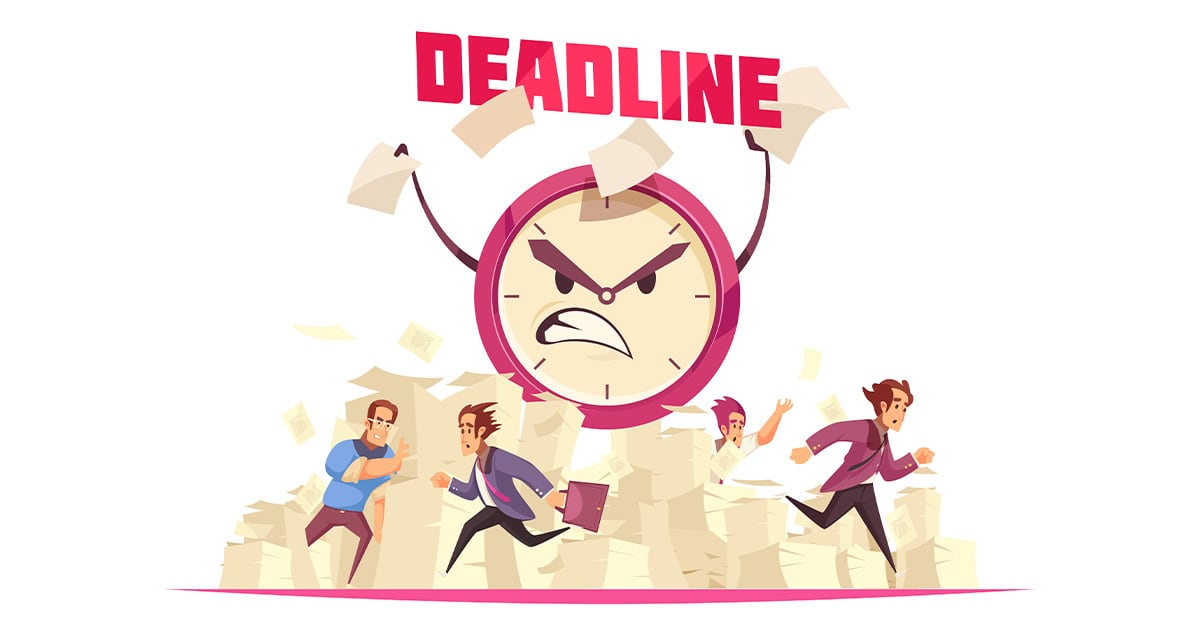
Missing deadlines rarely stems from a lack of ability. It mostly comes from incorrectly estimating, organizing, and tracking work. Below are the 4 most common mistakes many people make – even those who are hardworking and responsible.
5.1. Misjudging the workload
One of the leading causes of missed deadlines is underestimating the volume and complexity of the work. We often only see the “main task” but overlook emergent factors such as:
-
Time to prepare data and input information
-
Rounds of revisions, feedback, and approvals
-
Intervening tasks or unplanned incidents
When you estimate time too optimistically, you are likely to fall into a situation where:
-
Your work schedule gets compressed right before the deadline
-
You always have to “sprint” at the last minute
-
Work
How to fix it:
Break down the work into milestones and regularly ask yourself:-
What percentage of the work have I completed?
-
Are any parts behind schedule?
-
Do I need to adjust resources or time?
Regularly tracking progress helps you stay ahead of deadlines, rather than being rushed by them.
5.4. Relying too much on memory
Believing “I’ll remember” is one of the most common mistakes. Human memory is not designed to store dozens of tasks, deadlines, and details simultaneously.
Consequences of relying on memory:
-
Forgetting important tasks
-
Misremembering deadlines
-
Only remembering tasks when they are near or past due
Especially in a work environment with many parallel tasks, not taking notes or having a reminder system will always leave you in a reactive state.
How to fix it:
Let’s “free up your brain” by:-
Writing down all the tasks that need to be done
-
Setting clear reminders and deadlines
-
Using tools or to-do lists to keep track
When everything is recorded and reminded, you will have better control over your work and significantly reduce the risk of missing deadlines.
6. Effective time management skills at work
6.1 Make a to-do list
The first thing you need to do to manage time effectively is to make a list of tasks to be done along with their deadlines. Using a to-do list to write down tasks is a very effective way to control projects and tasks and to keep yourself organized.
-

6.2 Plan your work
Planning is essential for you to achieve your goals, so pay attention and invest in making it detailed. When you have listed the tasks needed to achieve your goal, reaching the destination becomes much simpler. Without a plan, you won’t have a direction or know what you need and what you should do.
In addition, planning helps you check whether you have achieved your goals and provides solutions for adjustments when errors occur. We must break down a large task into many smaller, simpler ones, then prioritize them and set specific deadlines. Spending a little time on planning will help you increase productivity and manage your work more easily.
Read more: <a href="https://1office